Week 5 - Rayleigh Taylor Instability
Rayleigh-Taylor Instability
Rayleigh-Taylor instability occurs in an interface between two fluids of different densities and it occurs when the heavier fluid accelerates the lighter fluid.Water surface above the oil surface is an every day example of Rayleigh -Taylor instability. Rayleigh-Taylor instability is modeled by completely two parallel layers immiscible fluid. And in the model, if the more denser fluid is placed over the less denser and both are in equal volume subjected to the earth gravity, leads to decrease the potential energy of the configuration than the initial state Because of less potential energy , the heavier fluid moves down under the gravitational field and less denser fluid moves upwards. This was the set up studied by Lord Rayleigh. And G.I Taylor reported his study that, the situation is equivalent to the situation when the fluids are accelerated, with the less dense fluid accelerating in to the denser fluid.
Kelvin Helmholltz Instability
It is a fluid instability occurs at Velocity shear in a continuous fluid or velocity difference across the interface between two fluids
Richtmyer-Meshkov Instability
It occurs when fluids of different density are impulsively accelerated.The devolopment of the instability begins with small amplitude perturbation which initially grow linearly with time.This is followed by a nonlinear regime with bubbles appearing in the case of a light fluid penetrating heavy fluid, and with spikes apperaing in the case of heavy fluid penetrating a light fluid.A chaotic regime eventually is reached and the fluid mix. This instability can be considered the impulsive acceleration limit of the Rayleigh Tylor instAbility.
Plateu-Rayleigh instability
This instability, often just called as Rayleigh instabilty explains about the falling of strams breaks up in to smaller packets with the same volume but less surface area.It is related to the RTI and is greater part of fluid dynamics concerned with the fluid thread break up.This fluid instability is exploited in the design of a perticulat type of ink jet technology where by a jet liquid is perturbed in to a steady stream of droplets.The driing force of the Plateau- Rayleigh is that liquids, by virtue of their surface tension, tend to minimize their surface area.
Geometry
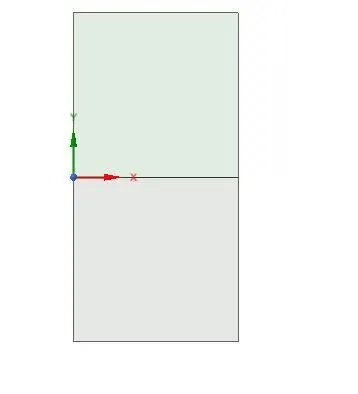
- Created Geometry in Ansys space claim by creaing two surfaces named as Air & Water
- Opted Share option in workbench to share the topology between two surfaces.
- Updated The geometry.
Mesh
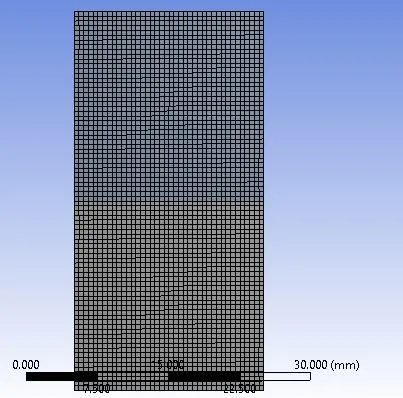
- Hexahedral Mesh is created over the surface
- Size is varied according to the rid size and quality of the mesh
- Named the Boundary Condetion as Air and Water
Case Set Up
- Pressure based ,Transient type solver is used
- Two materials are assigned , Air and Water
- Enabled the garvity
- Selected volume of fluid method and number of two phases are 2, one is water and anther one is air.
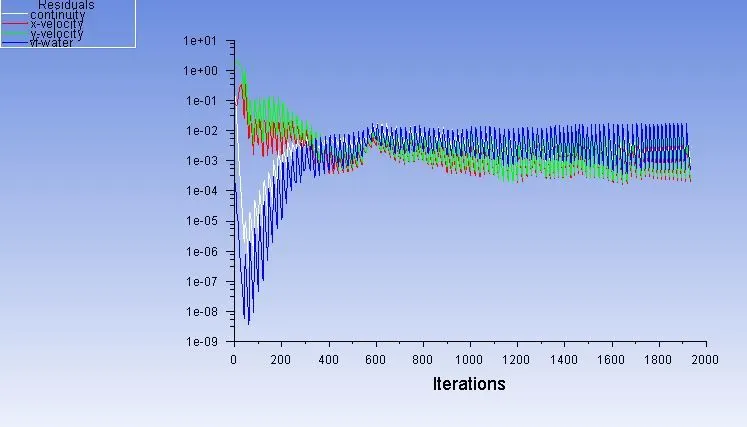
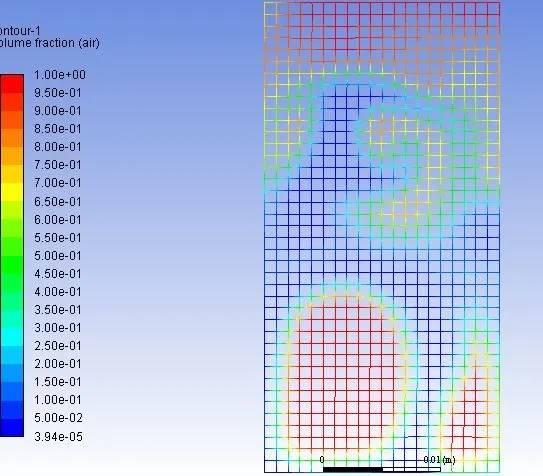
Case-1(a):Mesh Size0.5mm
Contour
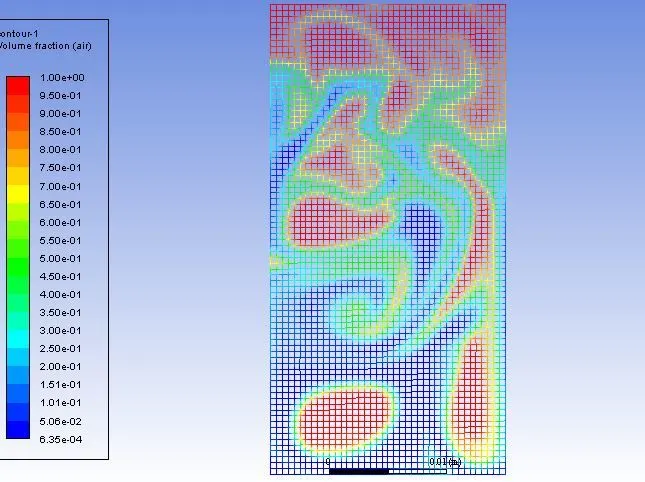
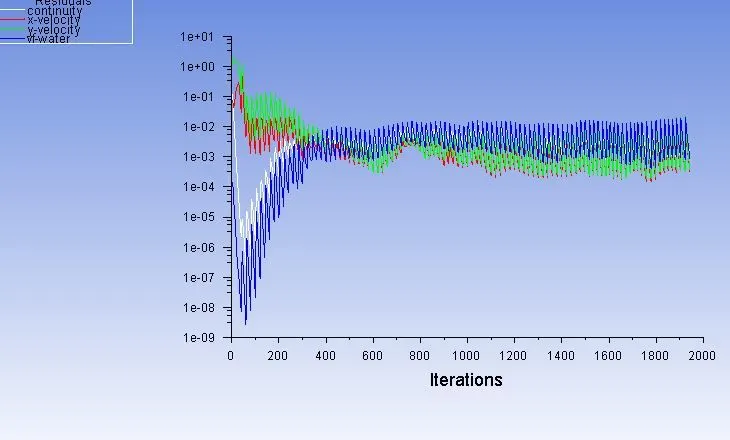
Case-2(b):Mesh Size 1 mm
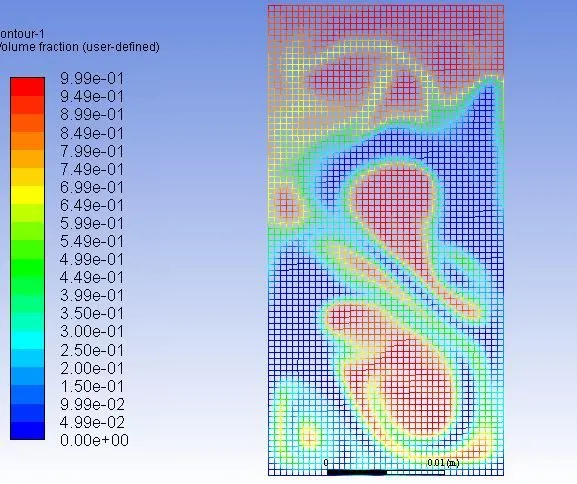
Case-2: User Defined Fluid with Density 400kg/m^3 voscosity 0.001 kg/m-s
Contour
Atwood Number
1)Water -Air Interface
A= (`rho`1-`rho`2)/(`rho1+rho2`)
A=(998.2-1.225)/(998.2+1.225)
A=0.997
2) User Defined Interface
A=(998.2-400)/(998.2+400)=0.427
Atwood number is a dimensionless number in fluid dynamics.It is used to study the instabilities of fluid when two phases of fluid with different densities are present.
It is obesrved that interface groes faster when atwood number is high.Therefore in water-air combination there is high instability compared to user defined interfave because of atwood number.
Steady state solution gives only end result and it is not giving intermediate results, and it is time independent . Transient state gives intermediate results and it is time dependent.In this case there is two fluids with different densities are present therefore transient state is more suitable comapared to steady state in this calculation
https://drive.google.com/file/d/1GqzGkIa9AbN9AukOSPuYg7sc0nSRKBC_/view?usp=drivesdk