Week 5: Prandtl Meyer Shock problem
Shock Wave
strong pressure wave in an elastic medium such as air, water, or a solid substance, produced by supersonic aircraft, explosions, lightning, or other phenomena that create violent changes in pressure. The edge of the cone forms a supersonic wavefront with an unusually large amplitude called a "shock wave, Shock waves alter the mechanical, electrical, and thermal properties of solids and, thus, can be used to study the equation of state (a relation between pressure, temperature, and volume) of any material.
Prandtl–Meyer expansion
A supersonic expansion fan, technically known as Prandtl–Meyer expansion fan, a two-dimensional simple wave, is a centered expansion process that occurs when a supersonic flow turns around a convex corner. The fan consists of an infinite number of Mach Waves, diverging from a sharp corner. When a flow turns around a smooth and circular corner, these waves can be extended backward to meet at a point.
Each wave in the expansion fan turns the flow gradually (in small steps). It is physically impossible for the flow to turn through a single "shock" wave because this would violate the second law of Thermodynamics.
Across the expansion fan, the flow accelerates (velocity increases) and the Mach number increases, while the Static Pressure, Temperature, and Density decrease. Since the process is Isentropic, the Stagnation properties (e.g. the total pressure and total temperature) remain constant across the fan
A fundamental relation between the gas velocities before and after the normal shock and critical velocity of sound is derived this known as the Prandtl-Meyer relation
`(sqrt((r+1)/(r-1)))*arctan(sqrt(((r-1)/(r+1))*(M^2)-1)))-arctan(sqrt(M^2-1))`
BOUNDARY Condition
Solver
Solver: Steatystate
Simulation mode: Fully hydrodynamic
gas flow solver: compressible
Simulation time parameter
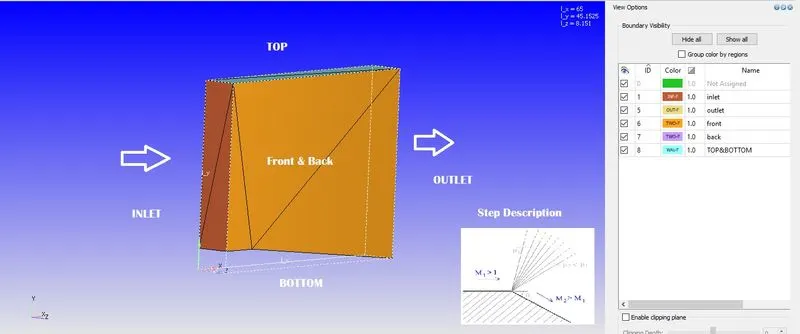
Steady-State Analysis (SS)
Inlet: Since it’s a supersonic flow at the inlet we should assign Dirichlet boundary conditions for all parameters like Pressure, Velocity, and Temperature. So, We can give Static pressure= 101000 Pa, Velocity=678m/s and Temperature=286k
Outlet: At the outlet, we should assign Neumann boundary conditions for all parameters like Pressure, Velocity, and Temperature. So, We can give a Zero normal gradient for all the parameters.
Top-Bottom wall:
Since the supersonic flow is inviscid in nature(the viscous effect is negligible) we can assume the Slip condition at the wall.
Front-Back: 2D Wall
Reason: The 2D planar assumption is used because the flow gradients along the z-direction are negligible when compared to the other two directions. By reducing the model to 2D, the Prandtl Meyer can be simulated and analyzed cost-effectively compared to a full 3D model.
Region
v-678 m/s
P-50000Pa
Base Grid
dx,dy,dz-0.8
Adaptive grid
min cell-1
max cell-2000000
Embed frequency-1
Release Frequency-25
Temperature control
Embedded Type-Subgrid scale (SGS)
maximum embedding level-2
start cyl-5000
end cyl-9999999
Prandtl Meyer Shock problem Using Different cases
sub Grid-`Grid size=(base grid)/2^(embed-Level)`
| S.NO | Description | Sub Grid Criteria |
initial mesh size |
medium mesh size | more refined Mesh |
| 1 | case1 | 0.025 | 4322 | 5924 | 7643 |
| 2 | case2 (base mesh) | 0.05 | 4322 | 8697 | 12437 |
| 3 | case 3 | 0.1 | 4322 | 4914 | 5224 |
Incodition calculation
"""
Analysis study of prandtl-Meyer
Program by Jagaveerapandiyan
"""
import numpy as np

c=678
a=343 #m/s
P1=101000 #pa
T1=286 #k
r=1.4

#Mach no
M1=(c/a)
print('Mach initial=',M1)
#first Mach line angle
mu1=np.arcsin(1/M1)
print('angle of fist Mach line=',mu1,'deg')
#maximum turning angle
nu_max=(np.pi/2)*((np.sqrt((r+1)/(r-1)))-1)
print('maximum turning angle=',nu_max,'deg')

#Prandtl_Meyer Function
vM1=(np.sqrt((r+1)/(r-1)))*np.arctan(np.sqrt(((r-1)/(r+1))*(pow(M1,2)-1)))-np.arctan(np.sqrt(pow(M1,2)-1))
print('Prandtl Meyer Function=',vM1)
#Maximum Turning angle
theta=nu_max-vM1
print("Maximum Turning angle=",theta,'deg')
Mach initial= 1.9766763848396502
angle of fist Mach line= 0.530424671306974 deg
maximum turning angle= 2.276853163690696 deg
Prandtl Meyer Function= 0.4491560159071164
Maximum Turning angle= 1.8276971477835797 deg
Result
Case1
Calculation output Cygwin
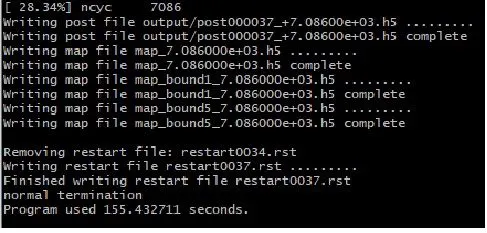
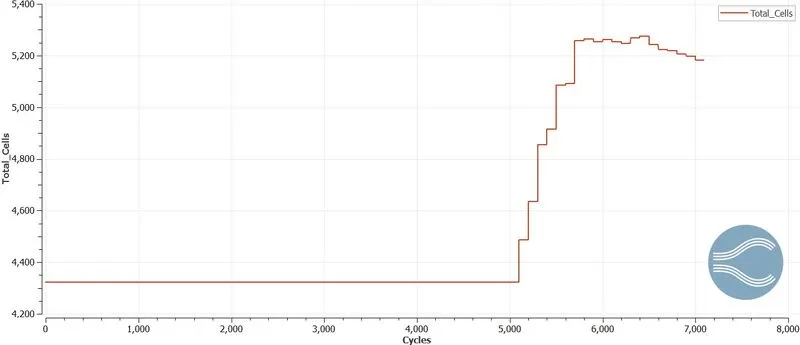
Cell Count
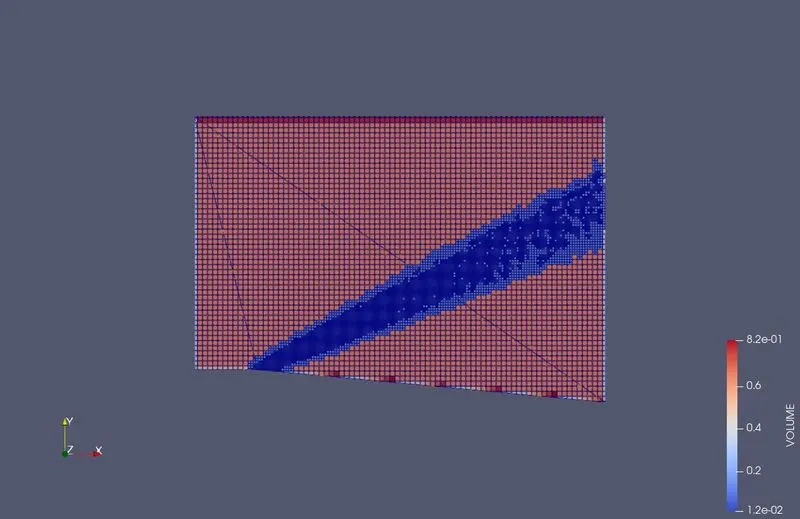
cell count ss volume count
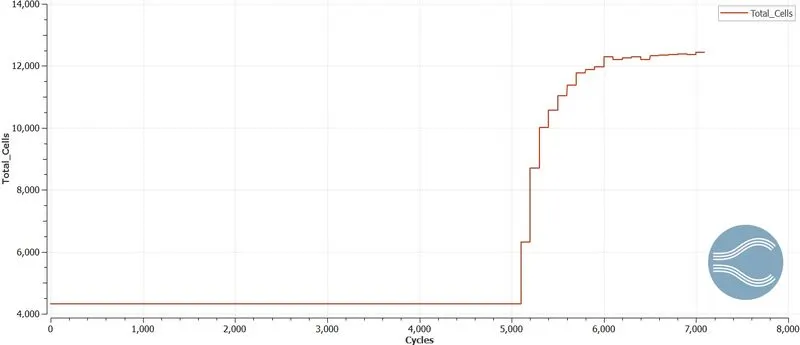
cell count graph
Temperature Gradient contour
Temperature SS
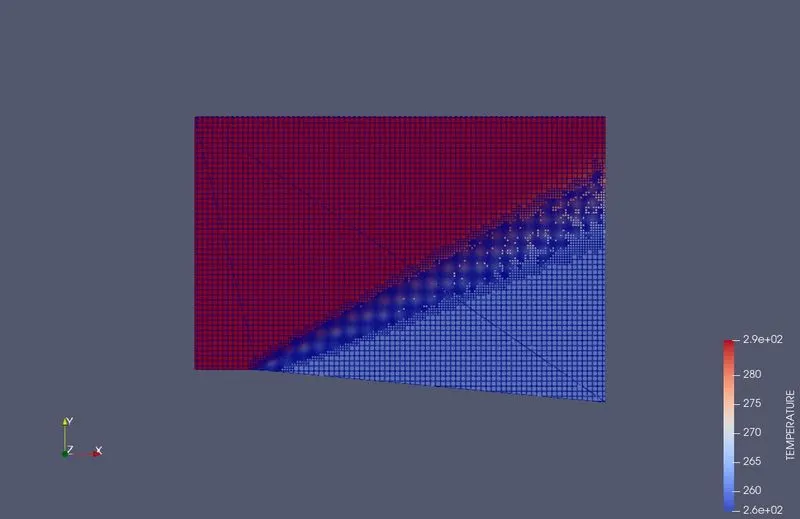
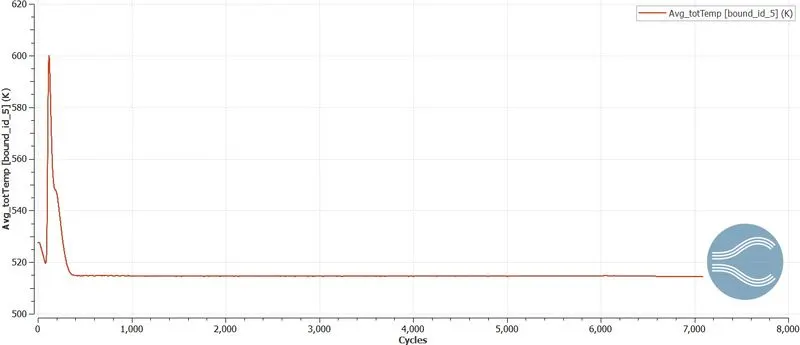
Temperature outlet
Pressure Gradiant contour
Pressure SS
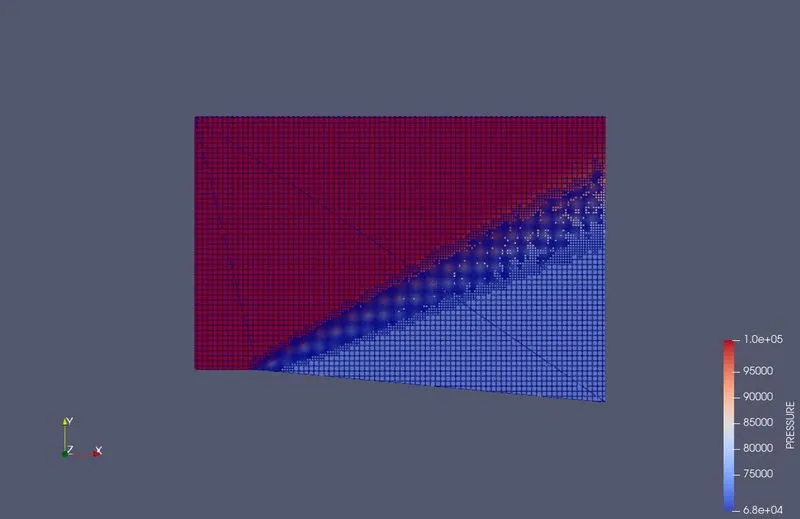
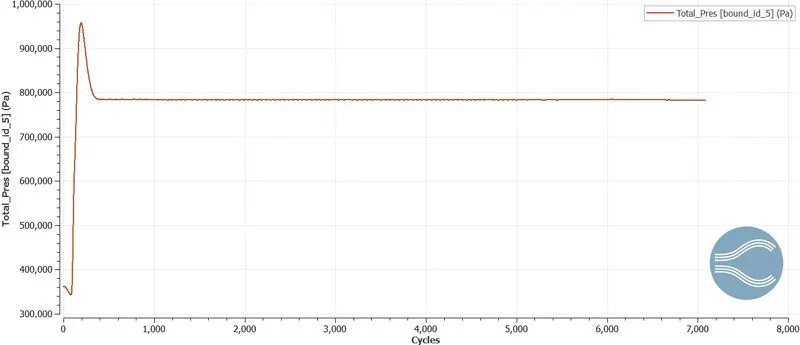
Pressure outlet
Velocity Gradient contour
velocity SS
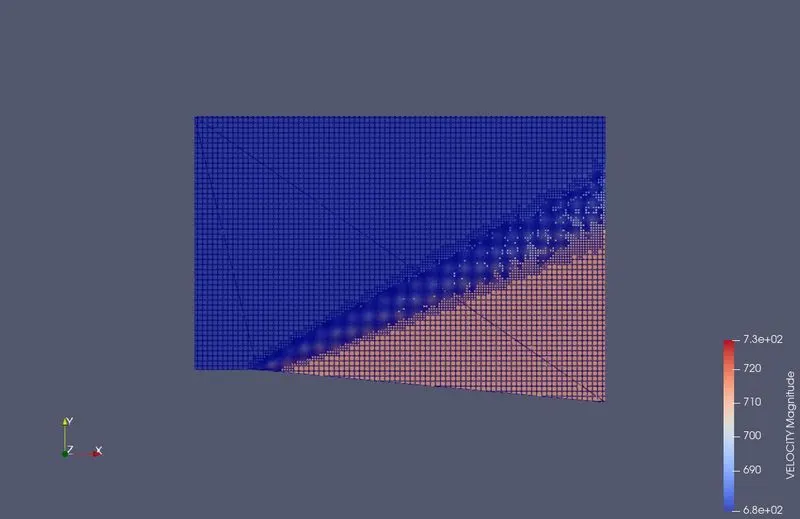
velocity outlet
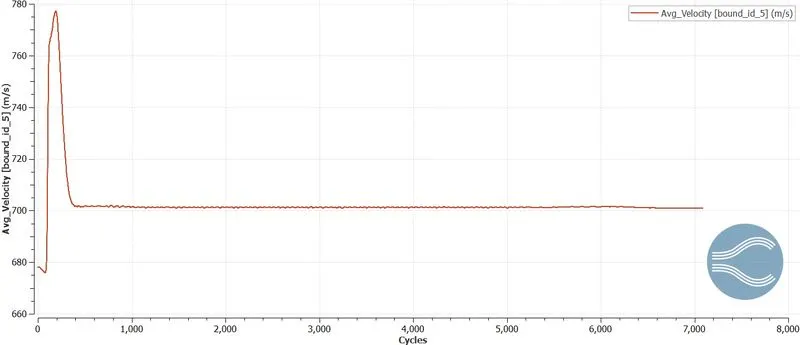
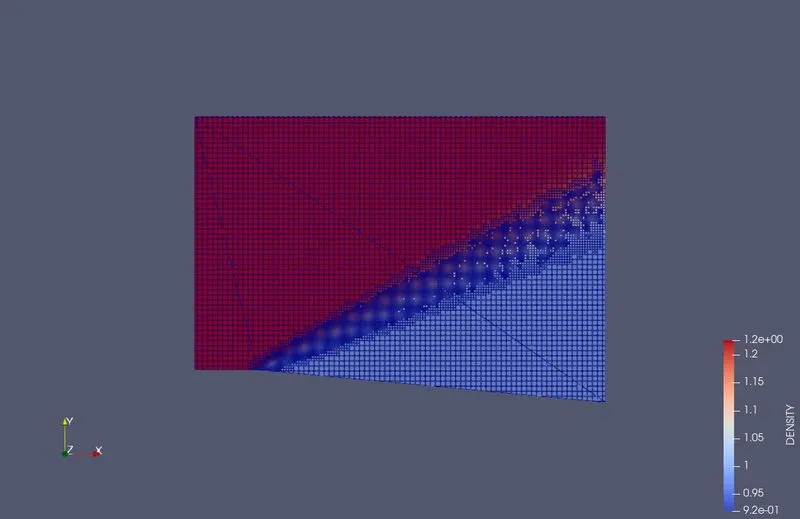
Density Gradient contour
Density outlet
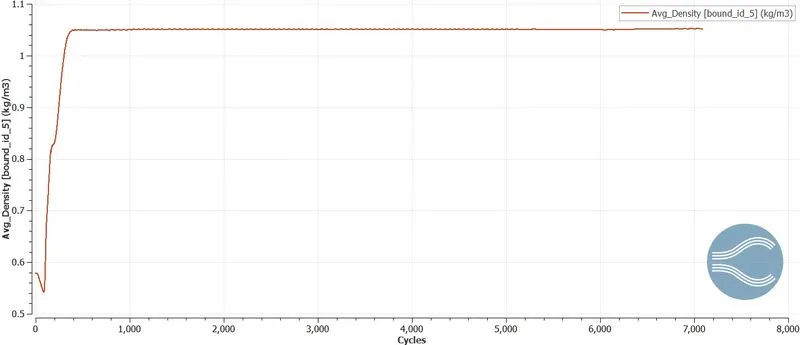
Density SS
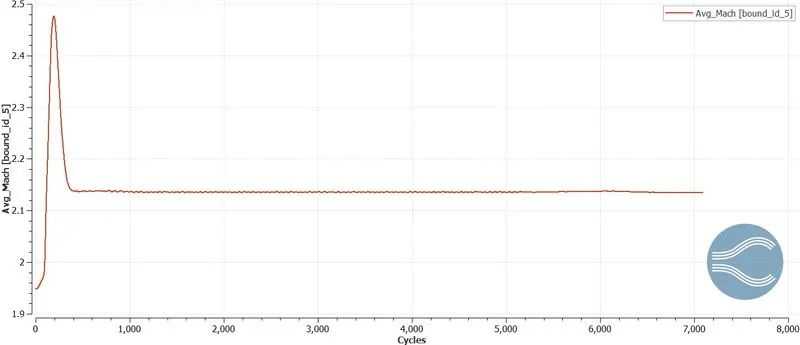
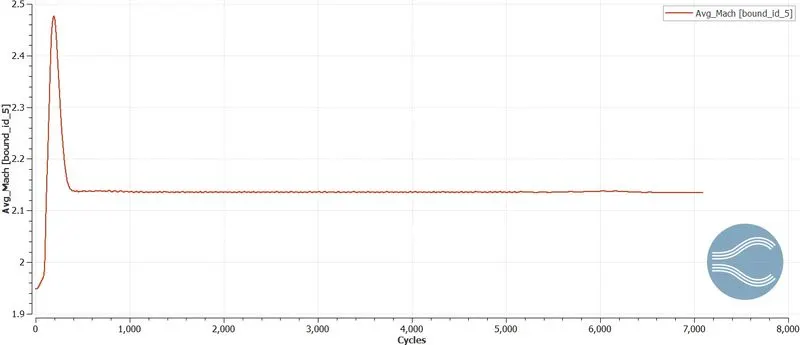
Mach outlet
Case2
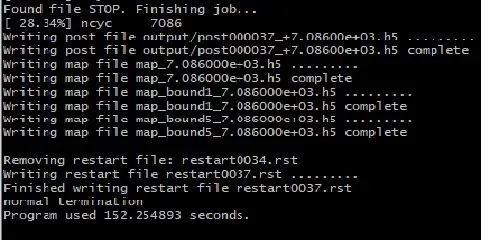
Calculation output Cygwin
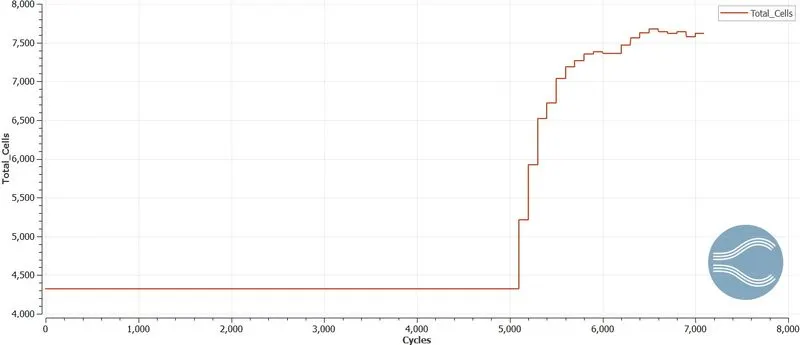
Cell count
cell count graph
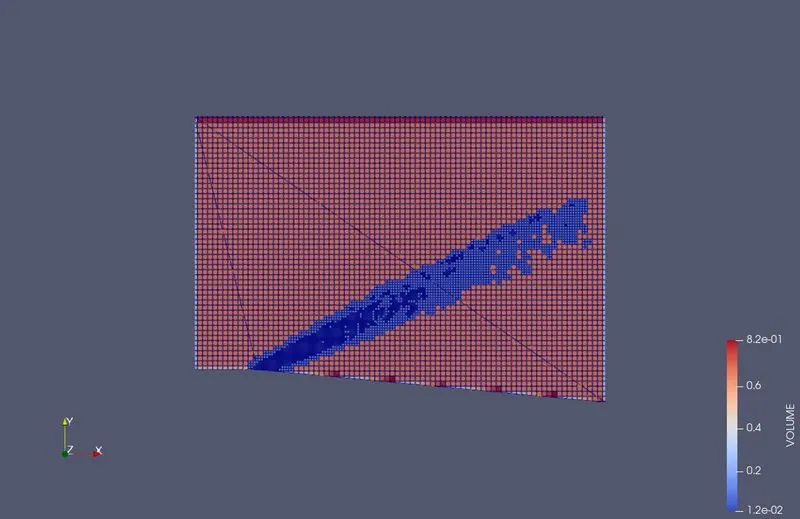
cell count ss volume count
Temperature Gradient contour
Temperature SS
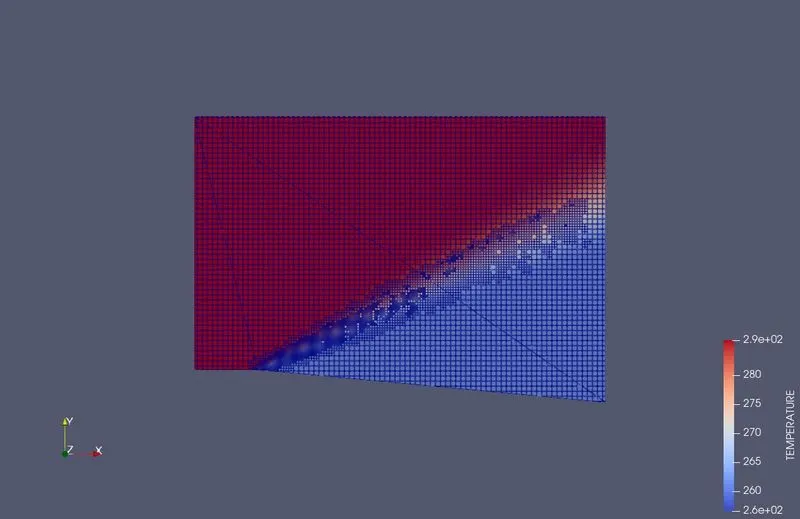
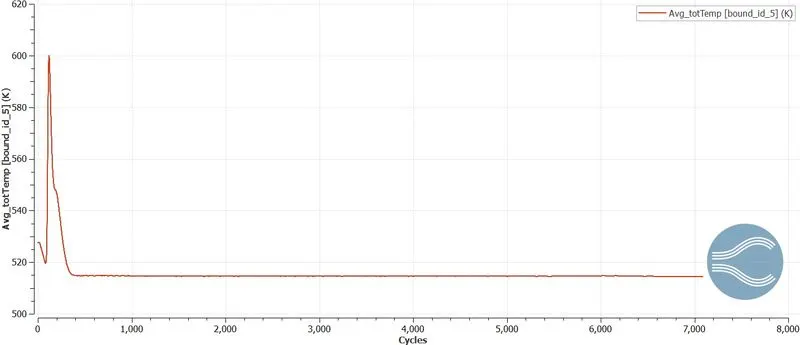
Temperature outlet
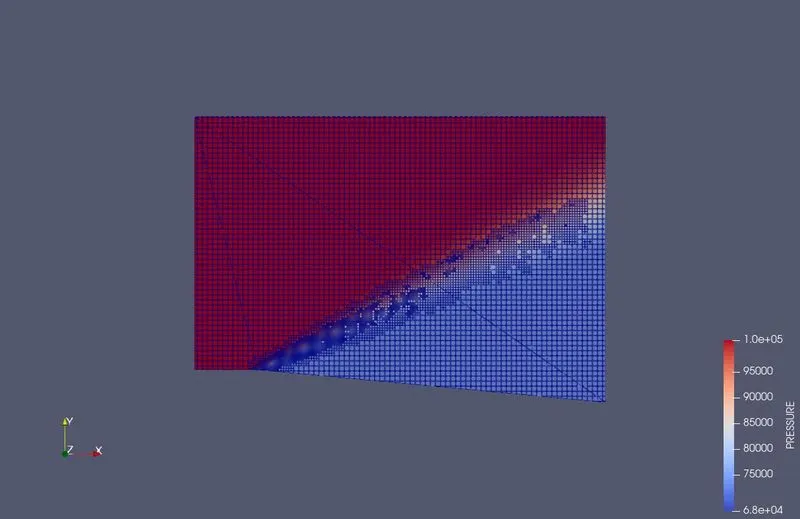
Pressure Gradiant contour
Pressure SS
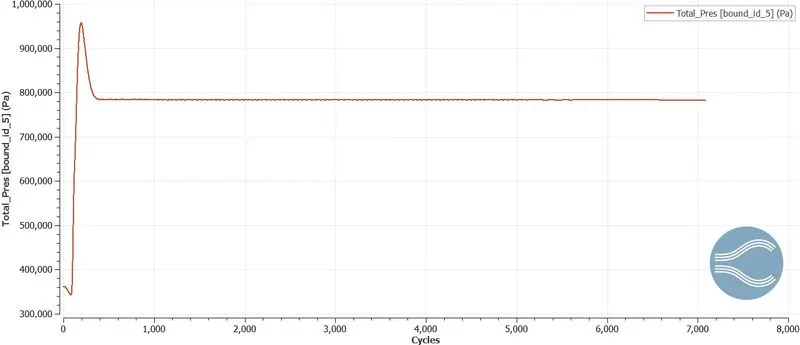
Pressure outlet
Velocity Gradient contour
Velocity SS
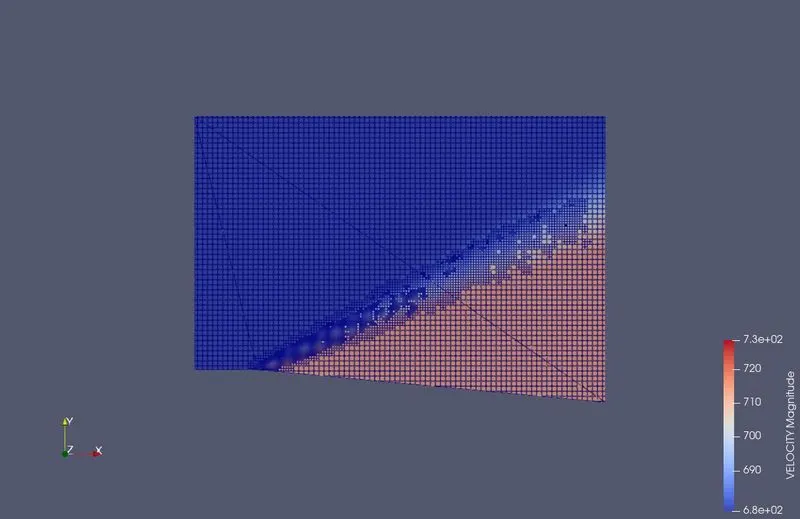
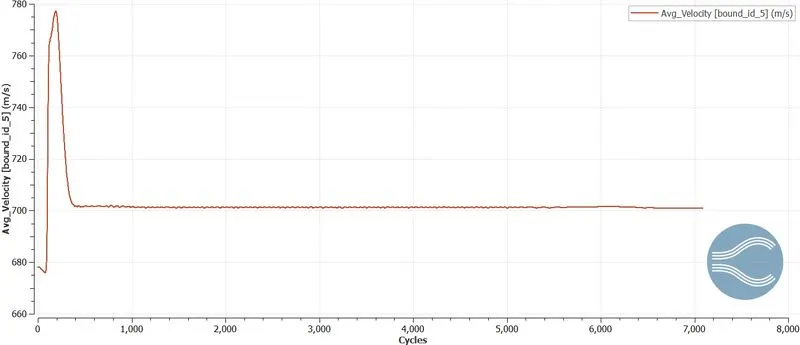
Velocity outlet
Density Gradient contour
Density SS
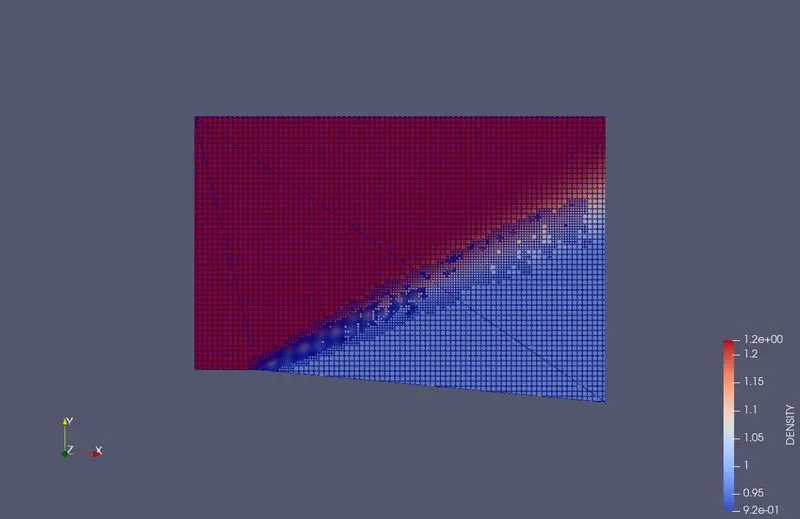
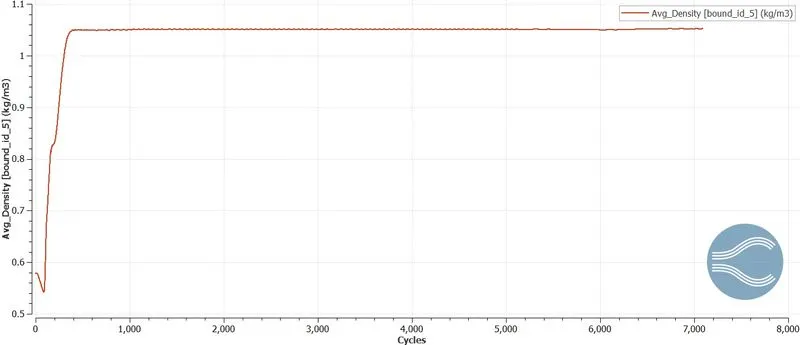
Density outlet
Mach outlet
Case3
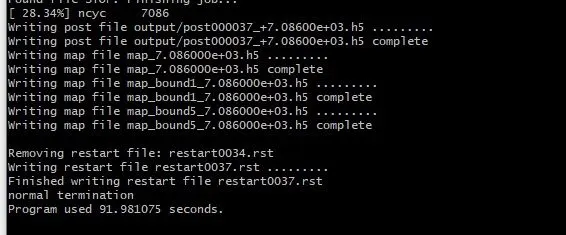
Calculation output Cygwin
Cell count
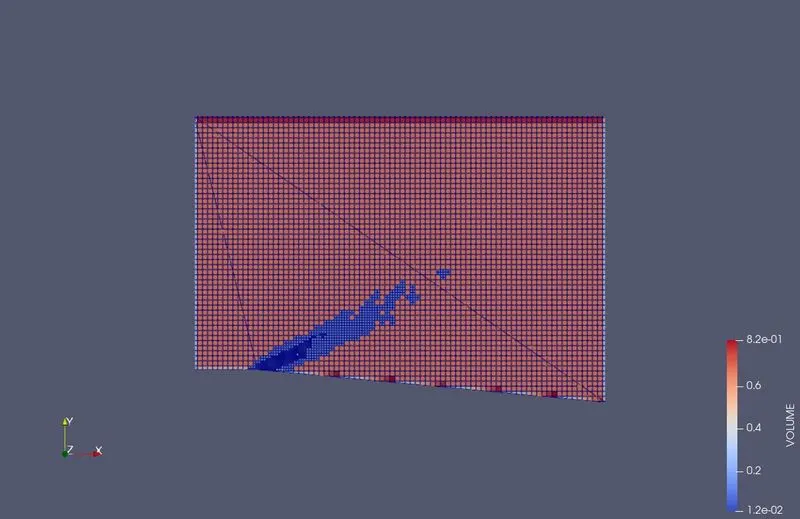
cell count ss volume count
cell count graph
Temperature Gradient contour
Temperature SS
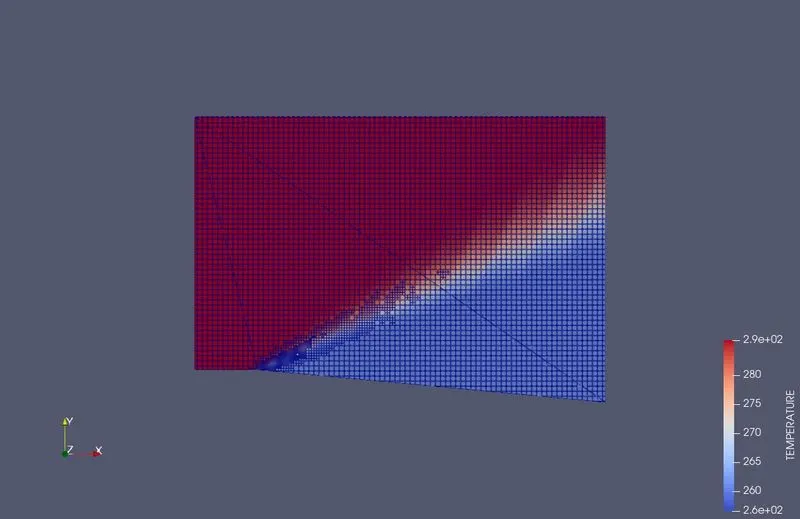
Temperature outlet
Pressure Gradiant contour
Pressure SS
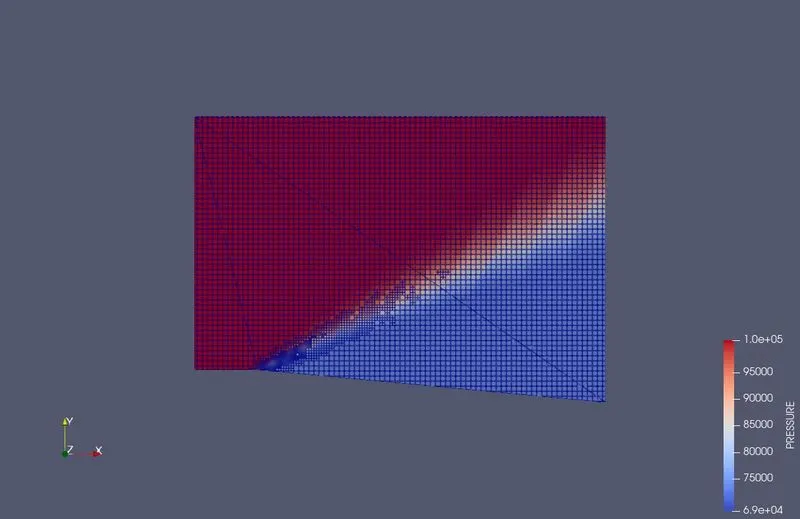
Pressure outlet
Velocity Gradient contour
Velocity SS
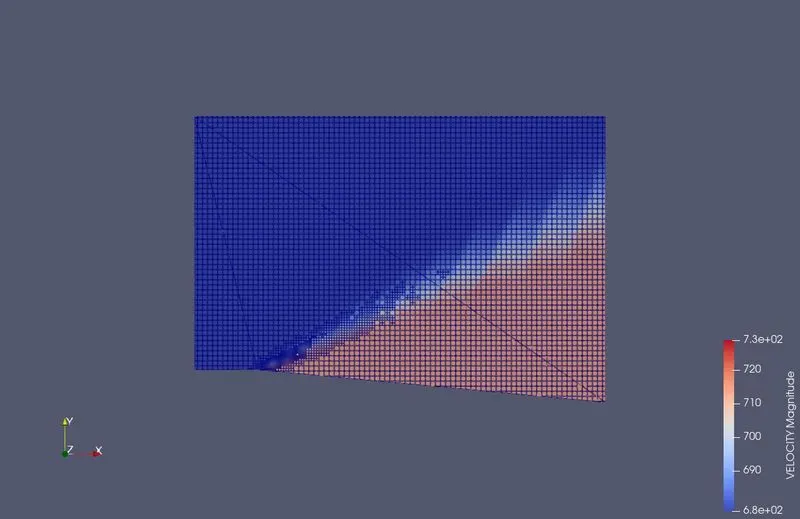
Velocity outlet
Density Gradient contour
Density SS
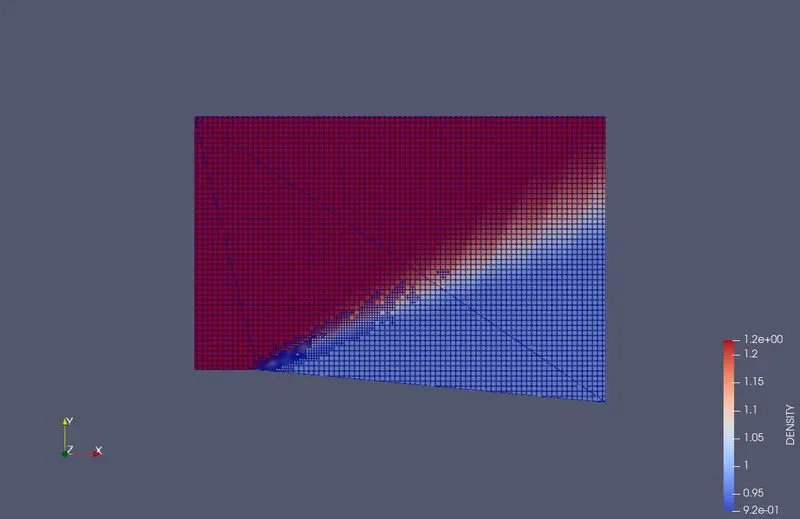
Density outlet
Mach outlet
the separation, the oscillatory flow structures, the heat transfer localization, and the pressure loads would be induced accordingly. In this survey, recent advances on the shock wave/boundary-layer interaction and its control in the internal and external flow fields were summarized, and it is obvious that the micro-vortex generator has been widely used in both the internal and external flow fields to suppress the separation induced by the shock wave/boundary-layer interaction, and the quantitative measurement and assessment approaches should be developed
Conclusion
Angle of physics changes
angle of fist Mach line= 0.530424671306974 deg
maximum turning angle= 2.276853163690696 deg
Due to step in model slip condition on the wall as compressible supersonic flow separation occurs was there a sudden change in physical property inflow and model which can be taken into consideration
From the study of Sub Grid Criteria with different value case1 which is finer mesh the output value at the stream from flow separator gives smooth output towards theta degree where value increases the quality of result output decreases
by absorbing the flow separation region we can reduce the effect by using different technic and the
Reference
https://www.britannica.com/science/shock-wave
https://en.wikipedia.org/wiki/Prandtl%E2%80%93Meyer_expansion_fan