Week 5: Prandtl Meyer Shock problem
Objective:
- To do a literature review on various boundary conditions and shock waves.
- To perform Prandtl Meyer Shock problem using Converge Studio software and make a comparative study for different SGS(Sub-Grid Scale) 0.01, 0.05, 0.07.
- Effect of SGS parameter on shock location.
Boundary Conditions
Boundary conditions are most important for solving equations involved in CFD.These specify the value of the objective function at their boundaries.
There are basically three types of boundary conditions, namely:
- Dirichlet's Boundary Conditions,
- Neumann's Boundary Conditions,
- Robin or Mixed Boundary Conditions.
Dirichlet's Boundary Conditons:
- The prescribed surface value of the objective function is given as the boundary condition.
- At the boundary,ϕ=Constant, where ϕis the objective function, ϕ(t)orϕ(x,y,z)orϕ(t,x,y,z)
- Examples: ϕ(0)=0m,v(l)=0m/s,f(0)=50N/m2
- Basically, this is used when the boundary conditions are specified directly.
Neumann's Boundary Conditions:
- The prescribed flux value of the objective function is given as the boundary condition.
- At the boundary, dϕdn=Constant,where n-is the normal to the considered parameter,dϕdn=f(t) ordϕdn=f(x,y,z) ordϕdn=f(t,x,y,z)
- Examples: dϕdn=0,for adiabatic boundary for heat transfer
- It is used for heat flux problems to specify the heat gradient variation along a direction, adiabatic boundary conditions, etc.
- Generally, this is used in circumstances where the boundary conditions are calculated by the solver and not specified directly.
Mixed Boundary Conditions:
- As the name suggests, this boundary condition is a combination of Dirichlet's and Neumann's boundary conditions.
- The boundary condition includes both the surface and flux values in the form of an equation.
- At the boundary, αϕ+βdϕdn=γ
- So, from the above, it is clear that the Neumann's boundary condition is used for the problems when the actual value at the boundary can't be calculated and is calculated by the solver itself.
- Now, for supersonic flows the values of various parameters in the outlet boundary can't be calculated directly, so, the Neumann's boundary condition is used.
- In Prandtl Meyer Shock or Prandtl Meyer Expansion Fan, the flow is supersonic, hence Neumann's boundary condition is used.
Note: Prantl Meyer Expansion Fan is generated when the air with supersonic(or sonic) velocity is flowing over a sharp convex edge. The above figure shows the generation of expansion fan when a plate at an angle θ to the horizontal is incident with air of Mach number greater than 1, i.e. supersonic.
Shock Waves:
- Shock waves are formed when the source of sound or disturbance is moving with the speed of sound or more than that of sound in that medium.
- These are formed due to the constructive interference of the sound waves as the source moves.
- There are two types of shock:
- Oblique Shock
- Normal Shock
- There is another classification based on whether the shock is attached to the body or not:
- Attached Shock
- Detached Shock(or Bow Shock)
AMR
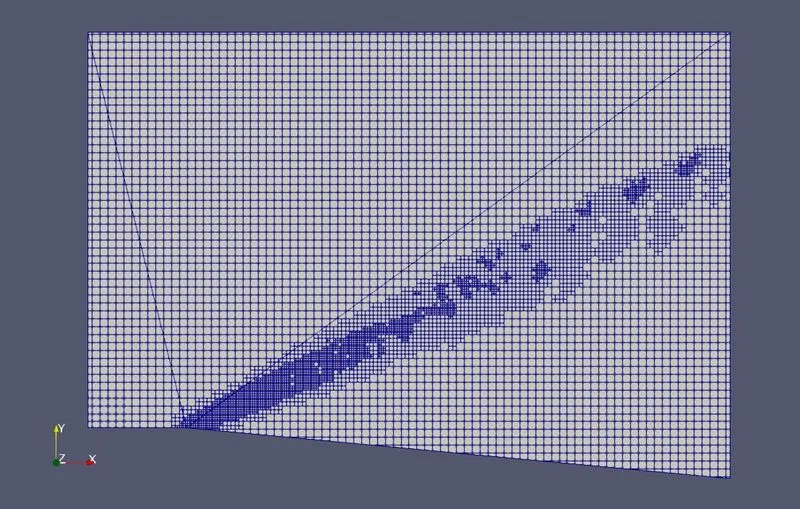
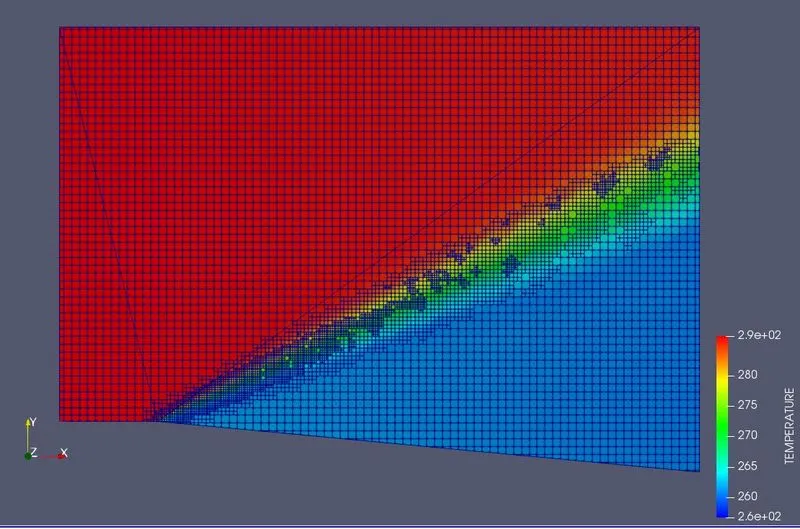
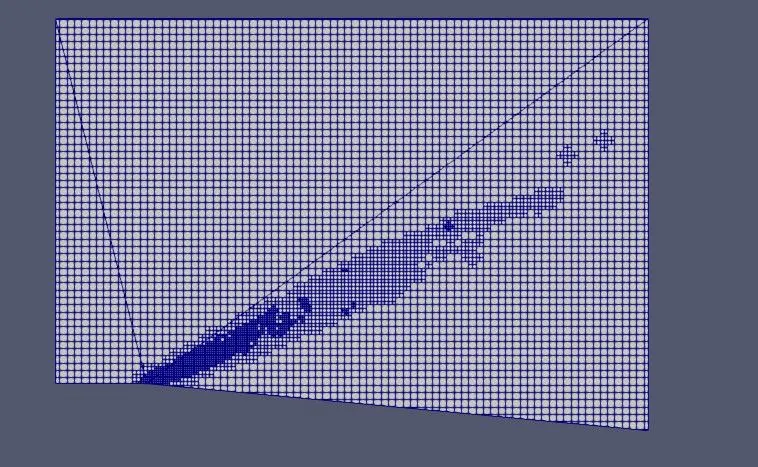
The adaptive cell refinement creates cells based on sub grid criteria. It determines the location of refinement based curvature (y'') of temperature field. The Converge CFD manual states that the algorithm calculates the solution on base grid and then on refined grid and calculates the difference in values.
Geometry:
Case Setup:
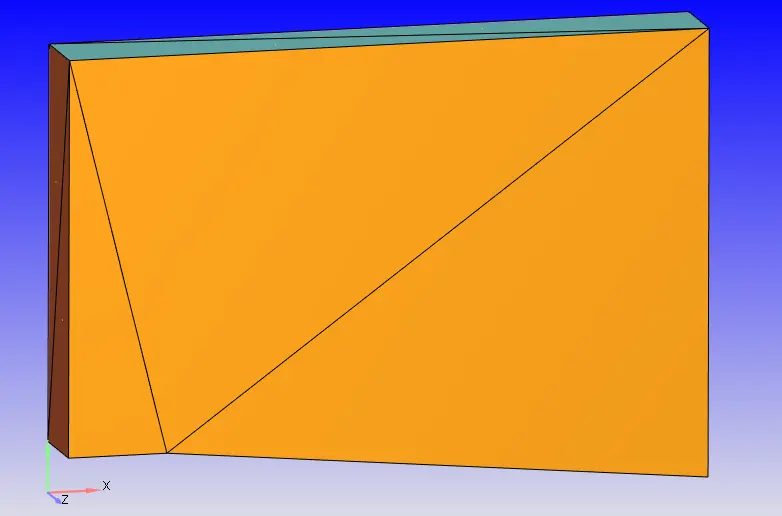
Mesh Settings:
Global element size in all directions = 0.8 m
Adaptive mesh refinement settings:
Minimum cells: 1
Maximum cells: 200000
Refinement based on: Temperature
Max Embedding level: 2
Sub grid criteria: 0.05 ,0.07 and 0.01
Boundary conditions:
Material: Air
Inlet: velocit- 680 m/s & temperature - 286.1 K
Outlet: Temperature - 300 K
Top and bottom : Slip wall
Front and back : 2D
Region initial settings: Pressure at 50000 Pa, Velocity of 680 m/s in x direction, temperature of 300 K.
Turbulence model: RNG k-e model with standard wall functions.
Results:
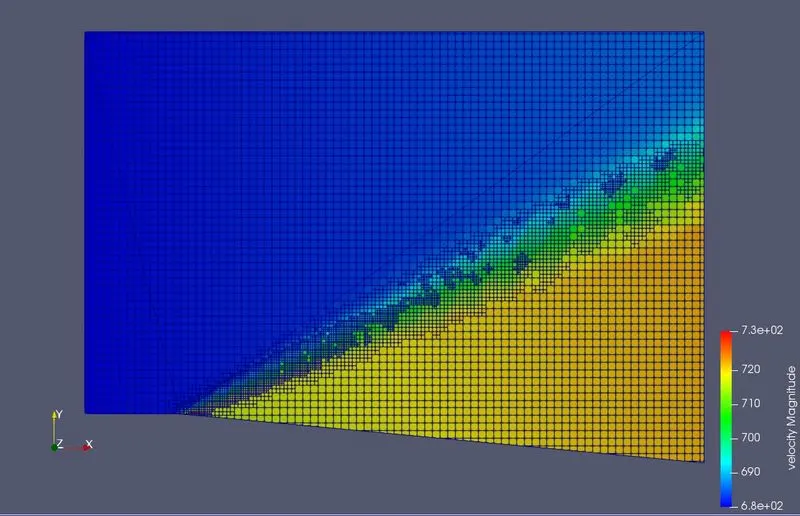
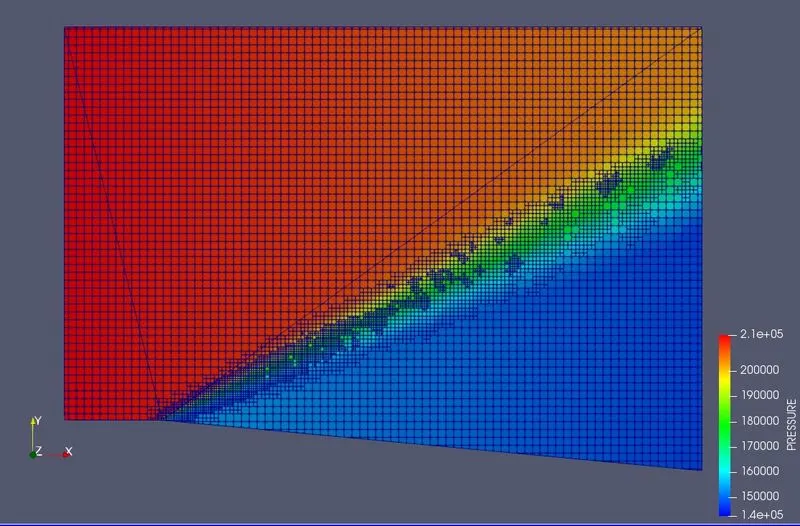
Case 1:SGS 0.05
Mesh:
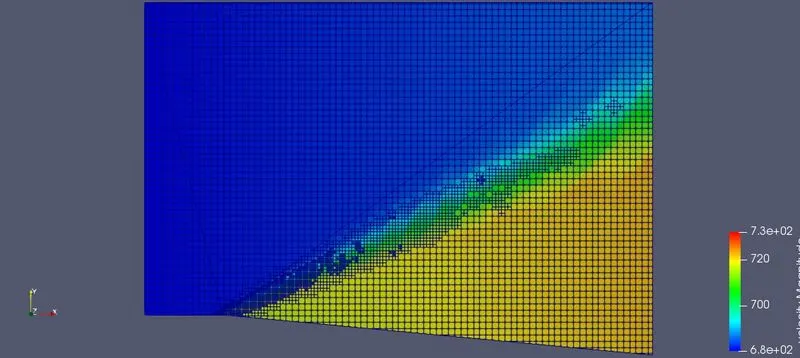
Velocity contour:
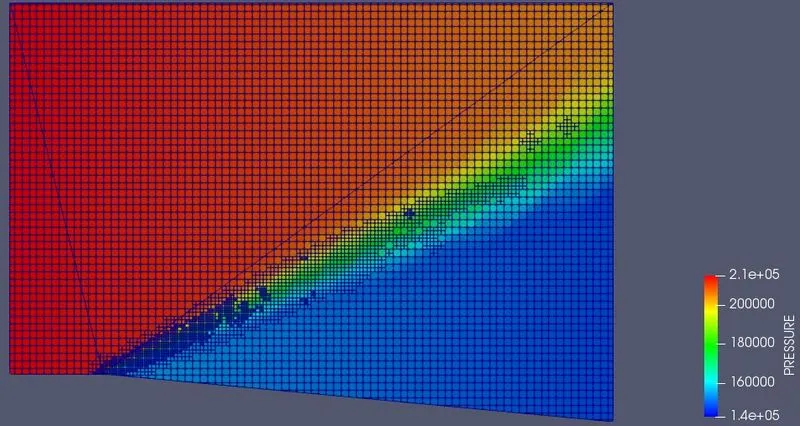
Pressure contour:
Temperature contour:
Case 2:SGS 0.07
Mesh:
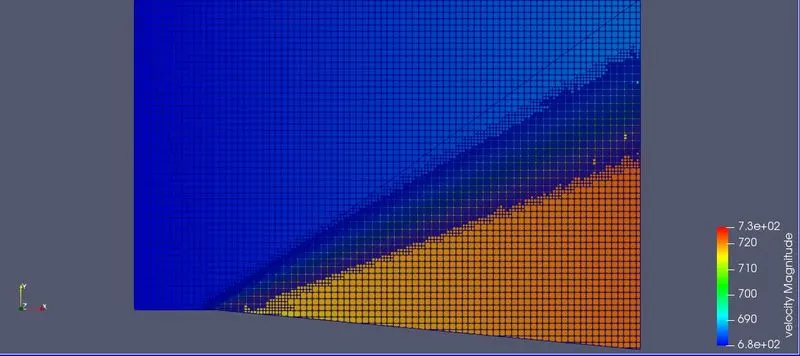
Velocity contour:
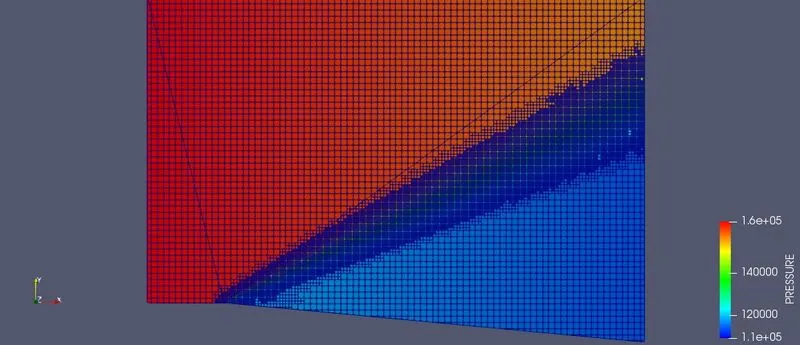
Pressure contour:
Temperature contour:
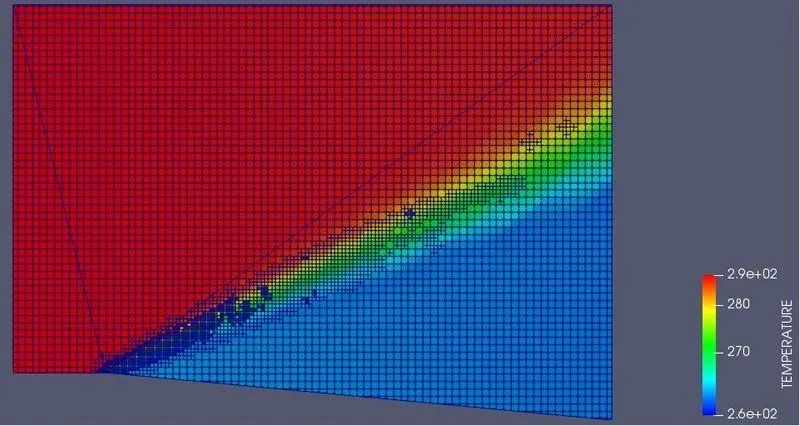
Case 3:SGS 0.01
Mesh:
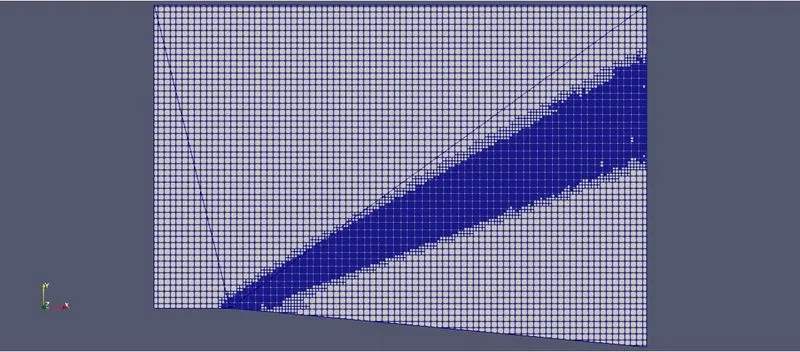
Velocity contour:
Pressure contour:
Temperature contour:
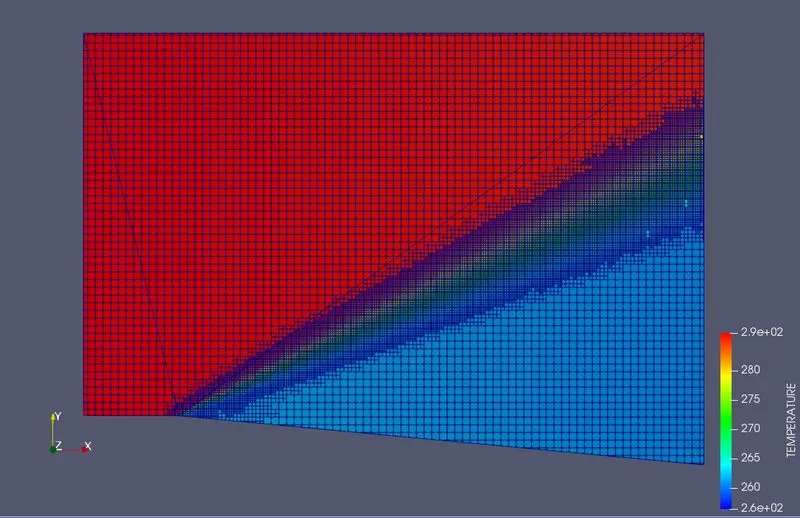
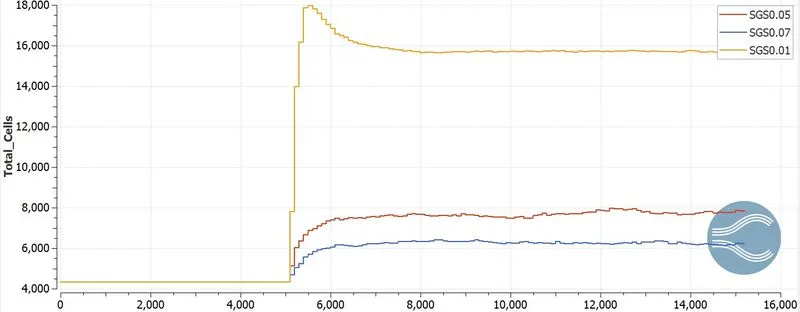
Effect of SGS :
Animation link:
https://drive.google.com/file/d/1Oaz_eeWRTMRsQsCIexJp7cJtzRBaac9B/view?usp=sharing
Conclusion:
- The highest total number of cells is the observed when the SGS parameter is set to 0.01.
- As the SGS value increases the total number of cells decreases, leading to less accurate contours.
- The temperature of air lowers down after expansion. The finer grid gives better variation of expansion fan. The Temperature difference is same for all grids