Prandtl Meyer Shock problem
AIM
The aim of the simulation is to study the Prandtyl Meyer Shock Flow
OBJECTIVES
- Boundary conditions for shock flow
- Analysis of shock wave in physics
- Effect of sub-grid scale on temperature
SHOCK WAVE
In physics, a shock wave, or shock, is a type of propagating disturbance that moves faster than the local speed of sound in the medium. Like an ordinary wave, a shock wave carries energy and can propagate through a medium but is characterized by an abrupt, nearly discontinuous, change in pressure, temperature, and density of the medium.
For the purpose of comparison, in supersonic flows, additional increased expansion may be achieved through an expansion fan, also known as a Prandtl–Meyer expansion fan. The accompanying expansion wave may approach and eventually collide and recombine with the shock wave, creating a process of destructive interference. The sonic boom associated with the passage of a supersonic aircraft is a type of sound wave produced by constructive interference.
Unlike solitons (another kind of nonlinear wave), the energy and speed of a shock wave alone dissipates relatively quickly with distance. When a shock wave passes through matter, energy is preserved but entropy increases. This change in the matter's properties manifests itself as a decrease in the energy which can be extracted as work, and as a drag force on supersonic objects; shock waves are strongly irreversible processes.
PRANDTYL-MEYER EXPANSION WAVE
A supersonic expansion fan, technically known as Prandtl–Meyer expansion fan, a two-dimensional simple wave, is a centered expansion process that occurs when a supersonic flow turns around a convex corner. The fan consists of an infinite number of Mach waves, diverging from a sharp corner. When a flow turns around a smooth and circular corner, these waves can be extended backwards to meet at a point.Each wave in the expansion fan turns the flow gradually (in small steps). It is physically impossible for the flow to turn through a single "shock" wave because this would violate the second law of thermodynamics.Across the expansion fan, the flow accelerates (velocity increases) and the Mach number increases, while the static pressure, temperature and density decrease. Since the process is isentropic, the stagnation properties (e.g. the total pressure and total temperature) remain constant across the fan.
The expansion fan consists of an infinite number of expansion waves or Mach lines. The first Mach line is at an angle  with respect to the flow direction, and the last Mach line is at an angle
  with respect to final flow direction. Since the flow turns in small angles and the changes across each expansion wave are small, the whole process is isentropic. This simplifies the calculations of the flow properties significantly. Since the flow is isentropic, the stagnation properties like stagnation pressure (
 ), stagnation temperature (
 ) and stagnation density(
  ) remain constant. The final static properties are a function of the final flow Mach number (
 ) and can be related to the initial flow conditions as follows,

The Mach number after the turn () is related to the initial Mach number ( ) and the turn angle (
 ) by,
) by,

where,  is the Prandtl–Meyer function. This function determines the angle through which a sonic flow (M = 1) must turn to reach a particular Mach number (M). Mathematically,
By convention, 
Thus, given the initial Mach number (), one can calculate  and using the turn angle find
  . From the value of one can obtain the final Mach number () and the other flow properties.
BOUNDARY CONDITION FOR SHOCK WAVES
There are 3 types of boundary conditions which are present in the context with CFD which are as follows
- Dirichlet BC - In mathematics, the Dirichlet (or first-type) boundary condition is a type of boundary condition, named after Peter Gustav Lejeune Dirichlet (1805–1859). When imposed on an ordinary or a partial differential equation, it specifies the values that a solution needs to take along the boundary of the domain.The question of finding solutions to such equations is known as the Dirichlet problem. In applied sciences, a Dirichlet boundary condition may also be referred to as a fixed boundary condition.
-
Neumann - In mathematics, the Neumann boundary condition is a type of boundary condition, named after Carl Neumann.[1] When imposed on an ordinary or a partial differential equation, the condition specifies the values in which the derivative of a solution is applied within the boundary of the domain.It is possible to describe the problem using other boundary conditions: a Dirichlet boundary condition specifies the values of the solution itself (as opposed to its derivative) on the boundary, whereas the Cauchy boundary condition, mixed boundary condition and Robin boundary condition are all different types of combinations of the Neumann and Dirichlet boundary conditions.
- Mixed BC - In mathematics, a mixed boundary condition for a partial differential equation defines a boundary value problem in which the solution of the given equation is required to satisfy different boundary conditions on disjoint parts of the boundary of the domain where the condition is stated. Precisely, in a mixed boundary value problem, the solution is required to satisfy a Dirichlet or a Neumann boundary condition in a mutually exclusive way on disjoint parts of the boundary.
PRANDTYL MEYER SHOCK FLOW
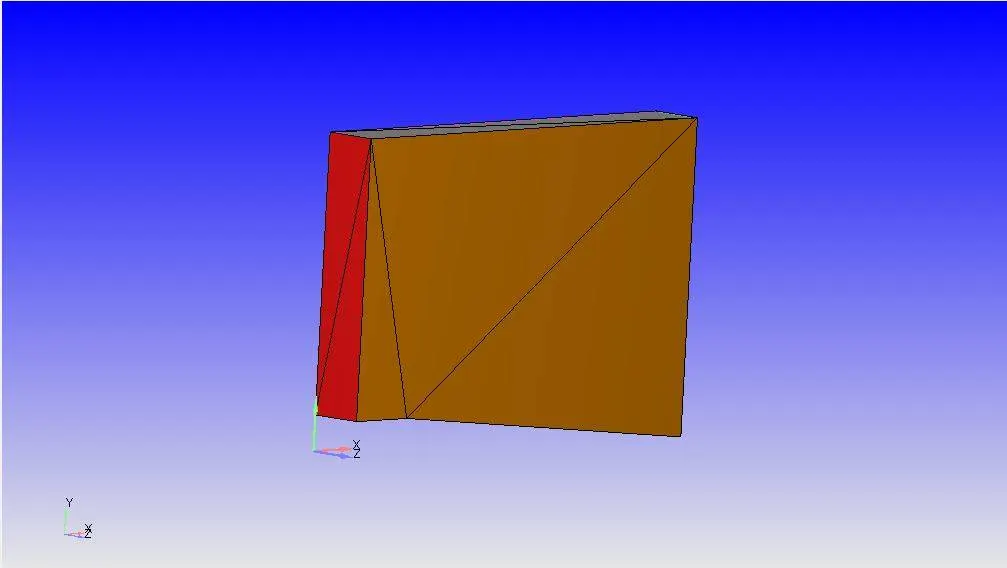
Geometry
Mesh
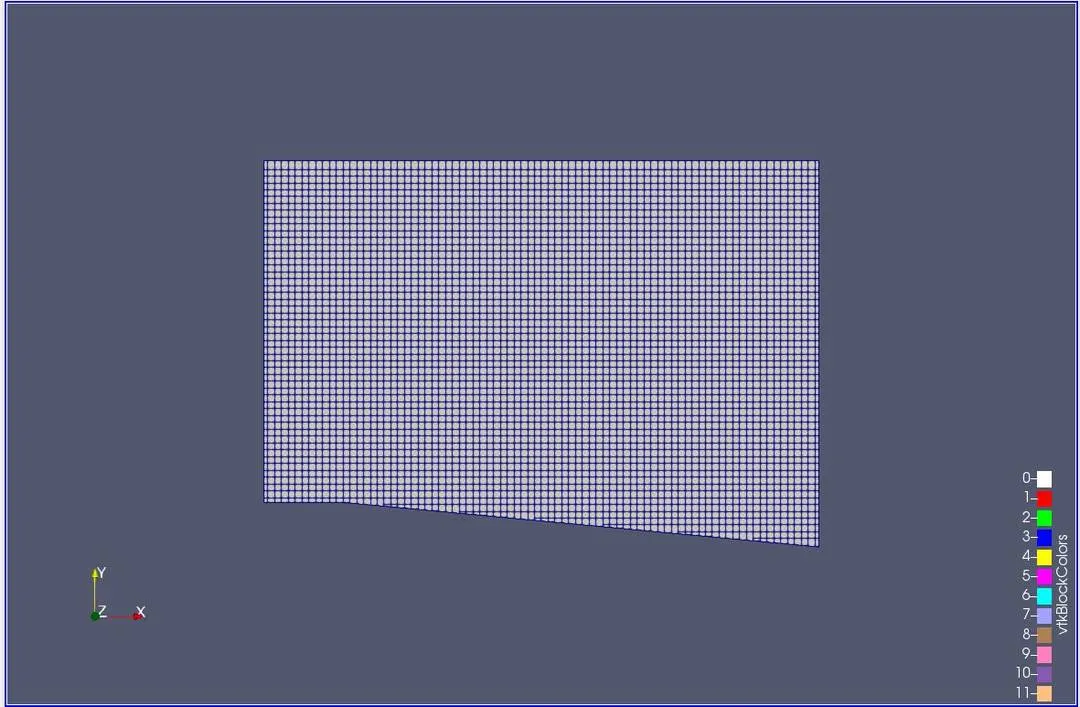
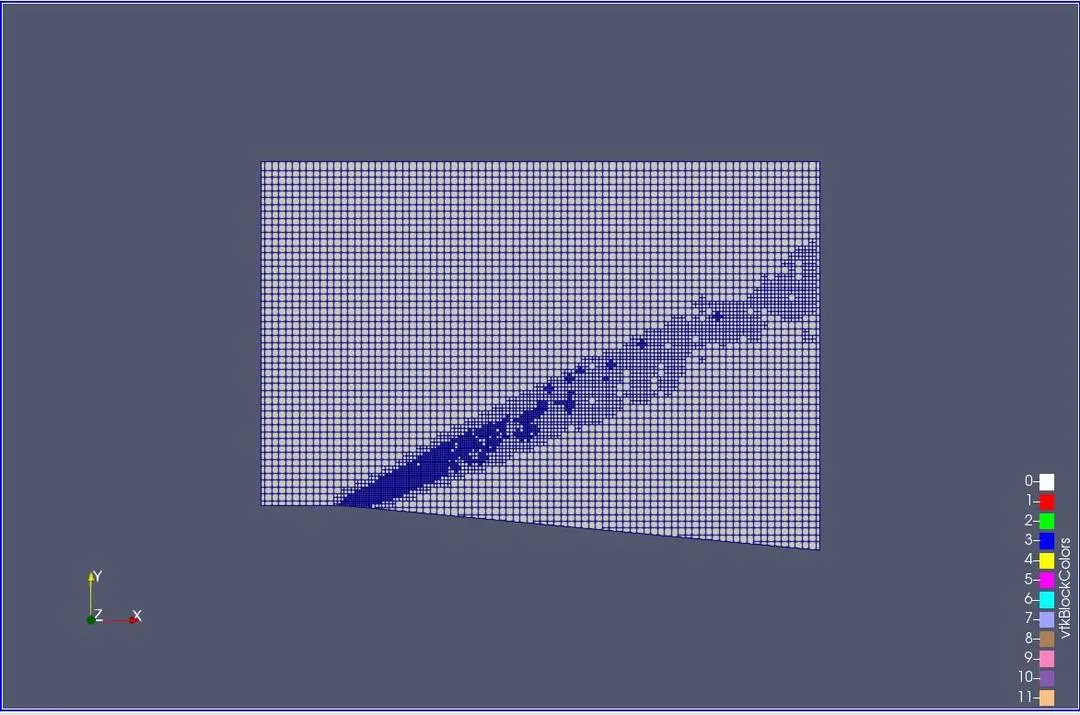
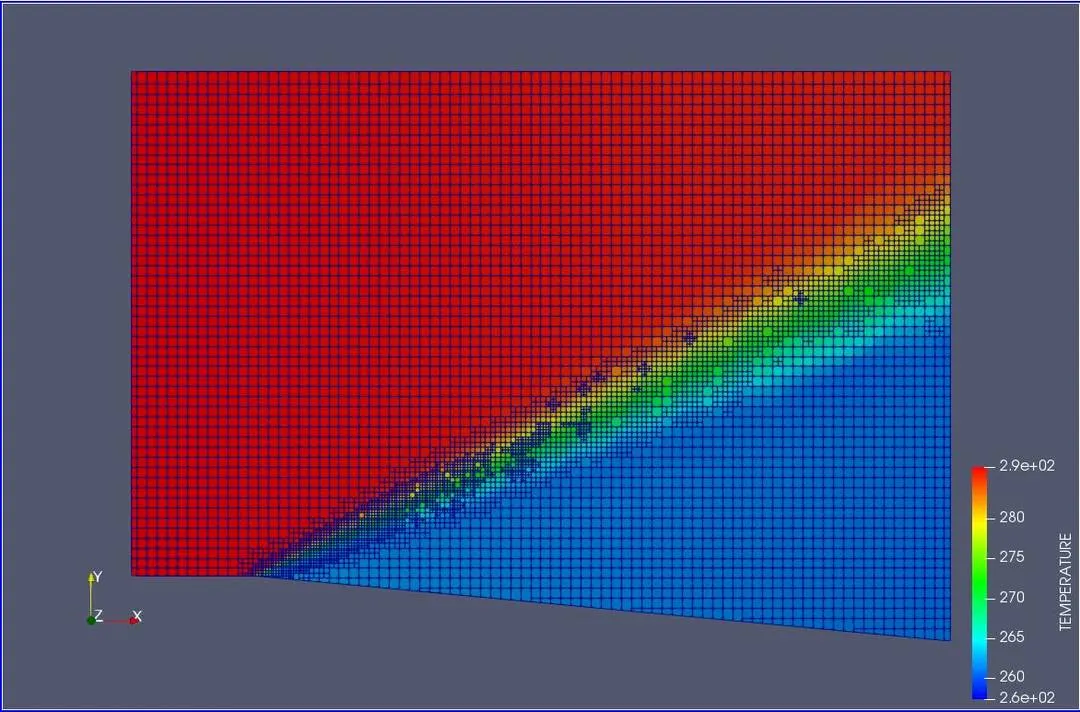
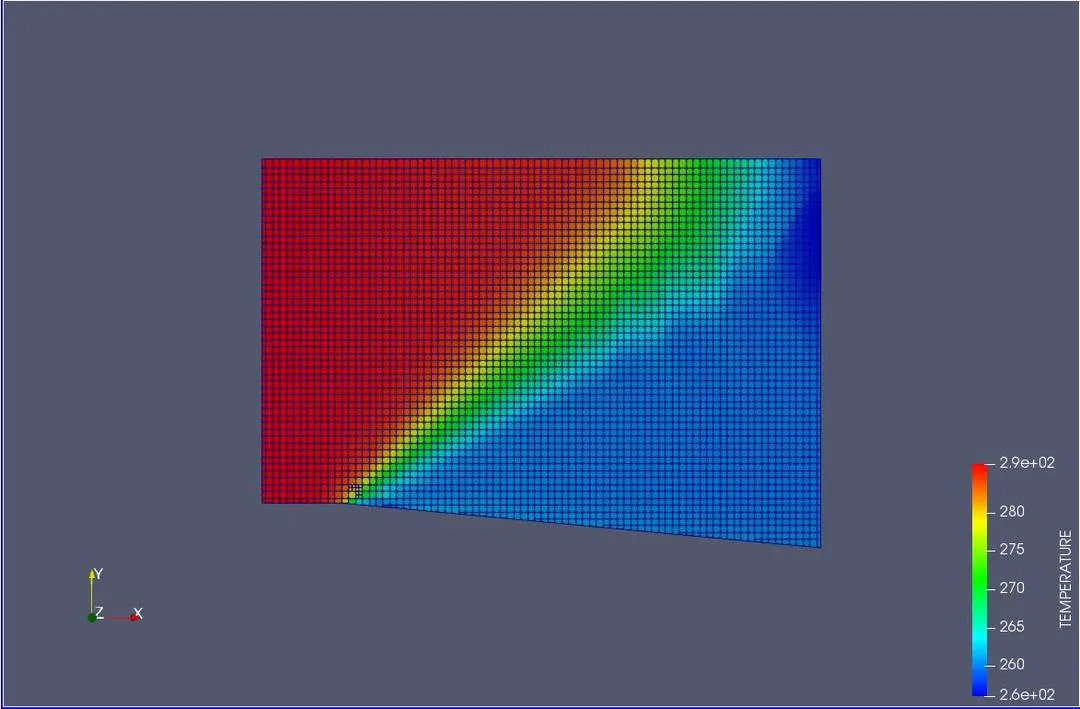
The mesh shown in the figure are at the time step of 0 cycles. As we march ahead in time, the adaptive mesh refinement feature adds smaller grids based on the temperature sub grid scale. When the curvature of temperature exceeds a certain value smaller grids are formed to capture the curvature and the expansion waves.
BOUNDARY CONDITIONS
Inlet boundary
- INFLOW CONDITIONS
- Velocity = 680 m/s
- temperature = 286.1 K
- Mixture - Air
- Turbulence Model - RNG K-Epsilon
Outlet Boundary
- OUTFLOW CONDITION
- Temperature = 286.1 K
- Mixture - Air
Wall
- WALL BOUNDARY
- Temperature = 300 K
- Velocity - Stationary
- Temperature - Law of Wall
- Turbulent Kinetic Energy - Zero normal gradient
- Turbulent Dissipation - Wall model
Results
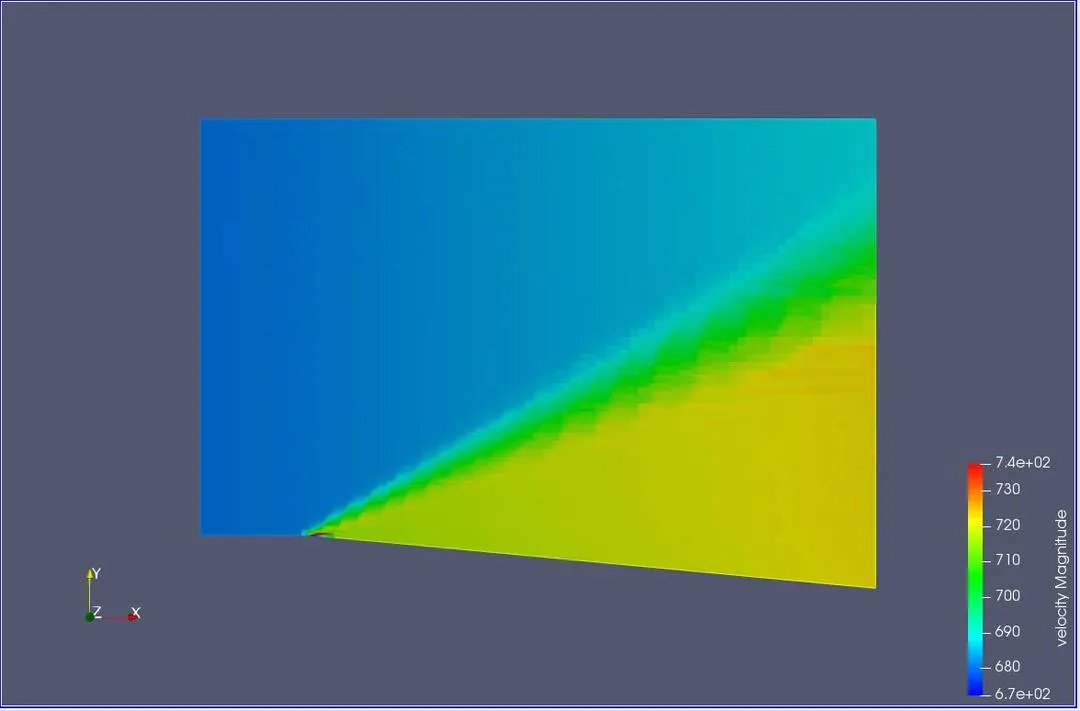
Velocity Contour
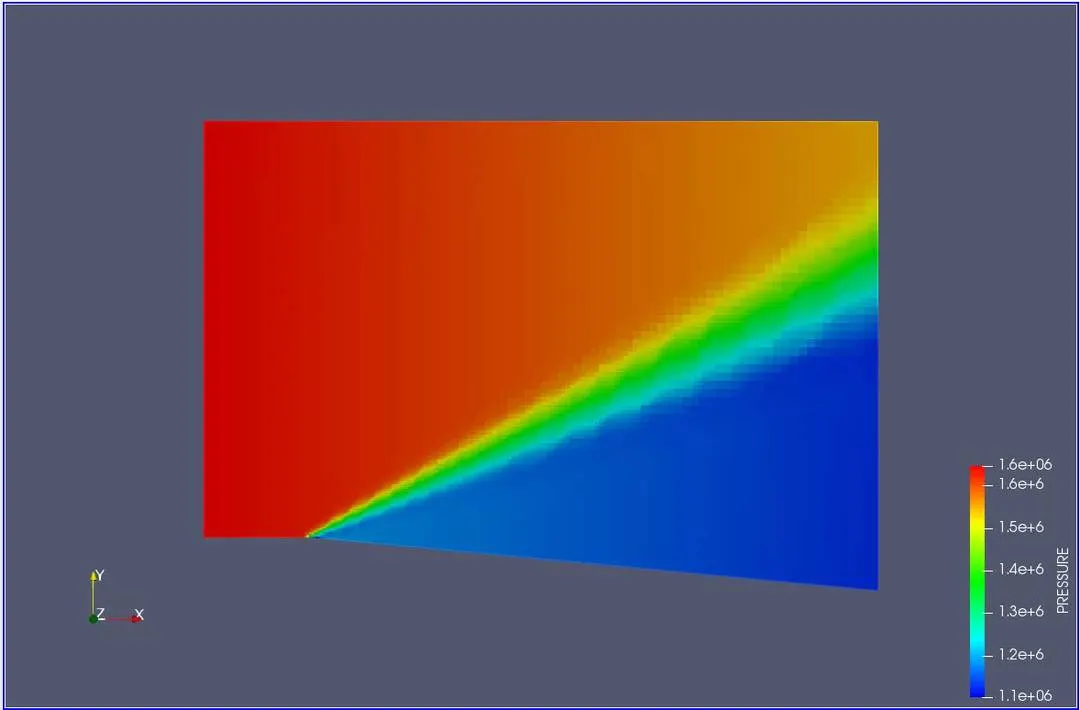
Pressure Contour
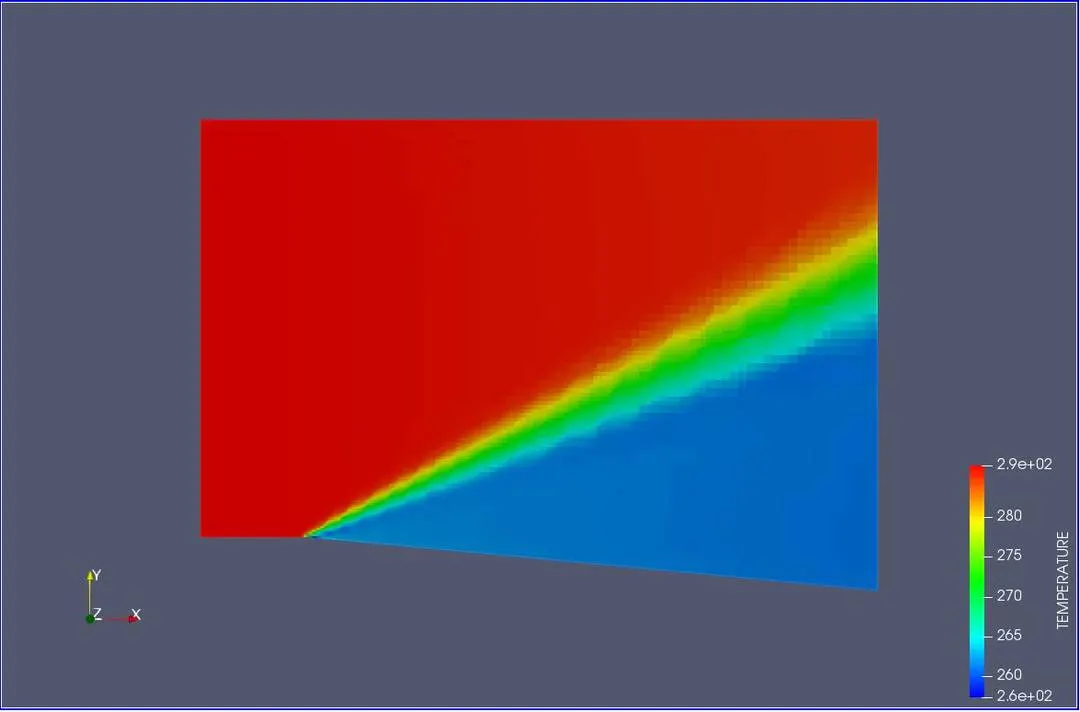
Temperarature Contour
EFFECT OF SGS ON TEMPERATURE CONTOUR
SGS = 0.05 K
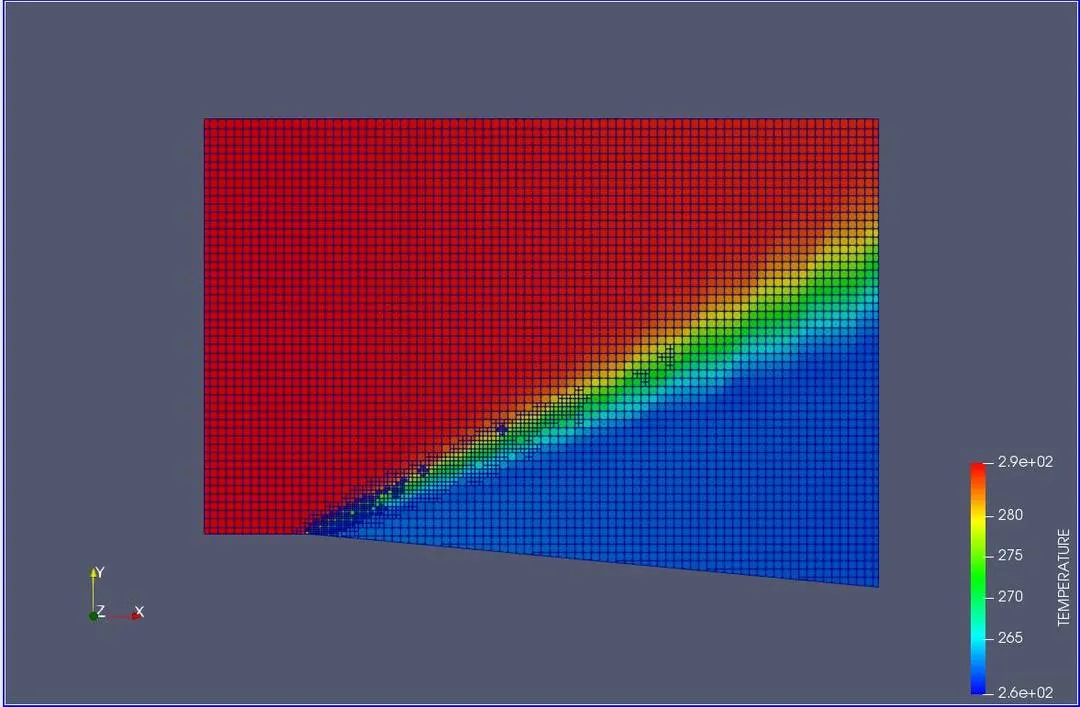
SGS = 0.1 K
SGS = 0.2 K
SGS = 0.4 K
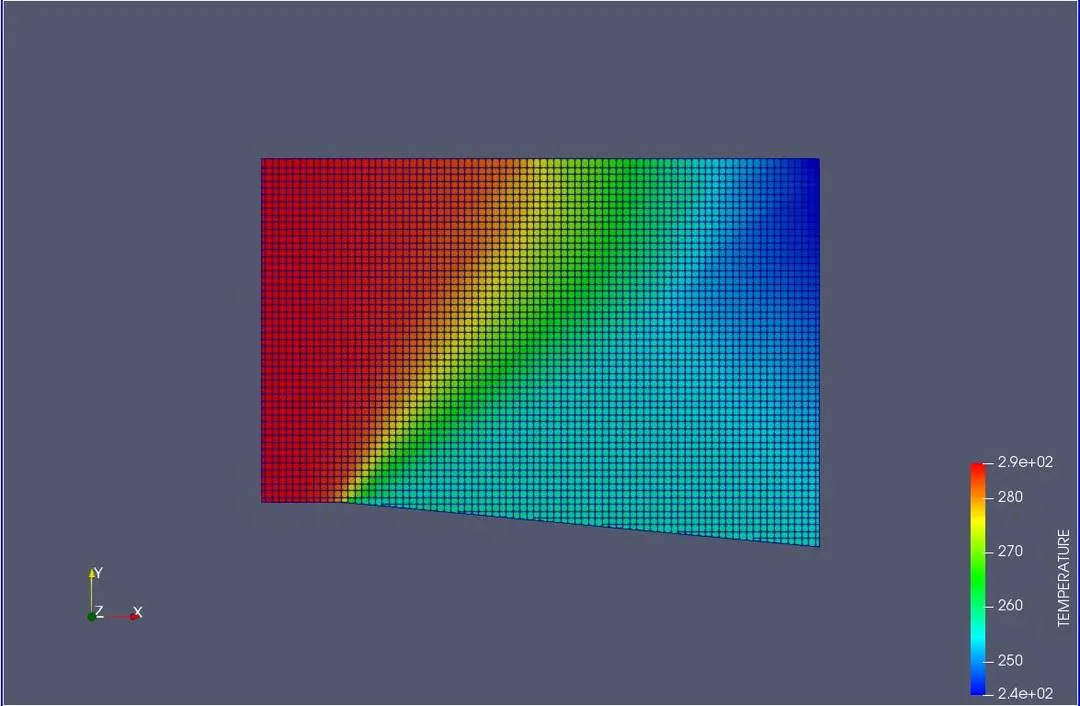
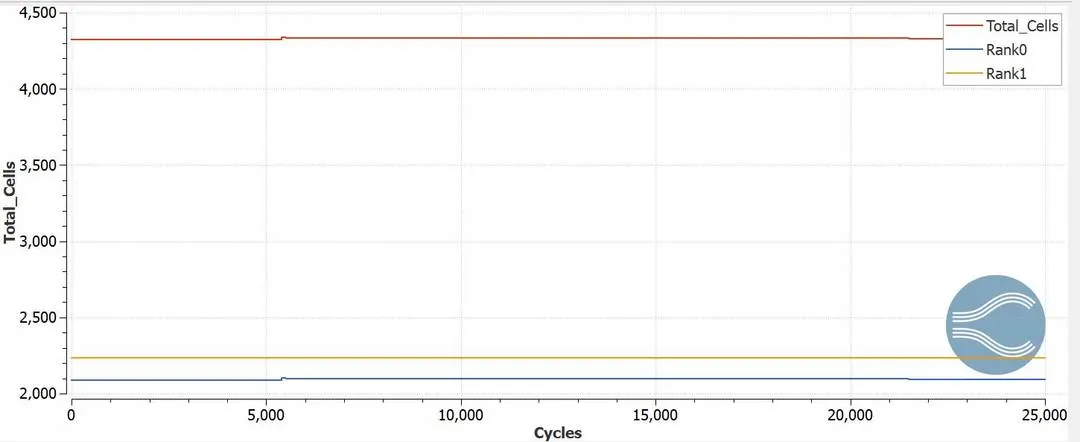
As we can see, 4 different cases with varying sub grid scale factors. When the SGS criteria is small, the shock waves are correctly captured by the AMR feature that has been provided in converge CFD software. If the SGS goes on increasing the shock locations changes a lot and the expansion waves are not seen properly in the temperature contour. The Mach wave angles also increases drastically not capturing the effect of expansion. in first 2 cases there are proper number of cells generated when the SGS number was small whereas the later 2 cases witness no grid generation at all.
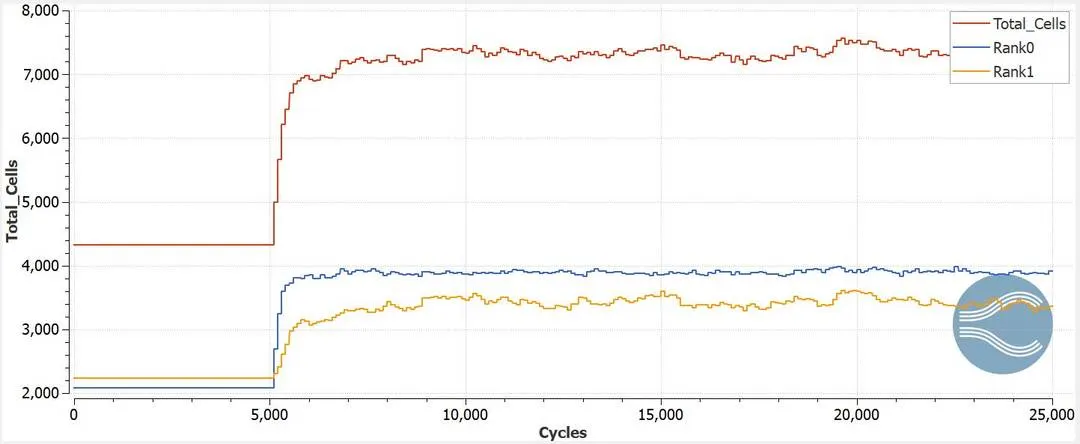
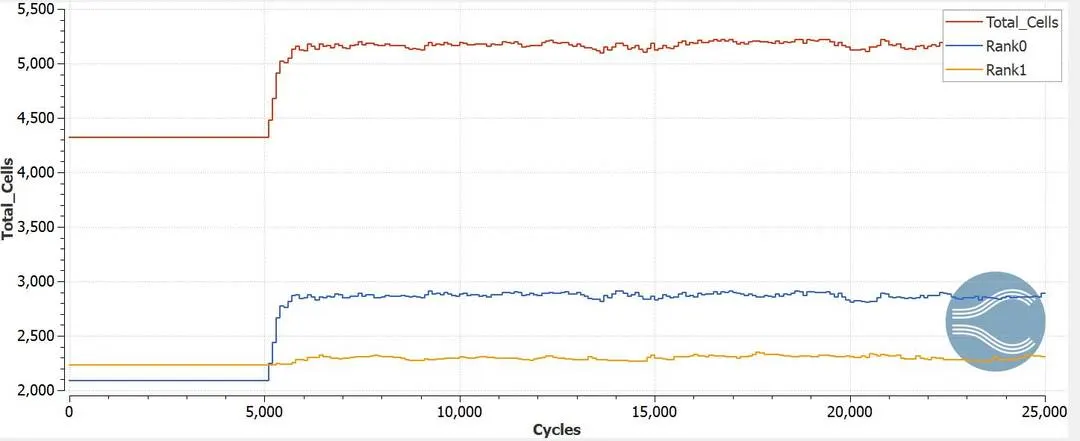
CELL COUNT VERSUS SECONDS
SGS = 0.05 K
SGS = 0.1 K
SGS = 0.2 K
SGS = 0.4 K
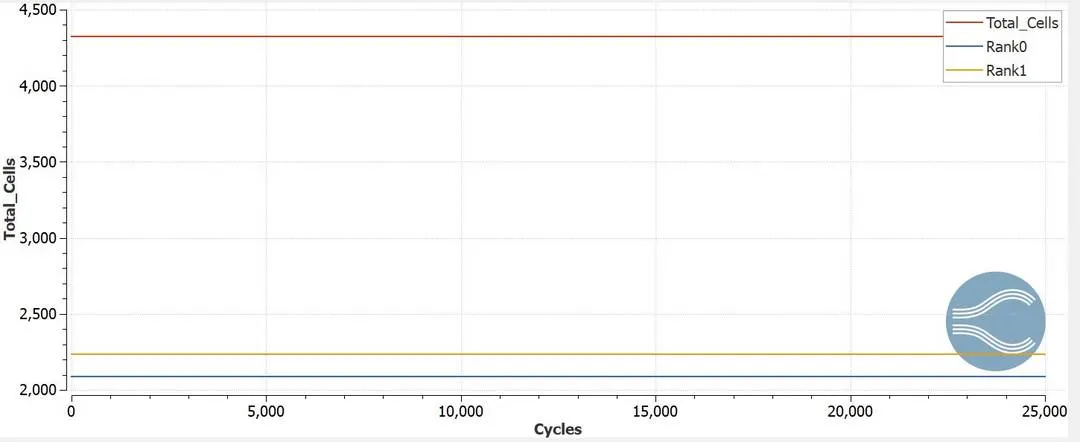
Now as far as the cell count is concerned, when the SGS criteria is small more number of cells are generated to counter the problem and see the expansion waves in proper order. As the cell count decreases as we increase the SGS criteria for the temperature plots.
TEMPERATURE ANIMATION
CONCLUSION
- Prandtyl Meyer Shock flow was simulated
- The physics behind the shock waves and the expansion waves are reviewed
- SGS criteria study was performed for temperature and cell count
- This type of supersonic inlet conditions were simulated