Week 5 Challenge
1. Battery vs Ultra capacitor:
The answer for the statement in the question is False. In the above scenario, it is urban driving situation where the driver have to apply break and acceleration simultaneously as per the flow of traffic. In this scenario, the driver would aggressively apply acceleration and apply breaks. So, in the powertrain point of view, there are spikes present as when the driver applies accelerator suddenly, there is a demand for more power for small duration of time. It is like when we switch on or switch off the power supply aggressively. This is similar to the case of transients. We need to first understand the difference between the battery and ultra capacitor and their application. So, for such scenario, ultracapacitor would be a choice of supply than battery. Following are the reasons:
i) Power Density: Ultracapacitors can deliver high power output quickly, making them ideal for sudden acceleration and deceleration. Batteries, while capable of storing more energy, take longer to discharge and recharge which can lead to sluggish performance during rapid acceleration.
ii) Cycle life: Ultracapacitors have a much longer life than batteries, meaning they can withstand many more charge-discharge cycles without degrading significantly. This is crucial for aggressive driving which puts a lot of stress on the energy storage device.
iii) Regenerative breaking: Ultracapacitors can efficiently capture and store energy from regenerative breaking which can significantly improve the vehicle's overall efficiency. Batteries, while also capable of regenerative breaking, may not be as efficient at handling the rapid charging and discharging that occurs during aggressive driving.
In conclusion, while batteries are excellent for storing large amounts of energy, ultracapacitors are better suited for applications that require high power output and rapid charge-discharge cycles. For an aggressive driving scenario like the urban driving scenario explained above, an ultracapacitor would be the more effective choice.
2. Comparison of different types of cells based on Energy density vs Cell voltage graphs:
Here, we are creating and comparing different types of cells based on the energy density vs cell voltage curve. We have plotted the average energy density on the Y-axis and cell voltage in the X-axis.We are going to compare the following battery types:
i) Lead Acid Battery: Cell voltage- 2V and Average Energy Density- 30-50Wh/kg
ii) Nickel Cadnium Battery: Cell voltage- 1.2V and Average Energy Density- 45-80Wh/kg
iii) Nickel Metal Hydride Battery: Cell voltage- 1.2V and Average Energy Density- 60-120Wh/kg
iv) Lithium-ion (Lithium Manganese Oxide): Cell voltage- 3.8V and Average Energy Density- 100-135Wh/kg
v) Ultracapacitors: Cell voltage- 3.8V and Average Energy Density- 1-10Wh/kg
The following table shows the value of cell voltage and average energy density which is plotted.
| Cell Type | Cell Voltage (V) | Average Energy Density (Wh/kg) |
|---|---|---|
| Lead Acid | 2 | 40 |
| Nickel Cadnium | 1.2 | 62.5 |
| Nickel Metal Hydride | 1.2 | 90 |
| Lithium-ion (LMO) | 3.2 | 118 |
| Ultracapacitor | 2.8 | 10 |
Figure (2.1) shows the plot in which we have plotted energy density on x-axis and cell voltage on y-axis.
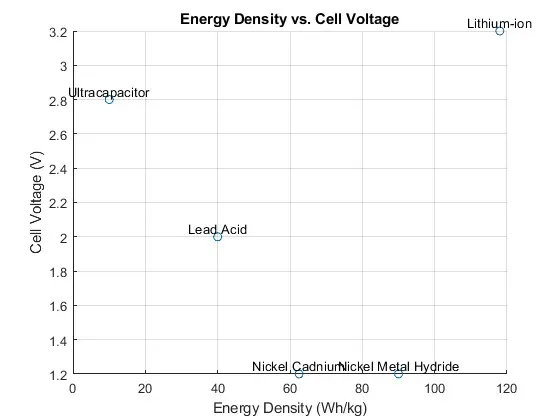
here from the plot, we understand that,
i) Lithium ion battery type has a higher voltage level and higher energy density.
ii) Nickel cadnium and nickel metal hydride have nearly equal cell voltages but their energy density is different. Nickel metal hydride has a higher energy density than the nickel cadnium battery type.
iii) Lead acid battery type has a medium voltage higher than nickel cadnium and nickel metal hydride and it's energy density is lesser than other types of batteries except for ultracapacitors.
iv) Ultracapacitors have a high voltage range but their energy density is lesser than all types of batteries.
Thus ultracapacitors are used only in conditions where high power requirements are at a small amount of duration.
3. Comparison of different types of cells based on Power density vs Cell voltage graphs:
Here, we are going to plot a curve between Power density of different types of batteries on x-axis and cell voltage on y-axis. W are considering the same sets of batteries. The following table shows the datas of different types of batteries and their average power densities and cell voltages respectively. Figure (3.1) shows the curve Average Power Density vs Cell voltage of different types of batteries like starting with Lead Acid, Nickel-cadnium, Nickel Metal Hydride, Lithium-ion (LMO) and Ultracapacitor.
| Cell Type | Cell Voltage (V) | Average Power Density (W/kg) |
|---|---|---|
| Lead Acid | 2 | 155 |
| Nickel Cadnium | 1.2 | 225 |
| Nickel Metal Hydride | 1.2 | 105 |
| Lithium-ion (LMO) | 3.2 | 550 |
| Ultracapacitor | 2.8 | 600 |
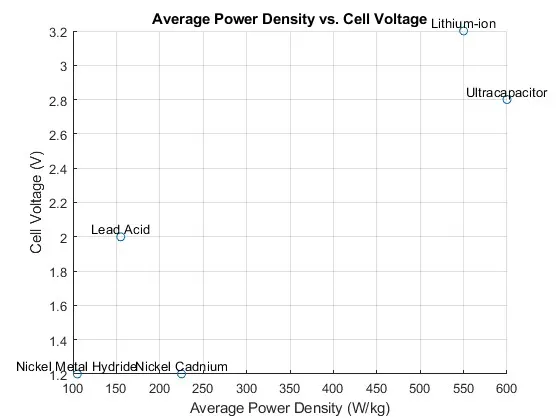
From the above plot, we can conclude that Lithium-ion battery types are almost in the higher preference range for better energy density, power density and voltage ranges. However, Ultracapacitors are also suitable for conditions where high power requirements in shorter duration. Other types excluding the above are also used for applications corresponding to their specification matching of loads.
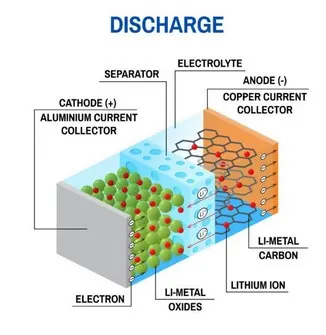
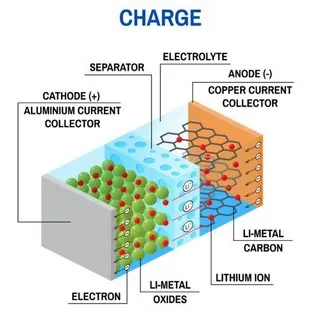
4. True. The main chemistry involved in lithium ion batteries is intercalation and deintercalation of lithium ions between anode and cathode. Since the battery is connected to the charger for the first time, all the lithium ions are present in the cathode (positive electrode). During charging Li+ ions are deintercalated from cathode and intercalated into the anode layer (mostly graphite). In the image provided, the Li+ ions are transfering from positive electrode to negative electrode during charging, thus (1) marked electrode is negative electrode.
Components of Lithium -ion battery:
A battery is made up of several individual cells that are connected to one another. Each cell contains three main parts:
i) Positive Electrode (Cathode)
ii) Negative Electrode (Anode)
iii) Electrolyte
iv) Separator
Reactions involved in lithium-ion batteries:
Inside a lithium-ion battery, oxidation-reduction (Redox) reactions takes place.
Reduction takes place at the cathode. There, cobalt oxide combines with lithium-ion form lithium-cobalt oxide (LiCoO2). The half-reaction is:
CoO2 + Li+ + e- ---------> LiCoO2
Oxidation takes place at the anode. There, the graphite intercalation compound LiC6 forms graphite (C6) and lithium ions. The half-reaction is:
LiC6 ------>C6 + Li+ + e-
Here the full reaction is as follows:
LiC6 + CoO2 <---------------> C6 + LiCoO2
Recharging a Lithium-ion Battery:
Figure (4.1) and figure (4.2) shows the charging and discharging of lithium-ion battery respectively. When the lithium-ion battery is charging, lithium ions (Li+) move from the negative anode to the positive cathode. They do this by moving through the electrolyte until they reach the positive electrode. The electrons on the other hand, move from the anode to cathode. When we charge a lithium-ion battery, the exact opposite process happens. The lithium ions move back from the cathode to the anode. The electrons move from anode to cathode.