Week 5 Challenge
Q.1..?
- False
Because,
Solution: Battery is not a better choice in the given driving scenario.
Condition: The driver is driving aggressively. Very rapid accelerating and braking (deceleration) take place in the driving.
Battery:
- A battery converts chemical energy to electrical energy and it is reversible in chemical reactions.
- They have low power density
- The battery charge/ Discharge process is relatively slower.
Ultra-Capacitor:
- Ultracapacitors are also known as supercapacitors.
- The source of energy is electrical energy.
- They are a very high energy density.
- As the Ultracapacitors are bigger capacitors, they store a large amount of electrical charge than the chemical batteries.
- They are having high power density.
- Ultracapacitors undergo a quick charge and discharge rate.
Result:
As per the above comparison between battery and ultracapacitor, it is understood that Ultracapacitors are more suitable for vehicles that accelerate and decelerate very frequently.
Q.2...?
Energy Density: It is the measure of how much energy a battery contains in proportion to its weight. This measurement is typically presented in watt-hours/kilogram. The higher the energy density, the longer the runtime.
Lead Acid batteries:
Lead-acid batteries have relatively low energy density.
Nickel-Cadmium Battery:
Nickel Cadmium has a much higher energy density compared to lead-acid batteries.
Nickel-Metal Hydride Battery:
Ni-MH batteries can have two to three times the capacity of NiCd batteries of the same size, with high significance and also much less than lithium-ion batteries.
Lithium-ion battery:
Lithium-ion batteries have a high energy density.
Ultracapacitor:
Energy density is more in ultracapacitors compared to capacitors.
Q.3...?
The power density of the above set of batteries is as shown below.
|
Battery name |
Power density (W/Kg) |
Cell voltage (V) |
|
Lead-acid battery |
180 |
2.1 |
|
Nickel Cadmium |
150 |
1.2 |
|
Nickel Metal Hydride |
1000 |
1.2 |
|
Lithium-ion |
340 |
3.6 |
|
Ultracapacitor |
496 |
3.5 |
Q.4...?
True. The number indicated as 1 is a -ve electrode.
Lithium-ion batteries generate DC power by utilizing chemical reactions.
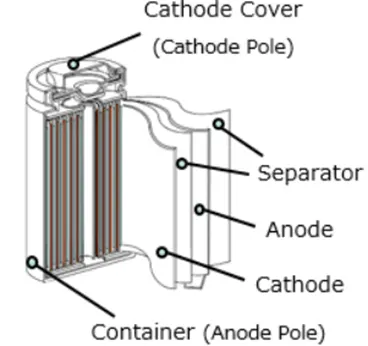
- During discharge, lithium ions from the -ve anode move through the electrolyte to gets intercalate the +ve cathode.
- During charging, electrons move from anode to cathode in the external circuit.
- Electrons flow to balance the cell voltage.
- During the electrochemical process, the anode is -ve and the cathode is +ve.
- At the first time charging, the lithium-ion from the cathode gets attached to anode and it forms the inseparable layer on the anode.
- A solid Electrolyte Interface (SEI) is formed at the anode. Anode gets decomposed if it comes in contact with the electrolyte. SEI protects the anode.
Summary:
A battery has just been manufactured in the industry and has been connected to a charger for the first time. The electrode marked as (1) in the picture below is the negative electrode. this is true