Week-11 Challenge: Braking
Q.1....?
Braking:
The function of the braking system is to retard the speed of the moving vehicle or bring it to rest in the shortest possible distance whenever required. The vehicle can be held on an inclined surface against the pull of gravity by the application of a brake. Brakes are mechanical devices for increasing the frictional resistance that retards the turning motion of the vehicle wheels. It absorbs either kinetic energy or potential energy or both while remaining in action and this absorbed energy appears in the form of heat. While moving down a steep gradient the vehicle is controlled by the application of brakes. In this case, brakes remain in action for a longer period making it imperative to dissipate the braking heat to the atmosphere as rapidly as possible.
Kinetic energy is the force that keeps the vehicle moving. This energy is provided by the engine in order to accelerate the vehicle from a standstill to desired speed. Kinetic energy is dissipated as heat by the brakes during application of breaks (Fig. 28.1). The kinetic energy of a vehicle during braking is given by
Thus, the kinetic energy doubles as the weight doubles, but it increases four times as speed doubles.
Before calculating the Braking Energy of a particular vehicle ,we need to create an excel sheet for a drive cycle.
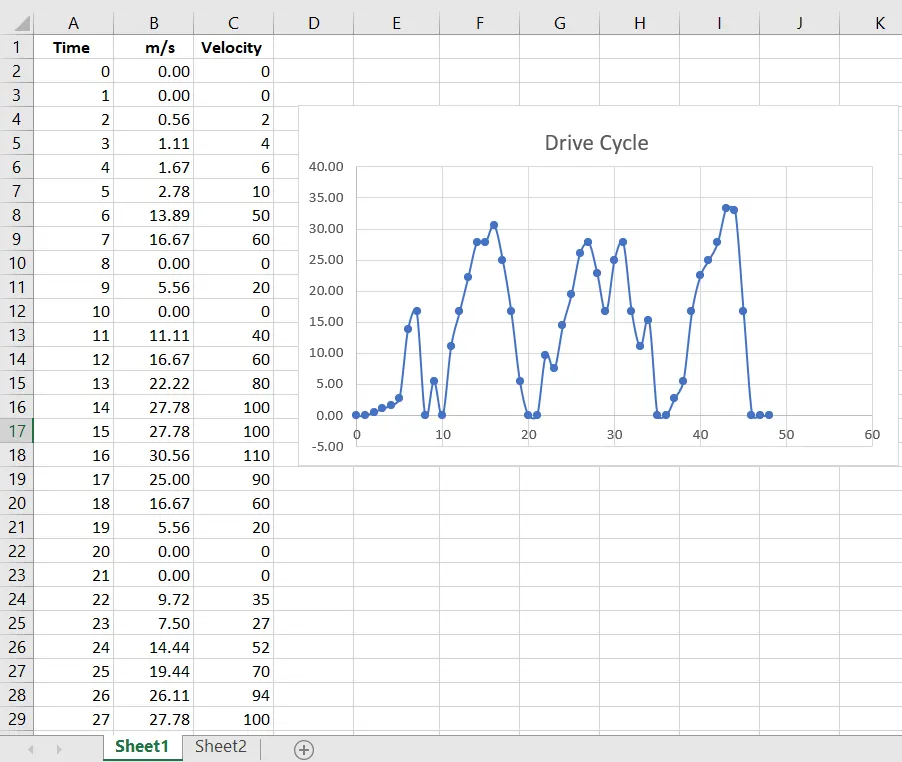
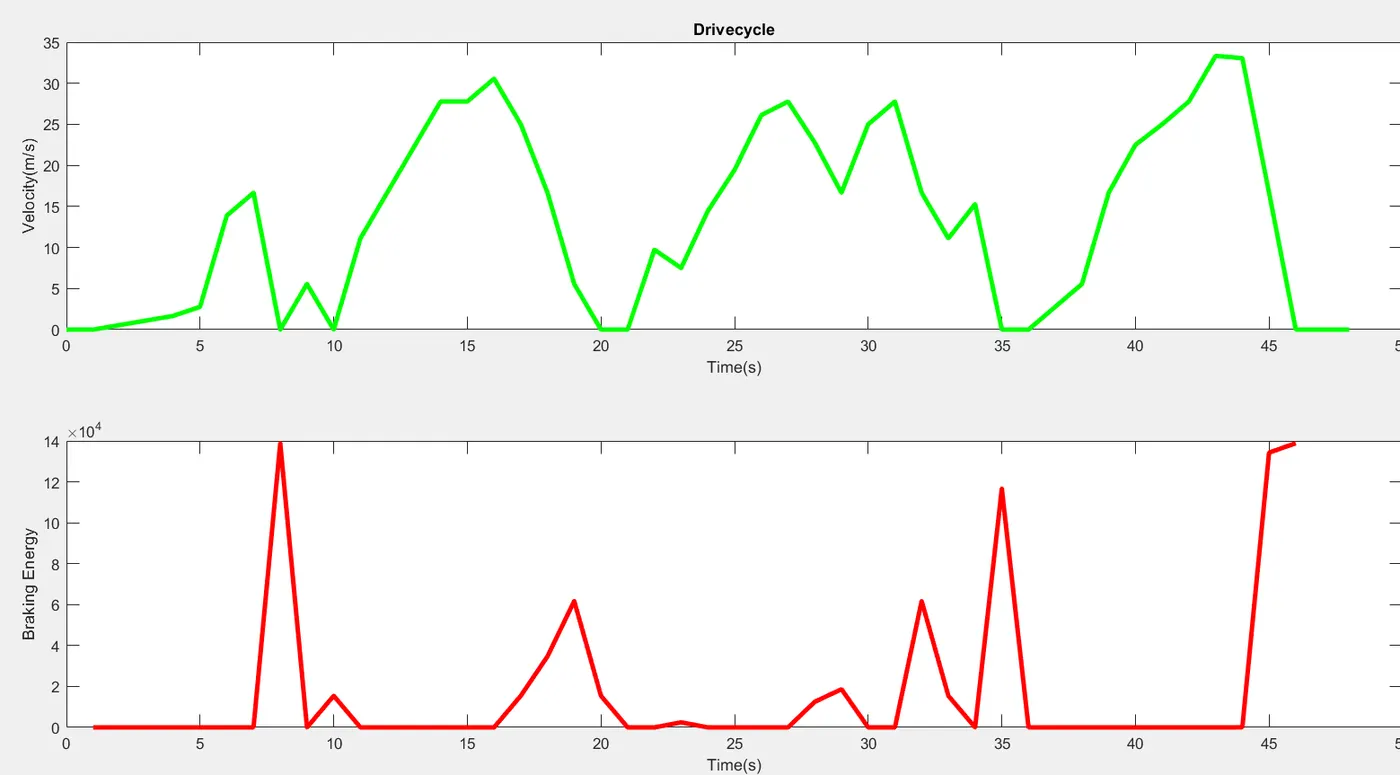
Now we need to import this excel data to the MATLAB and then create a program to calculate and plot the results of the brake energy.
Results:
Q.2....?
Regenerative braking is an energy recovery mechanism that slows down a moving vehicle or object by converting its kinetic energy into a form that can be either used immediately or stored until needed. In this mechanism, the electric traction motor uses the vehicle's momentum to recover energy that would otherwise be lost to the brake discs as heat. This contrasts with conventional braking systems, where the excess kinetic energy is converted to unwanted and wasted heat due to friction in the brakes, or with dynamic brakes, where the energy is recovered by using electric motors as generators but is immediately dissipated as heat in resistors. In addition to improving the overall efficiency of the vehicle, regeneration can significantly extend the life of the braking system as the mechanical parts will not wear out very quickly.
The most common form of regenerative brake involves an electric motor functioning as an electric generator. In electric railways, the electricity generated is fed back into the traction power supply. In battery electric and hybrid electric vehicles, the energy is stored chemically in a battery, electrically in a bank of capacitors, or mechanically in a rotating flywheel. Hydraulic hybrid vehicles use hydraulic motors to store energy in the form of compressed air. In a hydrogen fuel cell powered vehicle, the electrical energy generated by the motor is used to break waste water down into oxygen and hydrogen which is recycled back into the fuel cell for later reuse.
Coordination of Electric and Mechanical Brake :
In an electric Motor, the Total Brake distribution is in two aspects which are Electrical Brake which is called Regenerative Brake, and Mechanical Brake or Classical Brake with a hydraulic cylindrical system. Brake Force distribution must be uniform, If the Regenerative braking power requirement is more than the charging limit of the battery or more than the regenerative capacity of the machine we must apply Mechanical brakes as well. In a practical case, the combination of these two is applied. So usually it is a combined response of Mechanical brake and Regenerative brake. The reason for how this braking force is combined, that particular phenomena are called Brake Control Strategies. There are two Brake Control Strategies, which are Series - In case of Series, we apply Mechanical brake and Regenerative electric brake one after another. We can apply only one brake strategy at a time either apply Regeneratively or apply Mechanical brake. The Series Brake Control Strategy has a further classification, that is based on whether we want the comfort of driver or Brake behavior compared to energy efficiency. Parallel - In the case of Parallel, we apply both brakes simultaneously. This Particular Parallel braking is going to happen both at a time. Electric Driven Intelligent Brake (EDIB) is a combination of Hydraulic brake or Mechanical brake along with a Regenerative brake. It is a Parallel braking technique. The Control criteria such that at low speed use regenerative braking higher and at high speed or during the initial braking period we actually combine the both.
Q.3....?
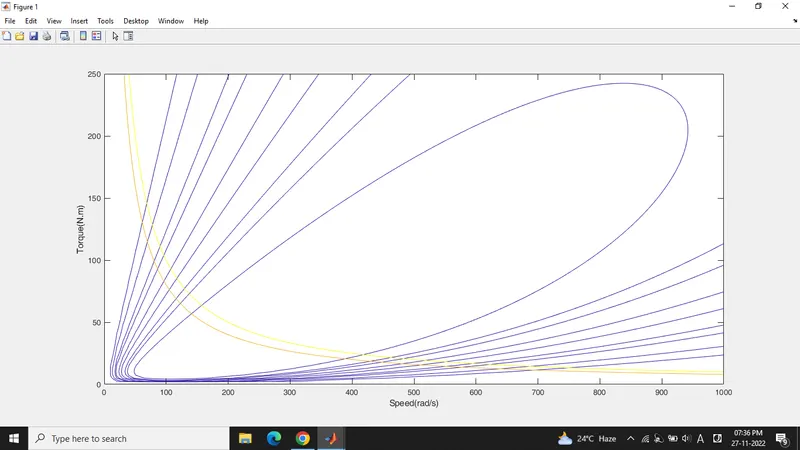
To plot contour line for a given Motor. A Motor have various types of losses happening inside. The various types of losses are:
Copper Losses - I2RI2R , where R is the Armature resistance and we say that Torque is proportional to Current, this copper loss can be consider as .where is to take care of resistance of brushes and also take care of ux and its effect.
Copper losses = kc⋅T2kc⋅T2
Iron Losses - Iron Losses are nothing but Magnetic losses, which is denoted as , where factor is based on the Magnetic eld effect. For Permanent Magnets have constant Magnetic eld and this Iron losses is based on the value of and this are going to change according to the Speed. At Various Speed have different value of Back EMF and that is going to affect the Iron Losses.
Iron Losses = ki⋅ωki⋅ω
Windage Losses - This is a Mechanical or friction of Windage losses. This is based on size of shape of Motor and the amount of windage losses that the motor is going to experience.
Windage Losses = kw⋅ω3kw⋅ω3
Constant Losses - This is denoted as C.
Total Losses - The Total Losses are considering the above four losses and denoted as,
Total Losses = kc⋅T2+ki⋅ω+kw⋅ω3+Ckc⋅T2+ki⋅ω+kw⋅ω3+C
All Motors are model as per the above equation of losses. This above equation is not only applicable for Permanent Magnet DC Motor, but other motors as well like induction motor.
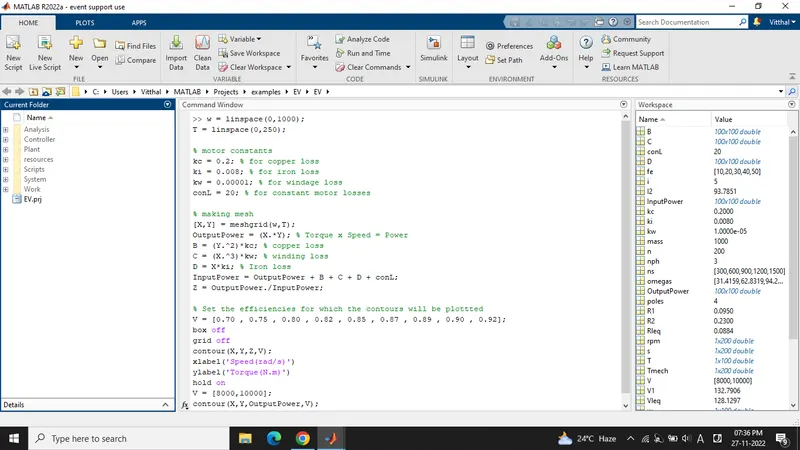
MATLAB program for calculating the losses of the EV motor:
Results: