Week 5 Challenge
QUESTION -1
1) Which is better choice to supply power for aggressive driver:
Aim:
To explain whether battery is better choice to supply power than ultracapacitor to aggressive driver who accelerates and brakes harshly.
Explanation:
- The aggressive driver accelerates rapidly and brakes harshly.
- This requires the instantaneous high power to meet this condition.
- By operating battery at this condition increases depth of discharge and it degrades the battery.
- Battery pack has less specific power capacity than ultracapacitor.
- In order to meet this amount of peak current, the battery has to designed as per this condition.
- Hence the battery pack size and cost also increase.
- For this instantaneous high power for short duration of time, it is not efficient to increase the battery pack.
- But ultracapacitor has ten times high specific power than battery.
- The specific power is about 10kW/kg.
- Hence it can take care of peak loads.
- Thus, the sudden load can be used to meet sudden acceleration and braking.
- Sudden braking produces high regenerative current. This current can be used to charge the battery but it is not efficiently used.
- Because the battery must be charged in the particular charging rate.
- Ultracapacitor can be charged and discharged quickly.
- So, this current can be used to charge the ultracapacitor.
Summary:
Hence, Ultracapacitor is the better choice to supply the power for the aggressive driver who accelerates and brakes rapidly.
QUESTION-2
Cell voltage vs Energy density:
Aim:
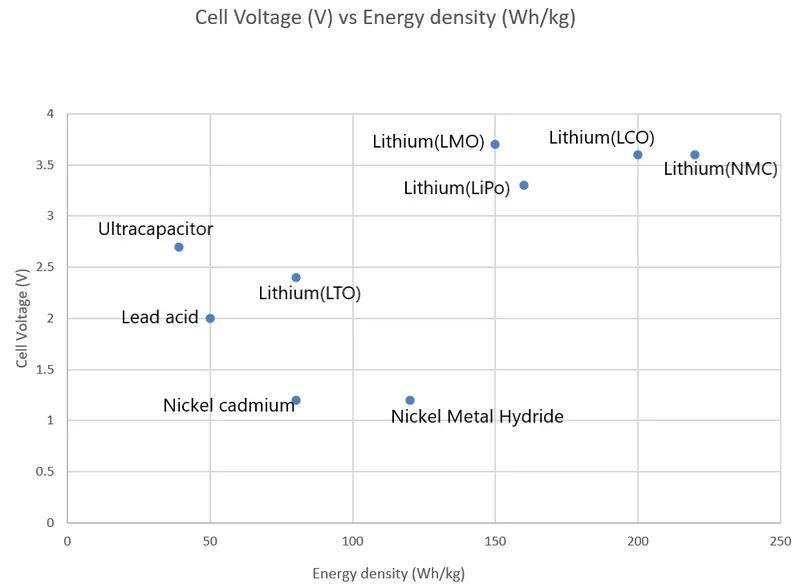
To create the plot for cell voltage in y axis and energy density in x axis for Lead acid battery, Nickel cadmium battery, Nickel metal hydride, Lithium battery and ultracapacitor.
Plot:
Explanation:
- Lead acid batteries can be used in IC engine vehicles to supply the auxillary 12V system load and in emergency lighting because of low energy density, simple construction and stable operation.
- Nickel cadmium batteries has less cell voltage and little higher energy density than lead acid hence it is can be used in toy cars, calculators.
- Nickel Metal Hydride batteries can be used in wide electronic devices because of high energy density. Voltage is less hence it is sufficient to power electronic devices such as computers, cellular phones.
- Lithium - ion batteries have high energy density and high cell voltage. Lithium is also light in weight and hence it can be used in Battery Electric Vehicle, Smartphones, Laptops.
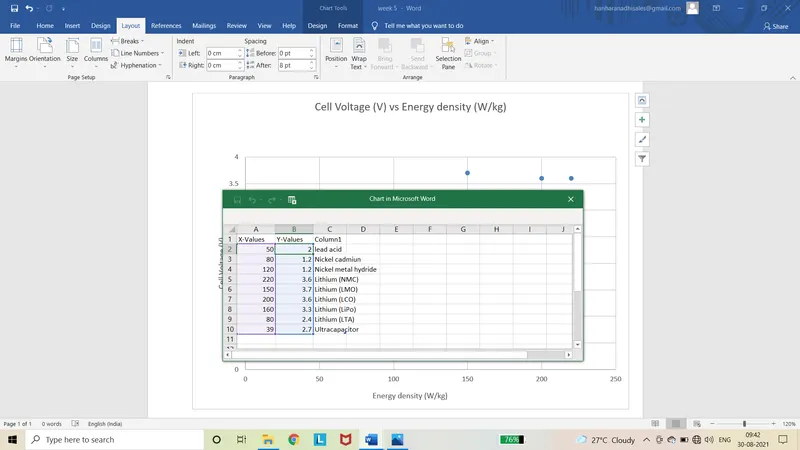
- Y axis values are cell voltage and X axis values are Energy density and column 1 shows type of battery.
- NMC has highest energy density among all hence it is used in most of BEV vehicles.
- Leading automakers Toyota, Tata uses this chemistry for their BEV’s.
-
- chemistry for their BEV’s.
QUESTION -3
-
3) Cell voltage vs Power density
Aim:
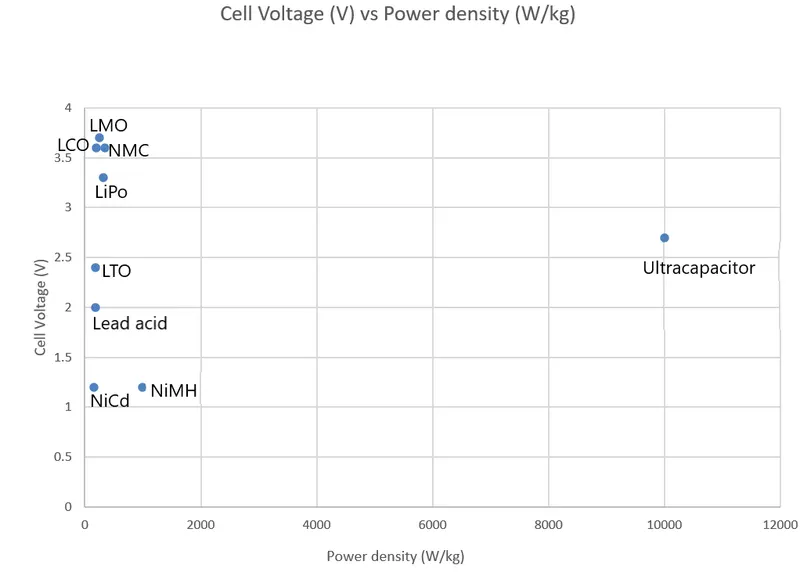
To create the plot for cell voltage in y axis and power density in x axis for Lead acid battery, Nickel cadmium battery, Nickel metal hydride, Lithium battery and ultracapacitor.
Plot:
Explanation:
- Lead acid, Nickel Cadmium, Lithium titanate, Lithium manganese oxide and lithium cobalt oxide has low power density. Hence these can be operates for low power applications.
- Lithium Nickel Manganese Cobalt battery has comparatively high power density than other batteries except NiMH. Hence it is used for high power and high energy requiring systems.
- Nickel metal Hydride has high power density than other batteries hence it can be used in HEV’s and portable power tools where high power is required.
- Ultracapacitors have far high power density than any other source of energy storing elements.
- Ultracapacitors have ten times higher power density than lithium-ion batteries.
- Hence it can be used to supply power to peak load without any tension.

4) Electrode polarity in the battery:
Aim:
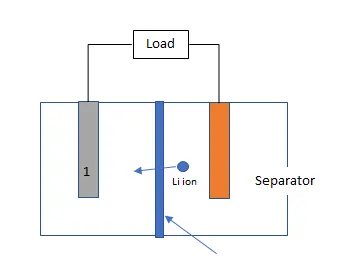
To analyze whether the specified electrode in the Lithium ion battery during first time of charging from the manufacturer is negative or positive.
Explanation:
- In Lithium ion batteries both the anode and cathode has lithium. The lithium gets intercalated in both cathode and anode.
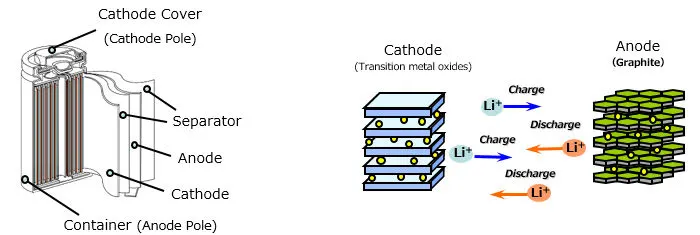
- During discharge, the lithium ions from the negative anode moves through the electrolyte to gets intercalates to positive cathode.
- In order the balance the charge, the electrons moves from the anode to cathode in the external circuit.
- The lithium gets deposited in the cathode. Not all the lithium ions are flows to the cathode.
- Because, if all lithium ions are extracted the structure of anode becomes reduced.
- Hence it leads to degradation of battery.
- During charging, external current is given to positive of the battery.
- The lithium ions from the positive electrode diffuses through the electrolyte and gets intercalated to the negative anode.
- The electrons flows in order to balance charge.
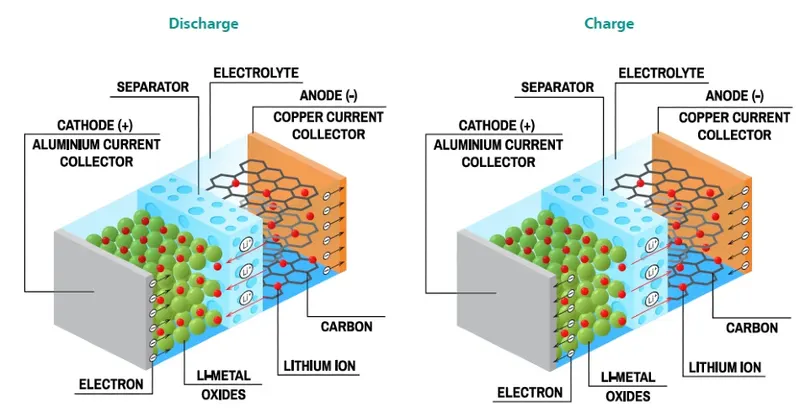
- During all electrochemical process, the anode is negative and cathode is positive.
- During first time of charging, the lithium ion from cathode gets attached to anode and it forms the inseparable layer on the anode.
- It leads to formation of SEI. The anode gets decomposes if it comes in contact with the electrolyte.
- This SEI formation protects the anode.
Summary:
The electrode marked as 1 in the picture is negative electrode. The Statement is True.