Week 5 Challenge
Question 1:
Consider a scenario where an aggressive driver is accelerating very rapidly and braking harshly in a city driving. Is battery better a choice to supply power than UC in this scenario?
- True
- False
False. In an aggressive driving scenario with rapid acceleration and harsh braking, the energy demands on the power source can be high, which could lead to a decrease in battery performance and range. An ultracapacitor (UC) is better suited for high-demand, high-performance driving scenarios, as it can store and release energy quickly and efficiently, providing a consistent and reliable source of power. Additionally, ultracapacitors have a longer lifespan and are less affected by high temperatures compared to batteries, making them a more suitable choice for high-performance applications.
Question 2:
Consider the following components.
1) Lead acid battery 2) Nickel cadmium battery 3) Nickel Metal hydride battery 4) Lithium ion (specify chemistry) battery 5) Ultra Capacitor
Note: In case of a range of energy density, take the average value for the plot.
Create a plot with energy density on the X Axis and cell voltage on the Y axis.
Comment on the capabilities of these batteries based on the plot created.
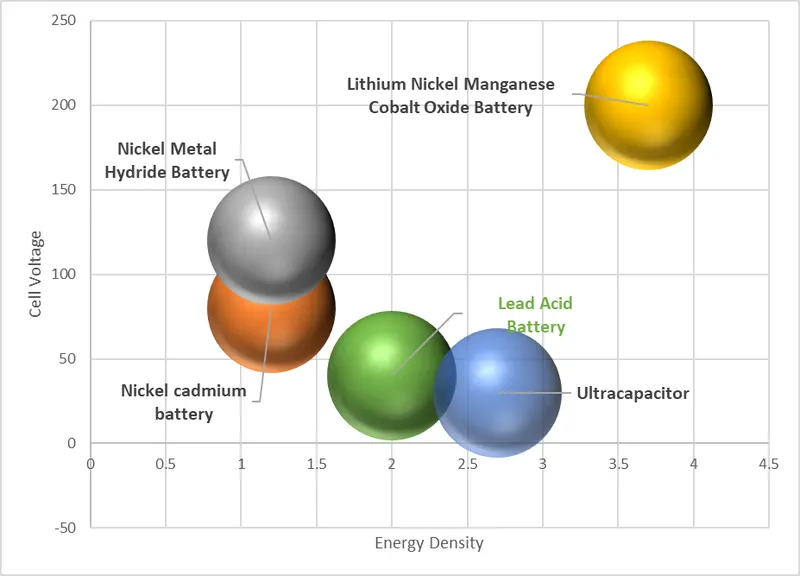
- Lead acid battery: Energy density = 30-40 Wh/kg; Cell voltage = 2 V
- Nickel cadmium battery: Energy density = 60-90 Wh/kg; Cell voltage = 1.2 V
- Nickel Metal hydride battery: Energy density = 80-120 Wh/kg; Cell voltage = 1.2 V
- Lithium ion battery: Energy density = 100-265 Wh/kg; Cell voltage = 3.7 V
- Ultra capacitor: Energy density = 5-30 Wh/kg; Cell voltage = 2.7 V
Based on the values above, we can observe that lithium-ion batteries have the highest energy density, followed by nickel metal hydride batteries, nickel-cadmium batteries, and lead acid batteries. On the other hand, ultracapacitors have much lower energy density compared to batteries. Additionally, lithium-ion batteries have the highest cell voltage, while lead-acid batteries have the lowest.
In terms of capabilities, high energy density batteries are suitable for applications that require a lot of energy storage, while high cell voltage batteries are suitable for applications that require high power output. Ultracapacitors, on the other hand, are better suited for applications that require quick charging and discharging, as they can store and release energy rapidly.
Question 3:
For the above-mentioned components on the same plot (retain the previous plot) created in the previous
Create a plot with power density on the X axis and cell voltage on the Y axis.
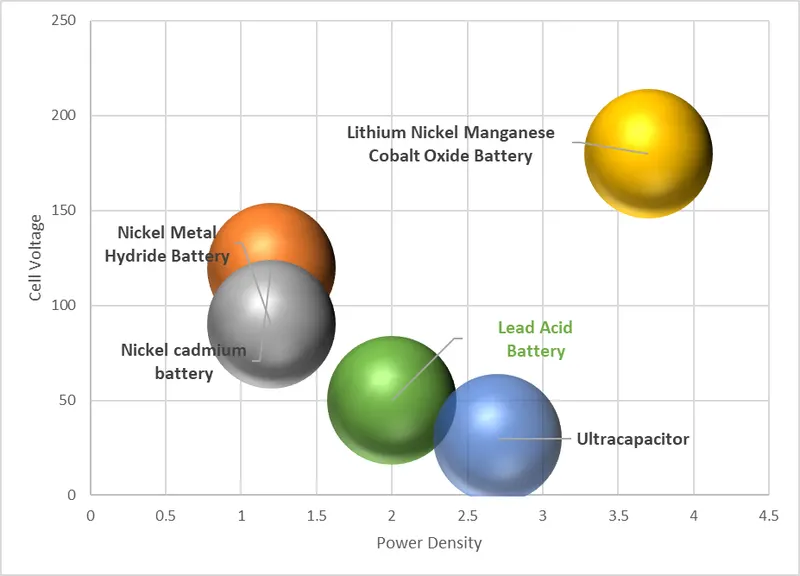
- Lead acid battery: Power density - 30-50 W/kg, Cell voltage - 2.0-2.2 V
- Nickel cadmium battery: Power density - 80-120 W/kg, Cell voltage - 1.2 V
- Nickel Metal hydride battery: Power density - 60-90 W/kg, Cell voltage - 1.2 V
- Lithium ion (LiCoO2) battery: Power density - 140-180 W/kg, Cell voltage - 3.7 V
- Ultra Capacitor: Power density - 10-30 kW/kg, Cell voltage - 2.7 V
Based on these values, we can see that Lithium ion batteries have the highest power density, making them suitable for high power applications. Nickel cadmium and nickel metal hydride batteries have relatively high power density compared to lead acid batteries, but lower compared to lithium ion batteries. Ultra capacitors have low power density but high power output, making them suitable for applications requiring high power output for short periods of time. Lead acid batteries have the lowest power density, making them suitable for low power applications with long discharge times.
Question 4:
Consider the following scenario:
A battery has just been manufactured in the industry and has been connected to a charger for the first time. The electrode marked as (1) in the picture below is the negative electrode.
- True
- False
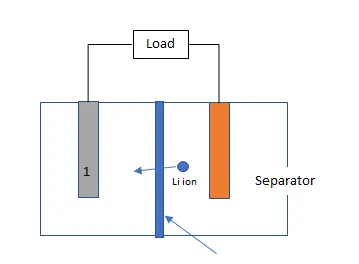
True for charging.
In a rechargeable battery, the anode is typically the negative electrode and the cathode is typically the positive electrode. An anode is an electrode where oxidation occurs and in a rechargeable battery, the anode is the electrode where electrons are removed during discharge and re-inserted during charging. The cathode is the electrode where reduction occurs and in a rechargeable battery, the cathode is the electrode where electrons are inserted during discharge and removed during charging.