Week 5 Challenge
Question 1: Consider a scenario where an aggressive driver is accelerating very rapidly and braking harshly in a city driving. Is battery better a choice to supply power than UC in this scenario?
- True
- False
Why?
Answer: False
As we learned during the course, based on the aggressive driver profile of accelerating very rapidly and braking harshly in city driving. The battery is not a good choice in this driving condition.
As Battery:
- Converts chemical energy to electrical energy without reversible chemical reactions.
- Batteries have charge and discharge cycles/Process is relatively slow.
- Also, Batteries have low power density. so cannot deliver so much power in an instant.
As Ultracapacitors/ Superconductors:
- As UC are bigger capacitors, it stores a large amount of electrical charge than the batteries.
- UC has a fast Charge and Discharge cycle/process relative to batteries.
- Also, UC has high power density and high energy density.
Based on the above parameters/Specifications of Batteries and Ultracapacitors. Ultracapacitors are more suitable in a scenario where an aggressive driver is accelerating very rapidly and braking harshly in city driving.
Question 2: Consider the following components.
1) Lead acid battery 2) Nickel cadmium battery 3) Nickel Metal hydride battery 4) Lithium ion (specify chemistry) battery 5) Ultra Capacitor.
Answer:
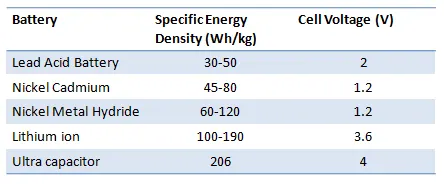
Energy Density: It can be defined as the amount of energy per unit of volume that can be obtained from charged Batteries or supercapacitors. It is measured in Wh/kg or Wh/L.
The following data in the table indicates the Energy density and Cell voltage for the respective set of batteries and Ultracapacitor and the same is represented in the X-Y plot shown below:
(Ref. link:https://www.epectec.com/batteries/cell-comparison.html; https://www.ncbi.nlm.nih.gov/pmc/articles/PMC6409971/)

As per the above plot, It can be referred to as :
- Lead acid batteries have the Lowest energy density, Whereas NiCd & NiMH batteries have relatively higher energy density. Also, NiMH batteries have double the capacity/energy density compared to NiCd batteries.
- Li-Ion batteries have the best Cell voltage and high energy density in the batteries. Ultracapacitors have the highest energy density with the highest cell voltage.
Question 3:
Answer:
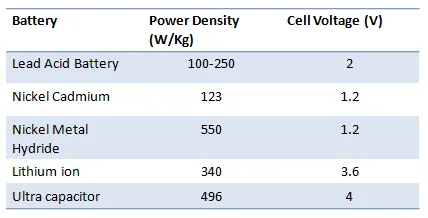
Power density is a measure of power output per unit volume.
- Energy density and power density differ in one important way: while battery energy density measures the watt hours (wh) per kilogram (kg), power density measures the watt output per kilogram. This is where power vs. energy comes into play. Power density measures how fast energy can be delivered, while energy density measures how much energy a battery holds.
The following data in the table indicates the Power density and Cell voltage for the respective set of batteries and Ultracapacitor and the same is represented in the X-Y plot shown below:
(Ref. Link:
https://www.ncbi.nlm.nih.gov/pmc/articles/PMC6409971/
https://patents.google.com/patent/US20130309550A1/en
Performance Comparison of Rechargeable Batteries for Stationary Applications (Ni/MH vs. Ni-Cd and
VRLA), Pg.2 Table S1. )
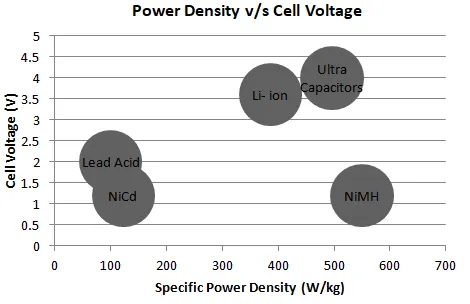
As per the above plot, It can be referred to as :
- Lead acid and NiCd batteries have the Lowest power density, Whereas NiMH batteries have relatively higher power density. Indicating NiMH can deliver power at the fastest rate.
- Li-Ion batteries and Ultracapacitors have a similar high power density range and deliver power at a faster rate compared to lead acid and NiCd batteries.
Question 4: Consider the following scenario:
A battery has just been manufactured in the industry and has been connected to a charger for the first time. The electrode marked as (1) in the picture below is the negative electrode.
- True
- False
Answer: True
With reference to the picture of a battery, it is a Li-ion battery that has just been manufactured in the industry and has been connected to a charger for the first time.
When plugging in the device, Lithium ions are released by the cathode and received by the anode. The opposite happens while the battery is discharging and providing an electric current, the anode releases lithium ions to the cathode, generating a flow of electrons from one side to the other.
During charging, electrons move from the anode to the cathode in the external circuit. Electrons flow to balance the cell voltage. During the electrochemical process, the anode is -ve and the cathode is +ve. At the first time charging, the lithium-ion from the cathode gets attached to the anode and it forms the inseparable layer on the anode.
Thus it indicates that the electrode marked 1 in the picture is Anode or negative electrode