Week 5.1 - Non-Conformal Meshing and Solving a Cold plate model
JORGE LOZANO
Electronic Cooling Simulations using ANSYS ICEPAK
Non-Conformal Meshing and Solving a Cold plate model
Problem Description:
The model setup is shown in figure 5.1: The model includes two heated plates, cooled by water circulating inside the cold-plate cavity, as well as by air driven by natural convection externally. Separately meshed assemblies will be employed to reduce the overall mesh count in the domain.
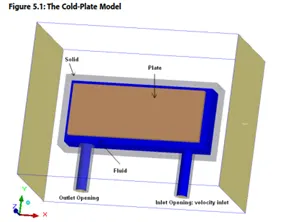
- Cabinet Size: 400 mm X 300 mm X 200 mm
- Cold plate solid block: start (50 mm, 80mm, 70 mm), End (350mm, 220 mm, 130 mm) made of aluminum extruded
- Cold plate fluid block: start (60 mm 90mm, 80 mm), End (340mm, 210 mm, 120mm)
- Incoming pipe: thickness: 5mm, connected @ (100mm, 0 mm, 100mm) and radius 15 mm, the inlet water velocity is 0.2 m/s
- Outgoing pipe: thickness: 5mm, connected @ (300mm, 0 mm, 100mm) and radius 15 mm
- Plate 1: conducting thick 10mm, 200W, located at 60mm having dim (260 mm X 100 mm) in Z plane
- Plate 2: conducting thick 10mm, 200W, located at 130mm having dim (260 mm X 100 mm) in Z plane
- Cabinet opening: Min X and Max X
Process
The process will be introduced from a new project document by opening the Icepak software, and starting to generate each block representing the system, fluid or solid, according to its coordinates and its properties given earlier, as seen in the image having an open system, having side boundary layers as ambient conditions.
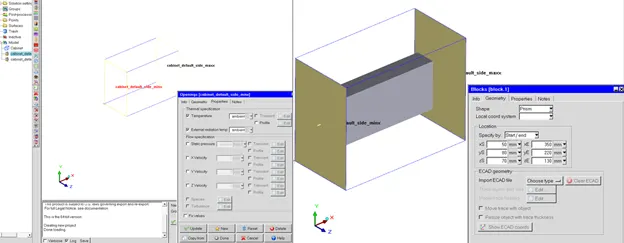
Continuing with this cold plate geometry and preprocessing conditions, the fluid volume, in volume and out volume are generated presented by the gray color, and the bronze color plates as the cold plated solids which according to the conditions it has a 200W power generation.
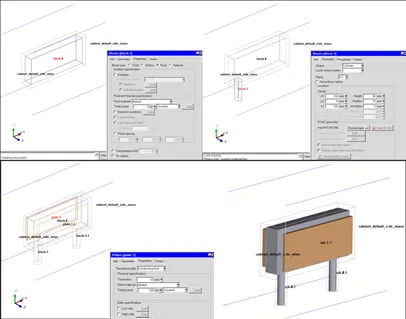
The end conditions after determining the geometry were the inlet and outlet of the inside pipe, having an inlet velocity of 0.2 m/s in the +y direction at 45 C, having an initial condition of 0.005 m/s in the opposite direction of the gravity (+y) direction.
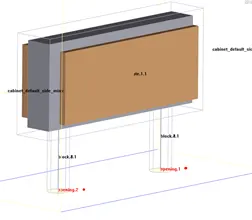
As seen in the videos the mesh conforming conditions will begin by creating an assembly with the inner parts of the system and indicating the max mesh element size as 5 mm and a minimum gap of 0.1 in all directions.
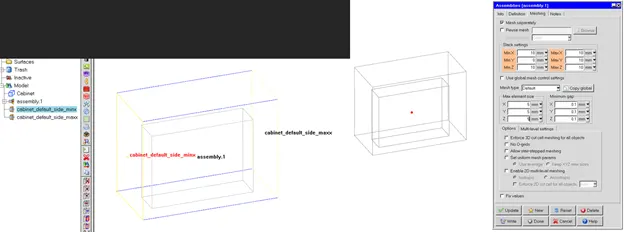
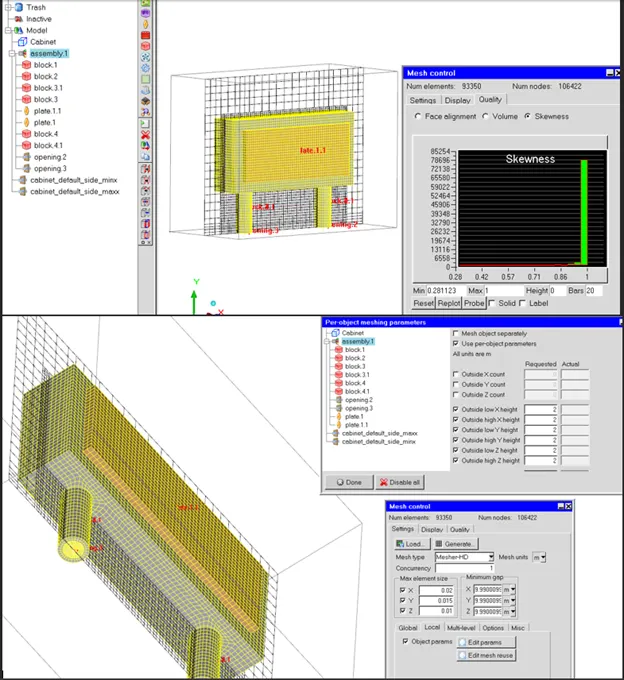
By doing this a separation of the mesh element conditions will be created, having a good skewness of the global mesh, the following image shows the per-object meshing parameters to apply and the mesh control quality obtained, activating, and modifying certain conditions.
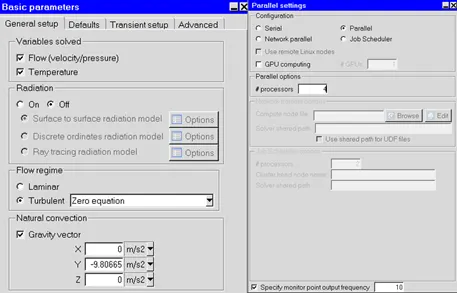
Once all preprocessing conditions and geometry are processed, the processing conditions will be selected, as follows having a parallel of 4 processors, transient simulation using a Zero equation turbulence model, applying gravity in the y- direction with the default discretization conditions.
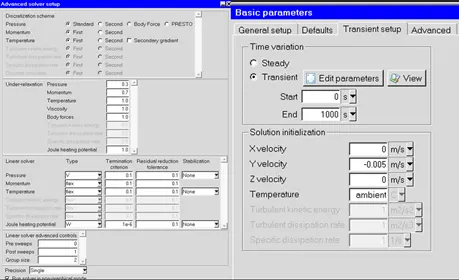
Once the simulation is completed at the specified iteration number:
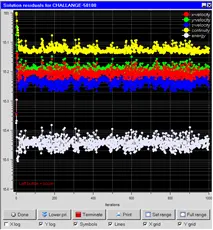
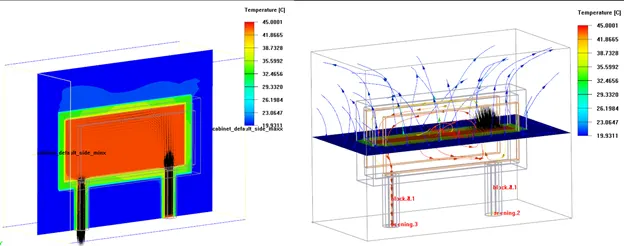
The contour, plane cut and vectors postprocessing are generated, seeing the natural convection effect from having a heated inner volume of water at 45 C and an ambient temperature of 20 C. Being able to see the velocity pattern that the water follows and the gradient in which the outer fluid is being heated.
Seeing the arrows’ direction where in flow inside the volume is moving and the effect of the density variation in the outer fluid.
Conclusion
A cold plate transient CHT using Icepak CFD simulation was performed seeing both an inner forced turbulent water flow and an external natural convection flow, generating a good quality non-conforming mesh using an assembly condition box and obtaining the postprocessing contours and vectors to see the effect of the system conditions.