Week 5.1 - Mid term project - Solving the steady and unsteady 2D heat conduction problem
Successive over-relaxation
%% Transient heat conduction by Jacobi, guass Siedel & sor iterations

clear all
close all
clc
%slving 2D transient heat conduction equation using implicit
nx=10;
ny=10;
%defining the mesh size
x=linspace(0,1,nx);
y=linspace(0,1,ny);
%defining varriables
alpha=1.3;
dt=3e-4;
t=0.5;
dx=x(2)-x(1);
dy=y(2)-y(1);
%pre defining T
t=300*ones(nx,ny);
%applying boundary conditions
t(:,1)=400;
t(:,end)=800;
t(1,:)=600;
t(end,:)=900;
t(1,1)=500;
t(1,end)=700;
t(end,1)=650;
t(end,end)=850;
% copy of T which changes with in the time step
told=t;
t_pre_dt=t;

k1=((alpha*dt)/(dx^2));
k2=((alpha*dt)/(dy^2));
cfl=k1+k2;
error=9e9;
tol=1e-4;
%number of time steps
nt=t/dt;
iterative_solver=1;
%jacobi method
if  iterative_solver==1
    jacobi_iter=1;
    for nts=1:nt;
        error=1;
        while error>tol
            for i=2:nx-1;
                for j=2:ny-1;
                    term1=(1+(2*k1)+(2*k2))^-1;
                    term2=k1*term1;
                    term3=k2*term1;
                    h=(told(i-1,j)+told(i+1,j));
                    v=(told(i,j-1)+told(i,j+1));
                    t(i,j)=(t_pre_dt(i,j)*term1)+(h*term2)+(v*term3);
                end
            end
            error=max(max(abs(told-t)));
            told=t;
            jacobi_iter=jacobi_iter+1;
        end
        t_prev_dt = t;
    end
end
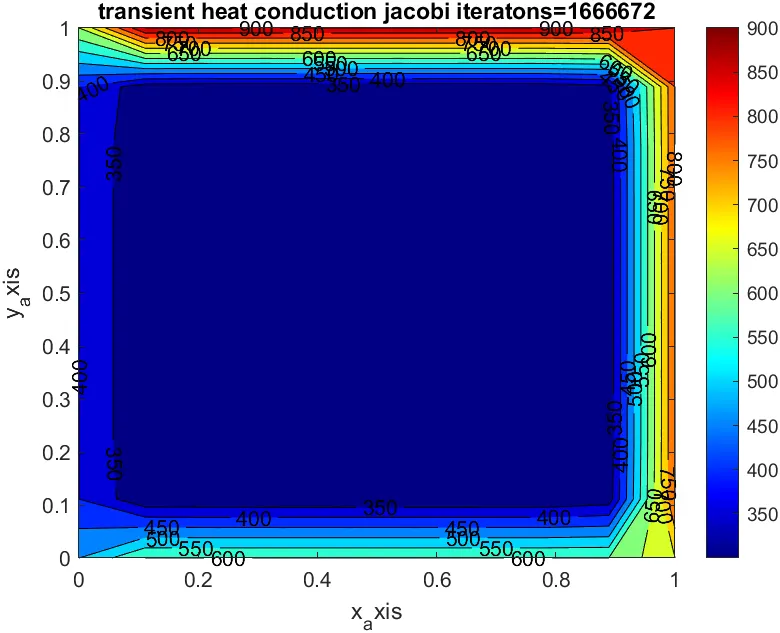
figure(1)
contourf(x,y,t,'showtext','on')
colormap(jet)
colorbar
title_text=sprintf('transient heat conduction jacobi iteratons=%d',jacobi_iter);
title(title_text);
xlabel('x_axis');
ylabel('y_axis');


%gauss siedel method
if iterative_solver==2;
    gs_iter = 1;
    for nts=1:nt;
        error=1;
        while error>tol
            for i=2:nx-1;
                for j=2:ny-1;
                    term1=(1+(2*k1)+(2*k2))^-1;
                    term2=(t(i-1,j)+t(i+1,j))*(term1);
                    term3=(t(i,j-1)+t(i,j+1))*(term1);
                    t(i,j)=(t_pre_dt(i,j)*term1)+(k1*(term2))+(k2*(term3));
                end
            end
            error=max(max(abs(told-t)));
            told=t;
            gs_iter = gs_iter + 1 ;
        end
        t_pre_dt=t;
    end
end
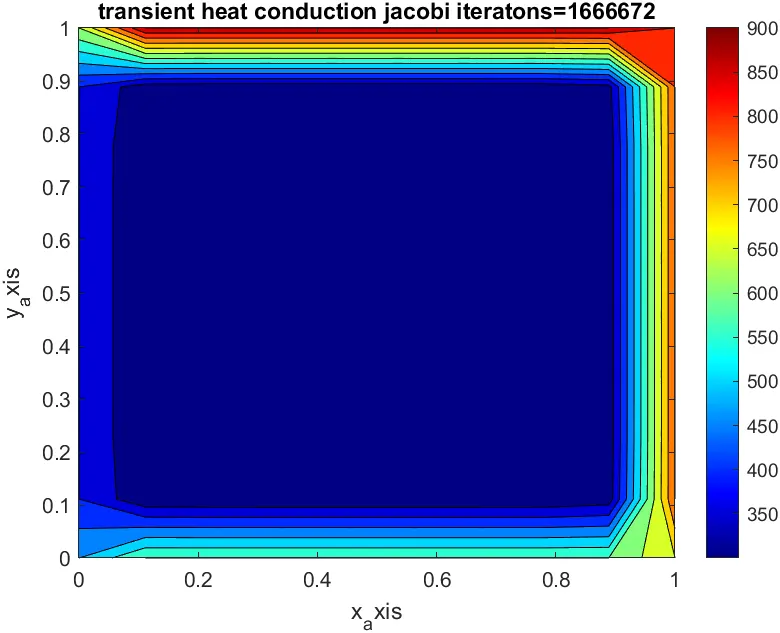
figure(2);
contourf(x,y,t);
colormap(jet)
colorbar;

title(title_text);
xlabel('x_axis');
ylabel('y_axis');

if iterative_solver==3
    sor_iter=1
    for nts=1:nt
        error=1;
        while error>tol
            for  i=2:nx-1;
                for j=2:nx-1;
                    term1=((1+(2*k1)+(2*k2))^-1);
                    term2=(told(i-1,j)+t(i+1,j))*(term1);
                    term3=(told(i,j-1)+t(i,j+1))*(term1);
                    t(i,j)=(1-omega)*told(i,j)+omega*(t_prev_dt(i,j)*term1)+(k1*(term2))+(k2*(term3));
                end
            end
            error=max(max(abs(told-t)));
            told=t;
            sor_iter=sor_iter+1;
        end
        t_pre_dt=t;
    end
end
figure(3)
contourf(x,y,t,'showtext','on');
colormap(jet)
colorbar;

title(title_text);
xlabel('x_axis');
ylabel('y_axis');
iterative solver==1
iterative solver==2
iterative solver==3
Gauss Seidel Method
clear all
close all
clc
%slving 2D steady state  heat conduction equation using implicit
nx=10;
ny=10;
%defining the mesh size
x=linspace(0,1,nx);
y=linspace(0,1,ny);
%defining varriables
alpha=1.3;
dt=3e-4;
t=0.5;
dx=x(2)-x(1);
dy=y(2)-y(1);
%pre defining T
t=300*ones(nx,ny);
%applying boundary conditions
t(:,1)=400;
t(:,end)=800;
t(1,:)=600;
t(end,:)=900;
t(1,1)=500;
t(1,end)=700;
t(end,1)=650;
t(end,end)=850;
% copy of T which changes with in the time step
told=t;
t_pre_dt=t;

k=2*(dx^2+dy^2)/(dx^2*dy^2)
error=9e9;
tol=1e-4;
%number of time steps
nt=t/dt;
iterative_solver=1;
%gauss siedel method
if iterative_solver==1;
    jacobi_iter = 1;
        while error>tol
            for i=2:nx-1;
                for j=2:ny-1;

                    term1=(told(i-1,j)+told(i+1,j))/(dx^2);
                    term2=(told(i,j-1)+told(i,j+1))*(dy^2);
                    t(i,j)=(term1+term2)/k;
                end
            end
            error=max(max(abs(told-t)));
            told=t;
            jacobi_iter = jacobi_iter + 1 ;
        end
end
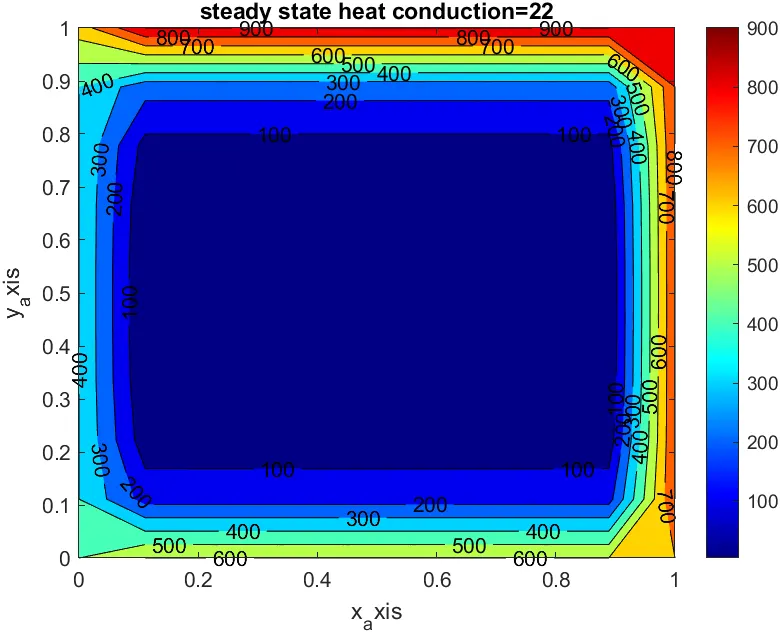
figure(1)
contourf(x,y,t,'showtext','on');
colormap(jet)
colorbar;
title_text=sprintf('steady state heat conduction=%d',jacobi_iter);
title(title_text);
xlabel('x_axis');
ylabel('y_axis');

%gs_method
if iterative_solver==2;
    gs_iter = 1;
        while error>tol
            for i=2:nx-1;
                for j=2:ny-1;

                    term1=(t(i-1,j)+t(i+1,j))/(dx^2);
                    term2=(t(i,j-1)+t(i,j+1))*(dy^2);
                    t(i,j)=(term1+term2)/k;
                end
            end
            error=max(max(abs(told-t)));
            told=t;
            gs_iter = gs_iter + 1 ;
        end
end
figure(2)
contourf(x,y,t,'showtext','on');
colormap(jet)
colorbar;

title(title_text);
xlabel('x_axis');
ylabel('y_axis');
if iterative_solver==3;
    sor_iter=1
    for nts=1:nt
        error=1;
        while error>tol
            for  i=2:nx-1;
                for j=2:nx-1;
                    term1=((1+(2*k1)+(2*k2))^-1);
                    term2=(told(i-1,j)+t(i+1,j))*(term1);
                    term3=(told(i,j-1)+t(i,j+1))*(term1);
                    t(i,j)=(1-omega)*told(i,j)+omega*(t_pre_dt(i,j)*term1)+(k1*(term2))+(k2*(term3));
                end
            end
            error=max(max(abs(told-t)));
            told=t;
            sor_iter=sor_iter+1;
        end
        t_pre_dt=t;
    end
end
figure(3)
contourf(x,y,t,'showtext','on');
colormap(jet)
colorbar;

title(title_text);
xlabel('x_axis');
ylabel('y_axis');
jacobi_iter = 1;
jacobi_iter = 2;
jacobi_iter = 3;
Solving 2D transient heat conduction equation using implicit
clear all
close all
clc
%slving 2D transient heat conduction equation using implicit
nx=10;
ny=10;
%defining the mesh size
x=linspace(0,1,nx);
y=linspace(0,1,ny);
%defining varriables
alpha=1.3;
dt=3e-4;
t=0.5;
dx=x(2)-x(1);
dy=y(2)-y(1);
%pre defining T
t=300*ones(nx,ny);
%applying boundary conditions
t(:,1)=400;
t(:,end)=800;
t(1,:)=600;
t(end,:)=900;
t(1,1)=500;
t(1,end)=700;
t(end,1)=650;
t(end,end)=850;
% copy of T which changes with in the time step
told=t;
t_pre_dt=t;

k1=((alpha*dt)/(dx^2));
k2=((alpha*dt)/(dy^2));
cfl=k1+k2;
error=9e9;
tol=1e-4;
%number of time steps
nt=t/dt;
%jacobi method
iterative_solver=1;
if  iterative_solver==1
    ex_iter=1;
    for nts=1:nt;
        error=1;
        while error>tol
            for i=2:nx-1;
                for j=2:ny-1;
                    term1=(told(i-1,j)-2*t(i,j)+t(i+1,j));
                    term2=(t(i,j-1)-2*t(i,j)+t(i,j+1));
                    t(i,j)=t_pre_dt(i,j)+((k1*term1)+(k2*term2));
                end
            end
            error=max(max(abs(told-t)));
            told=t;
            ex_iter=ex_iter+1;
        end
        t_prev_dt = t;
    end
end
contourf(x,y,t,'showtext','on')
colormap(jet)
colorbar

xlabel('x_axis');
ylabel('y_axis');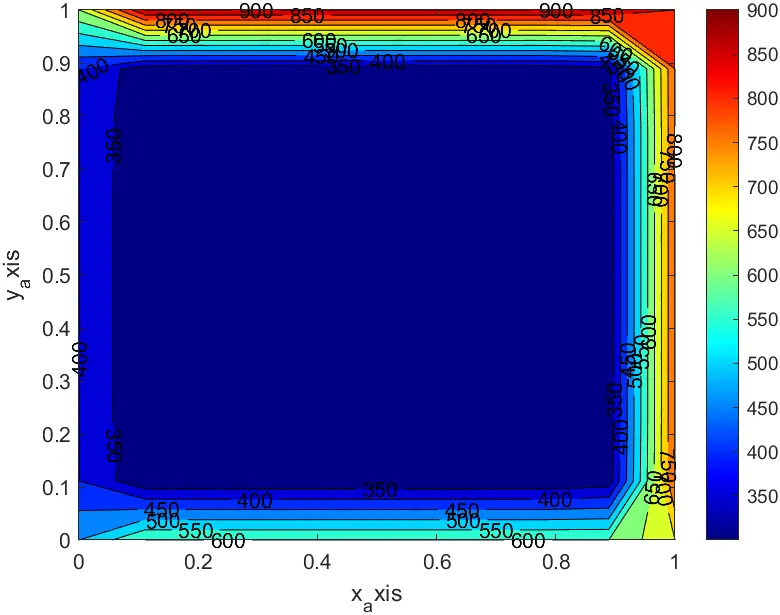
from the above results, the following observations have been made
for both steady and transient analysis Jacobi iterations are always greater than the Gauss-Siedel iterations
but for the successive over-relaxation method the no. of iterations mainly depends upon the value of omega either it is over relaxed or under relaxed in the problem we considered omega=1.2 therefore, the no. of iterations are greater than guass-Siedel iterations.