Week 4 -Wire Bending Challenge
AIM :
Wire bending process to be simulated in the Ansys workbench using three different materials.
OBJECTIVE:
The main objective of the challenge is to compare the result for Equivalent stress and Strain on the wire only using three different materials.
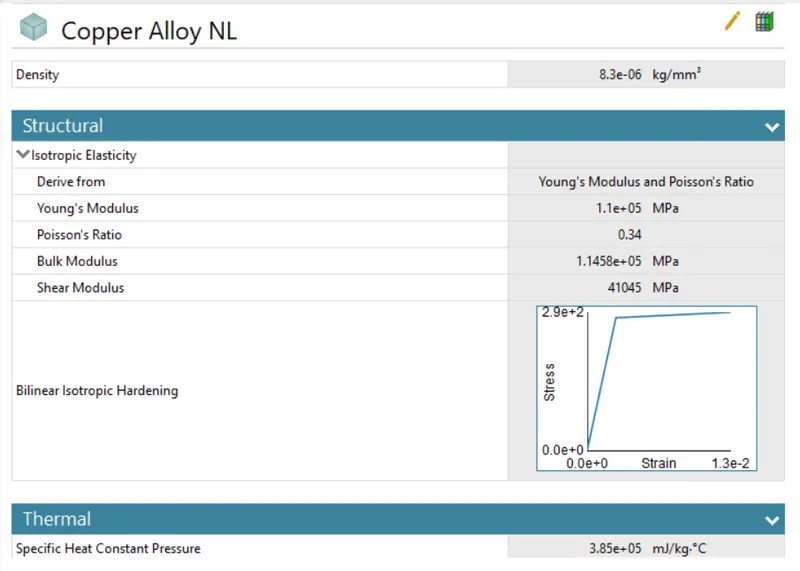
- Copper Alloy (Non-Linear).
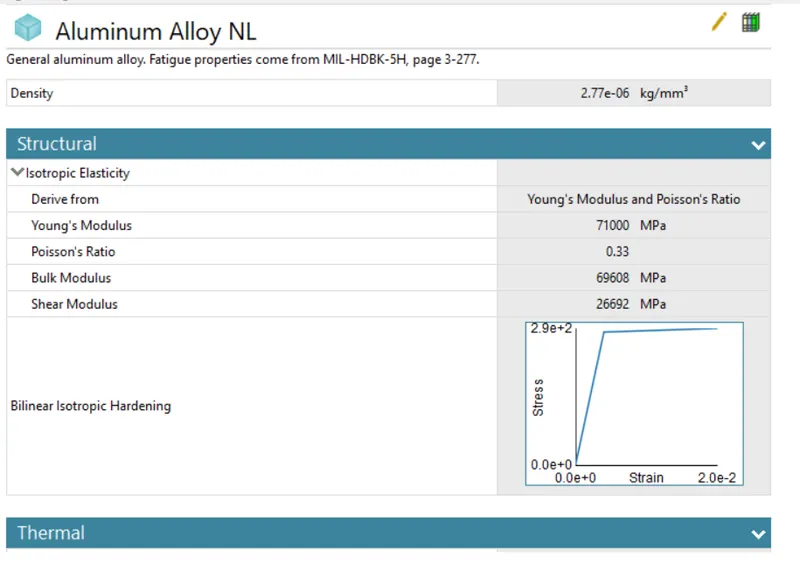
- Aluminium Alloy (Non-Linear).
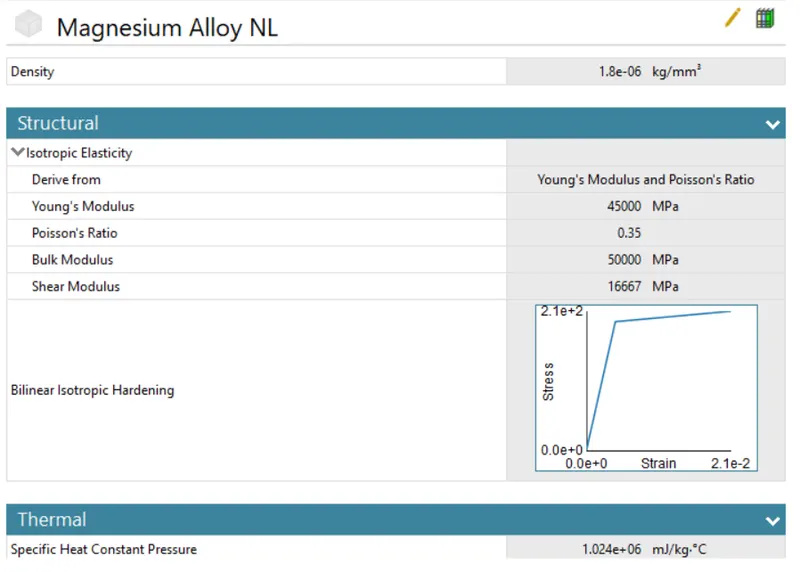
- Magnesium Alloy (Non -Linear).
PROPERTIES
- Copper Alloy (Non-Linear)
- Aluminium Alloy (Non-Linear)
- Magnesium Alloy (Non-Linear)
PROCEDURE
SIMULATION SETUP
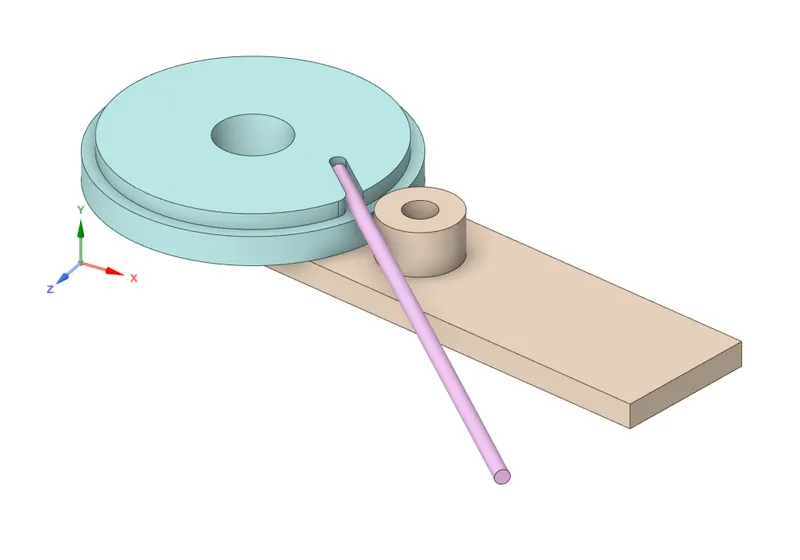
- For setting up the simulation process for wire bending, first adding all three materials to the engineering data, then importing the model to the geometry for checking any irregularities or the surface damage of the geometry
- And then updating the model in the mechanical module as reaming each part for further setup.
Contact
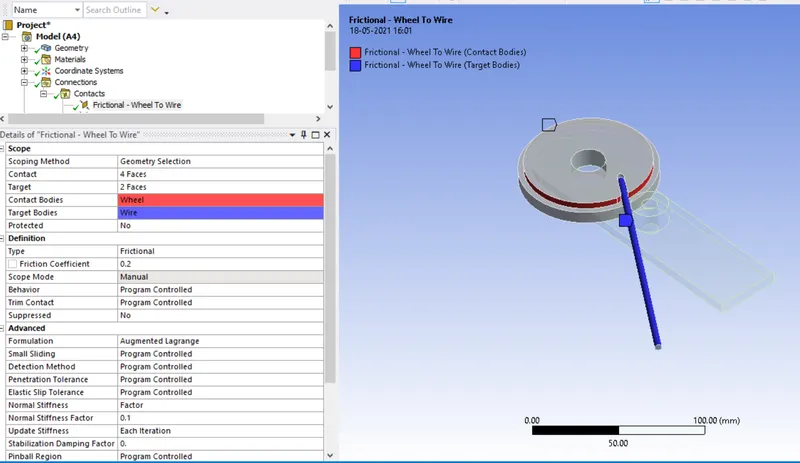
- As the model has contacts but they are Flip over the target and renamed based on the definition, As the first contact is between the wire as contact bodies and the wheel as a target bodies, which is the frictional type with a friction coefficient of 0.2, the formulation method is Augmented LaGrange, Normal stiffness as a factor 0.1, update stiffness at Each iteration, and interface treatment as Add offset
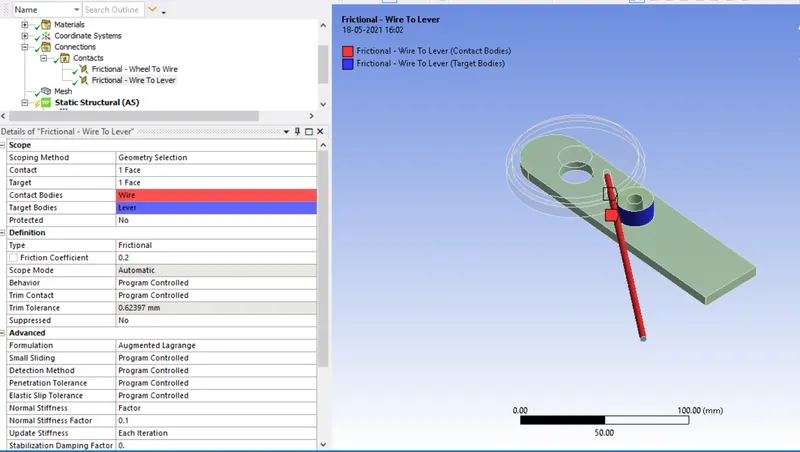
- The second contact is between wheel as contact bodies and wire as target bodies with the same settings for both.
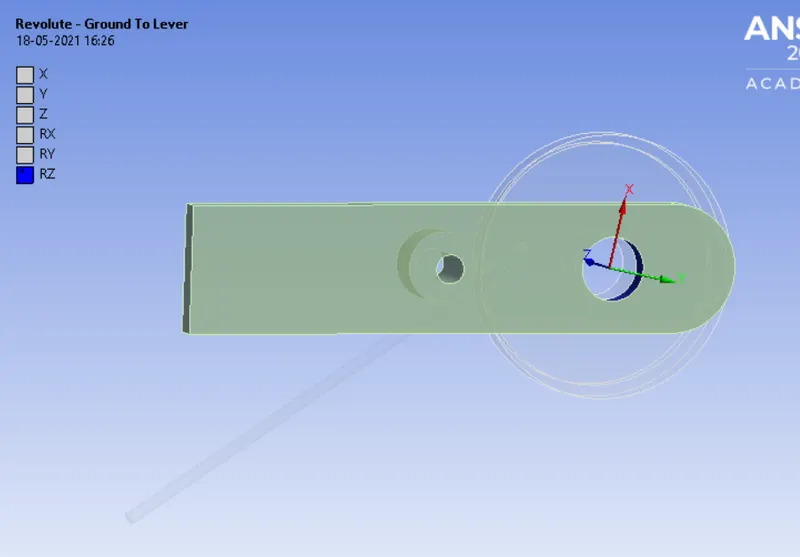
- A revolute Joint is provided to the base of the wheel so it can revolve while bending the wire but the coordinated system should be given properly so it can revolve in the right direction.
Mesh
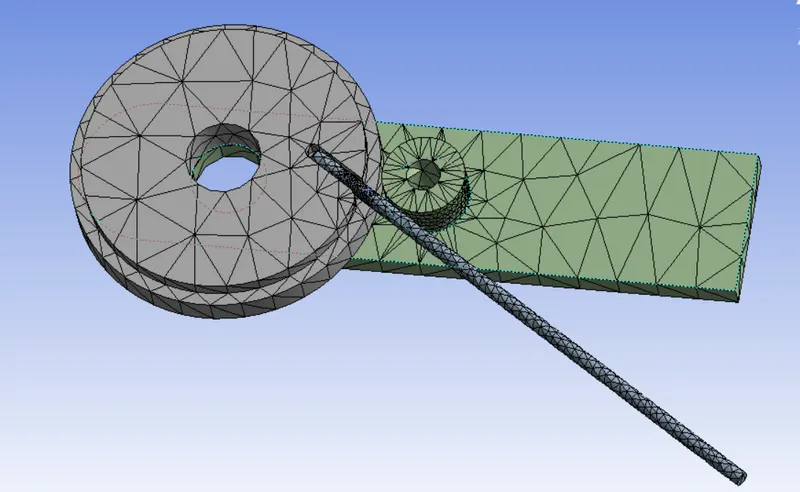
- This component is a solid part, tetra mesh can be generated, and to have the accurate result the mesh is refined at the wire and bending source by giving the face sizing.
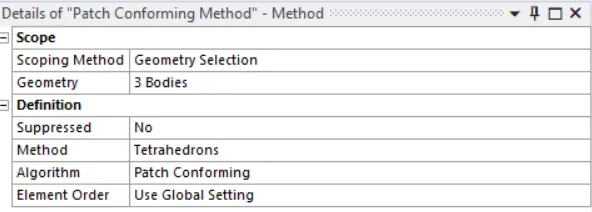
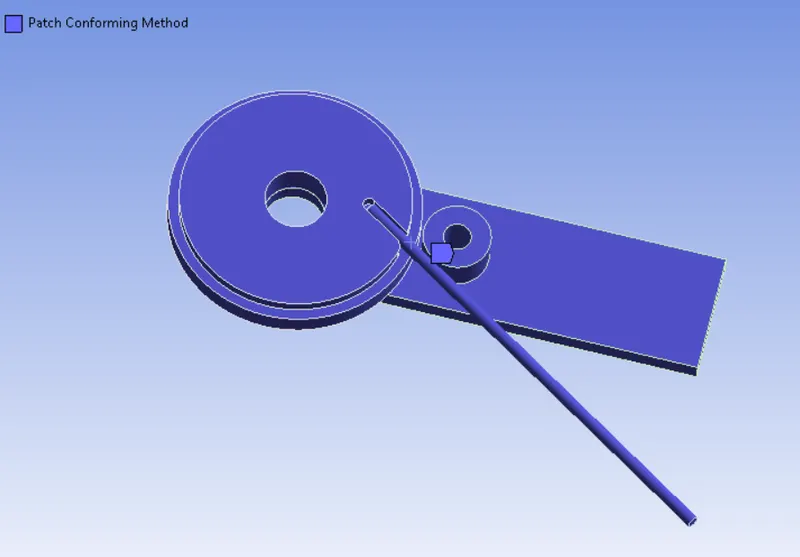
- First, the Patch conforming method is inserted by selecting all three bodies and methods as Tetrahedrons.
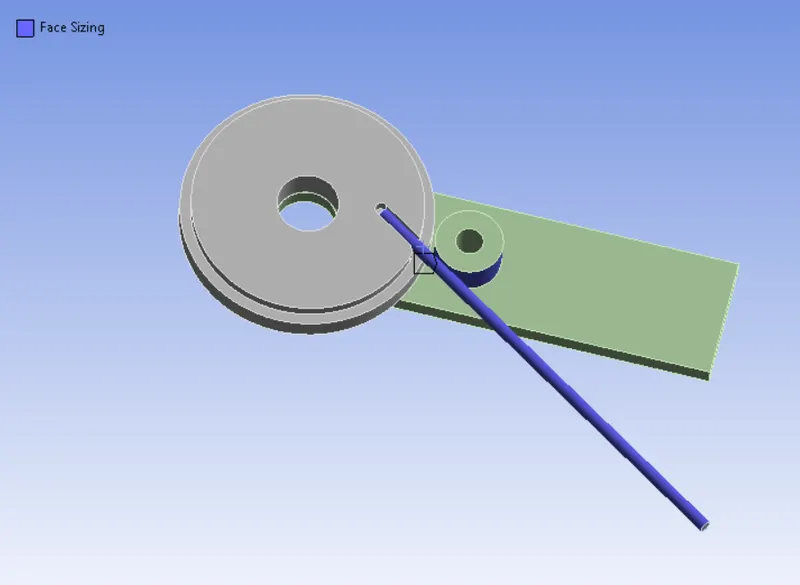
- The face sizing 1 with selecting 4 faces and element size 2.2mm
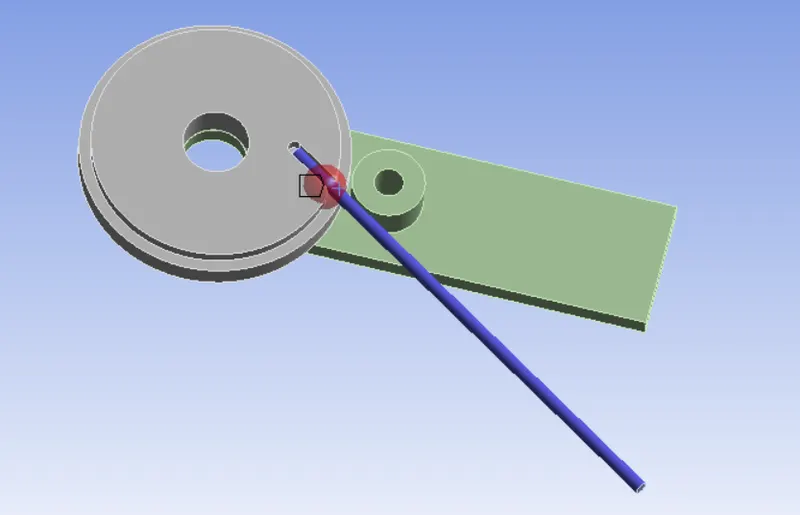
- The face sizing 2 with selecting 4 faces, sphere radius 7mm, and element size 0.8mm
After Meshing
Analysis settings
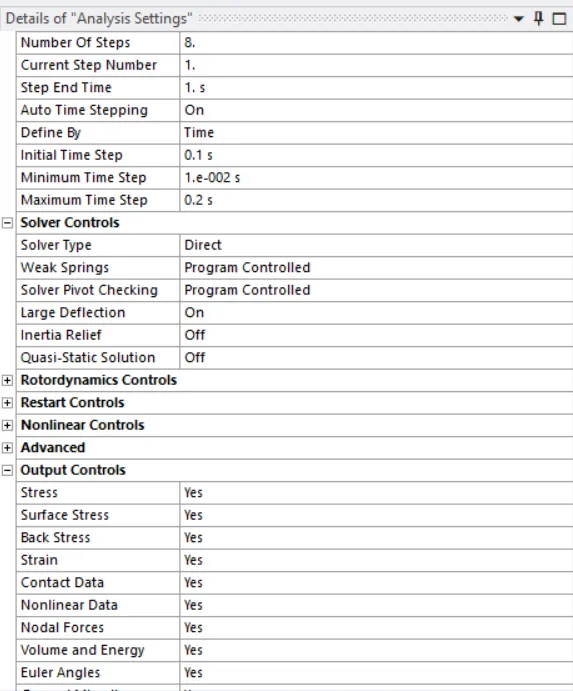
- A total of 8 steps are provided to run the simulation but step 1 has different parameters with an initial time step 0.1 s, minimum time step 1e-002 s, and final time step 0.2 s. From step 2 to 8 as carryover, the time step is ON with minimum time step is 1 e-002 s and maximum time step 1 s.
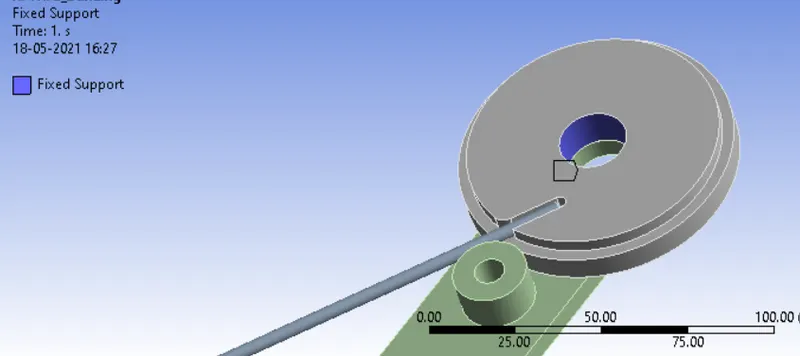
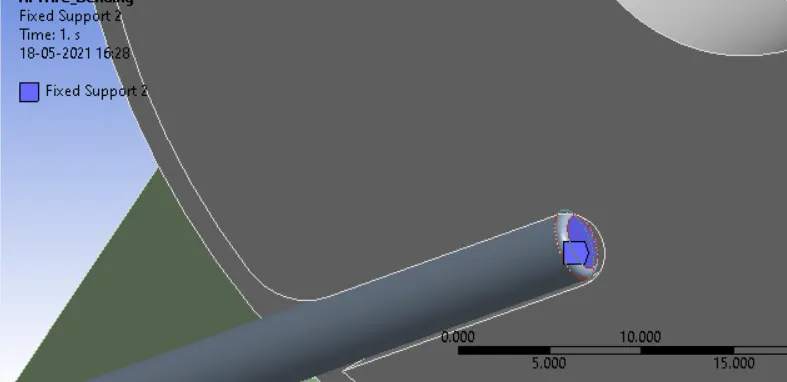
- The fixed support is given to the wheel which is connected to a wire and another fixed support to the top of the wire so while bending it should not get outside of the process to fail the simulation.
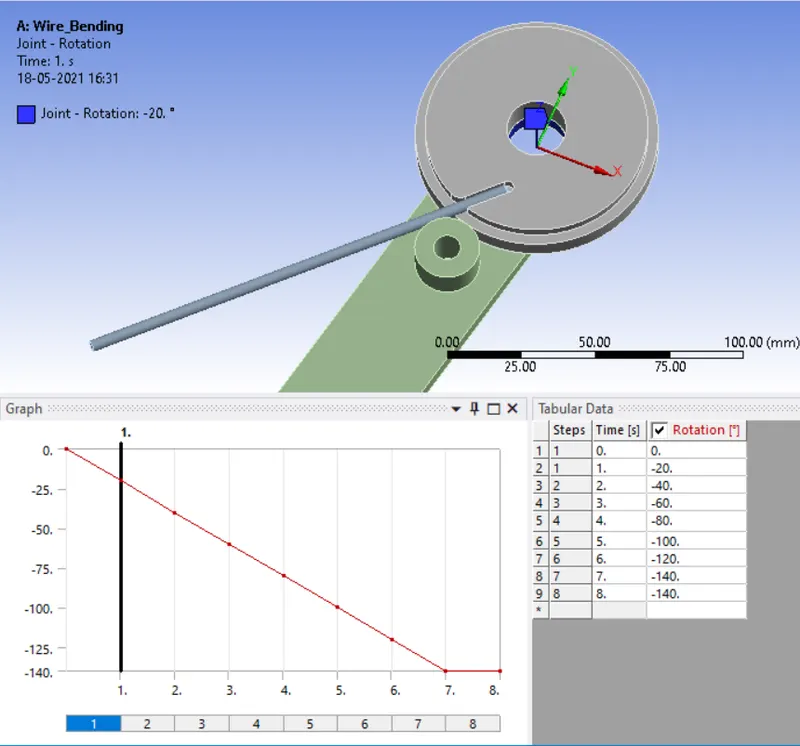
- Also, the joint rotation is also with an angle of 20 degrees at each rotation
RESULTS
Equivalent stress on the wire
Copper Alloy (Non-Linear). Aluminium Alloy (Non-Linear) Magnesium Alloy (Non -Linear)
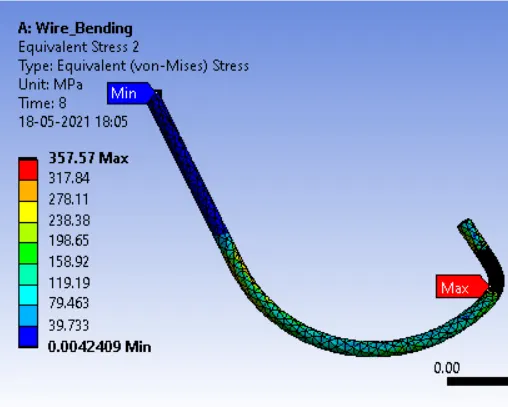
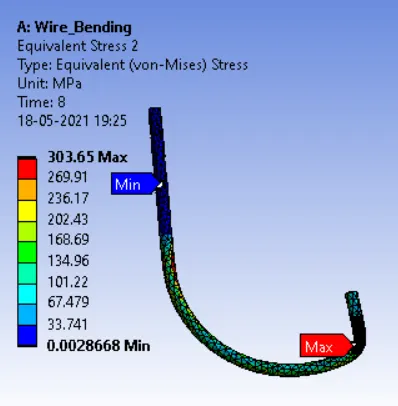
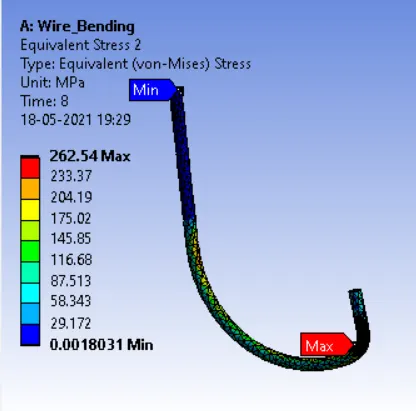
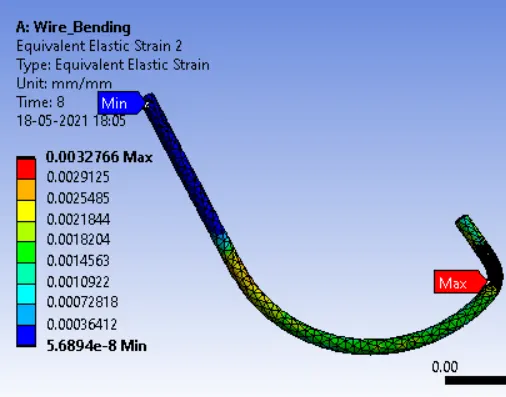
The equivalent strain on the wire
Copper Alloy (Non-Linear). Aluminium Alloy (Non-Linear) Magnesium Alloy (Non -Linear)
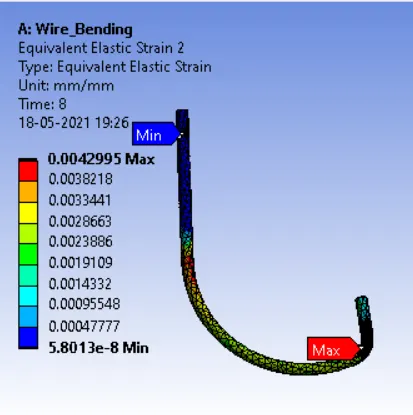
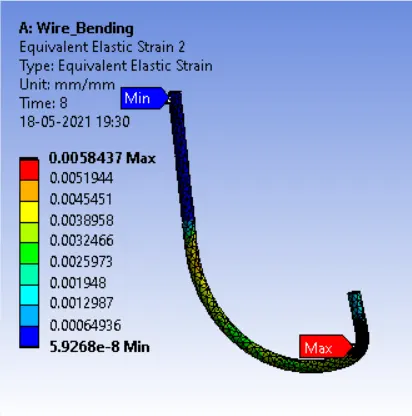
Result Comparison
Equivalent von misses stress of all three materials
| Sr.No | Copper Alloy | Aluminium Alloy | Magnesium Alloy |
| Equivalent stress min (MPa) | 0.0042409 | 0.0028667 | 0.001803 |
| Equivalent stress max (MPa) | 357.57 | 303.64 | 262.53 |
- As per the table listed below the result is obtained after the evaluating wire bending simulation for equivalent stress is that copper alloy material has higher stress to the wire at the time of bending with a maximum value of 357.57 MPa and the magnesium alloy has the least stress on the bending process with a maximum value of 262.53 MPa and the Aluminium alloy with 303.64 MPa average value.
Equivalent Elastic strain of all three materials
| Sr.No | Copper Alloy | Aluminium Alloy | Magnesium Alloy |
| Equivalent strain min (mm) | 5.6894E-08 | 5.80134E-08 | 5.9267E-08 |
| Equivalent strain max (mm) | 0.003276 | 0.00429 | 0.005843 |
- As per the table listed below the result is obtained after the evaluating wire bending simulation for an equivalent elastic strain is that copper alloy material has higher strain to the wire at the time of bending a maximum value of 0.003276 mm and the magnesium alloy has the least strain on the bending process a maximum value of 0.005843 mm and the Aluminium alloy with 0.00429 mm average value.
CONCLUSION
- Simulation of wire bending process conducted with Copper Alloy NL, Aluminium Alloy NL and Magnesium Alloy NL. From the analysis, it is found that each materials producing different results due to its unique properties.
- Wherever precision and strength of the job is required, Copper is suggested as it deforms less as compared to Aluminium and Magnesium
- If weight is the constrain, then Magnesium can be selected as it is light in density as compared to copper and magnesium.
- As Aluminium Alloy produces good strength in lightweight conditions, it’s the best-suited material for bending application.