Week 4 Session 5
AIM:
Explain the various applications of Power converters in an Electric vehicle. For Example what type of converter will you use for Horn which requires DC and less than 10V. Likewise come up with different applications.
Solution:
Power converters:
- A power converter is an electrical circuit that converts the electrical energy from one form into another, usually utilizing a high-frequency switching action. This conversion can be from direct current to alternating current or alternating current to direct current to increase or decrease the voltage or change the polarity.
- Also, the converter acts as a link between the power source and the power supply output. It works to process and control the flow of electric energy by supplying currents and voltage in the form needed for the end-user loads.
- Converters are available in the form of a simple transformer or maybe more complex, depending on the application.
- There are three power converters types located in the powertrain electrification systems that are used in the vehicle propulsion system: AC-DC converters (rectifiers), DC-DC converters, and DC-AC converters (inverters). Auxiliary units, such as pressure pumps, air-conditioning units, and auxiliary batteries, require a DC-AC inverter or a DC-DC converter at a lower power rating.
- A DC-AC power inverter converts a DC input voltage to the required magnitude and frequency of AC output voltage. Generally, AC power is more efficient, reliable and widely utilized in many commercial, domestic, and industrial applications, such as the renewable energy system (RES), motor drives system (MDS), and uninterruptible power supplies (UPSs).
The type of conversion categorizes power converters. They generally fall into four categories:
- AC to DC converters: AC to DC convertersconvert alternating current to direct current using a rectifier.
- DC to AC converters: DC to AC converters take direct current and convert it to an alternating current of the desired voltage and frequency. These are called inverters.
- DC to DC converters: These converters convert either a constant current to a variable or a constant direct current. These devices are also called choppers.
- AC to AC converters: AC to AC converters are often called cycloconverter or matrix converters. These devices convert an alternating current of a specific frequency or voltage from a line alternating current source to a different alternating voltage or frequency.
Out of these four power converters, first three converters are widely used in an electric vehicle applications.
AC to DC converter:
- One of the essential elements in electrical conversion is going from alternating currents to direct currents. The applications, known as AC - DC converters, convert the alternating current to a direct, one-directional current. These converters are also known as rectifiers.
- Inverters are used in EV/HEV mainly for the on-board charging purpose. Since the charging stations use AC power to charge the vehicle and the battery stores DC power, rectifiers are used to convert AC-DC.
- Transformers adjust the AC source, reducing the voltage for a better operational range for the DC supply. This conversion from alternating current to direct current has become significant during recent years because of the amount of technology in homes that require DC to charge them.
- This converting alternating current to direct current is rectification, and the converter is called a rectifier.
- Also, a series of diodes convert the AC supply into DC. This transforms the sinusoidal AC wave into a series of positive peaks. A transformer adjusts the current from the source to a more manageable voltage for use at the direct current supply.
There are three significant benefits to an AC to DC converter:
- Compact: Devices that require AC-DC converters utilize the smallest possible sizes to convert the current efficiently, offering smaller devices. In an industrial setting, AC-DC converters are lightweight and easy to install.
- Energy Efficient: AC-DC converters eliminate the need for additional inverters and converters because they perform efficiently and reduce equipment failure.
- Less Expensive: Converting the current to a lower voltage saves users money on energy usage.
Applications:
- In EV's, mostly this type of power converters are used at charging stations, where incoming mains AC supply voltage needs to be step up or step down at same AC level as per the standard charging requirement of the E-Vehicles.
- Also, an AC to DC converters are used in most household appliances, such as refrigerators, computers, televisions, and chargers for handheld electronics such as cell phones or tablets. Also, they play an essential role in medical equipment, the aerospace industry, and transportation systems. Household and industrial use rely heavily on AC-DC converters.
DC to AC converter:
- Perhaps a less frequent conversion is Direct Current to Alternating Current. An inverter converts a direct, one-directional current into an alternating, reversing current. DC to AC converters can be designed in multiple ways. One common method is to employ an oscillator and a step-up transformer.
- An oscillator is an electronic circuit employing transistors and other semiconductor devices used to generate an alternating signal from a small DC voltage source. The AC signal can then be stepped up using a step-up transformer to the desired voltage magnitude.
- The inverter can change the speed at which the motor rotates by adjusting the frequency of the alternating current.
- When the vehicle has to be accelerated, the accelerator pedal sends a signal to the controller which adjusts the vehicle's speed by changing the frequency of the AC power from the inverter to the motor.
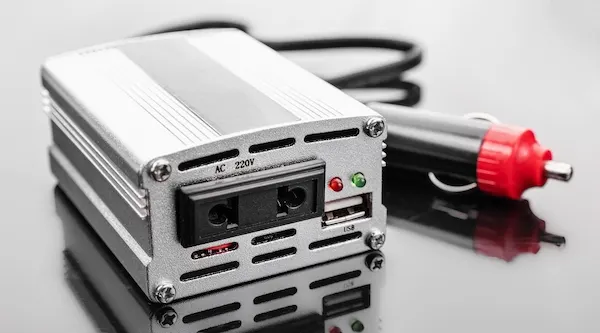
Fig. DC to AC power converter
There are a couple of limitations in converting direct current to alternating current.
- Transistor usage reduces circuit efficiency.
- Switching transistors can result in cross-over distortion but can be reduced by blasing diodes.
Applications:
- The primary use of direct current to alternating current charges electric vehicle batteries. But this current can also drive low-powered AC motors and solar-powered systems.
- In EV, an DC to AC converter also used to supply power to the auxillaries in the vehicles which requires an AC input supply. So this converter converts the battery DC voltage into AC forms and the respective devices are operates.
DC to DC converter:
- The DC- DC converter is the most widely used power converter in an electric vehicle applications.
- A DC-to-DC converter is a category of power converters, which converts a DC source from one voltage level to another. It can be unidirectional, which transfers power only in one direction or bidirectional, which can transfer power in either direction. This type of converter is also known as chopper.
- The batteries of an Electric Vehicle typically output several hundred volts of Direct Current (DC). However, the electric components inside the vehicle vary in their voltage requirements, with most running on a much lower DC voltage. This includes the radio, dashboard readouts, air conditioning, and in-built computers and displays.
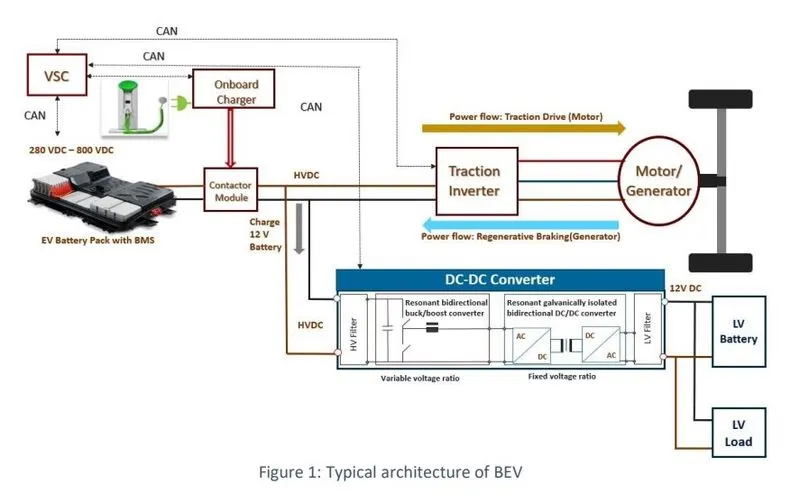
- Most of the components are bidirectional, allowing power to go from the battery to the inverter, which rotates the motor and moves it (traction drive).
- When decelerating, the vehicle's momentum turns the motor, which is now acting as a generator, drives power back through the inverter and charges the battery.
- DC-DC converter converts higher voltage DC power from the traction battery pack to the lower-voltage DC power needed to run vehicle accessories and recharge the auxiliary battery.
- Moreover, a DC-DC converter is a critical component in the architecture of a BEV, where it is used to convert power from the high voltage (HV) bus to the 12V Low Voltage (LV) bus to charge the LV battery and power the onboard electric devices.
Applications:
- Major role of this converter used in EV to supply the power to the traction motors which generates propulsion power and transfer these power to the wheels.
- Also, DC-DC converters are used to supply power to the low power auxillary devices like lamps, radios, and other illuminaries in an vehicle.
- DC-DC conveters are also used at charging stations to charge the EV batteries through generated DC supply at charging station.