Steady state simulation of flow over a throttle body
Objective:
To simulate the flow air through a throttle body using CONVERGE Studio.
A throttle body is a device used as a valve to restrict or permit the flow of a desired amount of fluid through it. It is located between the air intake filter and the intake manifold in an engine. It regulates the amount of air that goes into the engine. Throttle bodies are mostly electronically controlled although mechanical throttle bodies are still being used.
Here we were interested in simulating the flow through a pipe elbow with a throttle at the elbow in open condition. The throttle shall be stationary throughout the flow. As there were no moving parts in the simulation, the case was run using steady state solver.
Geometry:
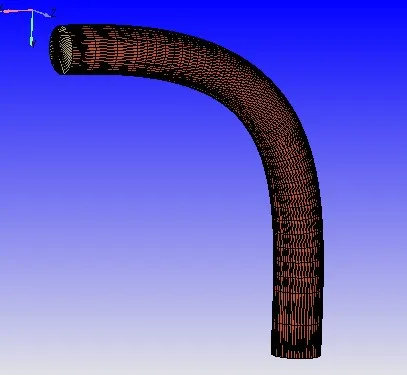
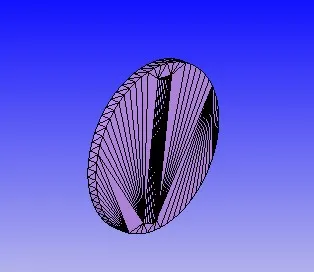
The throttle valve disc is in open condition inside the geometry. ie, The valve disc is parallel to the flow direction.
Setup:
- Application: Time based
- Materials: Air
- Solver: Compressible, fully hydrodynamic, steady state solver.
- Solver parameters: PISO scheme with steady state solver type.
- Total run cycles: 15000
- Initial/minimum time step: 1e-9
- maximum time step: 1
- Boundary conditions:
1) Inlet: Pressure inflow(1.5 bar)
2) Outlet: Pressure outflow(1 bar)
3) Pipe Wall: Wall boundary
4) Throttle disc: Wall boundary
- Initial conditions:
species: Air
Pressure: 1.01325 bar
Temperature: 300K
Velocity: 0 m/s
- Turbulence model: RNG K-Epsilon
- Grid control/ meshing:
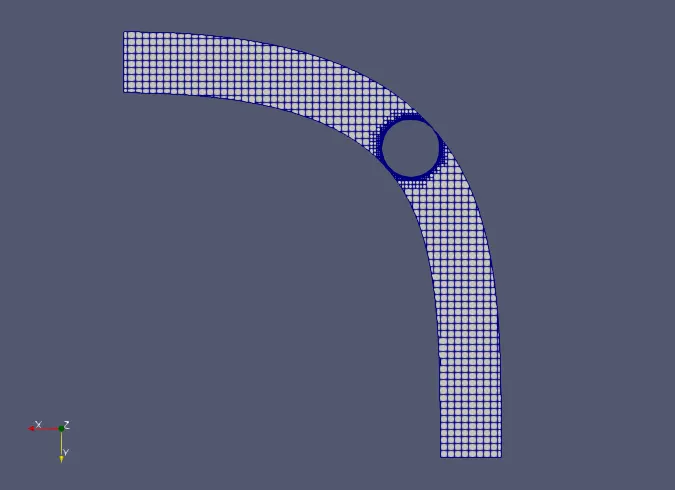
The meshing was done with a base grid size of 2mm. Also, fixed embedding was enabled at throttle disc boundary to refine the mesh near throttle valve.
Results:
The simulation ran successfully for 15000 cycles. The results were post processed usng PARAVIEW and CONVERGE line plotting interface.
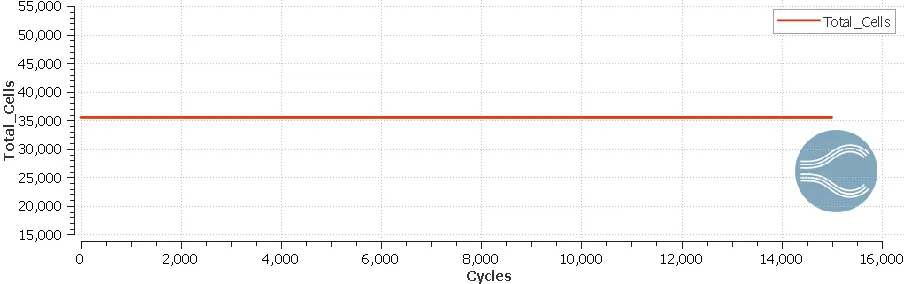
Total cell count:
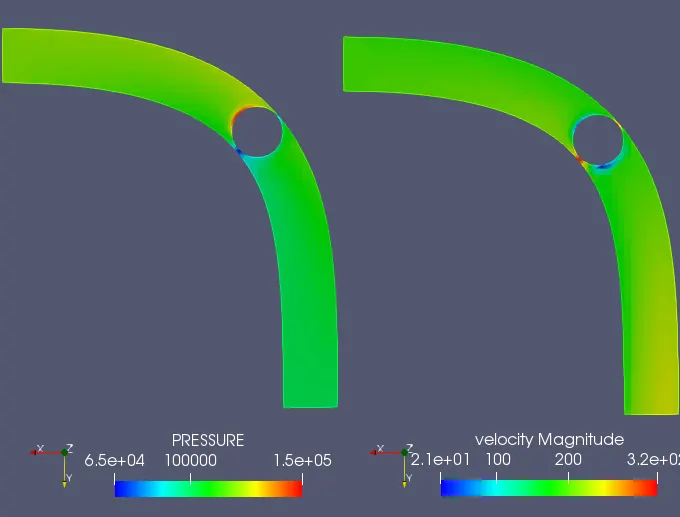
Pressure and Velocity contours:
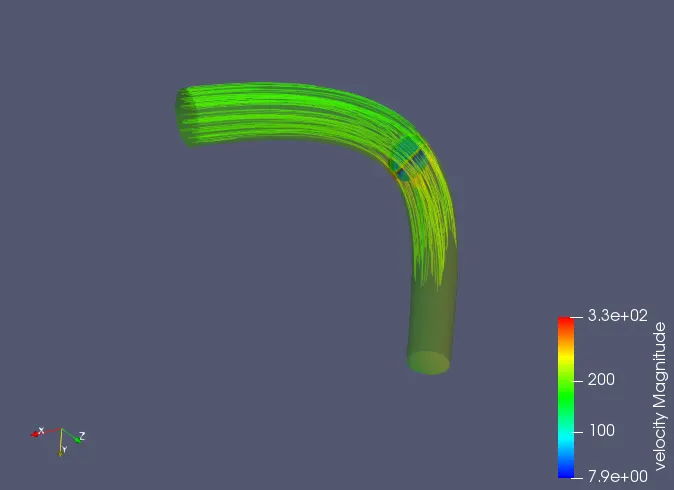
Flow streamline plot with throttle valve visible:
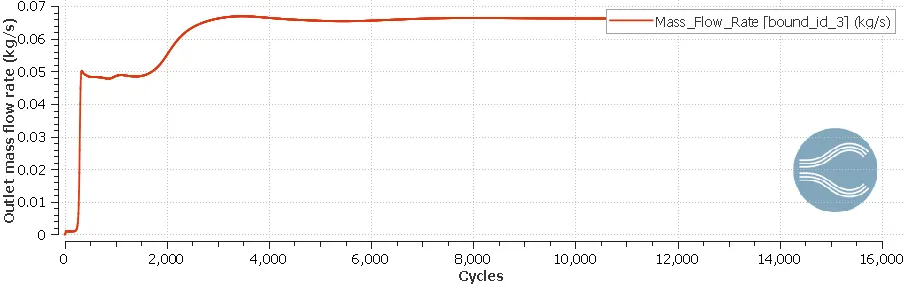
Outlet mass flow rate plot:
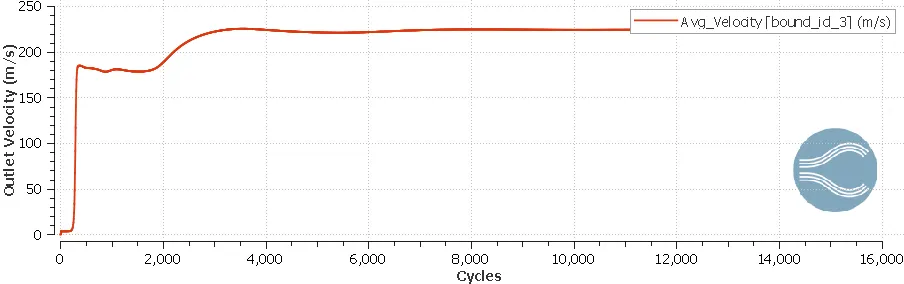
Outlet Velocity Plot:
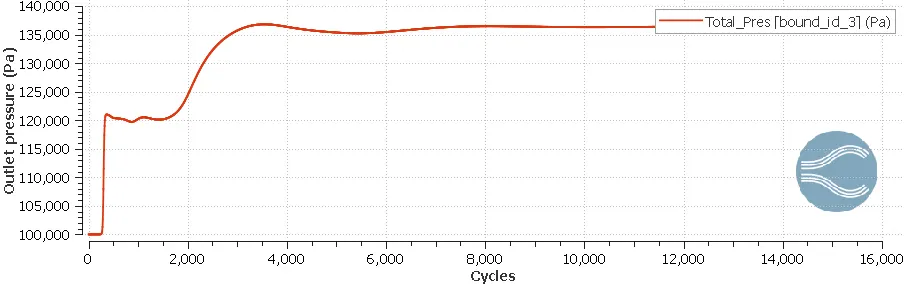
Outlet Pressure plot:
Flow Animation:
Observations:
- A total cell count of 35000 was observed.
- Convergence confirmed from line plots of mass flow rate, velocity and pressure at outlet.
- Minimal resistance to flow was observed inside the domain as throttle valve was open.
- Velocity and pressure was fairly uniform across the flow domain for the same reason.
Conclusion:
Ran steady state simulation of flow through an elbow with a stationary throttle valve inside in open condition. Observed line plots of output mass flow rate, velocity, pressure and contour plots of velocity and pressure.