Perform the Energy Absorption Test
Objective: To check the energy absorption of the rectangular crash box.
Why the crash box test is conducted?
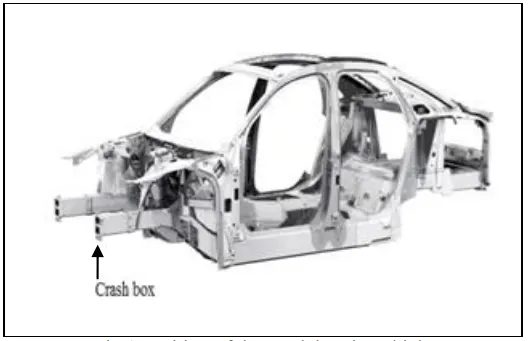
Automotive accidents are one of the major causes of fatality. Therefore it is necessary to the study effect of the impact on energy-absorbing components of automobiles. For energy absorption parts mounted on the front end of the vehicle are a major source of energy absorption in an automotive accident, which helps to protect the occupant and the occupant cabin. These energy absorbers are called crash boxes which can control the initial kinetic energy and decelerating pulse of the vehicle during impact. Crash box works on the principle of impact energy absorption by undergoing cyclic plastic deformation before the energy is fully transmitted to the occupant cabin. Crash boxes have been widely employed in crash-worthiness applications for automobiles to safeguard occupants from fatality, and are also largely used as kinetic energy absorbers for their robustness, high energy absorption performance, and weight efficiency.
Procedure of Setup for input Deck:
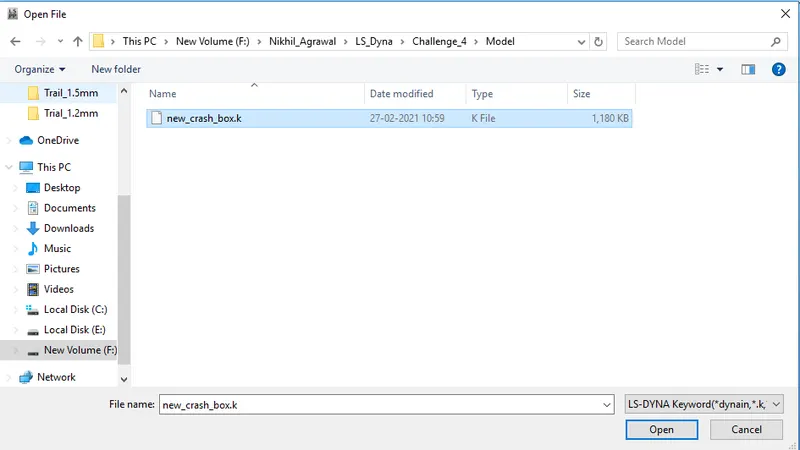
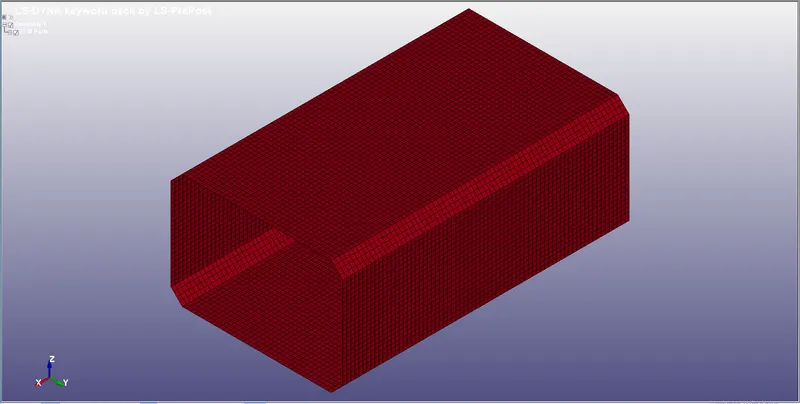
Step I - Importing the .k extension file in the LS PrePost GUI.
Step II - Nodes and Element Set Assignation
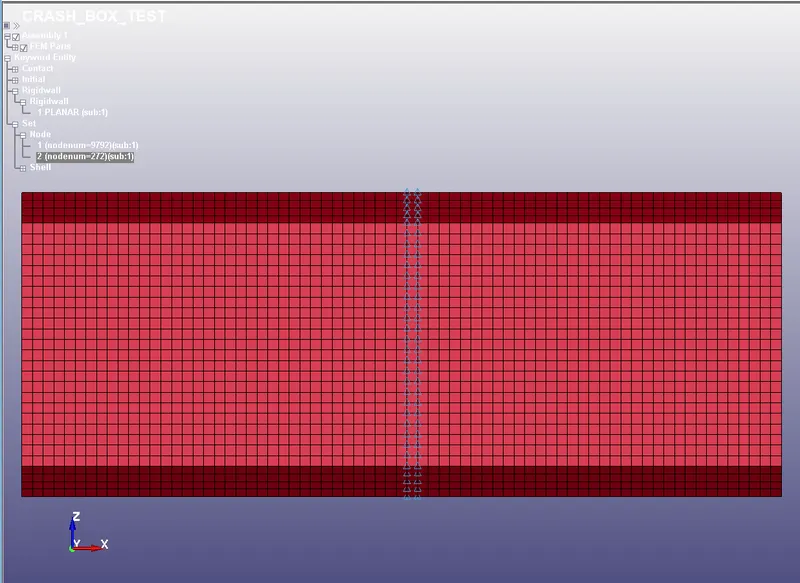
fig - Node Set Creation
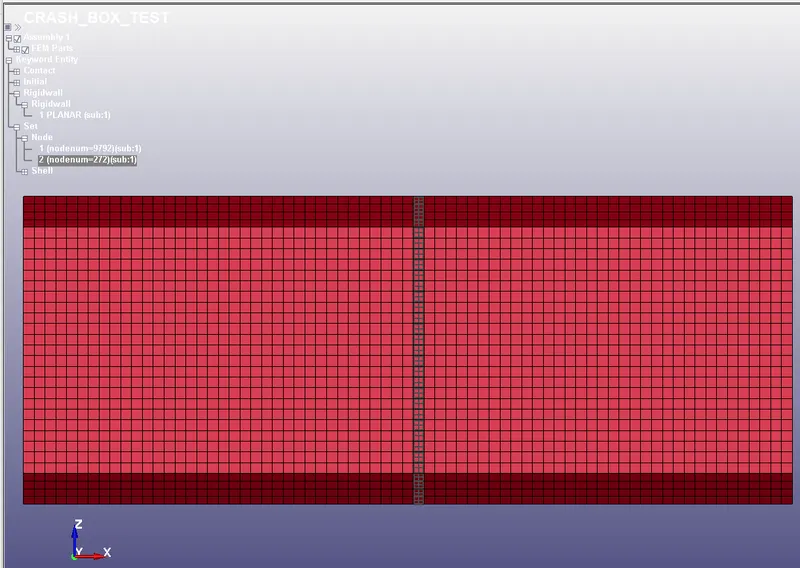
fig - Element Set Creation
Node Set and Element Set are assigned to the crash box part to find out the output results like section forces on the particular section of the crash box.
Step IV - Section Creation
From the tree diagram, the user identifies that the two parts are solid. Concerning this section keyword file is created under the keyword manager.
Path -
Keyword Manager - All - Section - Shell
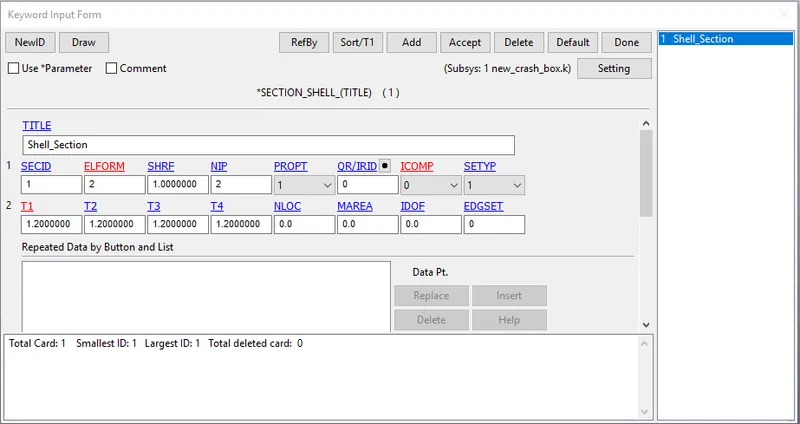
Here only one section is created as the part consists of the shell elements. Title name, Section Id & Element Formulation are important parameters provided by the user to define the section input.
Element formulation (ELFORM): 2 is selected as it depicts the default formulation and the input is accepted by clicking the accept button.
Step V - Material Input Creation
Based on the study through various papers it is found that the mobile cell casing is made up of Aluminum Alloy 7075 and the rigid wall on which the cell phone is dropped is considered to be concrete.
The properties of Aluminium and Concrete are researched on the internet with the following results:
Steel 1018 Properties
Density - 0.0078 g/mm^3
Young's Modulus - 205 Gpa = 2.05e+05 g/mm. ms^2
Poison's Ratio - 0.29
Concrete Properties
Density - 0.0023 g/mm^3
Young's Modulus - 200 Gpa = 2.00e+5 g/mm. ms^2
Poison's Ratio - 0.21
The next stage is to define the material using the keyword manager.
Path -
Keyword Manager - All - MAT - MAT24:Piecewise Linear Plasticity (Steel)
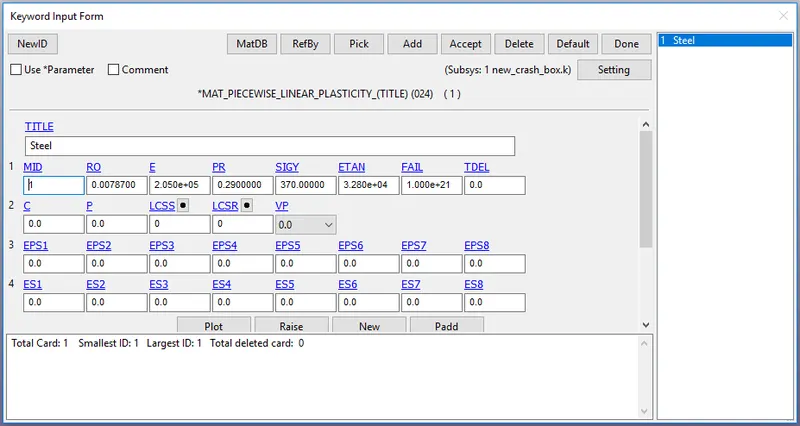
Title, Material Id, Density, Young Modulus, Poisson's Ratio, Yield Stress, and Tangent Modulus is defined.
Tangent Modulus is defined as 16% of the young's modulus of elasticity.
Keyword Manager - All - MAT - MAT20: Rigid (Concrete)
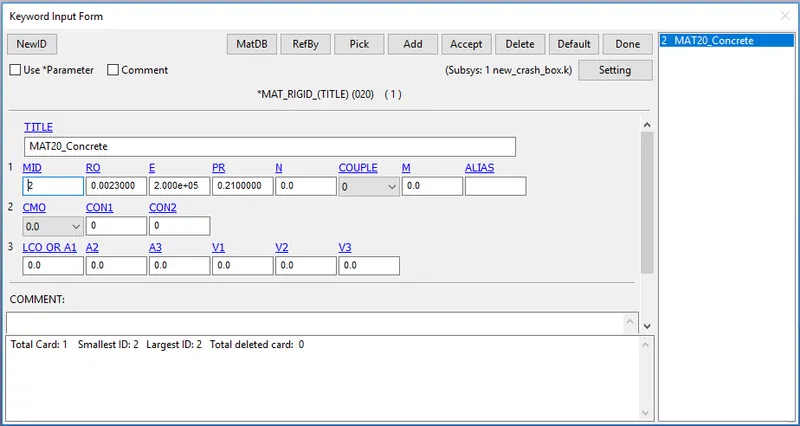
Title, Material Id, Density, Young Modulus, Poisson's Ratio, Yield Stress, and Tangent Modulus is defined.
Tangent Modulus is defined as 16% of the young's modulus of elasticity.
Apart from this Center of Mass, Moment in translation and rotation is constrained using CMO, CNO1 & CON2 parameter.
Step VI - Part Definition
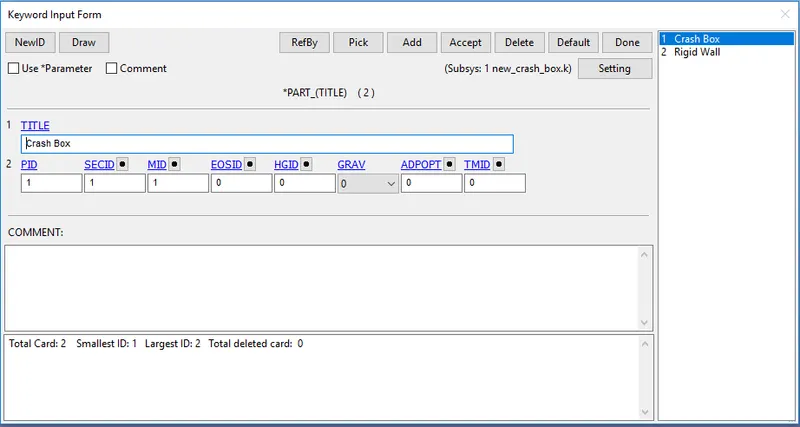
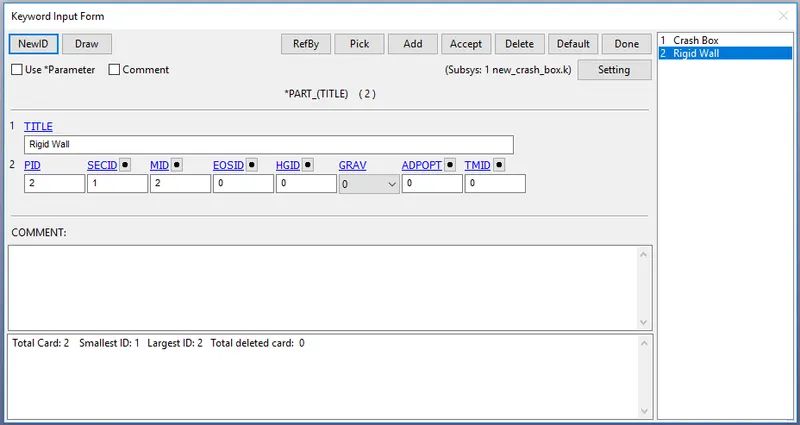
Parts are defined in the keyword manager using the Title, Part ID, Section ID & Material ID parameter and accepted to define the keyword.
Step VII - Contact Definition
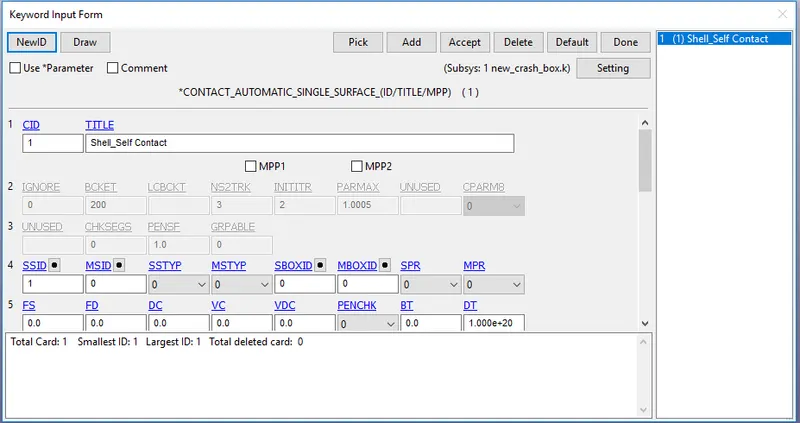
Automatic Single Surface contact is defined between the crash box as it is going to impact the rigid wall. Slave ID is assigned to the crash box element and Master ID is left open (0) as there is no need to define the master ID in single surface contact.
Step VIII - Initial Velocity of 50Kmph
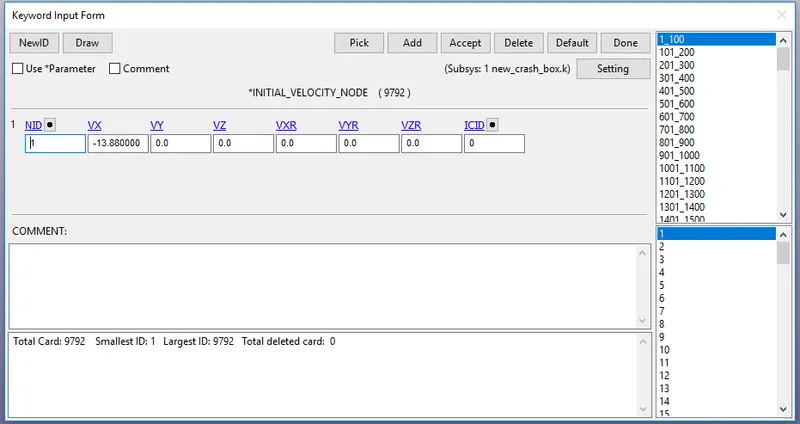
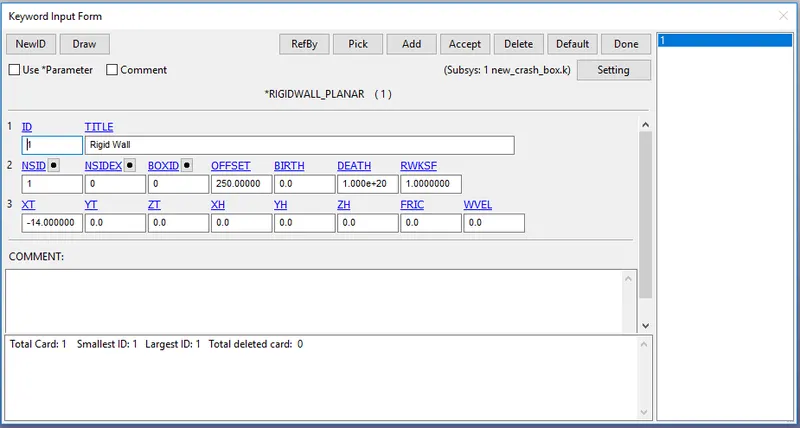
As the distance between the rigid wall barrier nearest node of the crash box is 14 mmm user-defined the initial velocity of -13.88 mm/ms (50 kmph) to the node-set (1) defined in the keyword manager. The negative direction of the velocity is based on the global coordinate axis.
This means that the impact will take place around 1.1 milliseconds.
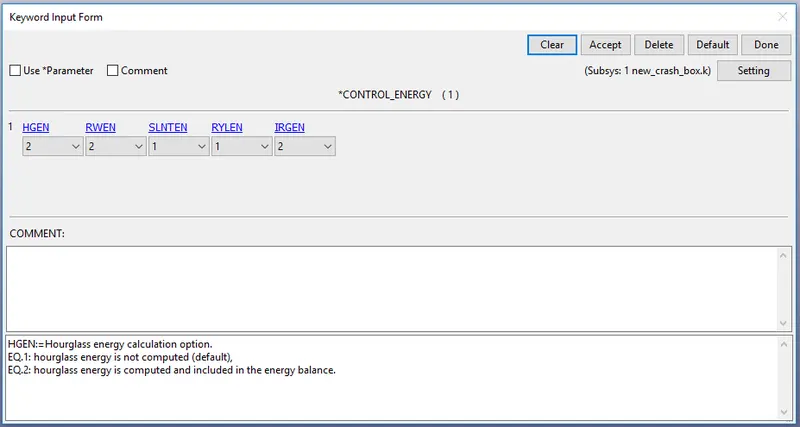
Step IX - Control Card
To capture the Hourglass energy induced in the crash box during the simulation the user adds the energy card with EQ:2 to compute the energy.
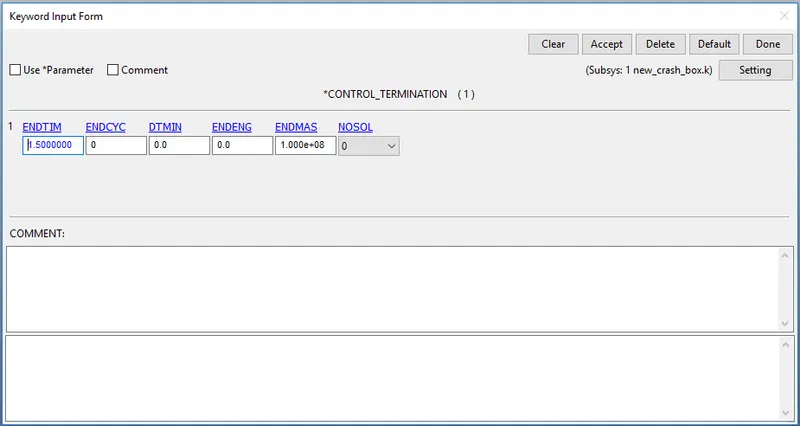
The termination end time is kept as 1.5 ms which is sufficient to capture the result of the drop test on the cell phone.
Step X - DATABASE FiLE
Database keyword is defined to capture the simulation of the crash box test to observe the result of the test. This is carried out base on the frames required to be capture to visualize the simulation. For user reference, the time of each frame to be capture is taken as dt = 0.01 ms. both in Binary D3plot and ASCII Keyword.
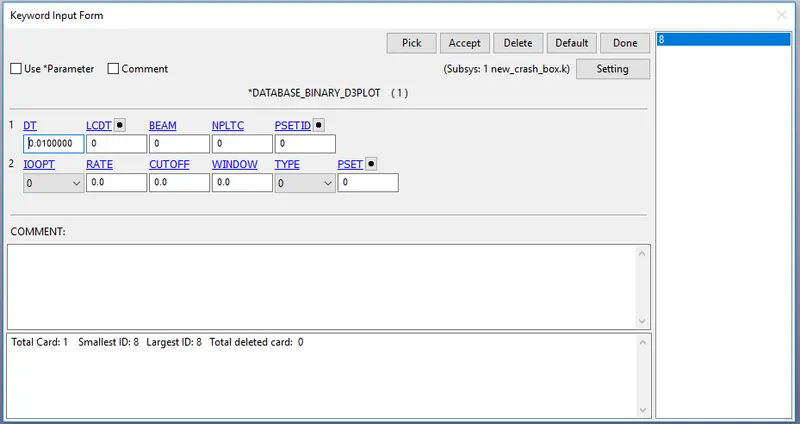
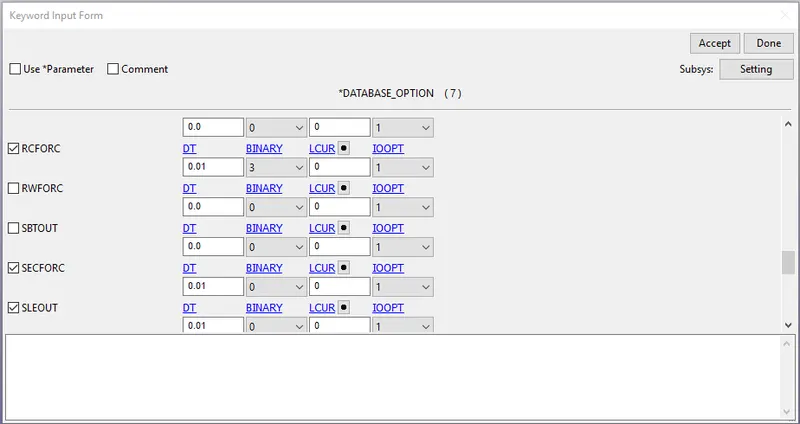
In ASCII Keyword file 3 outputs are requested glsat, rcforce & sleout.
To calculate the section force along the length of the crash box another database card called Cross-Section Set is added. Here the user provides the Node and Element Set Id created in the Set Card.
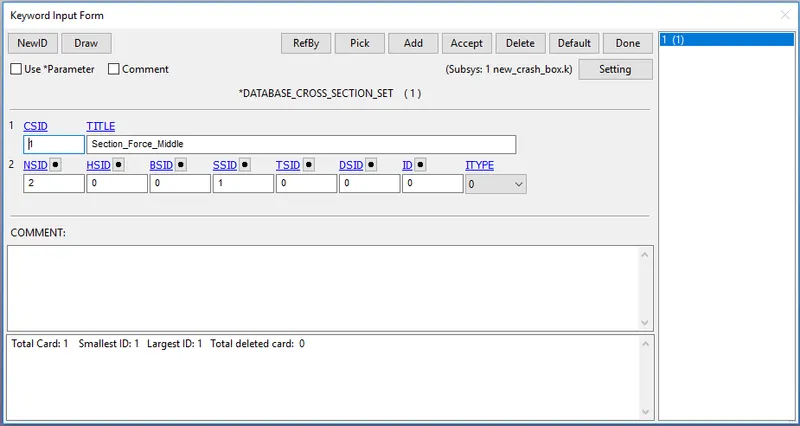
Step XI - Save the keyword file
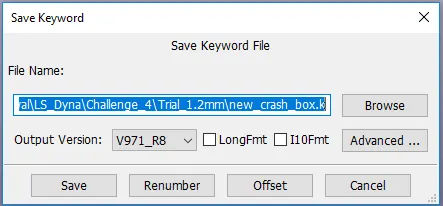
Save the keyword file as save as in the .k extension. The user makes sure that the file is kept in the folder name or path with no space in between to run the termination normally.
Step XII - Edit the keyword ID & Title
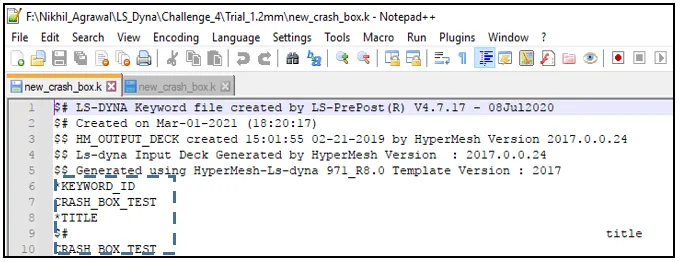
User edit the keyword ID and the Title using notepad++
Step XIII - Assigned 1.5 mm thickness
Once the user has the deck file ready for 1.2 mm thickness the user easily changes the thickness of the crash box using the same deck file and changed the section thickness. This file is then saved in a new folder.
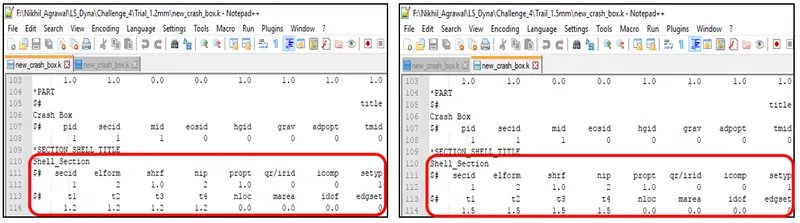
fig - Section Thickness - 1.2mm fig - Section Thickness - 1.2mm
Step XIV - Run the Keyword File
The user then runs the file using LS Run to ensure that the termination end with normal termination.
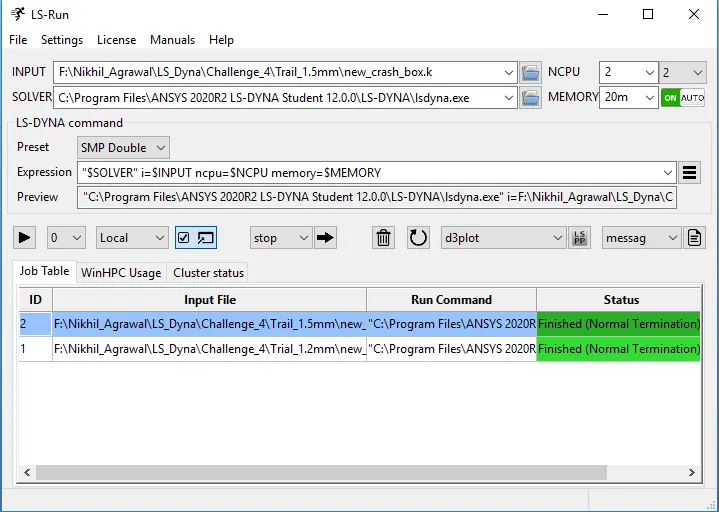
Results:
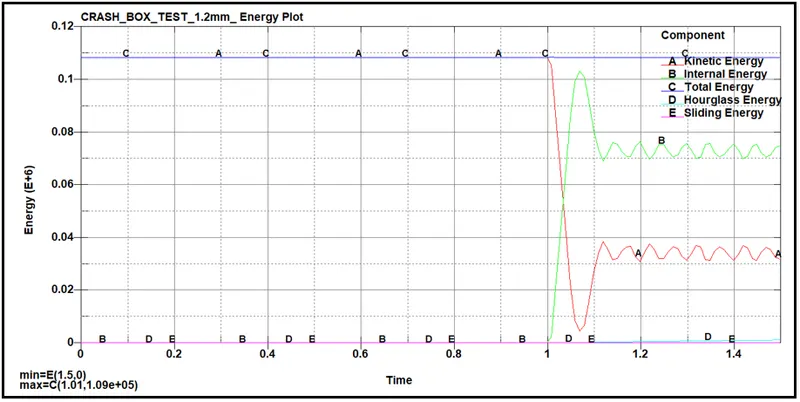
1] Energy Plot -
Case I
Case II
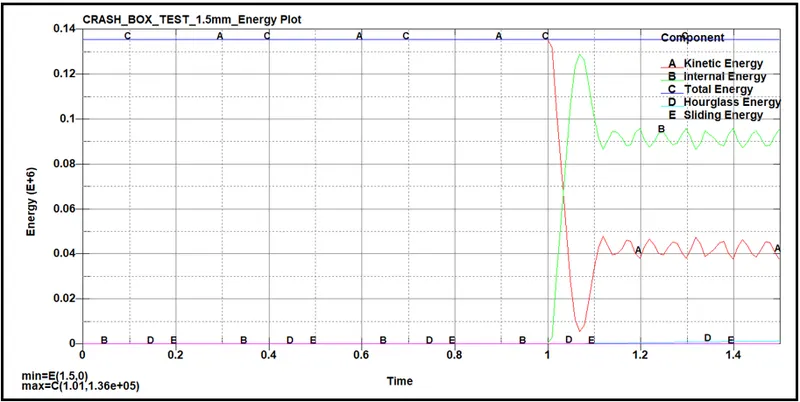
Comparing to the above two cases of energy plot, the user can see that the internal energy and kinetic energy are converging toward a point in the middle. This is the correct behavior of the energy plot. The maximum induced energy is higher in case II as the thickness of the crash tube is more in this case. More the thickness of the tube better is energy absorbing capacity of the tube.
Case 1 - 1.09e+05 mJ
Case 2 - 1.36e+05 mJ
2] Animation of the final simulation
Case I
Case II
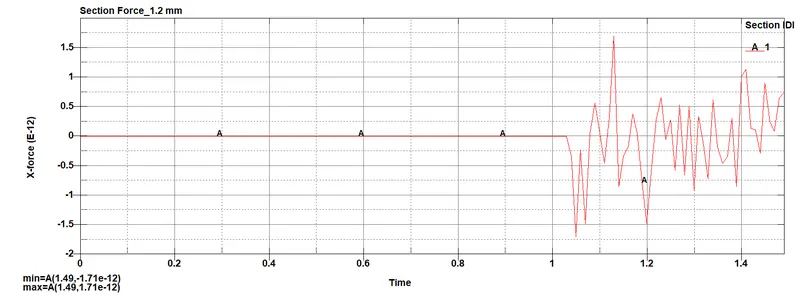
3] Cross-Sectional Force Generated in the Middle of the Crash Box (Along its Length)
Case I
Case II
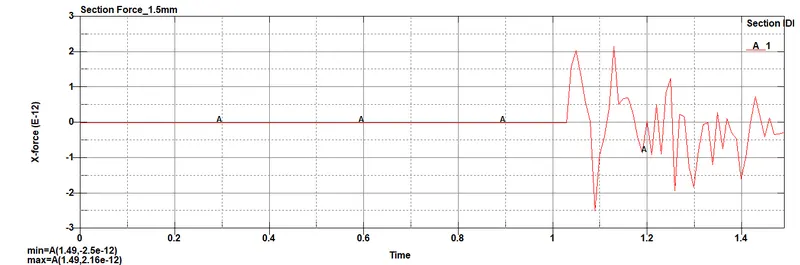
Comparing to the above two cases due to the thickness difference of the crash box, the crash box with 1.5 mm thickness will hold a higher amount of sectional forces along the length of the box.
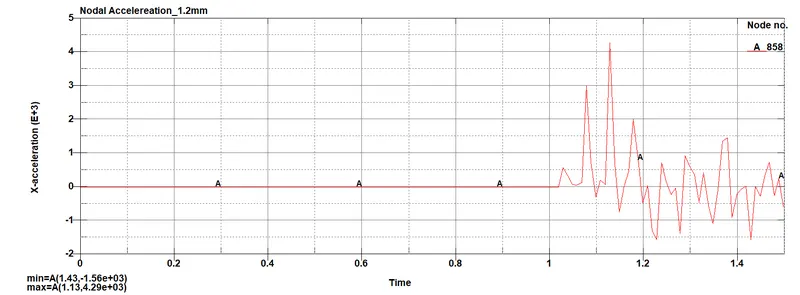
4] Acceleration plot of a node in the middle of the Crash Box (along its length)
Case I
Case II
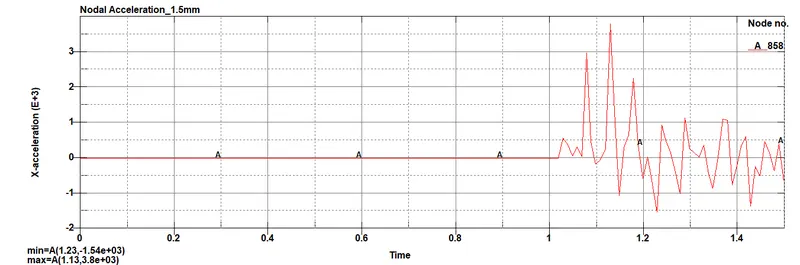
Comparing to the above two cases of the acceleration of the crash tube the user can clearly see that there is a slight decrease in the acceleration in case II. This is because of the fundamental theory of mass and acceleration.
As we know that,
`F = m* a`
Therefore, `a = F / m`
From the above equation as the mass increases the acceleration will decrease. Acceleration is inversely proportional to mass.
Maximum directional stress and strain along the length of the Crash Box (X strain, Y strain, etc)
Case I & II Stress
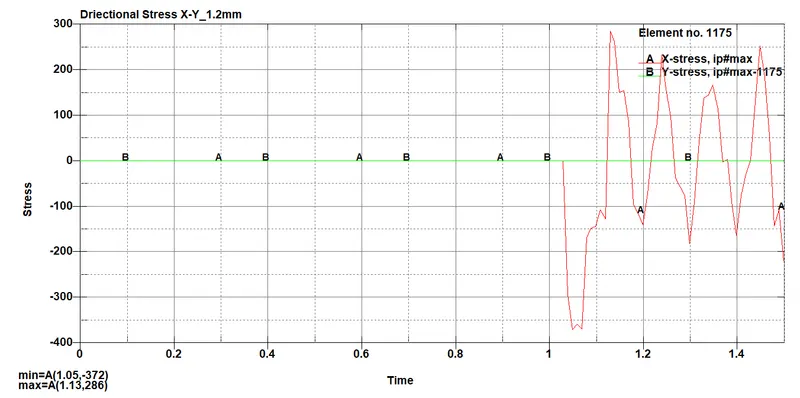
fig - Stress 1.2mm
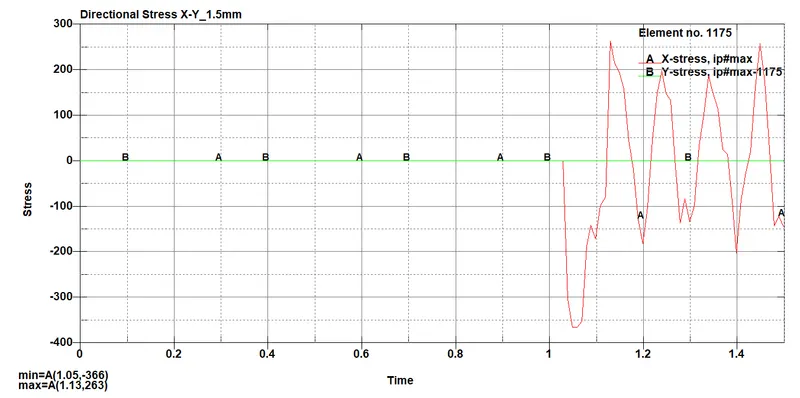
fig - Stress 1.5mm
Comparing to the above two cases for stress, the user can say that more stress will be induced in the crash box with 1.2mm thickness than compared to 1.5mm thickness due to the thickness difference. More the thickness better is the strength of the crash box.
Case I & II Strain.
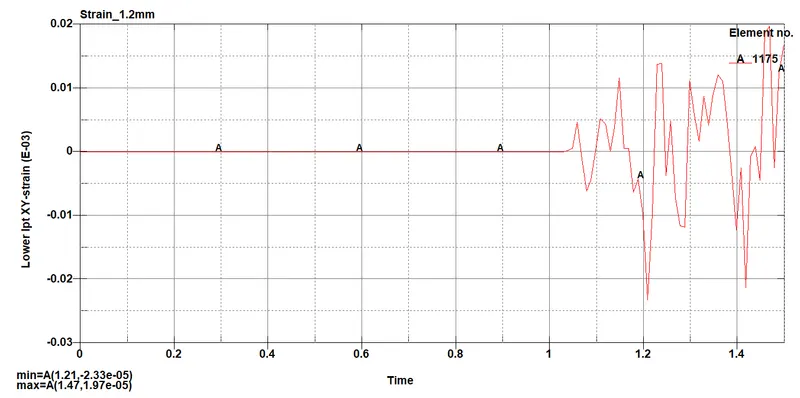
fig - Strain 1.2mm
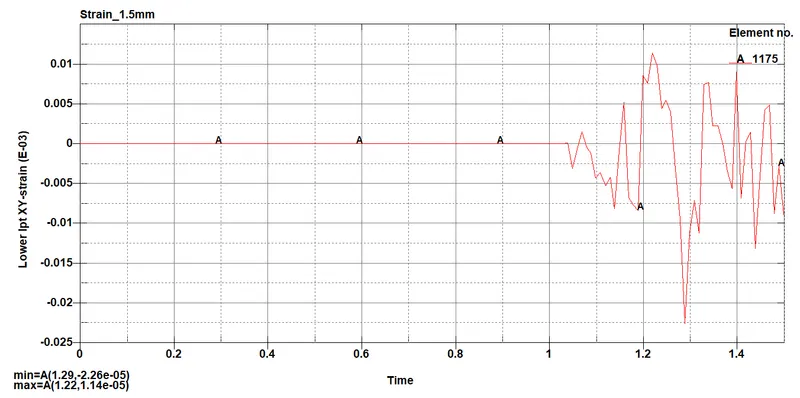
fig - Strain 1.5 mm
Comparing to the above two cases for strain, the user can say that more strain will be induced in the crash box with 1.2mm thickness than compared to 1.5mm thickness due to the thickness difference. Less the thickness more the crash box deformation.
Conclusion:
Created the input deck file using LS PrePost and Run the file using the LS Run.