Week 4 - Combustion Efficiency Calculation after Preheating
AIM
* To compute variation of Adiabatic flame temperature (AFT) with preheat temperature of reactant mixture in a furnace and to plot the same.
* To compute variation of combustion efficiency of furnace with preheat temperature and plot the same.
INTRODUCTION
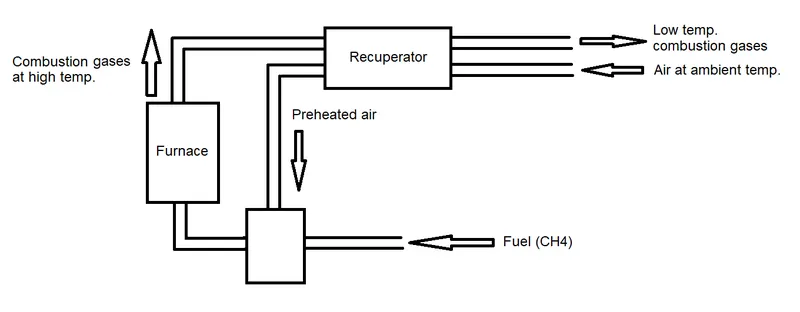
Furnace is basically a bolier or heater which can be used to heat air, vaporise water etc. A fuel is burnt inside the furnace the resulting heat release is used to serve different purpose, purpose varies widley it may be to heat the air or in industries it will vaporizing some fluids etc. As stated above it is clear that the fuel which is used as source of energy in the furnace needs to be combusted so as to derive heat energy out of it. Combustion is nothing but reaction of fuel with air and hence produce `CO_2, H_2O` and release heat. Heat released from the combustion process is used for different purpose as stated earlier and the combustion products are sent for an after treatment and vented out. The combustion gases (combustion products) has higher temperature when it comes out from furnace this high temerature gases can be used to heat the incoming air in a recuperator and hence preheat the air before it mixes with the fuel.
Below is a schematic representation of the same,
Logic : To plot variation of AFT with preheat temperature
* Stoichometric combustion equation: `CH_4 + 2(O_2+3.76N_2) = CO_2 + 2H_2O +7.52N_2` is considered in this challenge
* In first part of the challenge, AFT of the fuel is computed at different preheat temperatures using the cantera module. Different preheat temperatures are set using the Quantity class of the cantera module.
* Quantity class is used to define mixtures, the input to this Quantity class is the instance of the solutions class. If we consider the above mentioned stoichometric combustion equation then we can define a instance of quantity as shown below,
A = ct.Quantity(gas)

A.TPX = 300,101325,{'O2':0.21,'N2':0.79}
* Instance A of the quantity class is created, which represents the air (`O_2, N_2`) using the command A.TPX the temperature, pressure and mole fraction of the mixture is defined.
* Another instance with name B of Quantity class is defined, this represents the `CH_4`alone.
B = ct.Quantity(gas)

B.TPX = 300,101325,{'CH4':1}
* A mixture M is defined such that, M = A + B and equilibate function can be used to determine the AFT
* To compute AFT for a set of preheat temperatures a list of preheat temperature is defined t = [298,400,500,600]
* A for loop i defined in range(0,4) and while defining the temperature for mixture A the index is defined
for i in range(0,4):

    A = ct.Quantity(gas)

    A.TPX = t[i],101325,{'O2':0.21,'N2':0.79}
Logic : To compute combustion efficiency for varying preheat temperatures
* To compute efficiency first we need to define the efficiency formula, `eta_c = q_(op)/q_(ip)*100`
`q_(op) -` Heat released from furnace (J)
`q_(ip) -` Lower heating value of the fuel (J)
* Since the fuel used is `CH_4`, lower heating value(LHV) of `CH_4 =`50 MJ/kg. Since `CH_4`is defined as a separate instance B we can determine the mass of `CH_4` using the command, m = B.mass, this gives us the mass of `CH_4`in Kg for given number of moles, this can be multiplied to the LHV to obtain the `q_(ip)`
* As far as `q_(op)` is concerned it can be computed in 2 ways as mentioned below:
1. `q_(op) =`entalphy of reactant - entalphy of product.
* Since we have defined M = A + B which represents the whole reactant part, its entalphy is calculated using the command M.H, this is assigned to a variable react_h.
* To calculate the entalphy of products, a separate instance called C is created. Instance C represents the products of combustion. For this challenge `CO_2,H_2O, N_2` are the products considered as shown in above stoichometric combustion equation.
* Entalphy of products is computed using the command, prod_h = C.H where prod_h is the variable used to store the entalphy value.
M = A + B # represents the reactant part of stoichometric combustion equation

react_h = M.H # Entalphy of reactants

C = ct.Quantity(gas)

C.TPX = 1700,101325,{'CO2':009,'H2O':0.19,'N2':0.71}

C.moles = 10.52

prod_h = C.H # Entalphy of prodcuts
* Qunatity class provides 2 functions through which we can compute the entalphy. First one is by using '.H' this provides us with the total entalphy in Joules,m meaning the value of entalphy after multiplying with the mass.
* Second function which can be used to determine the entalphy is '.HP', using this we can obtain the entalphy in joules/Kg. How this function can be used to calculate the entalphy is disscussed below:
2. `q_(op) = m_a*h_a + m_f*h_f-m_p*h_p`
`m_a`- Mass of air (Kg)
`h_a` - entalphy of air (J/Kg)
`m_f` - Mass of fuel (Kg)
`h_f` - entalphy of fuel (J/Kg)
`m_p` - Mass of products (Kg)
`h_p` - Entalphy pf products (J/Kg)
* Using this method mass of air, fuel and products can be computed using the ".mass" function for given number of moles.
* Entalphy in Joules/Kg can be obtained using the function ".HP".
* This is same as the above defined method the only difference is that using this method we are manually multiplying the mass.
* For this challenge the codes are written using the first method.
* A index is defined for `q_(op)`and named as q, also a index is defined for efficiency values named as eff.
* The set of preheat temperatures used in the challeneg, t = [298,400,500,600]
* Below are the codes:
"""
Calculating the combustion efficiency
"""
"""
CH4 + 2(O2 + 3.76N2) = CO2 + 2H2O + 7.52N2 # Stoichometric combustion equation
"""
import cantera as ct

import matplotlib.pyplot as plt

t = [298,400,500,600]

T_AFT = [] # Defining an index for AFT values

q = [] # Defining an index for heat release values

eff = [] # Defining an index for efficiency values

gas = ct.Solution('gri30.xml')

for i in range(0,4):

	A = ct.Quantity(gas)

	A.TPX = t[i],101325,{'O2':0.21,'N2':0.79}

	A.moles = 9.52

	B = ct.Quantity(gas)

	B.TPX = 298,101325,{'CH4':1}

	B.moles = 1

	m = B.mass

	M = A + B

	M.equilibrate('HP','auto')

	T_AFT.append(M.T)

	react_h = M.H # Computing entalphy of reactant at mixture temperature

	C = ct.Quantity(gas)

	C.TPX = 1700,101325,{'CO2':0.09,'H2O':0.19,'N2':0.71}

	C.moles = 10.52

	prod_h = C.H # Computing entalphy (J) of product at 1700 K

	q.append(react_h - prod_h) # Heat release from the furnace is calculated using, q = enthalpy of product - enthalpy of reactants

	q_act = 50*pow(10,6)*m # Theoretical heat release from CH4 using LHV

	eff.append(q[i]/q_act*100) # Efficiency calculation


print('Preheat temperatures' + str(t))

print('AFT at different pre heat temperatures' + str(T_AFT))

print('Combustion efficiency at different preheat temperatures' + str(eff))

# plotting variation of AFT with preheat temperatures
plt.plot(t,T_AFT)
plt.xlabel('preheat temperatures')
plt.ylabel('AFT values')
plt.title('Variation of AFT with preheat temperature')
plt.show()

# plotting Variation of combustion efficiency with preheat temperature
plt.plot(t,eff)
plt.xlabel('preheat temperatures')
plt.ylabel('Efficicency')
plt.title('Variation of efficiency with preheat temperature')
plt.show()
* Executing the above codes prints the preheat temperature, AFT at preheat temperatures, Combustion efficiency at preheat temperatures as shown below,

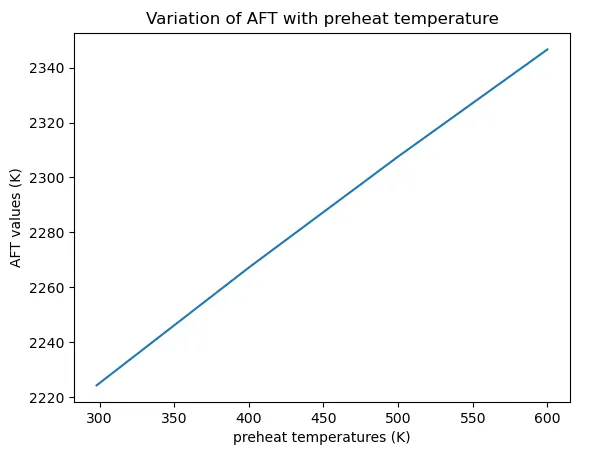
* Plot of preheat temperatures v/s AFT:
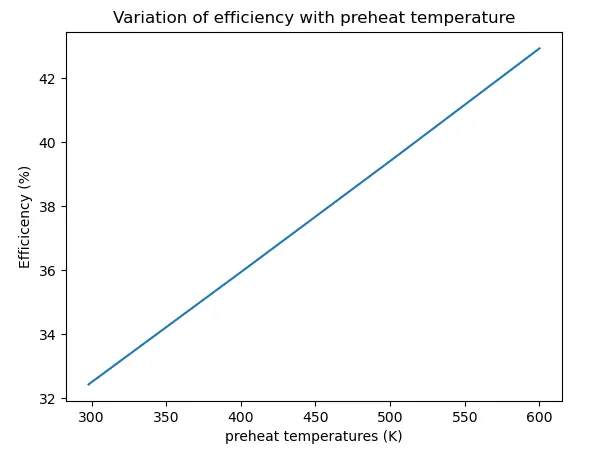
* Plot of preheat temperatures v/s combustion efficiency:
Observations:
* As preheat temperature increases the AFT also increases, for the selected range of preheat temperatures the increase in AFT is linear.
* As preheat temperature increases the combustion efficiency also increases and that to linearly.
* Increase in combustion efficiency helps in reducing fuel consumption. If we increase the preheat temperature for given mass of fuel the combustion efficiency can be increased. The reason for increase in combustion efficiency for given mass of fuel is because the entalphy that we consider in heat release calculation is temperature dependent rather than mass.
* Assuming a exit temperature of 1700 K is not wrong, as fuel combusts the max tempertaure that we can obtain as a result of combustion is AFT, but AFT is more theoretical there will be little of losses. So if we consider the losses and maintain a constant temperature output then considering 1700 K as outlet temperature is correct. This can be further improvised by considering the losses and deducting it from AFT value of each preheat temperature.