Week 4 - Combustion Efficiency Calculation after Preheating
Objective:-
- To know the effect of the range of inlet air preheating from 298k to 600k on the adiabatic flame temperature of Methane.
- To know the effect of pre-heating temperature on combustion efficiency.
Given:-
Device-Recuperator (constant pressure heat exchanger)
Fuel-CH4
Programs used- Python and Cantera
Theory:-
Recuperator and Regenerator
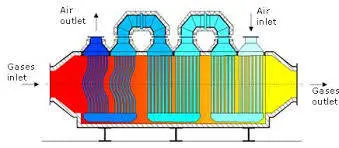
A Recuperator is a heat exchanger in which energy from a steady flow of hot combustion products i.e. flue gases, is transferred to the air supplied to the combustion process. A wide variety of recuperators are used in practice, many of which employ radiation heat transfer from the flue gases, as well as convection.
A Regenerator also transfers the energy from the flue gases to the incoming combustion air, but in this case, an energy storage medium such as corrugated steel or ceramic matrix is alternatively heated by the hot gases and cooled by the air.
A general flow diagram is shown below:
Combustion Efficiency of Recuperator:
We are going to write an energy balance for the control volume, assuming both the heat transferred to the load and the heat losses are the same, with and without preheating. Assuming steady flow, heat us transferred out of the control volume.
`-Q = -Qunderset(Products)()-Qunderset(Reactants)() = m.(hunderset(Products)()-hunderset(Reactants)())`
`-Q = (m underset(A)() + m underset(F)())h underset(Products)() - m underset(F)().h underset(F)() - m underset(A)().hunderset(A)()`
`frac{A}{F} = frac{m underset(A)()}{m underset(F)()}`
Above equation can be written as :
`-Q = [(frac{A}{F}+1).h underset(Products) - (A/F).h underset(A)() - h underset(F)()]`
Fuel Utilization will be defined as,
`eta = frac{Q}{m underset(F)().LHV`
Solution:
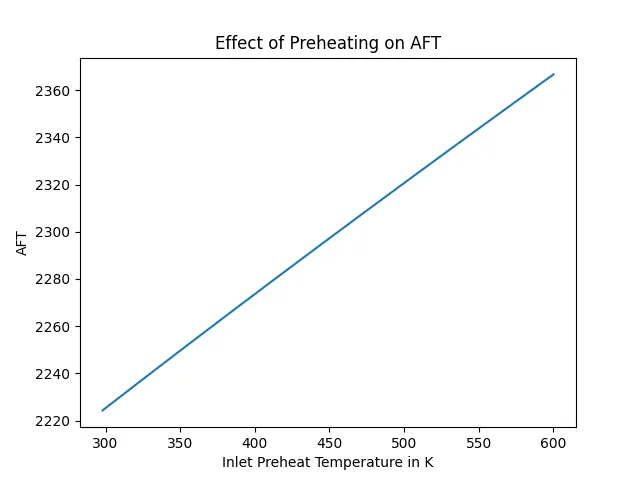
Part-1: To know the effect of preheating inlet air temperature on adiabatic flame temperature. Assume fuel as METHANE (CH4)
Here, we are going to look at how adiabatic flame temperature is being effected by varying inlet air temperature ranging from 298 K to 600 K.
Python code:
STEP_1: At first we have imported all the necessary applications i.e. Cantera to perform chemical kinetics calculations, NumPy for numerical calculations, and matplotlib to visualize the results obtained by plotting the results.
STEP_2: Defined the range of preheating temperature in the variable "i" using 'linspace' command.
STEP_3: "For" loop created inside which for all the values of preheating inlet air temperature AFT calculation done by using a mole basis system.
STEP_4: Printing and plotting the results we obtained.
"""
To undersatnd effect of preheating of air
"""

import cantera as ct
import matplotlib.pyplot as plt
import numpy as np

gas = ct.Solution('gri30.cti')

#preheating temperature range

#i = np.linspace(298,600,50)

#for storing the value of AFT

T_gas = []
t_preheat = []

#calculating AFT for all value of i
for t in range (298,601):
	#Reactants
	R = ct.Quantity(gas)
	R.TPX = t,ct.one_atm,'O2:0.21,N2:0.79'
	R.moles = 9.52

	#fuel
	F = ct.Quantity(gas)
	F.TPX = t,ct.one_atm,'CH4:1'
	F.moles = 1

	M = R+F

	M.equilibrate('HP', solver='auto')
	T=M.T
	t_preheat.append(t)
	T_gas.append(T)

if (t%10==0):
	print(T_gas)
	plt.plot(t_preheat,T_gas)
	plt.xlabel('Inlet Preheat Temperature in K')
	plt.ylabel('AFT')
	plt.title('Effect of Preheating on AFT')
	plt.show()
Result:
Observation:
- An increase in inlet air temperature increases the adiabatic flame temperature of methane.
- Adiabatic flame temperature varies linearly with air preheat temperature.
- With an increase in inlet air temperature to 600 K adiabatic temperature increases to 1302.84 K which is 245.63 K higher than that inlet air temperature of 298 K.
Part-2: To plot the effect of pre-heat temperature on combustion efficiency.
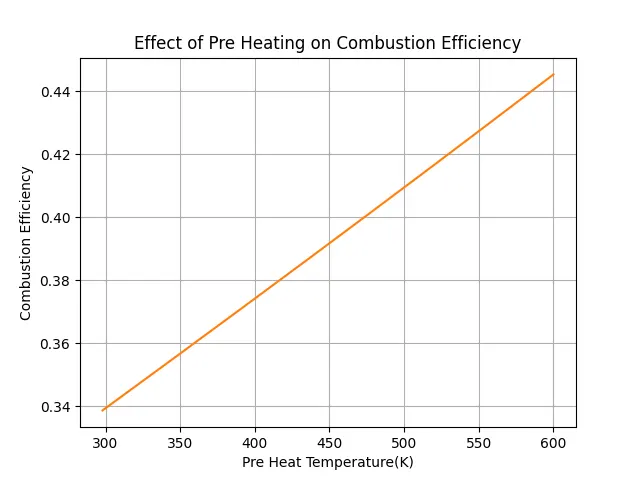
Here, we are utilizing the waste heat of flue gases to increase the temperature of the inlet air and how this preheating of inlet temperature affects the combustion efficiency of methane is visualized.
Assumptions made here are, equivalence ratio is 1, LHV of methane is 50 MJ, A/F ratio is 17.1.
Python Code:
"""
Effect of preheating on combustion efficiency
"""

import cantera as ct
import numpy as np
import matplotlib.pyplot as plt

gas = ct.Solution('gri30.cti')
LHV_fuel =  50e6

'''
Calculating moles

# Product moles = n_total = 1+2+7.52 = 10.52

n_CO2 = 1/n_total = 0.096 ; n_H2O = 2/n_total = 0.1901 ; n_N2 = 7.52/n_total = 0.7148

'''
#Coefficients
N_total=10.52
n_CO2=1/N_total
n_H2O=2/N_total
n_N2=7.52/N_total


#get enthalpy of fuel
F = ct.Quantity(gas)
F.TPX = 298,ct.one_atm,'CH4:1'
h_fuel = F.enthalpy_mass
F.moles = 1
mass_fuel=F.mass

T_min=298
T_max=600
saving=[]
T_preheat=[]
eff=[]


#get enthalpy of products
P = ct.Quantity(gas)
P.TPX = 1700,ct.one_atm,{'CO2':n_CO2,'H2O':n_H2O,'N2':n_N2}
h_product = P.enthalpy_mass


for j in range (298,601):

	A=ct.Quantity(gas)
	A.TPX=j,ct.one_atm,{'O2':0.21,'N2':0.79}
	A.moles=9.52
	h_a=A.enthalpy_mass

	A_F=(A.mass/mass_fuel)

	Q=-((A_F+1)*h_product-A_F*h_a-h_fuel)
	eta=Q/(LHV_fuel)
	if j==298:
		eta_init=eta
	fuel_saving=100*(1-(eta_init/eta))
	saving.append(fuel_saving)
	T_preheat.append(j)
	eff.append(eta)


if (j%10==0):
	plt.figure(1)
	plt.plot(j,eta)
	plt.plot(T_preheat,eff)
	plt.xlabel('Pre Heat Temperature(K)')
	plt.ylabel('Combustion Efficiency')
	plt.title('Effect of Pre Heating on Combustion Efficiency')
	plt.grid(True)
	plt.show()
Result:
Observations:
- From the plot above, we can say an increase in inlet air temperature will increase the combustion efficiency linearly.
- We also know that nitric oxide emissions also be effected, since peak temperature will increase as a result of the preheating of inlet air.
- The percentage of fuel-saving is found out as 23.93% if we increase the inlet air temperature to 600 K.