Week 4 - Combustion Efficiency Calculation after Preheating
Aim:
1.What is the effect of preheating on the adiabatic flame temperature?
- Change pre-heating from 298 to 600K
- Explain your results
2. Does preheat help with fuel-saving? If yes, how does combustion efficiency go up as a function of pre-heating temperature? Assume that the furnace exit temperature is 1700K
- Write the formula for combustion efficiency
- Plot the effect of pre-heat temperature on combustion efficiency
- Is it right or wrong to assume a fixed furnace exit temperature? Explain your answer.
The formula used for efficiency
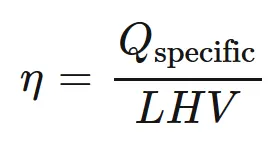
A fixed furnace exit temperature helps us determine the enthalpy of product species, and hence, we are able to benchmark the results. Moreover, the given temperature could also be an average after estimating all losses.
Introduction:
Industrial furnaces are used for carrying out certain processes that require heat. Heat in the furnace is provided by (i) fuel energy, (ii) chemical energy, (iii) electrical energy, or (iv) a combination of these energies. Gases which are generated during the process leaves the furnace at a temperature which is the inside temperature of the furnace and hence have a high sensible heat content. Sometimes the exhaust gases carry some chemical energy, which raises the temperature of exhaust gases further due to post-combustion because of this chemical energy. The heat energy contained in the exhaust gases is the waste energy since it gets dumped in the environment. However, it is possible to recover some part of this energy if investments are made in waste heat recovery devices.
Methods for waste heat recovery include (i) transferring heat between exhaust gases and combustion air for its preheating, (ii) transferring heat to the load entering furnaces, (iii) generation of steam and electrical power, or (iv) using waste heat with a heat pump for heating or cooling facilities.WHRDs work on the principle of heat exchange. During heat exchange, the heat energy of the exhaust gases gets transferred to some other fluid medium. This exchange of heat reduces the temperature of the exhaust gases and simultaneously increases the temperature of the fluid medium. The heated fluid medium is either recycled back to the processor utilized in the production of some utilities such as steam or power etc. The benefits of WHRDs devices are multiple namely (i) economic, (ii) resource (fuel) saving, and (iii)environmental. The benefits of these devices include (i) saving of fuel, (ii) generation of electricity and mechanical work, (iii) reducing cooling needs, (iv) reducing capital investment costs in case of new the facility, (v) increasing production, (vi) reducing greenhouse gas emissions, and (vii) transforming the heat to useful forms of energy.
Heat exchangers are most commonly used to transfer heat from combustion exhaust gases to air entering the furnace. Since preheated combustion air enters the furnace at a higher temperature, less energy must be supplied by the fuel. Typical WHRDS used for air preheating include recuperators, furnace regenerators, recuperative and regenerative burners, passive air preheaters, shell and tube heat exchangers, finned tube heat exchangers or economizers, rotary regenerator or heat wheel, preheating of load, waste heat boilers, and heat pumps.
Recuperators:-
In a recuperator, there is a direct transfer of heat. The two fluids (exhaust gases and the combustion air) are separated by a heat transfer surface and they do not mix. The heat exchange takes place between the exhaust gases and the air through metallic or ceramic walls. Duct or tubes carry the air for combustion to be pre-heated, while the other side contains the waste heat stream.
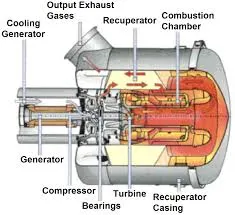
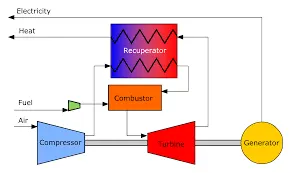
Recuperators generally recover heat from the exhaust gases of a furnace of medium temperature or high temperature and transfer it to incoming combustion air. Recuperators can be categorized by the relative directions of gas flow such as (i) ‘in parallel-flow heat exchangers’ where both the gases flow in the same general direction, (ii) ‘in counterflow exchangers’ where both the gases flow in opposite directions, or (iii) ‘in cross-flow’ where the gases flow at right angles to each other. Counterflow heat exchangers have the greatest effectiveness while the parallel flow arrangement has the lowest effectiveness.
Recuperators can be based on the principle of heat transfer by radiation, convection, or combinations. Recuperators are constructed out of either metallic or ceramic materials. Metallic recuperators are used in applications with temperatures below 1050 deg C, while heat recovery at higher temperatures is better suited to ceramic tube recuperators which can operate with hot side temperatures as high as 1500 deg C and cold side temperatures of around 950 deg C.
#Program for this challenge:
import matplotlib.pyplot as plt
from numpy import *
import cantera as ct

gas = ct.Solution('gri30.cti')
fuel = ct.Quantity(gas)
fuel.TPX = 298.15, ct.one_atm, {'CH4':1}
fuel.moles = 1
air = ct.Quantity(gas)

# Defining the pre-heating conditions
T_pre = linspace(298, 600, 51)
T_aft = []
plot_interval = 5

# Calculating AFT for different pre-heating temperatures
for T in T_pre:
	air.TPX = T, ct.one_atm, {'O2':0.21, 'N2':0.79}
	air.moles = 2 + (2*3.76)
	flue = fuel + air
	flue.equilibrate('HP','auto')
	T_aft.append(flue.T)

# Printing and plotting the results
print('Effect of Pre-heating on AFT')
print('AFT with no pre-heating = ' + str(round(T_aft[0],2)) + ' K')
slope = (T_aft[1]-T_aft[0])/(T_pre[1]-T_pre[0])
print('Rate of change of AFT with pre-heating = ' + str(round(slope,2)) + ' Kelvin per Kelvinn')
print('-----------------------------')
T_pre_plot = [T_pre[i] for i in range(0,len(T_pre),plot_interval)]
T_aft_plot = [T_aft[i] for i in range(0,len(T_aft),plot_interval)]
#fig, ax = subplots()
plt.plot(T_pre_plot, T_aft_plot,'-*',color='red', linewidth=2)
plt.grid('both', linestyle='--', linewidth=1.2)
plt.xlabel('Pre-heating Temperature [K]')
plt.ylabel('Adiabatic Flame Temperature [K]')
plt.title('Effect of Air Pre-heating on AFT')
plt.show()

"""
Effect of Pre-heating on Combustion Efficiency
Reaction: CH4 + 2(O2 + 3.76N2) <=> CO2 + 2H2O + 7.52N2
"""
gas = ct.Solution('gri30.cti')
fuel = ct.Quantity(gas)
fuel.TPX = 298.15, ct.one_atm, {'CH4':1}
fuel.moles = 1
h_fuel = fuel.enthalpy_mass
air = ct.Quantity(gas)

# Creating the estimated products instance from the gas
est_prod = ct.Quantity(gas)
n_tot = 1 + 2 + (2*3.76)
n_co2 = 1/n_tot
n_h2o = 2/n_tot
n_n2 = 7.52/n_tot
est_prod.TPX = 1700, ct.one_atm, {'CO2':n_co2, 'H2O':n_h2o, 'N2':n_n2}
est_prod.moles = n_tot
h_est_prod = est_prod.enthalpy_mass

# Defining the pre-heating conditions
T_pre = linspace(298, 600, 51)
LHV = 50e6
eff = []
fuel_saving = []
plot_interval = 5

# Calculating efficiency for different pre-heating temperatures
for T in T_pre:
	air.TPX = T, ct.one_atm, {'O2':0.21, 'N2':0.79}
	air.moles = 2 + (2*3.76)
	air_fuel_ratio = air.mass/fuel.mass
	h_air = air.enthalpy_mass

	Q_spec = air_fuel_ratio*(h_air - h_est_prod) + h_fuel - h_est_prod

	eff.append(Q_spec/LHV*100)
	# Calculating the fuel saving from the efficiency
	fuel_saving.append((1 - (eff[0]/eff[-1]))*100)

# Printing and plotting the results
print('nEffect of Pre-heating on Combustion Efficiency')
print('Efficiency without pre-heating = ' + str(round(eff[0],2)) + '%')
print('Efficiency at pre-heating of 600 K = ' + str(round(eff[-1],2)) + '%')
slope = (eff[1]-eff[0])/(T_pre[1]-T_pre[0])
print('Rate of change of efficiency with pre-heating = ' + str(round(slope,4)) + ' %/K')
print('Fuel-saving at pre-heating of 600 K = ' + str(round(fuel_saving[-1],2))+ '%n')
('----------------------------------------------')

T_pre_plot = [T_pre[i] for i in range(0,len(T_pre),plot_interval)]
eff_plot = [eff[i] for i in range(0,len(eff),plot_interval)]
fuel_saving_plot = [fuel_saving[i] for i in range(0,len(fuel_saving),plot_interval)]

plt.figure(1)

plt.plot(T_pre_plot, eff_plot,'-*',color='red', linewidth=2)
plt.grid('both', linestyle='--', linewidth=1.2)
plt.xlabel('Pre-heating Temperature [K]')
plt.ylabel('Combustion Efficiency [%]')
plt.title('Effect of Air Pre-heating on Combustion Efficiency')

plt.figure(2)
plt.plot(T_pre_plot, fuel_saving_plot,'-*',color='red', linewidth=2)
plt.grid('both', linestyle='--', linewidth=1.2)
plt.xlabel('Pre-heating Temperature [K]')
plt.ylabel('Fuel Savings [%]')
plt.title('Effect of Air Pre-heating on Fuel Savings')
plt.show()
The output of the above program-
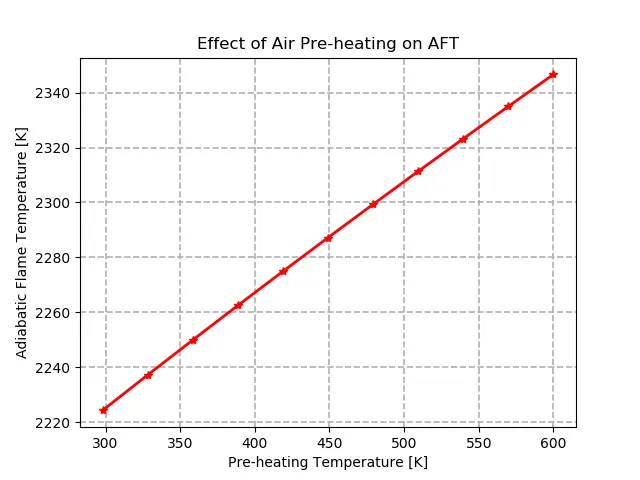
Effect of Pre-heating on AFT
AFT with no pre-heating = 2224.35 K
Rate of change of AFT with pre-heating = 0.43 Kelvin per Kelvin
-----------------------------
Effect of Pre-heating on Combustion Efficiency
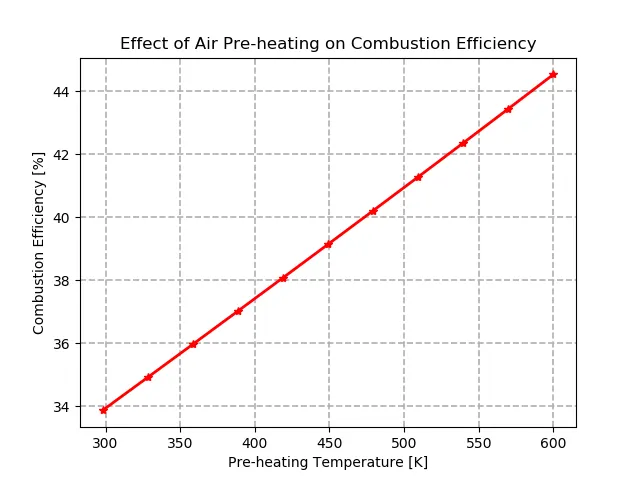
Efficiency without pre-heating = 33.87%
Efficiency at pre-heating of 600 K = 44.53%
Rate of change of efficiency with pre-heating = 0.0346 %/K
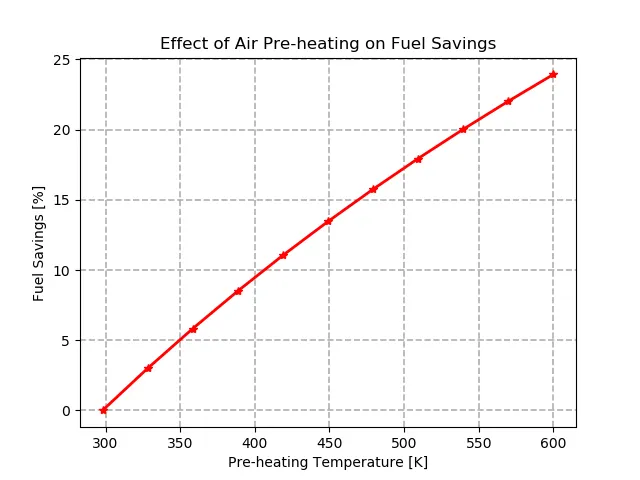
Fuel-saving at pre-heating of 600 K = 23.93%n
[Finished in 9.0s]
Graphical Results for the above Program-
Result:
- AFT and preheating have a linear relation (slope of 0.43) hence, more heat is liberated as heat is added in the combustion process.
- Efficiency without preheating was 33.87% and after preheating @ 600K it became 44.53%.
- Fuel savings had a linear relation to preheating which increased to 23.93% on preheating @ 600K.
- Hence, preheating is beneficial.
Q.Is it right or wrong to assume a fixed furnace exit temperature? Explain your answer.
Here we have assumed a fixed furnace exit temperature which is 1700 Kelvin.
Assume that is correct for the minimum value of preheat temperature (that is 298.15 Kelvin). With that, we got 34 % combustion efficiency.
But with the increase in preheat temperature till 600 kelvin we have kept exhaust gas temperature constant 1700 kelvin. So combustion efficiency increased from 34.87 to 44.53% and varied linearly also.