Week 4 - Combustion Efficiency Calculation after Preheating
OBJECTIVES :- To calculate combustion efficiency after preheating by using methane and air mixture.
PROBLEM STATEMENT :-
1. A furnace is used to burn methane and air mixture. A recuperator is connected to this furnace to recover some energy.
-
What is the effect of preheating on the adiabatic flame temperature (AFT)?
a. Change preheating from 298 to 600k.
b. Explain the results
2. Does preheating help with fuel saving? If yes, how does combustion efficiency go up as a function of preheating temperature? Assume that the furnace exit temperature is 1700k.
(for this case assume that the combustion products are CO2, H2O and N2).
a. Write the formula for combustion efficiency
b. plot the effect of pre-heating temperature on combustion efficiency.
c. Is it right or wrong to assume a fixed furnace exit temperature? Explain the results.
Note :- Use cantera for calculations. Assume the LHV (low eat value) of combustion of methane as 50MJ/KG.
INTRODUCTION AND THEORY :-
In a typical furnace only 30 to 40 % of total heat input is converted to useful heat and rest of the heat loss into the different area and forms waste flue gasses.
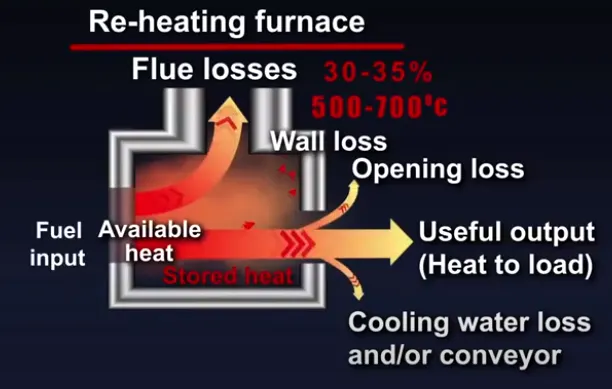
In preheating chamber significant amount of flue gas are wasted through the chimney. As an alternative to the conventional practice, recuperator i.e. heat exchanger is installed in flue duct and use to recover the waste heat from the flue gasses. In the recuperator heat exchange takesplace between flue gasses and inlet combustion air trough through metalic or ceramic poles. Thus a tube carry a combustion tobe preheated. The other side consist of the waste heat stream. The system works on the principle of physics which says energy move from hot body to cold body. Thus in the process inlet combustion air from atmosphere is preheated using waste gas. The preheated combustion air is fed directly into the burner and result is saving in terms of fuel to increases flame temperature and improvement furnace efficiency. The recuperator efficiency is depends on two important parameters are surface area and time available at heat exchange and recuperator materials.
Impact of recuperators are-
-
Waste heat recovery upto 80% of the exhaust flue gas temperature is possible
-
Saves fuel.
-
Reduces pollutions
-
Reduces equipment size
-
Reduces auxiliary energy consumption
Types of recuperators are-
1. Metalic radiation recuperator :- This type of recuperator has low efficiency.
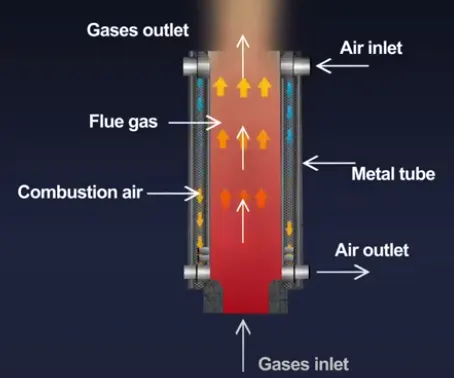
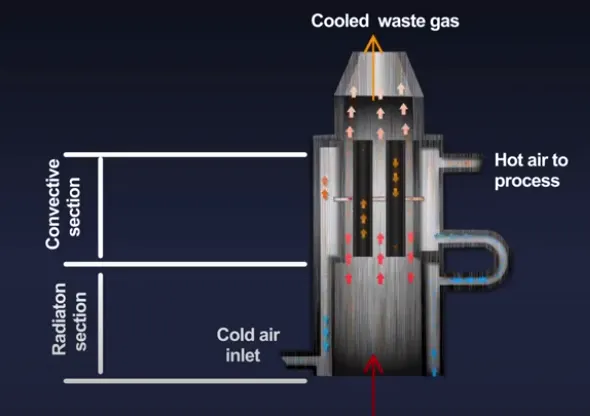
2. Combination of radiative & convective recuperator :- this recuperator recovers upto 50% of waste heat.
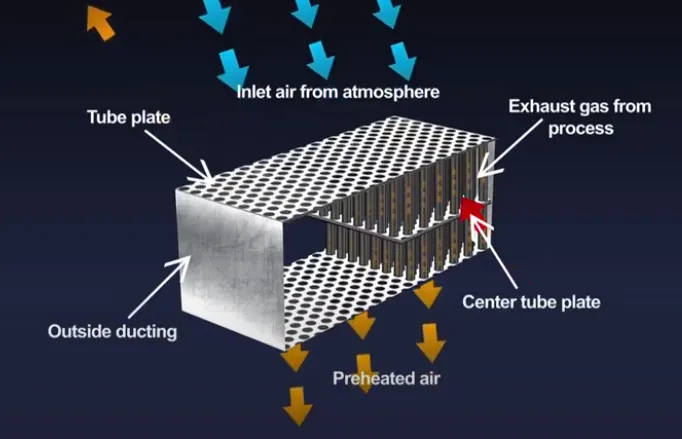
3. Cross flow type metallic U-tube recuperator :- this recuperator recovers upto 80% of heat. This recuperator is suitable for oil and gas furnaces.
Charecterize :-
-
Combustion pipelines should be insulated
-
Recuperator tubes should be cleaned regularly.
-
ID fan should be used for pulverized coal fired furnaces.
Recapitulations :-
-
Large amount of heat is wasted in the form of exhaust flue gasses
-
Recuperators are used to recover heat from the flue gasses
-
The recuperator efficiency depends upon surface area and time available at heat exchange and recuperator materials
-
Recuperator pays back within 1500 hours of operations.
Here have two casses which are as follows-
CASE-1 :-
Effect of preheating on the Adiabatic Flame Temperature-
Step wise procedures :-
The input file for the program require the definition of the fuel by providing the number of carbon, hydrogen, oxygen and nitrogen atoms constituting the fuel molecules, the equivalence ratio, a guess for the adiabatic flame temperature, the pressure and the reactants enthalpy. The input file for this example treating natural gas as methane.
-
First of all import cantera and matplotlib to done reaction and different plottings.
-
Then define the solution as “gri30.cti”.
-
Then define the quantity function for air and fuel i.e. O2 and CH4.
-
Then define the standerd temperature, pressure and mole fraction for 1 mole fuel.
-
Use for loop to calculate preheating temperature from temperature 298 to 600k.
-
Here air moles =9.52.
-
Append the air & fuel mixture into the adiabatic flame temperature.
-
For mixture use constant enthalpy and pressure solver.
-
Finally print and plot the Adiabatic flame temperature & preheating temperature.
CODE :-
"""
Preheat temperature vs Adiabatic flame temperature
The stoichometric mixture of combustion of methane looks like-
CH4 + 2(O2 + 3.76N2) => CO2 + 2H2O + 7.52N2
"""
import cantera as ct
import matplotlib.pyplot as plt

gas = ct.Solution("gri30.cti")

air = ct.Quantity(gas)
fuel = ct.Quantity(gas)

fuel.TPX = 298.15,ct.one_atm,"CH4:1"
fuel.moles = 1

T_preheat = []
Adiabatic_Flame_Temperature = []

# Change preheating temperature from 298 to 600k
for T in range(298,601):
	air.TPX = T,ct.one_atm,"O2:0.21, N2:0.79"
	air.moles = 9.52
	T_preheat.append(T)

	#Mixture of air & fuel
	Mixture = air + fuel
	Mixture.equilibrate("HP")

	Adiabatic_Flame_Temperature.append(Mixture.T)

print(Adiabatic_Flame_Temperature)
print(T_preheat)

plt.plot(T_preheat, Adiabatic_Flame_Temperature)
plt.title("Preheating Vs Adiabatic_Flame_Temperature",fontsize=15)
plt.xlabel("T_preheat(K)", fontsize = 10)
plt.ylabel("Adiabatic_Flame_Temperature(K)", fontsize=10)
plt.grid()
plt.savefig("Preheating Vs AFT")
plt.show()
RESULTS :-
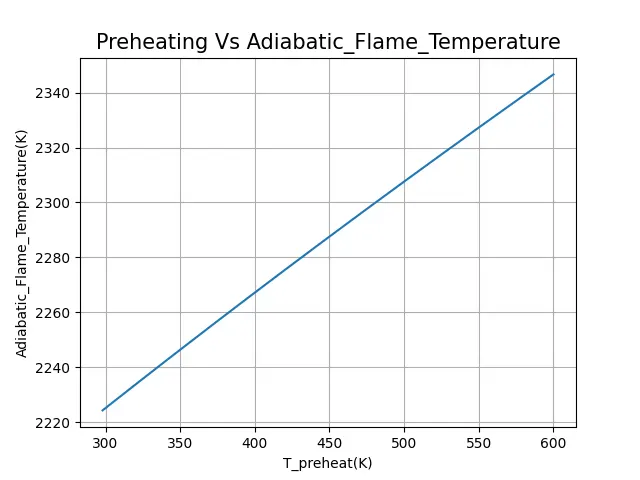
When looking at the plot we can see the AFT increasing linearly with respect to the preheating temperature of the air. This means the varying the temperature of the air getting heated increases the AFT. When the air temperature decreases the adiabatic flame temperature is also decreased meaning the air temperature is cold.
## Effect of preheating on the adiabatic flame temperature :-
To study the effect of preheating on the AFT, the inlet air temperature was varied from 298k to 600k, and for each temperature, a mixture of air and fuel was created under constant volume and brought to thermodynamic equilibrium to determine the adiabatic flame temperature of the mixture. The result is depicted by the following plot that compares the inlet air temperature with the adiabatic flame temperature.
CASE-2 :-
Combustion efficiency as a function of pre-heating temperature-
To determine amount of fuel saved as a result of preheating the air to 600k, we will write an energy balance for the control volume, assuming both the heat transfer to the load and the heat losses are the same, with and without preheat. Assuming steady flow, recognise that heat is transferred out of the control volume.
Steps wise procedures :-
-
Here has three quantity function i.e. Air, Fuel and Product.
-
Here mass and enthalpy for air and fuel are extra part because we use here here recuperator to increase combustion efficiency.
-
Air moles is 9.52 and fuel moles is 1.
-
Lower heating value is i.e. LHV = 50MJ/KG.
-
For standerd air temperature use O2 & N2 but, for 1700k use CO2, H2O and N2 is 1, 2, 7.52 moles.
-
Total moles i.e. Product moles is 10.52.
-
Use the formula for mass of air-fuel = mass_air/mass_fuel.
-
Then calculate efficiency for 298k by using the formula.
-
For calculating preheat temperature, efficiency and fuel saving use for loop.
-
Calculate efficiency at 600k.
-
From two efficiency calculate fuel savings.
CODE :-
"""
Preheat temperature Vs Combustion efficiency
Preheat temperature Vs Fuel savings
The reaction for stoichometric mixture of combustion of methane
CH4 + 2(O2 + 3.76N2) => CO2 + 2H2O + 7.52N2
"""
import cantera as ct
import matplotlib.pyplot as plt

gas = ct.Solution("gri30.cti")

Air = ct.Quantity(gas)
Fuel = ct.Quantity(gas)
Product = ct.Quantity(gas)

Air.TPX = 298.15,ct.one_atm,"O2:0.21,N2:0.79"
Air.moles = 9.52
mass_Air = Air.mass
H_Air = Air.enthalpy_mass

Fuel.TPX = 298.15, ct.one_atm,"CH4:1"
Fuel.moles = 1
mass_Fuel = Fuel.mass
H_Fuel = Fuel.enthalpy_mass		#Reactant enthalpy
LHV = 50e6		#Lower heating value in MJ/KG

#The total number of moles in the product is 10.52 which is calculated from the stoichometric mixture
Product.TPX = 1700, ct.one_atm,{'CO2':1/10.52,'H2O':2/10.52,'N2':7.52/10.52}
Product.moles = 10.52		#1+2+7.52 = 10.52
mass_Product = Product.mass
H_Product = Product.enthalpy_mass		#Product enthalpy
M_Air_Fuel = mass_Air/mass_Fuel

#Combustion efficiency at STP i.e. 298k
Eff_stp = (M_Air_Fuel*H_Air + H_Fuel - (M_Air_Fuel+1)*H_Product)/LHV
print("Combustion efficiency at STP = ",Eff_stp)

T_preheat = []		#Pre-heating temperature
Efficiency = []		#Combustion efficiency with respect to varying Preheat temperature
Fuel_saving = []	#Fuel savings

for T in range(298,601):
	Air.TPX = T,ct.one_atm,"O2:0.21,N2:0.79"
	Air.moles = 9.52
	mass_Air = Air.mass
	H_Air = Air.enthalpy_mass
	H_Air_Fuel = mass_Air/mass_Fuel

	# Efficiency at 600k
	Eff = (M_Air_Fuel*H_Air + H_Fuel - (M_Air_Fuel+1)*H_Product)/LHV

	#Fuel savings from two efficiency
	Fuel_savings = abs(1-(Eff_stp/Eff))

	T_preheat.append(T)
	Fuel_saving.append(Fuel_savings)
	Efficiency.append(Eff)


print("Combustion Efficiency at varied Preheating conditions = ",Efficiency)
print("Preheating Temperature(K) =",T_preheat)
plt.plot(T_preheat, Efficiency)
plt.plot(T_preheat, Fuel_saving, color = "red")
plt.xlabel("Preheating")
plt.ylabel("Efficiency")
plt.legend(["Combustion efficiency","Fuel Saving"])
plt.title("Combustion efficiency with Preheating",size = 20)
plt.grid()
plt.savefig("Combustion efficiency with Preheating")
print("Fuel Saved = ",Fuel_saving)
plt.show()
RESULTS :-
Fig :- Preheating temperature on combustion efficiency
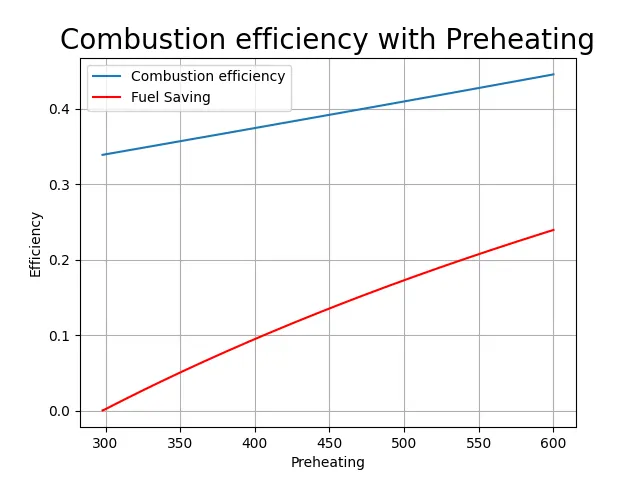
When looking at the plot we can see the combustion efficiency is increased with temperature and also there is saving in fuel. Initialy the fuel saving is negligible amount but as the air temperature is increased the fuel saving is also increased.
QUE.:- Does preheating help with fuel saving? If yes, how does combustion efficiency go up as a function of preheating temperature?
ANS. :- At 298.15k the fuel saved is 0.0001531 kg but at the temperature 608k the fuel saved is 0.239 kg giving as 199.74% increase in fuel savings with respect to the preheating temperature.
Similerly for the combustion efficiency at 298k is 0.3387 and combustion efficiency at 608k is 0.445 giving as 27.188% increase in combustion efficiency.
[Yes, Preheating helps the fuel saving and it increases the combustion efficiency of the furnace. As the temperature of air increases the combustion efficiency is also increased proportionally with respect to the preheating temperature assigned to the air.
We see that substaintial fuel savings can be realized by using recuperators to return some of the energy that would normaly go up the stack. Note that the nitric oxide emissions may be affected, since peak temperature will increase as a result of preheat. With air entering at 600k, the adabatic flame temperature increases 150k above the 298k air case.
For the range of preheat temperature investigated a 100k increase in air temperature results in about a 50k increase in flame temperature. This effect can be attributed to dissociation and to the larger specific heat of the product gasses compared with the air.
Combustion efficiency formula :-
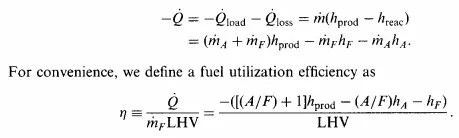
Fuel saving formula :-

##Is it right or wrong to assume a fixed furnace exit temperature ?
Explainations :-
The exit temperature depends upon the product temperature of the reaction which is necessary for the recuperator to preheat the air. If the exit temperature of the high then the preheating of the air will be faster which will help in increasing the thermal efficiency or the combustion efficiency which in turns helps in saving the fuel. This means that the exit temperature is directly proportional to the preheat temperature of the air.
CONCLUSIONS :-
From above project we can conclude that following points are-
-
Efficiency increases with increase in preheat temperature.
-
As inlet temperature gets preheated, it reduces the work of furnace to heat the air and hence fuel is saved.
-
As rate of combustion increases with increase in preheating temperature combustion efficiency increases.
-
Preheating temperature depends upon the product of the combustion, as the cycle proceeds which leads to damage of recuperator. Hence it is necessary to maintain outlet temperature of recuperator as fixed value.
-
Recuperator should be well insulated for preserving the inlet heat.
-
As efficiency is directly proportional to useful heat i.e. Adiabatic flame temperature, it must increases and indirectly proportional to the lower heat value (LHV), it decreases for getting more efficiency.
-
Fuel saving is depends upon efficiency ratio, if this ratio is minimum then we can save more fuel and vice versa.
- As preheating temperature increases, Adiabatic flame temperature (AFT) also increases and vice-versa.
In this way I completed this project by writing cantera script, plotting and calculating respected quantity.