Combustion Efficiency Calculation after Preheating
AIM
The aim of this challenge is to study the effect of Pre heated air on combustion efficiency and Adiabatic Flame Temperature
OBJECTIVES
- Effect of Preheating on adiabatic flame temperature
- Effect of preheating on Combustion efficiency
- Energy balance for Recuperator
RECUPARATOR
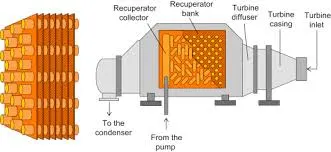
A recuperator is a special purpose counter flow energy recovery heat exchanger positioned within the supply and exhaust air streams of an air handling system, or in the exhaust gases of an industrial process, in order to recover the waste heat. Generally, they are used to extract heat from the exhaust and use it to preheat air entering the combustion system. In this way they use waste energy to heat the air, offsetting some of the fuel, and thereby improves the energy efficiency of the system as a whole.
In many types of processes, combustion is used to generate heat, and the recuperator serves to recuperate, or reclaim this heat, in order to reuse or recycle it. The term recuperator refers as well to liquid-liquid counterflow heat exchangers used for heat recovery in the chemical and refinery industries and in closed processes such as ammonia-water or LiBr-water absorption refrigeration cycle.
Recuperators are often used in association with the burner portion of a heat engine, to increase the overall efficiency. For example, in a gas turbine engine, air is compressed, mixed with fuel, which is then burned and used to drive a turbine. The recuperator transfers some of the waste heat in the exhaust to the compressed air, thus preheating it before entering the fuel burner stage. Since the gases have been pre-heated, less fuel is needed to heat the gases up to the turbine inlet temperature. By recovering some of the energy usually lost as waste heat, the recuperator can make a heat engine or gas turbine significantly more efficient.
ENERGY BALANCE FOR RECUPARATOR
The energy balance for the combustion efficiency is as follows
`eta_c=frac[Q][dotm_fxxLHV}`
`Q = dotm(h_p-h_r)`
now,
`Q= (dotm_a+dotm_f)h_p-dotm_fh_f-dotm_ah_a`
Combustion Efficiency
`eta_c=frac[-(dotm_a-dotm_f)h_p+dotm_ah_a+dotm_fh_f][dotm_fxxLHV`
CODE FOR EFFECT OF PREHEATING ON ADIABATIC FLAME TEMPERATURE
# Efficiency of Preheating on AFT

import matplotlib.pyplot as plt
import numpy as np
import cantera as ct

gas = ct.Solution('gri30.xml')
T_air = np.linspace(298,600,50)
tad = []


for i in T_air:

	gas.TPX = i,101325,{'CH4':1, 'O2':2, 'N2':7.52}
	gas.equilibrate('HP','auto')
	tad.append(gas.T)

print(tad)
plt.plot(T_air,tad,'c')
plt.xlabel('Preheated Air Temperature')
plt.ylabel('Adiabatic Flame Temperature')
plt.title('Effect of Preheating on AFT')
plt.grid()
This simple code represents the preheating of air mixture in the combustion process. First we create an object called gas and call the Cantera library. The Solution class includes the chemistry solver for the reactions. Since we have to vary the temperature of air from 298 K to 600 K we have create an array for the temperature of air using linspace command. So using the for statement we are telling python to solve for all the 50 values of temperatures to solve it. The stoichiometric combustion is assumed for this and STP conditions are defined. Then we keep on appending the tad array and plot the results.
CODE OUTPUT
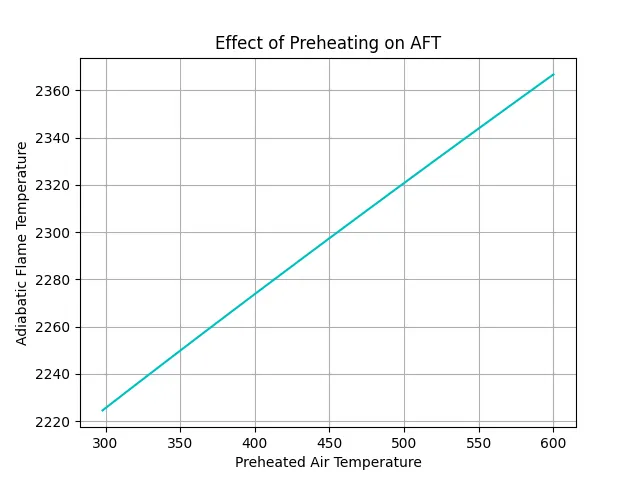
The prehating increases the adiabatic flame temperature in a linear trend.
CODE FOR EFFECT OF PREHATING ON COMBUSTION EFFICIENCY
# Air preheating temperature is varied from 298K to 600K
import matplotlib.pyplot as plt
import cantera as ct
import numpy as np

gas = ct.Solution('gri30.xml')
T_air = np.linspace(298,600,15)
LHV_fuel = 50e6
m_air = 274.656768
m_fuel = 16.04206
A_F = 17.121
H_air = []
Q = []
eta = []
# Stoichiometric reaction for Combustion

A = ct.Quantity(gas)
A.TPX = 298.15,101325,'CH4:1'
A.moles = 1

for i in T_air:
	B = ct.Quantity(gas)
	B.TPX = i,101325,{'O2':2, 'N2':7.52}
	B.moles = 1
	H_air.append(B.enthalpy_mass)

C = ct.Quantity(gas)
C.TPX = 1700,101325,{'CO2':1,'H2O':2,'N2':7.52}
C.moles = 1

H_fuel = A.enthalpy_mass
H_product = C.enthalpy_mass

for i in range(len(T_air)):
	Q= -(((A_F + 1)*H_product) - (A_F * H_air[i]) - H_fuel)
	eta.append(Q/LHV_fuel)

Fuel_saving = (1- (eta[1]/eta[-1]))*100

plt.plot(T_air,eta)
plt.xlabel('Temperature of Preheated Air')
plt.ylabel('Combustion Efficiency')
plt.title('Effect of Preheated Air On Combustion Efficiency')
plt.grid()
plt.show()
Now in this code we first define the air temperature using linspace command, then we define important parameters like mass of air, mass of fuel, A/F Ratio. Then we store the heat, enthalpies and combustion efficiency in an empty array. Now we define object A which is the fuel(methane) and give the respective moles for products and reactants.Now the object B is defined for the air which is to be repeated to execute the temperature from 298 K to 1700 K, so we use the for loop B. The C object denotes the preheated air mixture.
Next what is done is we write the formula to calculate the combustion efficiency in form of A/F ratios of all the 3 gases and is repeated again using for loop. Then the results are then plotted.
CODE OUTPUT
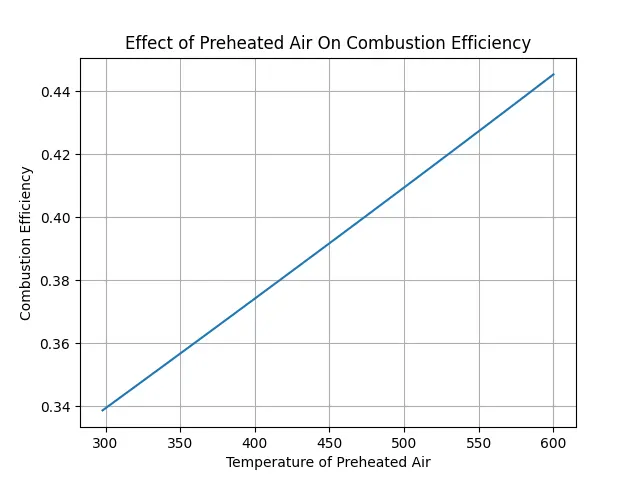
We can see that the preheated air increases the combustion efficiency and it almost follows the linear trend as well here. Now in this case we have assumed the exhaust temperature to be as 1700 K which is not right because the exhaust temperature depends on lot of factors as well
CONCLUSION
- The effect of preheating on adiabatic flame temperature was reviewed
- The effect of preheating on combustion efficiency was reviewed
- The plot shows linear trends for both the cases
- There is an raise in the combustion efficiency with preheating of air