Combustion Efficiency Calculation after Preheating
Objectives:
- To study the effect of preheating on Adiabatic Flame Temperature of the recuperator system
- To study the effect of preheating on combustion efficiency and fuel saving
Theory:
In a gas turbine, to increase the overall efficiency, the exhaust gases coming out of the turbine are utilised to heat up the incoming air to the boiler. When the work output is constant, this decreases the heat energy input to the boiler and thus increases the efficiency. This process of heating the incoming air using exhaust gases from the turbine is called as Regeneration.
Similarly, a heat exchanger (heat exchangers operatre at constant pressure, so constant pressure process) is incorporated right at the exit of the boiler or furnace to heat up the incoming air using exhaust gases from the boiler (combustion products), this heat exchanger is called as a Recuperator.
The maximum temperature upto which the incoming air can be heated to is the temperature of exhaust gases. So in case of regenration, regeneration efficiency is the ratio of actual heat added to the air to the maximum heat that can be added.
However, in this project, combustion efficiency is calculated and the effect of preheating on combustion efficiency is studied. The heat output from the boiler is compared with the maximum heat that can be extracted from the fuel (Lower Heating Value).
When the air is pre-heated, its pressure increases and because of which the work potential of the system increases, which promotes auto ignition process. As temperature increases, air density decreases, which gives an effect of lower mass of air and as for a given quantity of fuel, if quantity of air is less, the value of `phi` will become greater than one, which becomes a rich mixture. And the effect is that the combustion is rich for a stoichiometric quantity of fuel.
Tha Adiabatic Flame Temperature also increases with an increase in pre-heat temperature, as pressure increases with an increase in temperature and so fuel burns for more time.
The heat output from the system is calculated by applying energy balance as (First law of Thermodynamics for open system),
`h_(fuel) + h_(air) - Q_(out) + h_(pro) = 0`
From the expression above, heat output is found out.
The combustion efficiency or the percentage of maximum heat that can be extracted is,
`eta_(combustion) = Q/(LHV)`
Fuel saved due to pre heating = `1-(eta_(298)/eta_(current))`
Introduction:
In this project, the code to simulate the combustion is written in Python, using Cantera. Seperate objects (instances) are created for both fuel and air, so that characteristics of air can be altered independently. The temperature of products is kept constant at 1700 K. The range of preheat tempearture values considered is 298 K to 600 K. The equivalence ratio considered is 1 (the variation of AFT and combustion efficiency with pre heat temp. for rich and lean mixtures are shown in the appendix column).
A. Effect of pre heating on Adiabatic Flame Temperature:
The Python code to study the variation of AFT with preheating of air is,
import cantera as ct
import matplotlib.pyplot as plt

gas = ct.Solution('gri30.cti')

fuel = ct.Quantity(gas)
fuel.TPX = 298.15,ct.one_atm,'CH4:1'
fuel.moles = 1

T_min = 298
T_max = 601
T_aft = []
air = ct.Quantity(gas)
T = []

for i in range(T_min,T_max):
	air.TPX = i,ct.one_atm,{'O2':0.21,'N2':0.79}
	air.moles = 7.52/0.79
	M = fuel + air
	M.equilibrate('HP')
	A = M.T
	T_aft.append(A)
	T.append(i)

plt.plot(T,T_aft,'*',color='blue')
plt.xlabel('Preheat Temperature (K)')
plt.ylabel('Adiabatic Flame Temperature (K)')
plt.title('Effect of preheat temperature on AFT')
plt.show()
Results:
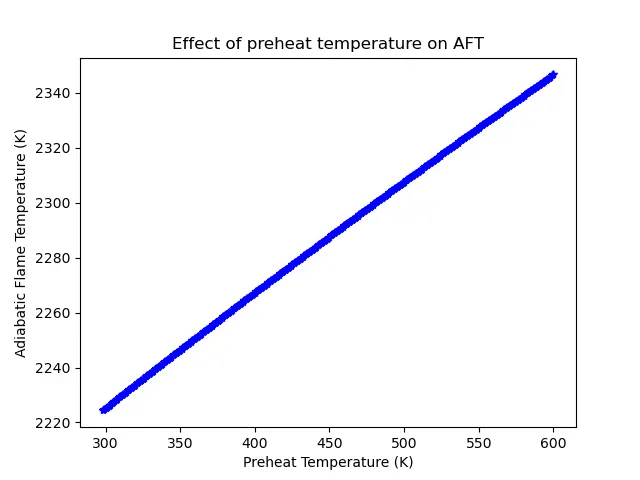
When the above code is executed, the result is,
Inferences:
- The Adiabatic Flame Temperature is increasing with increase in pre heat temperature linearly. This is because of disassociaation of molecules and large specific heat values of products. Large specific heat means that it takes large amounts of heat to increase the temperature. Temperature just means the kinetic energy of molecules and because of disassociation, the atoms and molecules store more kinetic energy and hence has large values of temperature
- Also, as mentioned above, as temperature increases, pressure increases and density decreases, which promotes pre iignition and also fuel burns longer, which increases the system temperature
- The slope of the line is ~0.4, which means that for each unit increase in pre-heated air temperature, the AFT is increasing 0.4 times
B. Effect of pre heating on combustion efficiency:
Python code to study the effect of pre heating on combustion efficiency is,
In the code e, the Lower Heating Value of the fuel is considered 50 MJ/kg. Also, the enthalpies of reactants (air and fuel) and products are directly calculated analytically, using Cantera.
NOTE: The furnace outlet temperature is maintained constant at 1700 K
import cantera as ct
import matplotlib.pyplot as plt

gas = ct.Solution('gri30.cti')

phy = 1

fuel = ct.Quantity(gas)
fuel.TPX = 298.15,ct.one_atm,{'CH4':1}
fuel.moles = phy


if phy <= 1:
	products = ct.Quantity(gas)
	tot = (phy + (2*phy) + 2*(1-phy) + 7.52)
	products.TPX = 1700,ct.one_atm,{'CO2':(phy/tot),'H2O':((2*phy)/tot),'O2':((2*(1-phy))/tot) ,'N2':(7.52/tot)}
	products.moles = tot

if phy > 1:
	products = ct.Quantity(gas)
	tot = (4-3*phy) + (2*phy) + 4*(phy - 1) + 7.52
	products.TPX = 1700,ct.one_atm,{'CO2':((4-3*phy)/tot),'H2O':((2*phy)/tot),'CO':((4*(phy-1))/tot) ,'N2':(7.52/tot)}
	products.moles = tot

LHV = 50e6 #J/kg

T_min = 298
T_max = 601


for T in range(T_min,T_max):
	air = ct.Quantity(gas)
	air.TPX = T,ct.one_atm,{'O2':0.21,'N2':0.79}
	air.moles = 7.52/0.79

	m_fuel = fuel.mass
	m_air = air.mass

	h_fuel = fuel.enthalpy_mass #J
	h_air = air.enthalpy_mass #J
	h_products = products.enthalpy_mass #J

	Q = m_fuel*h_fuel + m_air*h_air - ((m_air+m_fuel)*h_products) #J
	eff = (Q/(m_fuel*LHV))*100

	if T == 298:
		eff_atm = eff

	fuel_savings = abs((eff - eff_atm)/eff)*100

	plot_1 = plt.figure(1)
	plt.plot(T,eff,'*',color='red')
	plt.xlabel('Preheat temperature (K)')
	plt.ylabel('Combustion efficiency (%)')
	plt.title('Variation of combustion efficiency with preheat temperature, for stoichiometric mix.')


	plot_2 = plt.figure(2)
	plt.plot(T,fuel_savings,'*',color='blue')
	plt.xlabel('Preheat temperature (K)')
	plt.ylabel('Fuel savings (%)')
	plt.title('Variation of percentage of fuel saved with preheat temperature, for stoichiometric mix.')


plt.show()
Results:
When the above code is executed, the results are,
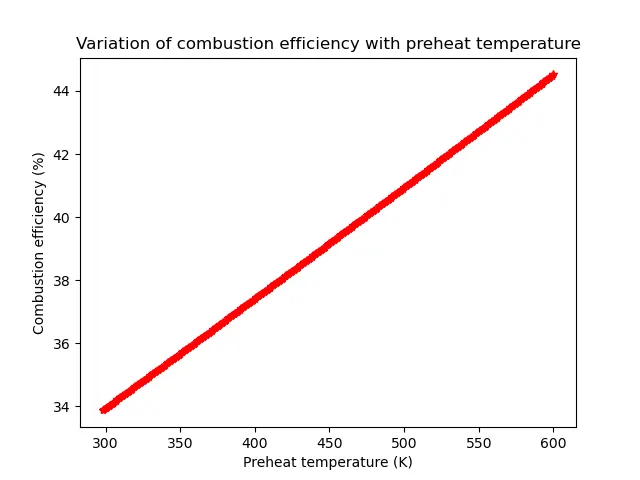
The effect of preheat temperature of air on combustion efficiency,
Inferences:
- The combustion efficiency is clearly increasing with increase in pre heat temperature, this can be traced back to the fact that as temperature increases, density decreases and the mass decreases, which makes the mixture rich. Because of which the heat generated is more and so is combustion efficiency
- Also, as temperature increases, pressure also increases which promotes auto ignition of fuel and also the intensity of burning. Both of these combined makes the fuel burn for more time which then generates more heat and thus the combustion efficiency increases
- The slope of the line is ~0.0345, meaning that for every unit increase in pre heat temperature, the efficiency is increasing 0.0345 times
Inferences:
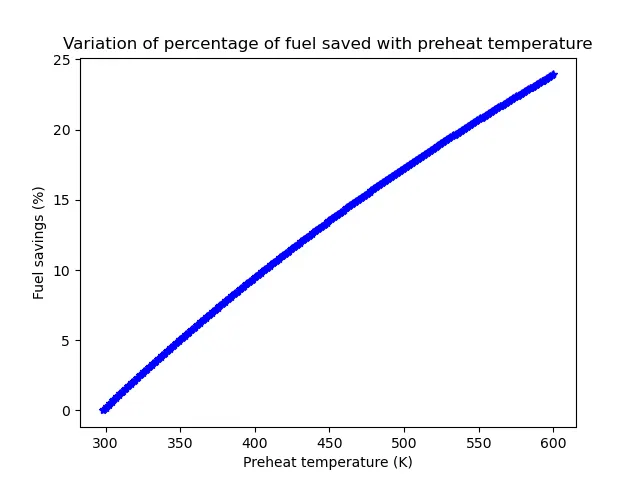
- The percentage of fuel saved is increasing with increase in preheated temperature of inlet air to the boiler (for a given outlet temperature). The reason for this, as mentioned above is because of decrease in density, which causes an effect of decrease in mass and so the mixture slightly becomes rich. Because of this, for a fixed outlet temperature, less fuel will be sufficient
- The variation though is not linear and the slope of the curve is initially increasing (rate of change of fuel saving is higher) and at higher temperatures, the slope is decreasing, meaning that the change in fuel savings is low for a given change in preheat temperature
C. It is good to use a fixed furnace exit temperature when a recuperator is employed because, as in recuperator the exhaust gases or flue gases or combustion products are used to heat the incoming air to the boiler, because of which the AFT keeps on increasing, the furnace exit temperature would be high. And for the next cycle, the temperature will be higher than the previous cycle and this keeps on increasing upto a point where this high temperature or the high pressure which comes along, the device will be damaged. To avoid the damage to the device, it is right to maintain a fixed furnace temperature.
Conclusions:
- Preheating the inlet air to the boiler or furnace has an increasing effect on Adiabatic Flame Temperature. When plotted, the slope of the line is found to be ~0.4 and the maximum AFT being 2340 for a given range of pre heated air temperature
- Preheating the inlet air to the boiler or furnace has an increasing effect on combustion efficiency too. The increment of combustion efficiency for a unit increase in preheated air temperature is found to be ~0.03
- Fuel savings also has an increasing effect, with maximum percentage of fuel that can be saved being ~25%, with increase in preheat temperature
- It can be concluded that when a recuperator is incorporated in the system, to get the maximum combustion efficiency, the mixture is to be maintained stoichiometric
Appendix:
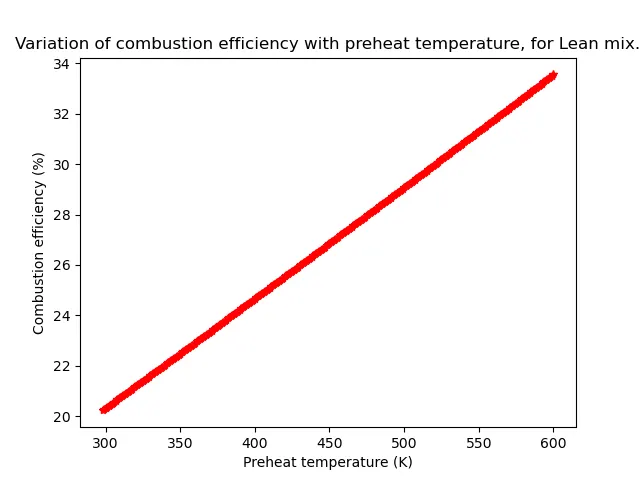
When the equivalence ratio is altered, the combustion efficiency also changes. The variation of combustion efficiency will be as follows,
A. Lean mixture:
B. Rich mixture:
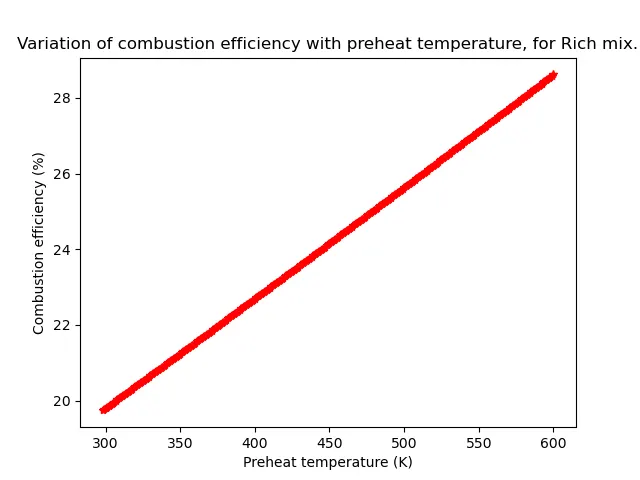
NOTE: The equivalence ratio values used for lean and rich mixture are 0.8 and 1.2 respectively.
- Notice that for lean mixture and rich mixture, the combustion efficiency is less than that of stoichiometric mixture with the latter being the lowest. So when a recuperator is used, to obtain maximum combustion efficiency, the mixture should be stoichiometric