Week 4 - CHT Analysis on Exhaust port
CHT Analysis on Exhaust port
Conjugate heat transfer
Conjugate heat transfer corresponds with the combination of heat transfer in solids and heat transfer in fluids. In solids, conduction often dominates whereas in fluids, convection usually dominates. Conjugate heat transfer is observed in many situations.
For example, heat sinks are optimized to combine heat transfer by conduction in the heat sink with the convection in the surrounding fluid.
Heat Transfer by Solids and Fluids
Heat Transfer in a Solid
In most cases, heat transfer in solids, if only due to conduction, is described by Fourier’s law defining the conductive heat flux, q, proportional to the temperature gradient:  .
.
Heat Transfer in a Fluid
Due to the fluid motion, three contributions to the heat equation are included:
- The transport of fluid implies energy transport too, which appears in the heat equation as the convective contribution. Depending on the thermal properties on the fluid and on the flow regime, either the convective or the conductive heat transfer can dominate.
- The viscous effects of the fluid flow produce fluid heating. This term is often neglected, nevertheless, its contribution is noticeable for fast flow in viscous fluids.
- As soon as a fluid density is temperature-dependent, a pressure work term contributes to the heat equation. This accounts for the well-known effect that, for example, compressing air produces heat.
Conjugate Heat Transfer Applications
Effective Heat Transfer
Efficiently combining heat transfer in fluids and solids is the key to designing effective coolers, heaters, or heat exchangers.
The fluid usually plays the role of energy carrier on large distances. Forced convection is the most common way to achieve high heat transfer rate. In some applications, the performances are further improved by combining convection with phase change (for example liquid water to vapor phase change).
Even so, solids are also needed, in particular to separate fluids in a heat exchanger so that fluids exchange energy without being mixed.
Heat sinks are usually made of metal with high thermal conductivity (e.g. copper or aluminum). They dissipate heat by increasing the exchange area between the solid part and the surrounding fluid.
Modeling and solving approach in ANSYS
We have a geometry given in the challenge, here we have to extract the volume for internal flow analysis.
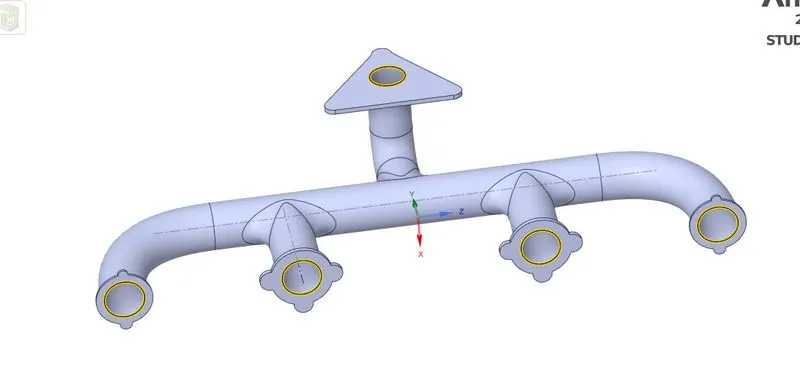
CHT analysis requires both the solid and liquid volume, the both volumes are copied unto one component, using share topology
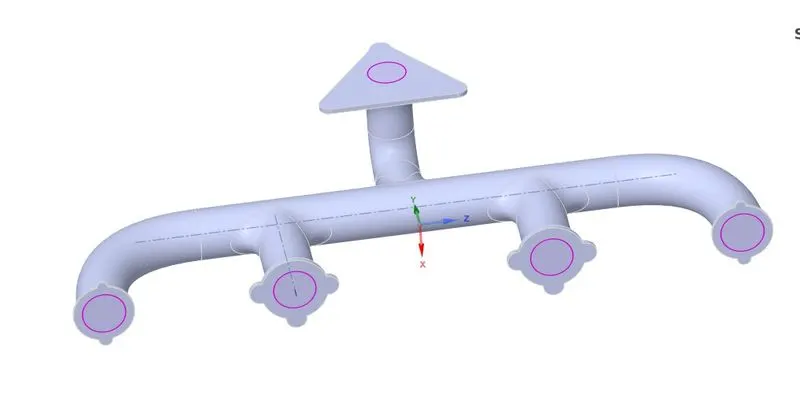
so that it shares the node points while meshing .
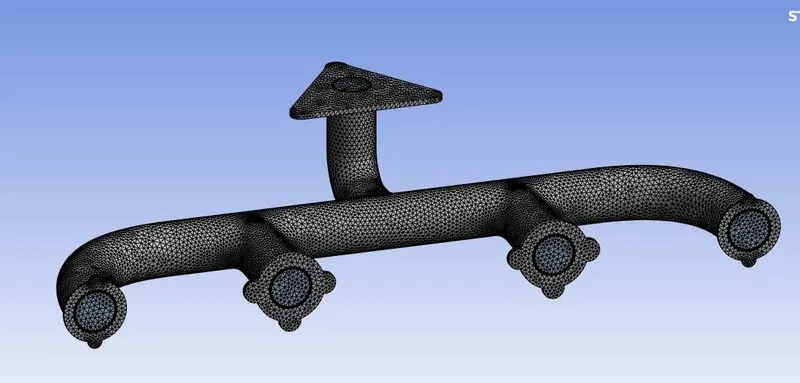
Mesh
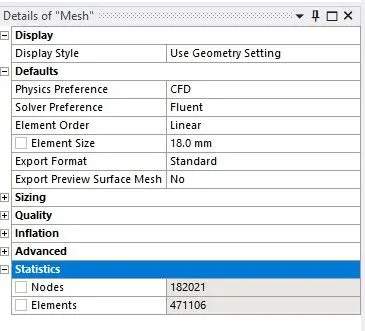
Then the geometry is loaded into mesh window for preprocessing and then simulated for refined mesh of 18mm
total elements are 471106.
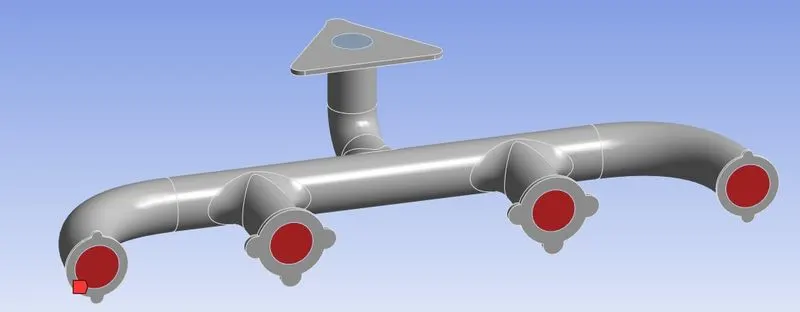
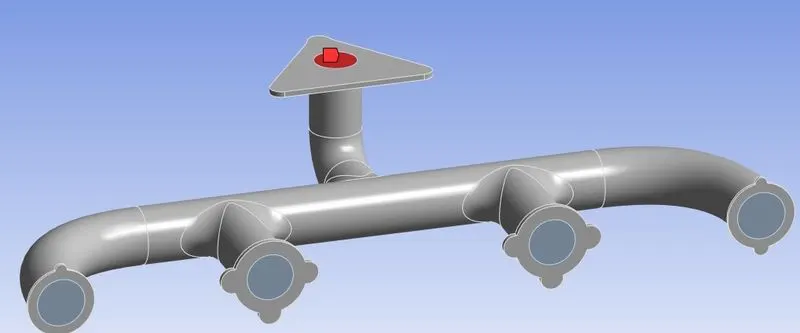
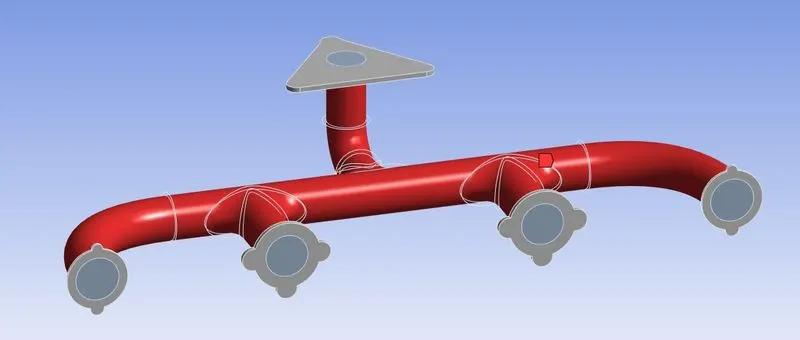
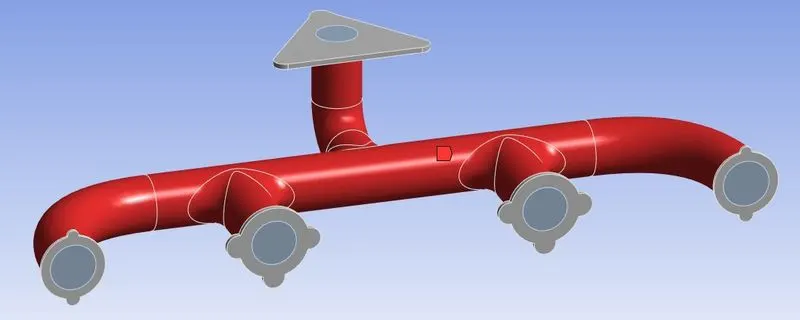
Name tag created as inlet,outlet,internal and external pipe wall. those collars at inlet and outlet ansys take it as adiabatic wall.
|
Inlet
|
Outlet
|
|
Internal pipe wall
|
External pipe wall
|
Inflation layer
According to y+ calculator first layer height is 0.06mm , total thickness of inflation layer should be atleast equal to boundary layer thickness. here our boundary layer thickness is 7.05mm and our total inflation layer thickness is 7.60mm
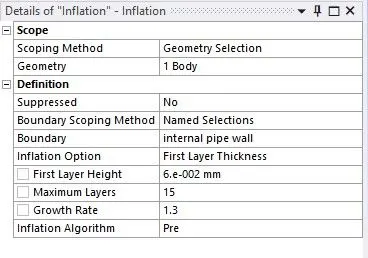
We have taken y+ value as 1 for k-omega model. there are 15 layers with the growth rate of 1.3.
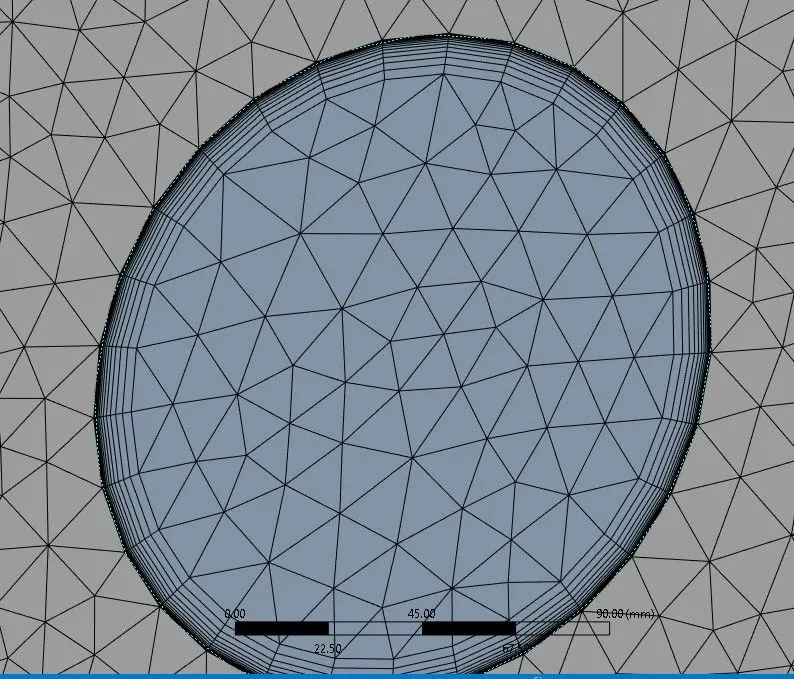
Final mesh
Now lets move on to setup for solving
We have taken the turbulence model as K-omega for nearby wall analysis.
Inlet parameters we have the velocity of 5m/s and the temperature is 700k.
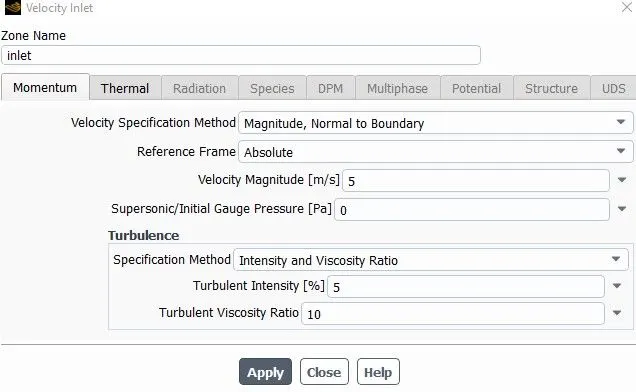

and HTC of external pipe wall is 20w/m^2k.
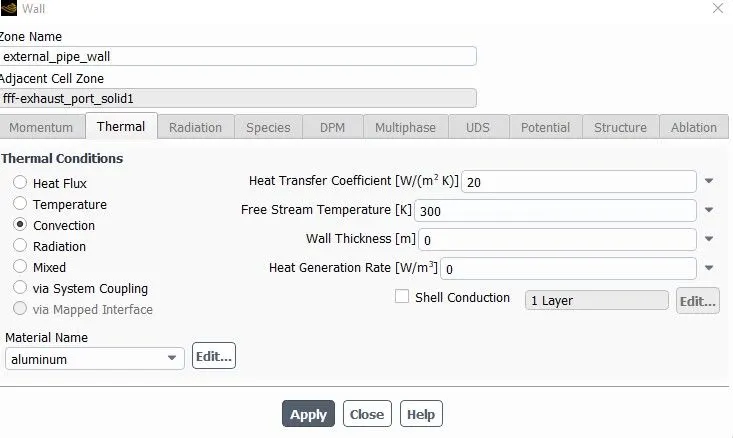
Heat transfer coefficient
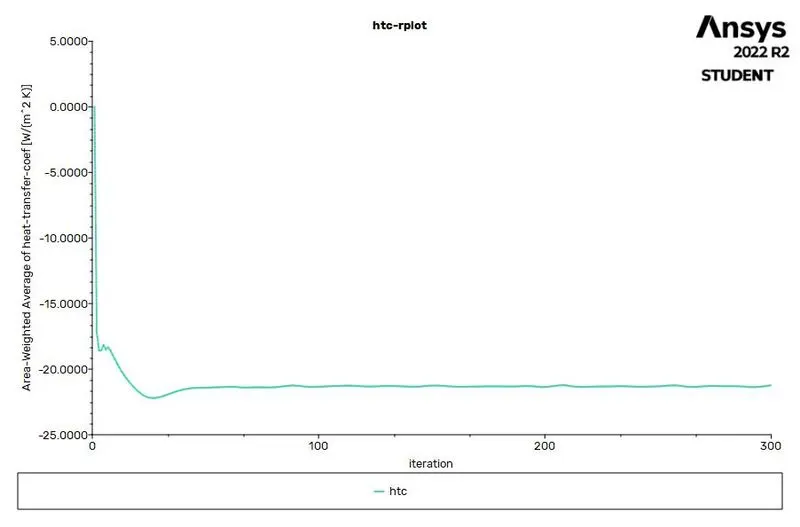
Averahe heat transfer coefficient=-21.22161w/m^2.k
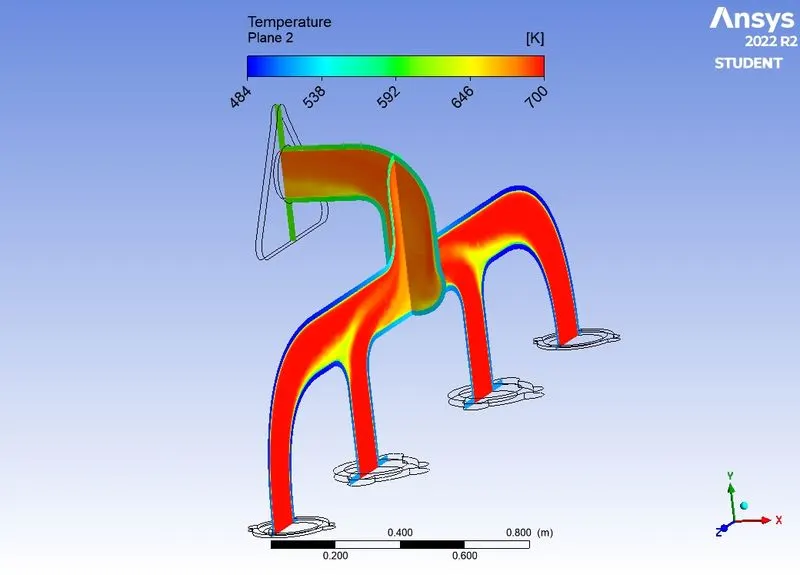
Temperature contour
Velocity contour
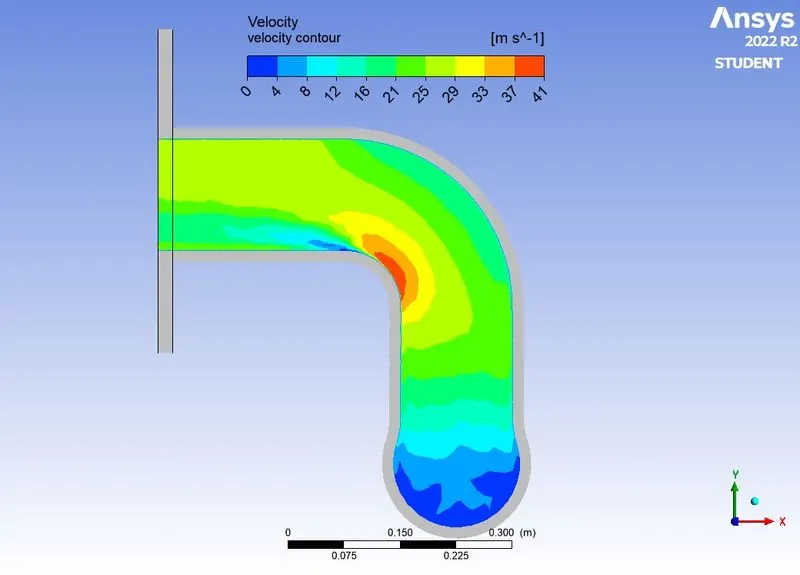
Here in velocity contour flow seperation happens at the bend and velocity increases due to sudden bend.
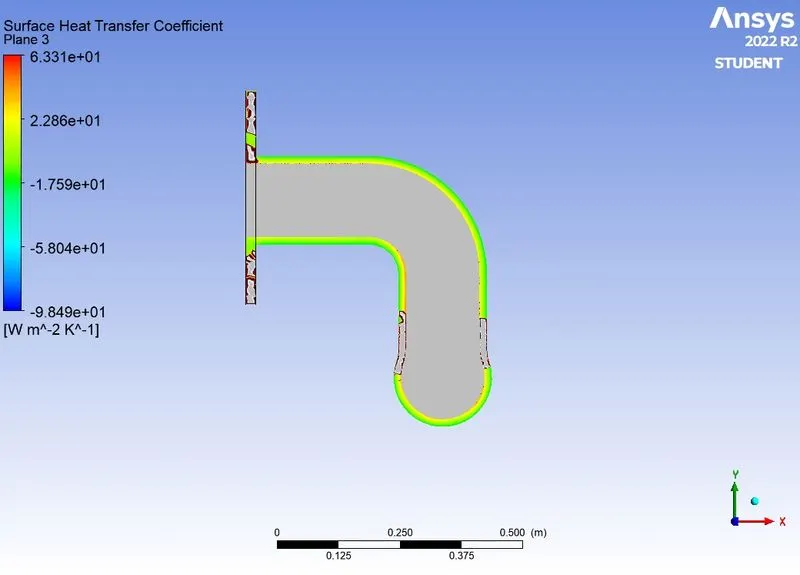
Surface heat transfer coefficient
Output:
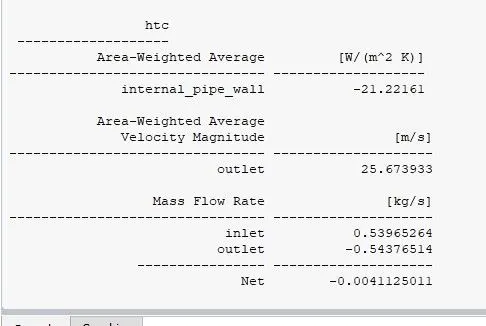
As per the challenge requirement we have to validate heat transfer coefficient for that we know Nusselt number
Nusselt number describes the relation between convective and conductive heat transfer.
Nu=h*D/k
for internal flow with turbulent we have a corelation
`Nu=0.023*Re^0.8 *Pr^0.3`
Prandtl number for air is 0.7
Reynolds number =56447
Nu=130.7886148
if Nu>1 convection dominates over conduction heat transfer
`130.7886148=(h*0.17)/(0.025)`
h=19.23361983w/m^2k
h will vary place to place, so here 21.22 is average heat transfer coefficient.