Week 4 - CHT Analysis on Exhaust port
Aim- CHT analysis on 4-cylinder in-line engine exhaust port.
Introduction- Conjugate heat transfer is a type of heat transfer between solids and fluid. This type of heat transfer includes both convection (between fluids) and conductive (between solids) heat transfer, as well as both forced and natural convection.
The Conjugate Heat Transfer (CHT) analysis type allows for the simulation of heat transfer between solid and fluid domains by exchanging thermal energy at the interfaces between them.
Procedure- the pre processing and geometry setup along with the modelling approach with solver setting is completed in the further steps.
Step_1 setting up the geometry
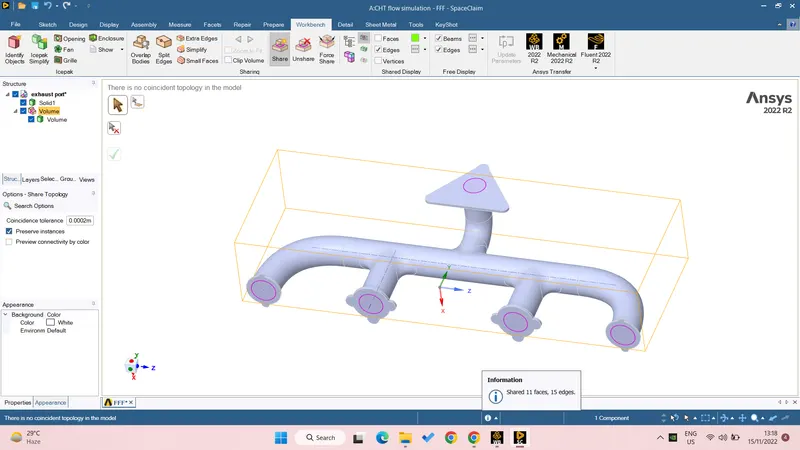
- Here the simulation is internal and the heat is flowing from hot fluid to solid boundary.
- Change the unit into meters.
- Extract the inlet volume from the whole model, by using volume extraction method.
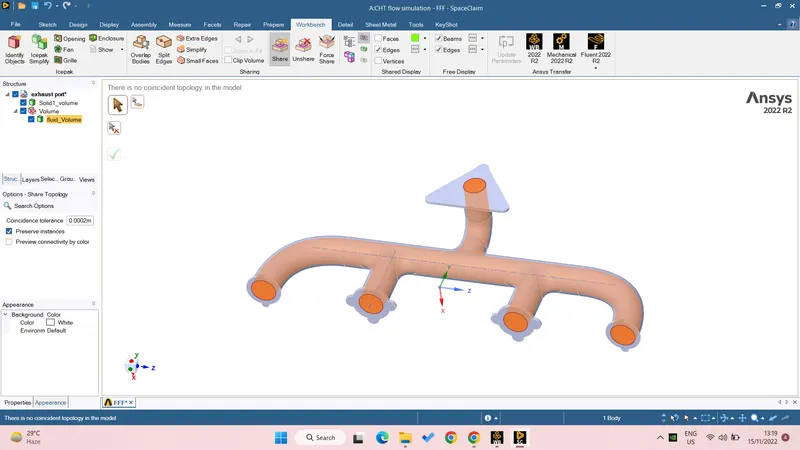
- Share the topology between both two interface.
- Check for the extra edge, and delete if any.
- The inner wall can be seen with different colour, which shows the share topology is working.
Step_2 meshing interface and pre processing
- Generate the mesh first, here will see as the share topology is on the cells node are attached to each other at the point.
- Now name the surfaces by selecting the face, inlet as the 4 inline part, outlet as the one part, outer wall as the convective wall and the inner wall as the fluid wall.
- Fluid domain is the box selection of inner wall along with inlet and outlet face.
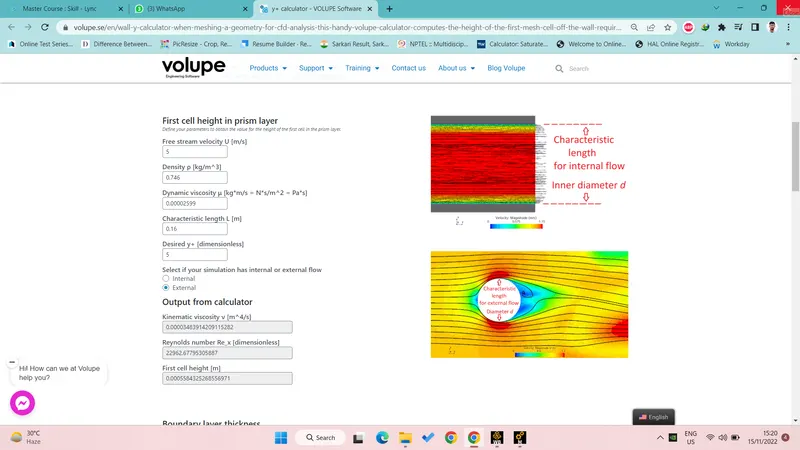
- Provide the Y+ or inflation layer as insert in the body by selecting fluid domain as the geometry and the inner wall as the boundary.
- By using the Y+ calculator and providing the appropriate inlet material property to the calculator we will have,
First layer thickness – 0.6mm
No of layer - 10
Growth rate – 1.2
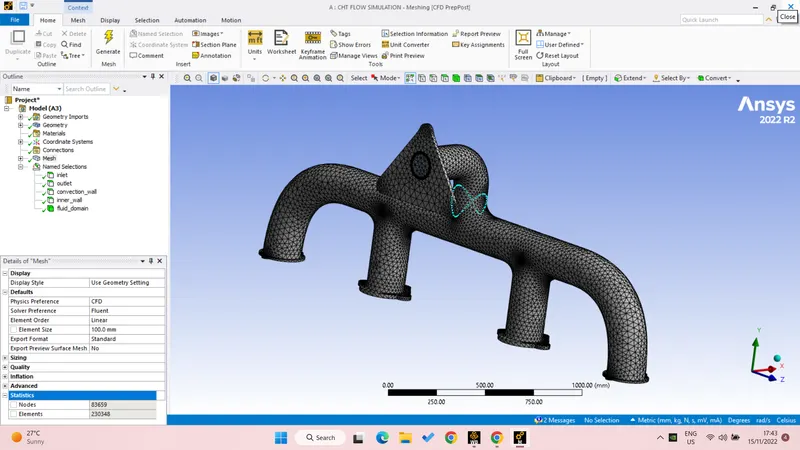
- Here it can be seen that the geometry is divided into around 2.3 lac no of mesh elements.
Step_3 setting up the physics and solver.
- Here the solver type is steady state, pressure based having the energy transfer is turned on.
- We are going to use the k- omega SST turbulence model. As it has the low range of working and heat transfer phenomena takes place near to the surface wall.
- The cell zone is solid for outer and liquid for inner.
- Boundary conditions are given as follows.
Inlet – velocity- 5m/s and temperature – 700k
Outlet – zero-gauge pressure outlet – with temperature -300k
Convection wall – 20 w/m2k and the temperature is 300k
Click apply and close the boundary condition.
- The material is aluminium for solid and air for liquid, the following are the inlet air material property as of the mean temperature is around 500k
Density - 0.746 kg/m3
Specific heat -1026 J/kgK
Thermal conductivity – 0.039 w/mK
Dynamic viscosity – 2.6e^-05 Ns/m2
These values are taken from the HMT data book at 1 ATM absolute pressure and 200 degree celcius.
- Here to see the result before initialising the hybrid solution we are providing the contour and plot to calculate the wall heat transfer coefficient.
Result- the following results are obtain from the solution after providing the plane on the different position and providing them with different measure variable.
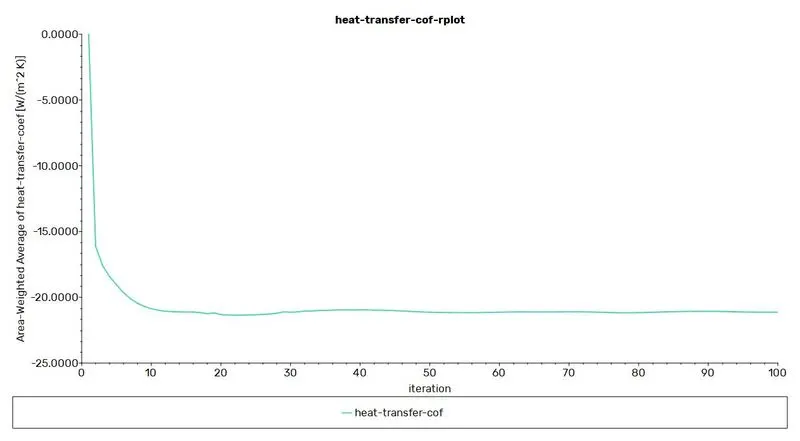
Here the plot is showing the value of wall heat transfer coefficient as the solution is being conserved. Also the negative sign is showing here the heat is going away from the surface wall.
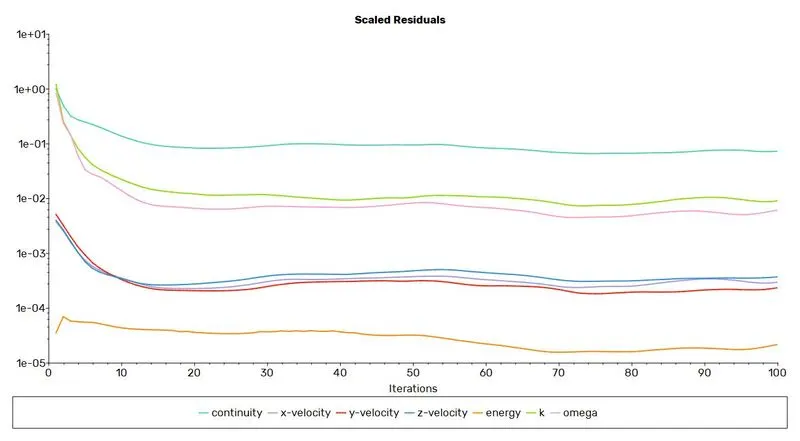
The residual from the equation is also being converged at some value after some iteration.
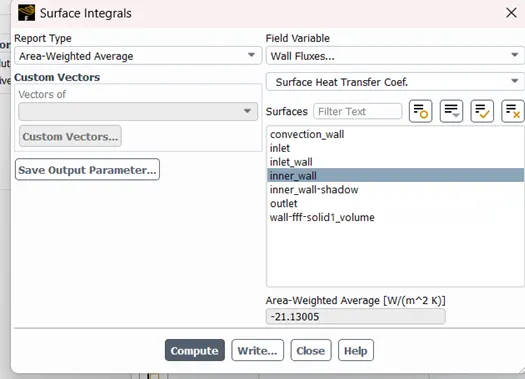
Here the area weighted average value of heat transfer coefficient can also be seen as around 21 with same negative sign.
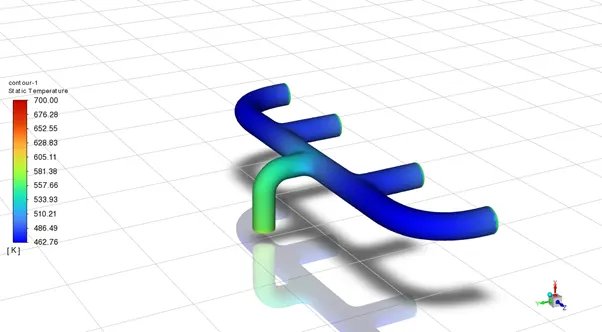
Temperature contour over the model is showing here the average 462.7K is present near the surface wall but above 500k near the inlet and outlet.
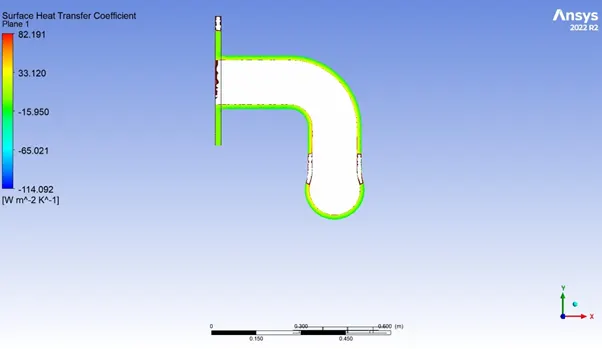
The image above is showing the heat transfer coefficient as the inflation layer is provided near the surface wall.
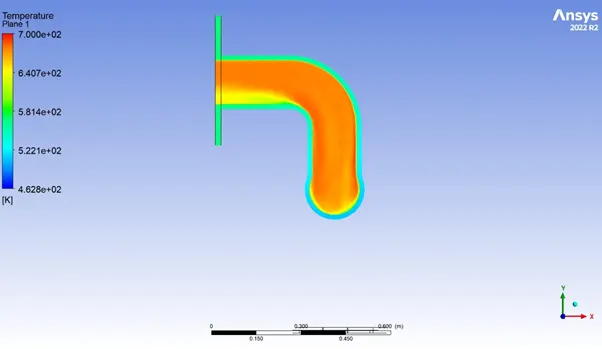
The above image is showing the temperature analyse near the outlet port and the above average the value of temperature can be seen here.
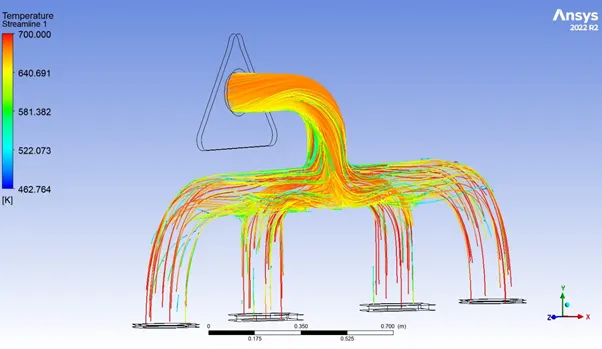
This image here is showing the streamline temperature analysis from 4 inlet to 1 outlet and the temperature distribution can be observe over the legend view.
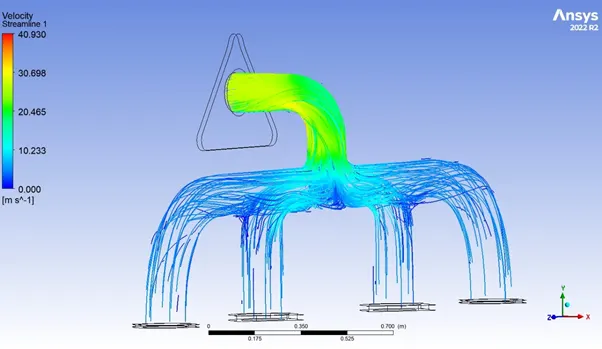
This image here is showing the streamline velocity analysis from 4 inlet to 1 outlet and the velocity distribution can be observe over the legend view, here near the outlet high velocity can be seen.
Learning outcome- The heat transfer coefficient is the heat transferred per unit area per kelvin. Thus area is included in the equation as it represents the area over which the transfer of heat takes place. The areas for each flow will be different as they represent the contact area for each fluid side.
Accordingly, the convection heat transfer coefficient depends on (1) the fluid thermophysical properties and (2) the fluid velocity. These factors should be considered in the analysis and design of energy structure. That coefficient depends on the fluid's material properties, the surface temperature and, for forced convection, also on the fluid's flow rate.is dependent on space, time, geometry, orientation of solid surface.
Here the heat transfer coefficient can also be calculated by the using following formula.
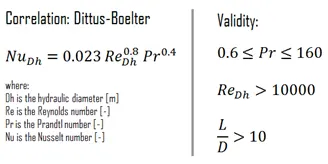
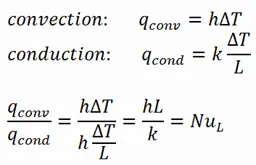
Here by using the following formula at the 200 degree Celsius by taking reference values of material from data book we will have the heat transfer coefficient value is nearly 20 W/m^2K.
Conclusion- Here we can see the value of heat transfer coefficient is coming around 21 W/m^2K from the fluent solution and by using the analytical formula its value is also coming almost near thus its validate our result and also show the accuracy of the model and physics values that we have taken along with the refine mesh size.
As from 1st class I know the ultimate use of the ANSYS software is not just to generate the colourful image at the end but also I should be capable of validating the generating result by comparing with some reference value, and that will provide me a good and fruitful result along with the learning in CFD domain.