Week-4 Challenge WOT Condition Part-2
What is the difference between mapped and dynamic model of engine, motor and generator? How can you change model type?
Model Mapped:
One form of model where the data points have already been assigned in lookup tables is the mapped model.
Without taking into account the actual motor or engine parameters, the required engine or motor torque is sensed, and the motor or engine block creates the output just as needed.
The output values are saved for the corresponding provided engine motor and generator input values.
This type's accuracy is not very good, but because it is not run using real-time parameters, the simulation can be completed considerably more quickly.
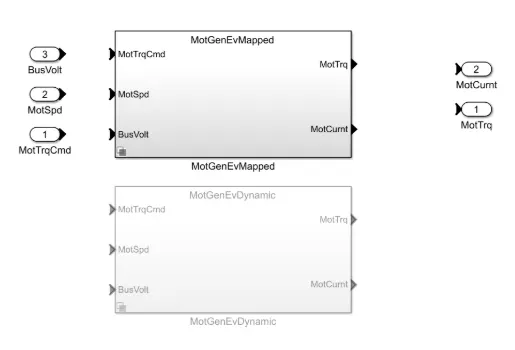
Dynamic Model:
* In contrast, the dynamic model creates its output by combining the outputs from several subsystems.
* It operates through real-time simulation, where the necessary input from the drive cycle is received, for which a separate real-time simulation is carried out, and for which the output for the simulation is obtained by adding together all the results of the subsystem.
* The initial Bus voltage, current, and vehicle feedback are provided in accordance with the drive cycle requirements so that the simulation is executed at that specific point during the drive cycle.
* Because it takes into account the actual outputs from every subsystem while creating the output, this model has a very high level of accuracy.
* It will take a very long time to finish the simulation
How to Choose a Model Type:
i. In the powertrain blockset module, we must first choose the type of vehicle, such as full electric, full engine, or hybrid.
ii. Following that, the Simulink model is displayed together with its work flow blocks.
iii. We must travel to the EV Motor/Generator Block at the Passenger Block Electric Plant.
iv. After that, simply select Variance Label mode with a right-click. MotorGenEV Mapped or Dynamic is an active option
2.How does the model calculate miles per gallon? Which factors are considered to model fuel flow?
Miles per Gallon is a fuel efficiency rating based on how far an engine-powered car can go on a gallon of gasoline or diesel.
In the case of an electric vehicle, it informs us of the amount of energy required to move the vehicle over a given distance in comparison to an engine-powered vehicle.
In order to calculate the miles per gallon, the quantity of fuel energy needed to move an engine-powered vehicle over a given distance is first calculated. This amount is then contrasted with the equivalent amount of electric energy needed to move the vehicle over the same distance.
A model that determines the miles per gallon for all types of vehicles is part of the powertrain blockset.
Calculating Miles Per Gallon :
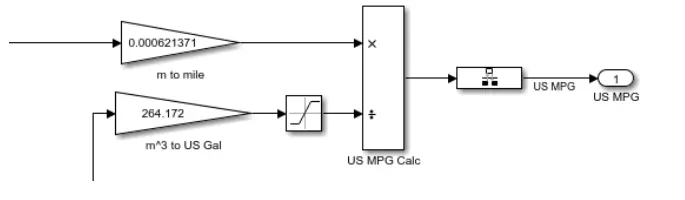
The distance we determined (in metres) is then added to the formula as an input along with the vehicle speed, and it is translated to miles by multiplying by 0.000621371.
The inputs from the fuel flow (Battery energy + Fuel energy) are then multiplied by 264.172 to convert them into equivalent US gallons.
The answer is obtained in Miles/Gallon after further dividing the two inputs, Miles Covered and Equivalent US Gallon.
3.Run the HEV ReferenceApplication with WOT drive cycle. Change the grade and wind velocity in the environment block. Comment on the results.
Hybrid Electric Vehicle:
- A hybrid electric vehicle (HEV) is a type of hybrid type that combines a conventional Internal combustion engine (ICE) system with an electric propulsion system
- The presence of the electric powertrain is intended to achieve either better fuel economy than a conventional vehicle or better performance.
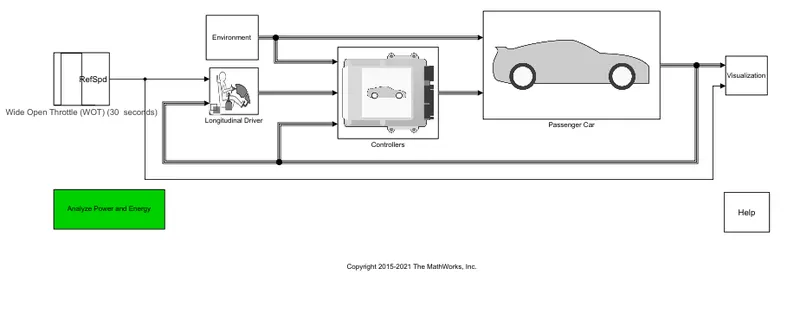
- In the powertrain blockset we have selected the hybrid electric vehicle and this is the simulink model .
- Here we can select the input parameters as we wish and we can Run the simulation to check the results.
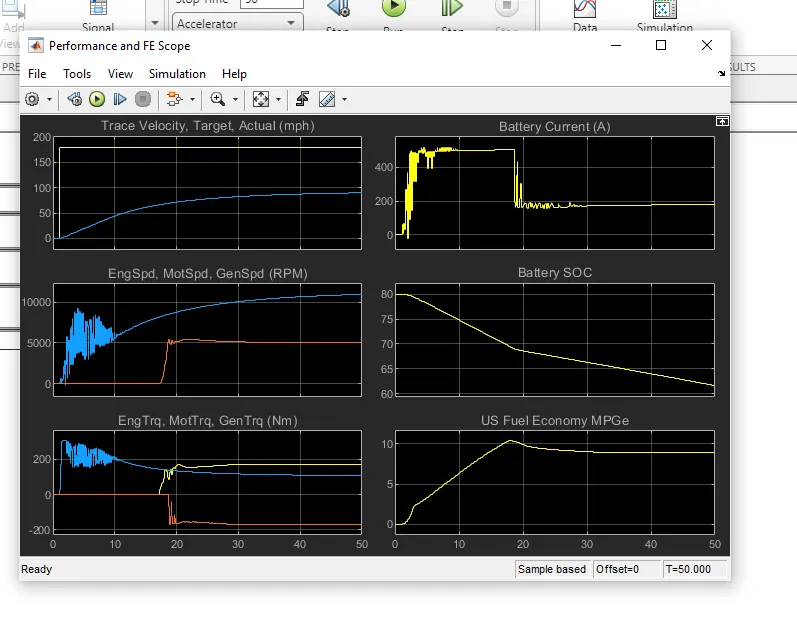
plot 1:
demonstrates the vehicle's speed in relation to the drive cycle data with time scale on the x axis.
16.7 seconds are needed to accelerate to 80 miles per hour.
The braking period from 80 to the minimum is 6.2 seconds.
plot 2:
demonstrates the variations in engine, motor, and generator rpm during the drive cycle.
4780 Rpm is the maximum engine speed.
Maximum motor speed is 9497 RPM.
13690 Rpm is the peak generator speed.
plot 3:
displays the engine, motor, and generator's torque characteristics and variations over the drive cycle in (Nm).
138.7 Nm is the maximum engine torque.
206.7 Nm Peak Motor Torque
42.2 Nm is the peak generator torque.
plot 4:
displays the Battery Current (A) figures and how they change depending on the acceleration inputs used during the Drive cycle.
The battery's maximum discharge current is 163.5A.
Peak charging current for the battery is -150.86 A.
Plot 5:
displays the Battery's state of charge (SOC) in percentage form and how it varies in response to driving inputs.
For the indicated driving conditions, the status of charge dropped from 60% to 39.8% of charge in a span of 49.3 seconds.
Plot 6:
displays the fuel efficiency in miles per gallon for the relevant input driving circumstances.
The maximum number of miles per equivalent gallon of gasoline that the provided vehicle can travel under the given driving circumstances is 46 miles.
Case2
Simulation Condition:
The simulation is done for Hybrid electric vehicle with Wide open Throttle Drive cycle.
The Total cycle time = 100 seconds
The Top speed of this cycle = 80 mph
Time to start deceleration = 50seconds
The Grade angle - 8 Degrees
The wind velocity = 10 m/s.
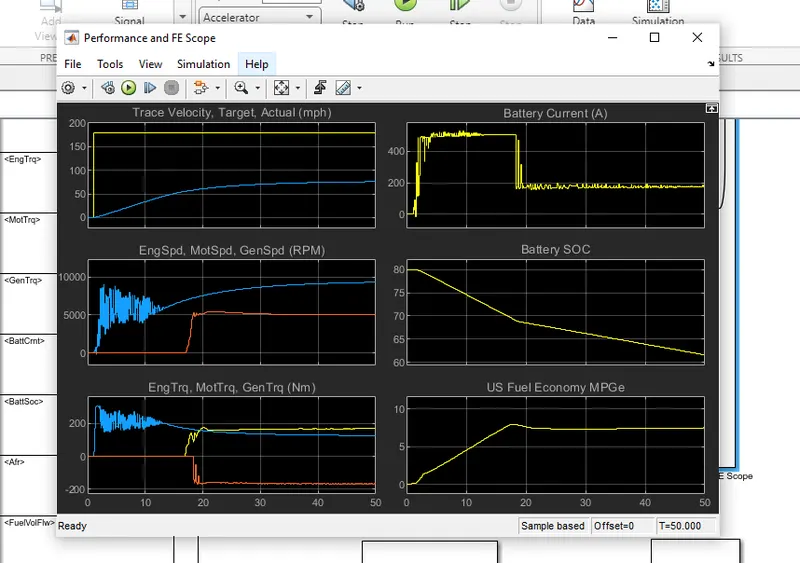
Observation:
We can see from the simulation results for both situations that simulation 1, which excludes the hill climbing conditions and the wind drag velocity, is far more effective than simulation 2, which includes the hill climbing conditions and the wind drag velocity.
Despite employing the greatest current discharge from the same battery as before, the car was unable to reach the needed peak speed.
The charge status also reveals that the discharge is higher than it was in the simulation 1.
Additionally, the Fuel Economy has decreased to 50% from the prior simulation.
Therefore, it is clear that a vehicle's efficiency is higher when it is not carrying any additional weight than it is when it does.
4. Keeping all other parameters same, compare the simulated results of hybrid and pure electric powertrains.
A pure electric car:
A battery electric vehicle, also known as a pure electric vehicle, is an electric vehicle (EV) that solely relies on chemical energy stored in rechargeable battery packs and does not employ any other propulsion sources, such as internal combustion engines or hydrogen fuel cells.
BEVs don't use conventional internal combustion engines for propulsion; instead, they employ electric motors and motor controllers. All of their energy comes from battery packs.
So they are environmentally friendly and don't emit any waste gas.
Additionally, they have their own restrictions, such as range, etc.
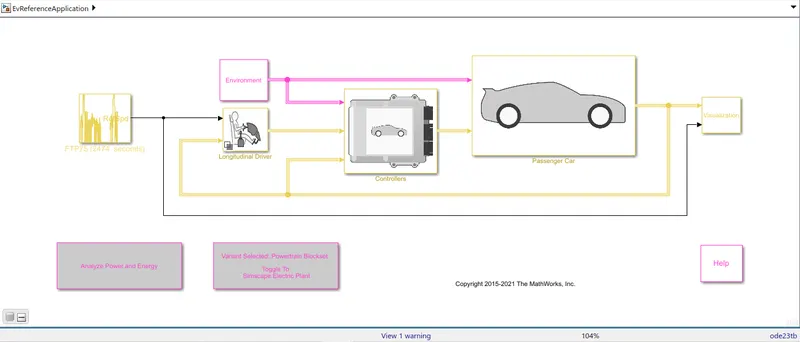
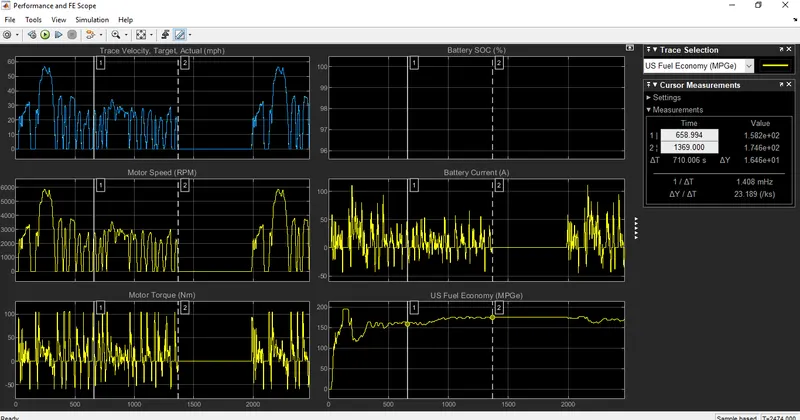
Simulation Condition:
The simulation is done for pure electric & Hybrid electric vehicle with Wide open Throttle (WOT) Drive cycle.
The Total cycle time = 100 seconds
The Top speed of this cycle = 80 mph
Time to start deceleration = 50 seconds
The Grade angle = 0 Degrees
The wind velocity = 0 m/s.
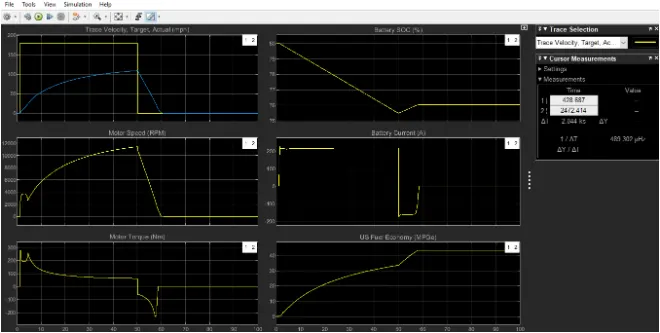
Case2
Simulation Condition:
The simulation is done for pure electric & Hybrid electric vehicle with Wide open Throttle (WOT) Drive cycle.
The Total cycle time = 100 seconds
The Top speed of this cycle = 80 mph
Time to start deceleration = 50 seconds
The Grade angle = 8 Degrees
The wind velocity = 10 m/s.
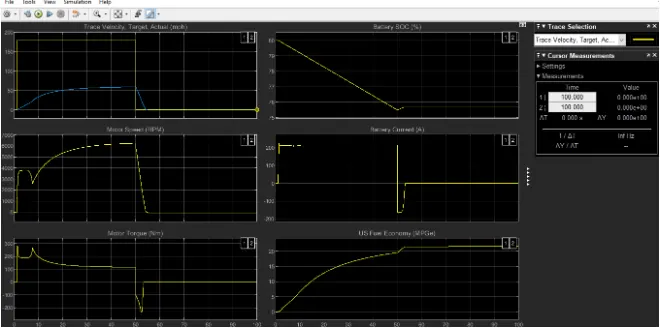
Pure electric versus hybrid vehicles under the same load conditions: observation
1. The highest speed achieved by an electric car is lower than that of a hybrid electric vehicle under identical environmental and drive cycle circumstances.
When the hybrid car's motor and engine are combined, the torque produced by the hybrid vehicle is higher than that of the electric vehicle. The electric vehicle produces higher values of motor speed and torque than the hybrid vehicle's motor alone.
This is what allows the hybrid vehicle to reach a higher peak speed than the pure electric vehicle.
2.Pure electric vehicles here use lithium-ion batteries, so the discharge capacity and charging rate of pure electric vehicles are higher than nickel-metal hydride batteries. Because it discharges quickly, high torque can be generated instantaneously compared to hybrid vehicles. The state of charge also shows that the battery efficiency of pure electric vehicles is higher than that of hybrid vehicles. This is also due to the type of batteries used in these cars.