Week-4 Challenge WOT Condition Part-2
Q1. What is the difference between mapped and dynamic model of engine, motor and generator? How can you change model type?
Mapped models:-
Mapped models are used when the behavior of the particular model is not of a our interest and can be modeled with predefined value in the form of lookup tables.
- Mapped model of engine is used for the steady state analysis.
- In this model all the pre-performed data are collected and feed as input.
- It is used for steady state performance of the system.
- It is mainly performed to calculate speed torque characteristics.
- The table provides the vital information for calculations such as actual torque, fuel flow rate and emissions.
- It is also used for quasi-steady state.
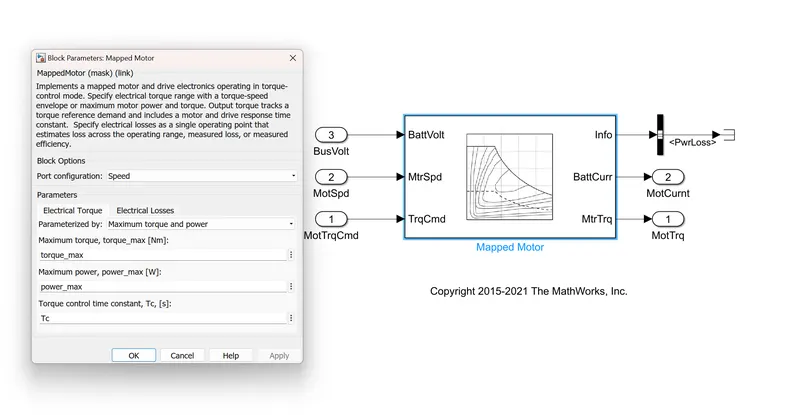
Implements a mapped motor and drive electronic operating in torque control mode.we have to specify electrical torque range with torque speed or maximum motor power and torque.
Output torque tracks a torque refernce demand and include a motor and drive response time constant .also have specify electrical loss as asingle operating point that estimate loss accross the operating range ,measured loss & efficiency.
Dynamic model:-
Dynamic model are used when ,internal response to a model with respect to its component is needed.(eg motor model)
- Dynamic model breaks the engine behaviour to the engine characteristics like the subsystems in the main system.
- It analyse the characteristics of the low level components.
- In this model the output values are feedback to input get the instantaneous value.
- This gives the detailed report of each component.
- It is used to calculate how the performance of engine is affected by the small components.
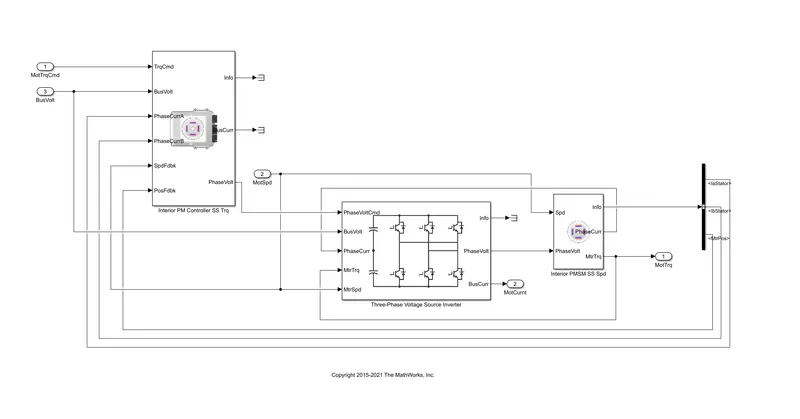
in above model, motor component such as inverter,phase controller,feedback circuits are also modeled.
CHANGING THE MODEL TYPE IN EV POERTRAIN BLOCKS :-
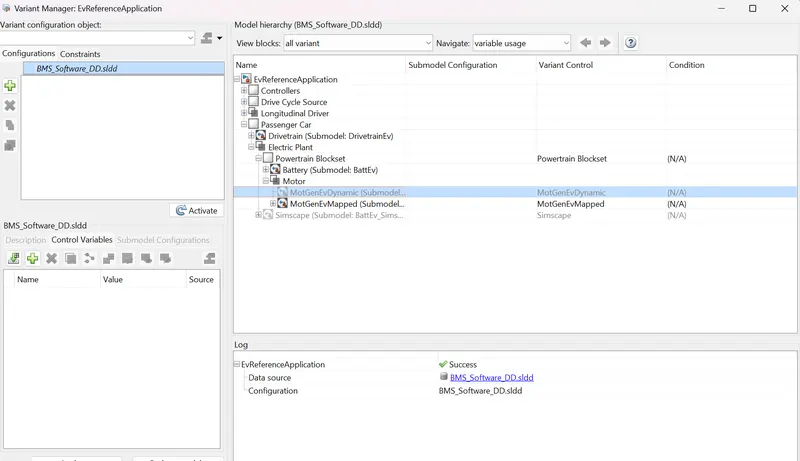
we can use variant manager in modelling tab to find the variant systems we have .
right click, the model you want and set as label mode active choice.
Results:-
If we have to design a vehicle it is more important to use the both mapped and dynamic model to calculate the steady state, quasi-steady state and instantaneous values.
Q2. How does the model calculate miles per gallon? Which factors are considered to model fuel flow?
objective:-
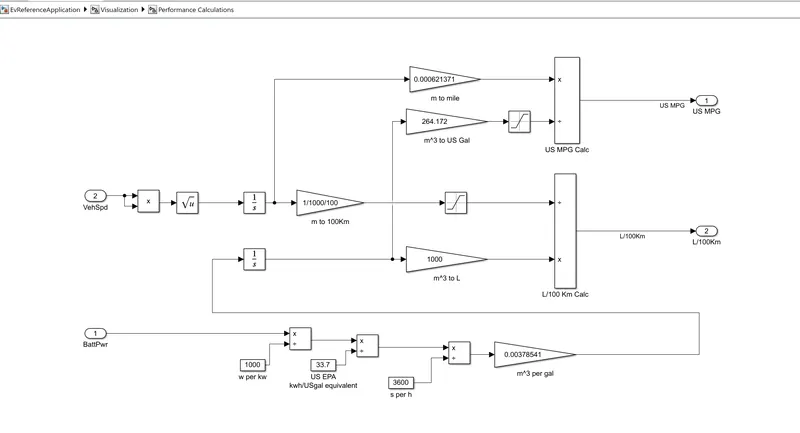
To observe how the model calculate the miles per gallon of fuel flow.
Model:-
Calculations:-
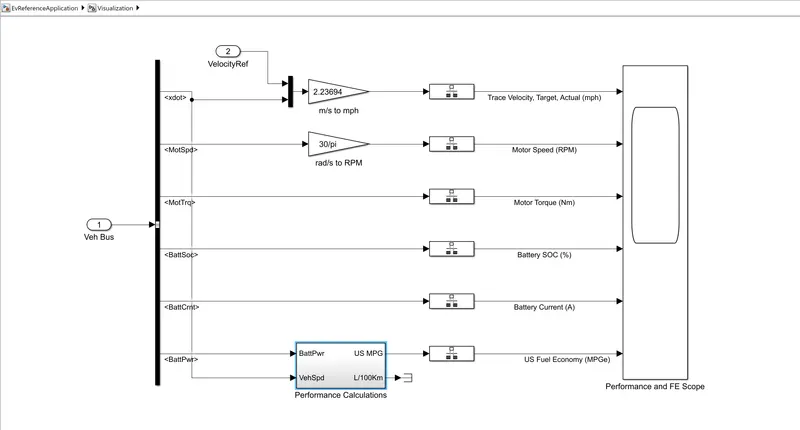
- Distance covered is calculated by integrating the vehicle speed and the values are converted to miles.
- Battery power in watts is converted to kW and the power is divide by 33.7 for converting it to kW/US gallon. Then to kwH/Us gallon by diving 3600.
- Then the total volume is found by multiplying the volume per gallon value of 0.00378541.
- The volume is integrated to find the fuel flow and it is converted to US gallon value by multiplying 264.12.
- The total distance in miles is divided by the US gallon equivalent to find the Miles Per Gallon.
Q3. Run the HEV ReferenceApplication with WOT drive cycle. Change the grade and wind velocity in the environment block. Comment on the results.
Objective:-
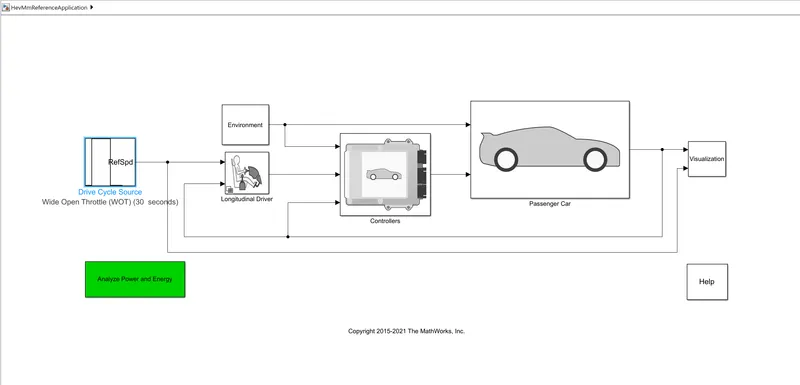
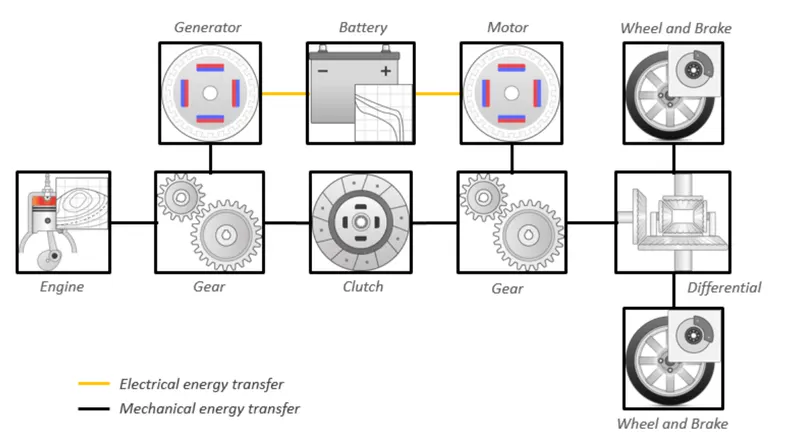
To run the HEV (hybrid electric vehicle) reference application in the WOT drive cycle. And to observe the performance , by changing the value of grade and wind velocity.
Model:-
Procedure:-
- open the HVE Reference application from the help of option of matlab. powertrain blockset by choosing the explore by the hybrid electric vehicle multimode powertrain blockset.
- Driving cycle, change the mode to WOT and applying and run model for (40sec).
- After the compilation ,the output is visualised from the scope of the visualisation subsystem.
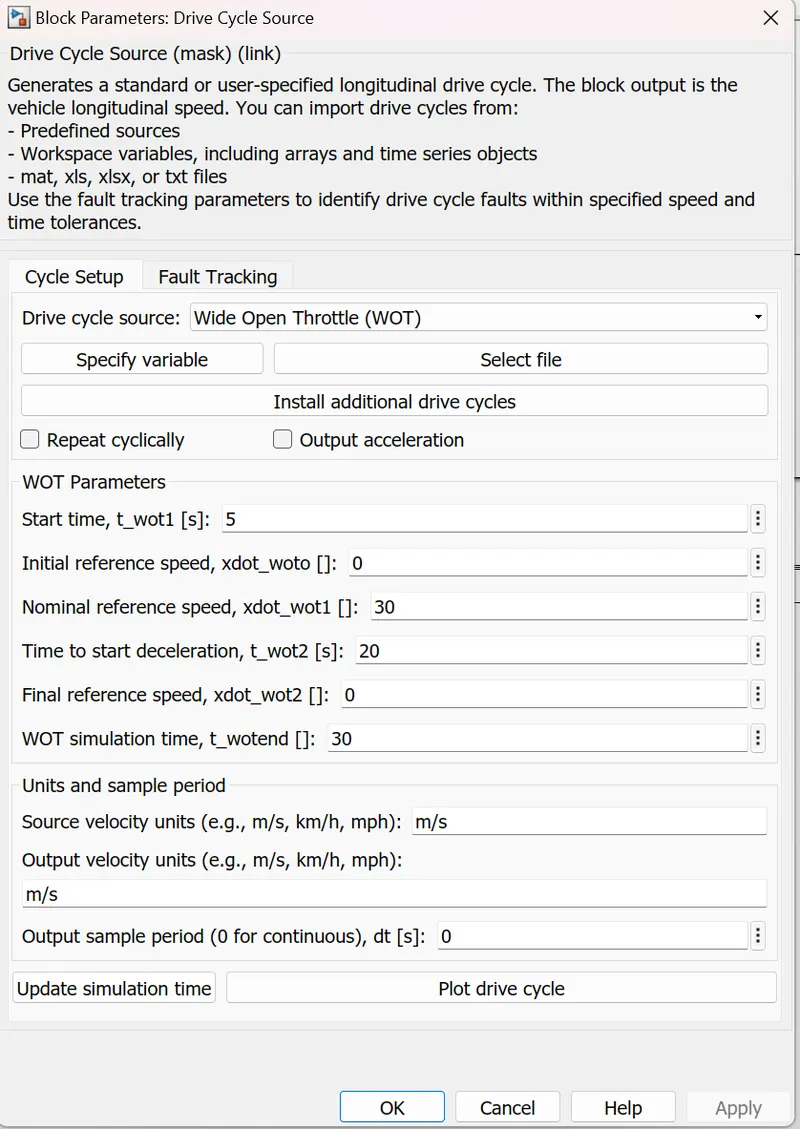
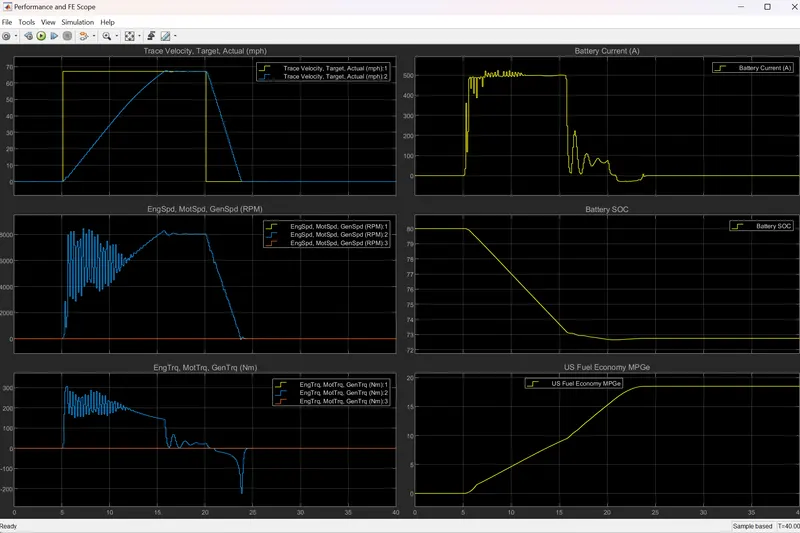
- Then again go back and in the environment subsystem ,the value of grade and wind velocity is changed to 10 and 5 respectively.
- again run simulation for (40sec).
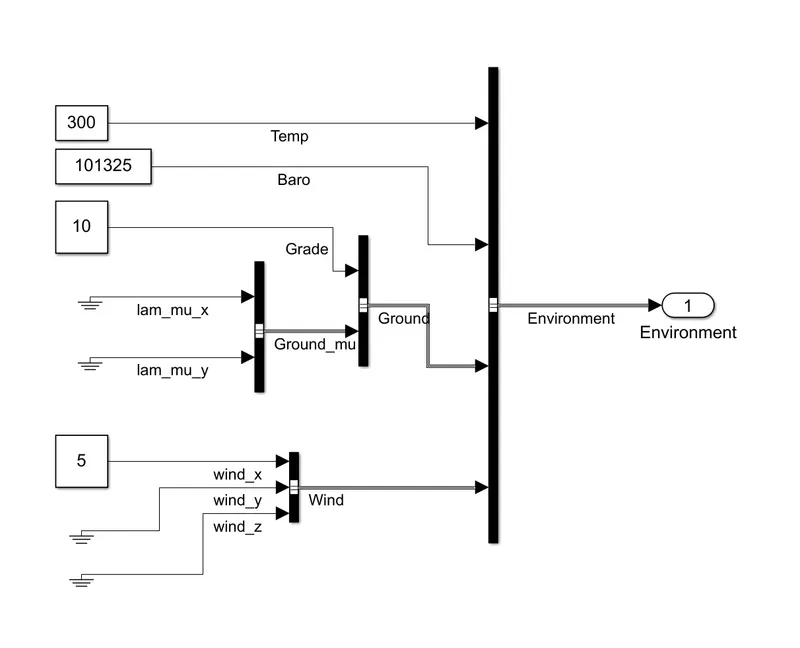
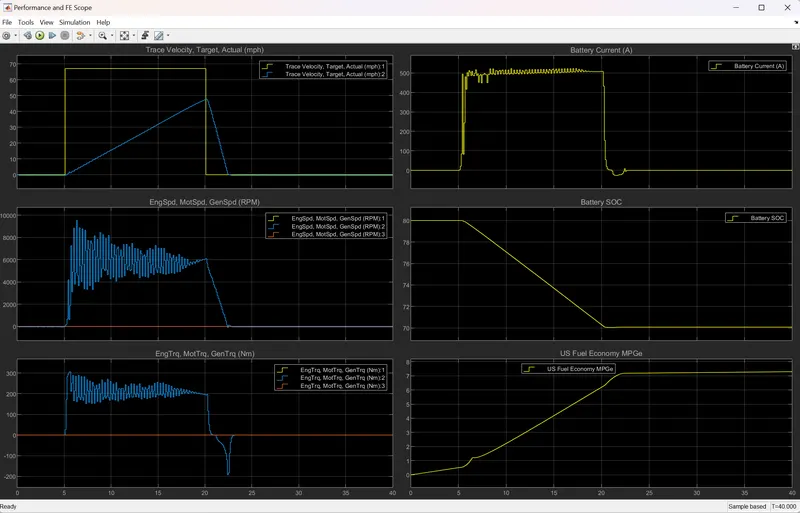
- By observing both due the environmental factors such as grade and wind velocity the performance of the vehicle is affected.
- The vehicle couldn’t attain the target velocity. Without grade and Wind velocity the same vehicle attains the top speed of 68mph in 17 seconds and runs the same speed for 3 seconds.
- But the same vehicle with the grade and wind velocity attains the maximum of 45mph in 20 seconds.
- And the fuel economy also reduced from 18 to 7mpg with the effect of grade and wind.
Results:-
When the grade and wind velocity is applied the additional power is required to overcome the opposing forces. Hence the speed is reduced and fuel consumption is increased.
Q4. Keeping all other parameters same, compare the simulated results of hybrid and pure electric powertrains.
Obejective:-
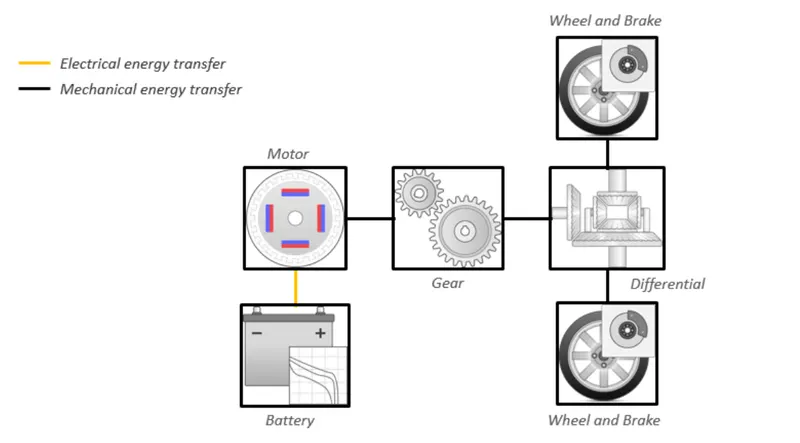
To compare the simulated results of Hybrid electric and pure electric powertrains by keeping all the parameter same.
Model:-
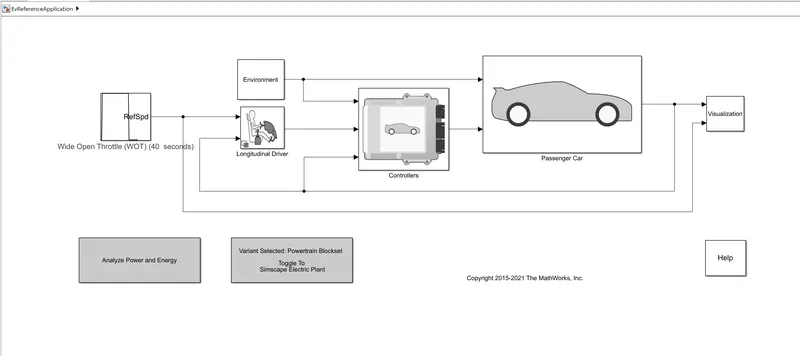
Procedure:-
- Open the explore using Electric vehicle powertrain from the Matlab help.
- Change the drive cycle to wide open throttle(WOT).
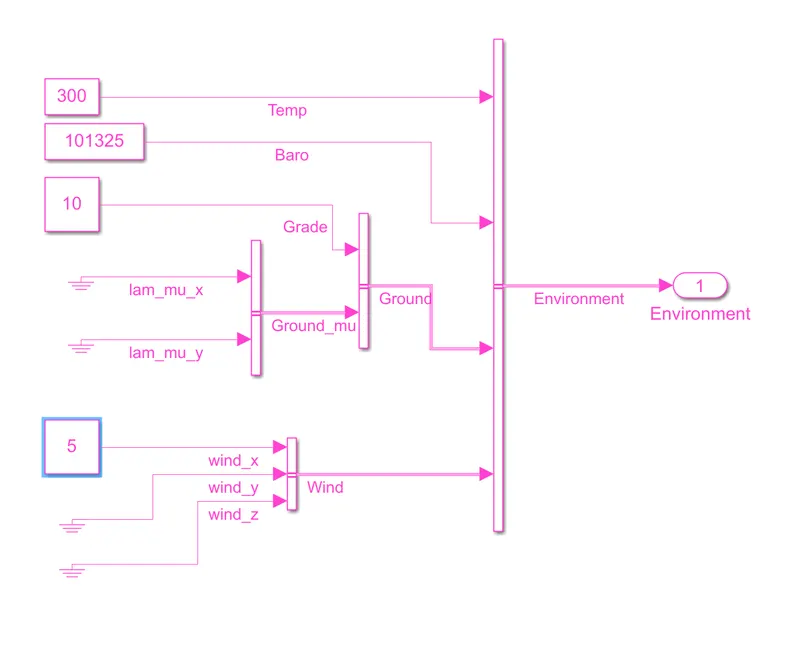
- In the environment subsystem, the value of grade and wind velocity is changed to 10 and 5 respectively.
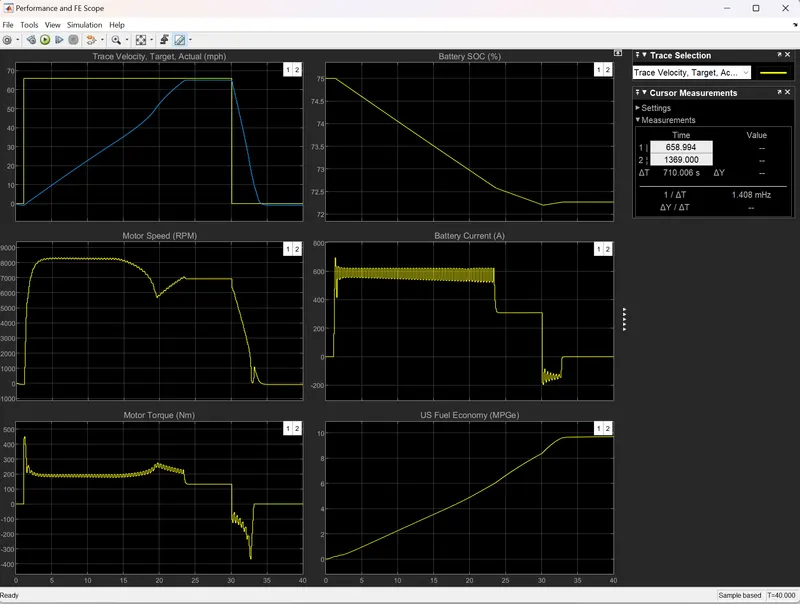
- Then the simulation is run for 40 seconds.
- The output is visualised in the scope of the visualisation subsystem.
Comparision:-
- The maximum velocity of the pure electric vehicle powertrain is 65mph at 30seconds while for the hybrid it is 45mph at 20seconds.
- The state of charge of battery for pure electric vehicle at the end is 72% while for the hybrid vehicle the soc is reduced beyond 72%.
- The Hybrid Electric powertrains requires the 500A of battery power but the pure electric requires only 700A.
- The maximum value of motor speed for the Hybrid electric powertrain is around 9000rpm and for the pure electric the speed is around 8200rpm.
- The maximum value of motor torque for the hybrid electric is 310Nm and for pure electric is around 450Nm.
- There will be the exhaust emission values for the hybrid electric due to combustion of fuel. On the other hand pure electric vehicle there will be no emissions.
Reference:-