Week-4 Challenge WOT Condition Part-2
1.What is the difference between mapped and dynamic model of engine, motor and generator? How can you change model type?
Ans.
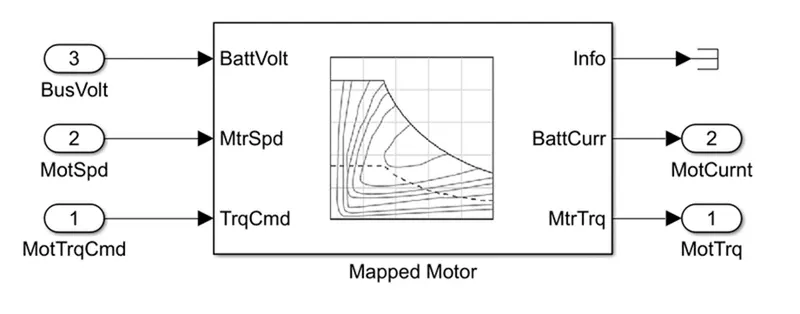
Mapped Model:
- In the mapped model created by using a lookup table and given datasheet by the manufacturer.
- If we take an example of a mapped motor model, it's created with the help of a lookup table and give breakpoint, table data as a motor speed torque characteristic, efficiency graph, etc as per requirement.
- And Mapped Motor block are present in the powertrain blockset created by mathworks already. Below figure of mapped model of motor:
Dynamic Model:
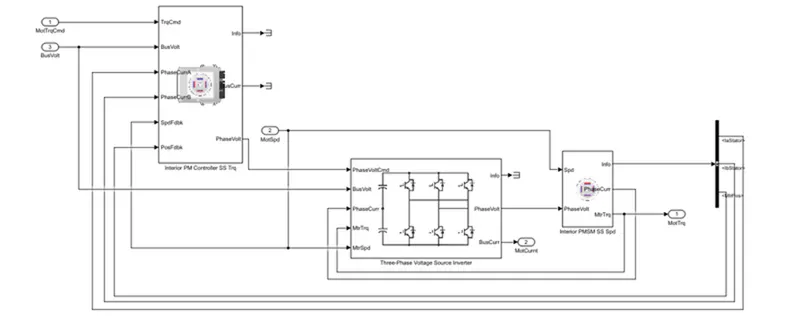
- The dynamic model is built with the actual system level block and its work on input real time values of every sample time.
- If we take a similar example of a dynamic motor, it's built by using system level blocks like Motor Controller, Motor, Inverter, etc and give input as real time values.
- And the dynamic motor not present in simulink library itr created by its own requirement. Below figure is a dynamic model of motor.
How can you change model type?
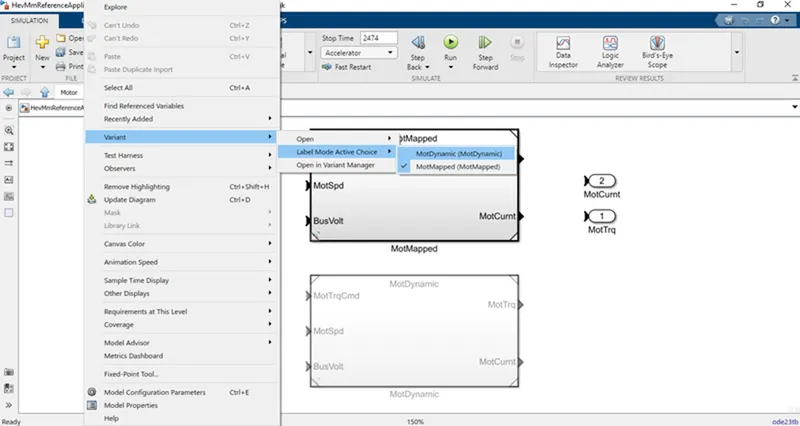
- Go to the subsystem where you want to change the model. Then right click on wherever in white box except the blocks which are present in that white box.
- After right click go to the variant >> Label Module Active Choice then select which you want to activate the model.
- Below figure shows how to change the model type.
2. How does the model calculate miles per gallon? Which factors are considered to model fuel flow?
Ans.
Miles per Gallon: (MPG)
Miles per gallon, is the distance, measured in miles, that a car can travel per gallon of fuel. MPG is also the primary measurement of a car's fuel efficiency: The higher a car's MPG, the more fuel efficient it is.
Below figure shows how to calculate the MPG in model form.
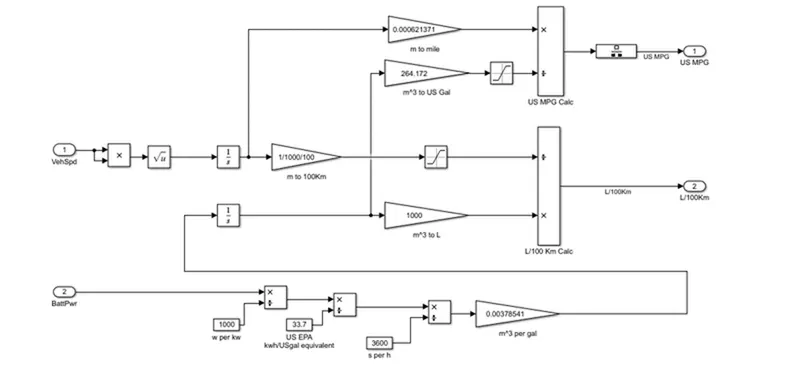
MPG model for pure EV model
- In the above figure we see the input are vehicle speed and Battery capacity which are from the passenger car subsystem. In HEV case we got fuel volume flow also.
- The vehicle speed in m/sec and battery capacity in watts-sec.
- In this model speed integrated by using an integrator block and calculated the displacement i.e. distance travelled by the vehicle. And then distance converted meter to miles by multiplying 0.000621371 with the help of gain block. Because 1 meter = 0.000621371 mile.
- As the same time battery power in watts converted into KW/sec by dividing 1000 and 3600 with the help of a math function block.
Because 1 KW = 1000 watts and 1 Hr = 3600 sec.
- Now this KW/sec battery power is converted into gasoline gallons equivalents by dividing 33.7 based on US EPA formula.
- Now calculate the gasoline gallons energy by integrating gasoline gallons power and they provide upper and lower limits by using a saturation block.
- Now we have energy in the form of gallons and distance travelled by vehicle in miles. We got MPG by dividing energy in gallons to distance in miles.
- In the above figure take two additional gain blocks (i.e. m^3 per gal and m^3 to US Gal) for calculating fuel efficiency in L/100Km.
Which factors are considered to model fuel flow?
Input Parameters are Vehicle Speed in m/sec and Battery Power in watts.
For converting to vehicle speed in m/sec to vehicle travelled distance in miles required factore:
Vehicle travelled distance (miles) = (1/s)*0.000621371*Vehicle Speed (m/sec)
Where,
1/s : Integrate for calculating the travelling distance (m)
0.000621371 : 1miles = 0.000621371 meters
For converting battery power in watts to battery energy in gallons required factors:
Battery Energy (gallons) = (1/s)*Battery Power (watts)/(1000*33.7*3600)
Where,
1/s : Integrate for calculating battery energy (watts-sec) from battery power (watts).
1000 : To converting battery energy in watts-sec to KW-sec
3600 : To converting battery energy in KW-sec to KWh
33.7 : To converting battery energy in KWh to US gallons as per the US EPA
Now,
For fuel efficiency in MPG:
Fuel Efficiency = Vehicle travelled distance (miles)/Battery energy (gallons)
= ((1/s)*0.000621371*Vehicle Speed (m/sec)) ÷ ((1/s)*Battery Power(watts)/(1000*33.7*3600))
= 75384.72972*(Vehicle travelled distance (m) ÷ Battery Energy (watts-sec))
In the model they use two additional factors for calculating the fuel efficiency in L/100Km.
i.e. 0.00378541 for gallons to m^3 and
264.172 for m^3 to gallons
If we multiple these two factors to each other then we get 1.
3. Run the HEV ReferenceApplication with WOT drive cycle. Change the grade and wind velocity in the environment block. Comment on the results.
Ans.
Model:
Drive Cycle:
Acceleration start time = 5 sec
Initial Speed = 0 m/sec
Nominal Reference Speed = 50 m/sec
Start Deceleration = 50 sec
Final Reference Speed = 0m/sec
WOT Simulation time = 60 sec
For better understanding we solve this question in two cases.
Result:
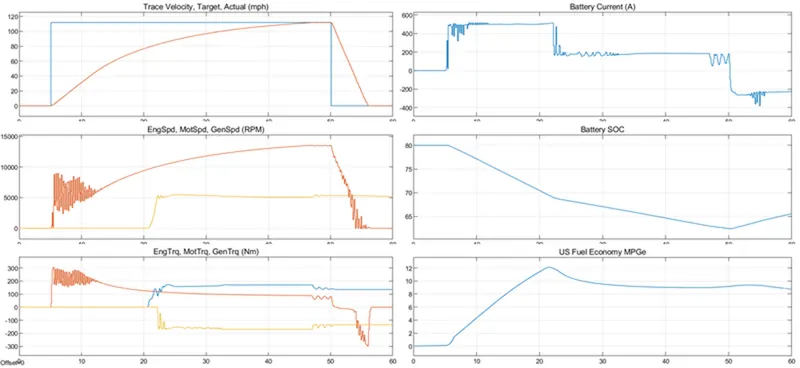
WOT drive cycle with 0 grade and 0 Wind Velocity
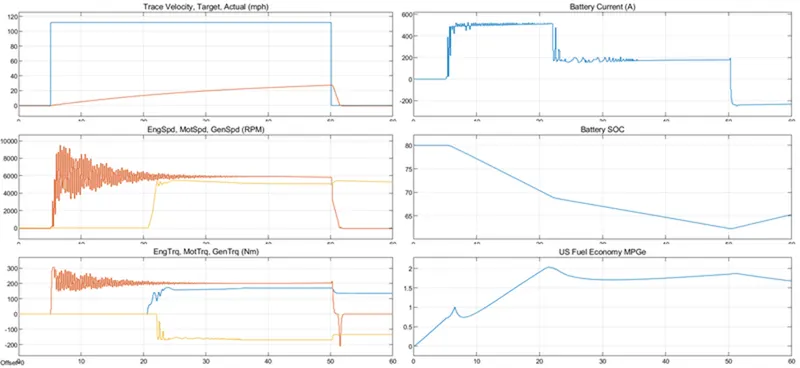
WOT drive cycle with 10 grade and 50 Wind Velocity
- Both graphs look identical but the values of output parameters are totally different.
- In case 1 vehicle achieves our desired speed of 50 m/sec in 41 sec, but in case 2 does not even reach our desired speed. Its reach upto 12.29m/sec only, that's why deceleration time in case 2 is less than case 1.
- Maximum motor torque applied at same time but maximum speed of motor is different, case 1 motor speed is higher because it reaches high speed.
- In booth cases battery current is the same because it's limited at a certain level.
- Battery SOC are same in both cases even after the 10 grade and 50 units wind velocity in case 2. Because our vehicle is HEV, the engine charges the battery after the SOC decreases at a certain level as per the vehicle control strategy.
- But the fuel economy is much much higher in case 1. Because in case 2 drag and hill climbing forces increases also in this case we drive the vehicle by the engine for battery charging.
4. Keeping all other parameters same, compare the simulated results of hybrid and pure electric powertrains.
Ans.
For this simulation I take the FTP75 drive cycle which is required 2474sec.
Case 1: Hybrid Powertrain
Powertrain Configuration:
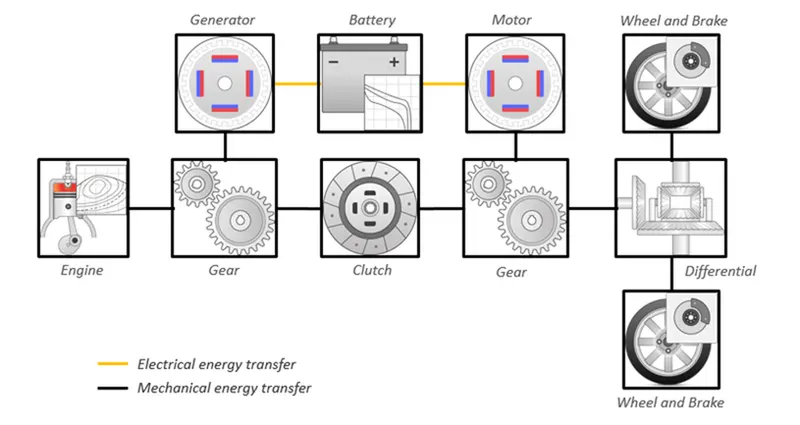
- In this case three machines work when vehicle are running which are engine, motor and generator. Engine and motor for propulsion of vehicle and generator use for charge battery when engine is ON.
- The arrangement of motor and engine is in a parallel manner so it's called a Parallel Hybrid Electric Vehicle.
- Engine and motor ON-OFF time is dependent upon its vehicle control strategy.
Case 2: EV Powertrain
Powertrain Configuration:
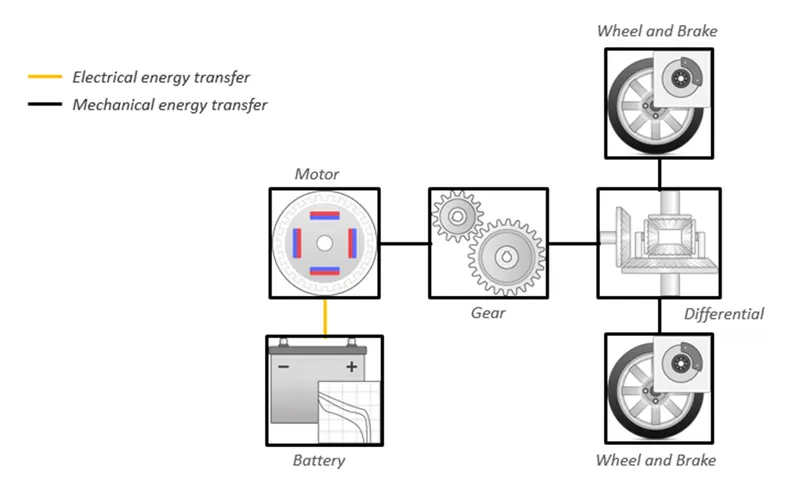
- In this case only the motor is used for vehicle propulsion, that's why it's called a pure electric vehicle.
- Regenerative braking is the one way to charge the battery when a vehicle is running.
Results:
Case 1: HEV Powertrain Result Graph
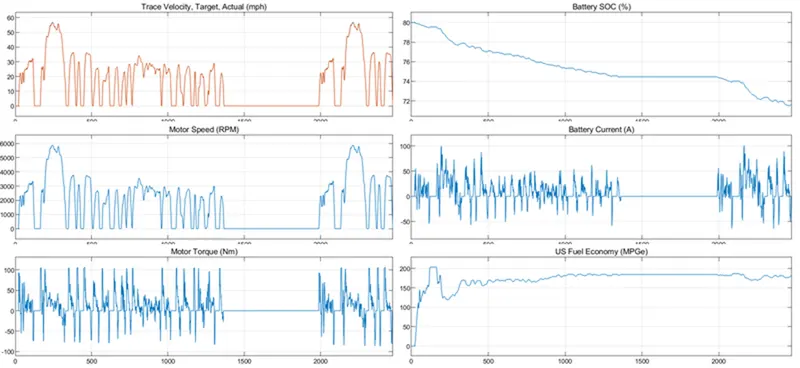
Case 1: EV Powertrain Result Graph
- In above both figures show the case 1 and case 2 output parameters of the vehicle.
- The fuel economy of the case 2 vehicle is much higher than the case 1 vehicle, because engine efficiency is comparatively low to the motor efficiency. In HEV case when the vehicle runs on motor alone at starting, fuel economy is better than the rest of the time.
- Therefore, the EV case final SOC is almost the same as the HEV case even after the EV runs on only battery source.
- After dropping the SOC at a certain level, the engine starts charging the battery through the generator till SOC reaches a certain level as per the vehicle control strategy. But in the EV case this does not happen, battery charge only by the regenerative braking.