Week-4 Challenge WOT Condition Part-2
EV Batch -16
Week-4 Challenge WOT Condition Part-2
Task 1:
What is the difference between the mapped and dynamic models of engine, motor, and generator? How can you change the model type?
Mapped Model:
- A mapped model refers to the block where the inputs and outputs of the blocks are given in steady-state lookup tables to characterize system performance.
- The lookup tables provide input parameters and output parameters.
- A mapped model can only be used when we have the system data.
- The mapped model is used to study the effect of a factor on the simulation to the system level.
Dynamic Model:
- The dynamic model is a model which breaks down a system or a subsystem into its components.
- The combined output of these components is considered the output of the system.
- A dynamic model can be used when we have the component level data and the input data of each componenents
- It is used to study the impact of different components on the performance of the system.
Engines:
Mapped Engine model: It represents macro engine behaviours in the form of lookup tables such as Brake power, Torque, Engine efficiency, Emissions, etc at a specific instant of engine speed or engine load. It is used for quasi-steady-state engine simulations.
Dynamic engine model: In a dynamic engine model, the behaviour of individual engine components is analysed to study the engine dynamics. It is used to study the engine behaviour on a component level. The dynamic model is useful in designing control estimators and diagnostic algorithms that depend on dynamic subsystem states.
Motors
Mapped motors: A mapped motor represents the macro model motor behaviours as a set of lookup tables for parameters such as battery voltage, motor speed and torque in a specified condition. This model is used when we don't know detailed parameters such as the power and torque of the motor.
Dynamic motor: In a dynamic model we know the input parameters of the motor. This model provides accurate results, but the processing time is longer. This motor model uses a 3-Phase voltage source, PMSM, and interior PM controllers.
Generators:
Mapped Generator: A mapped generator is similar to a mapped motor where the input values such as battery voltage for generator block are predefined or a lookup table is used for that. Simulation time is less for a mapped generator.
Dynamic generator: In a dynamic generator the outputs are continuously calculated according to changes in input values with respect to the governing equations. Simulation time is more for a dynamic generator.
How to change the model type?
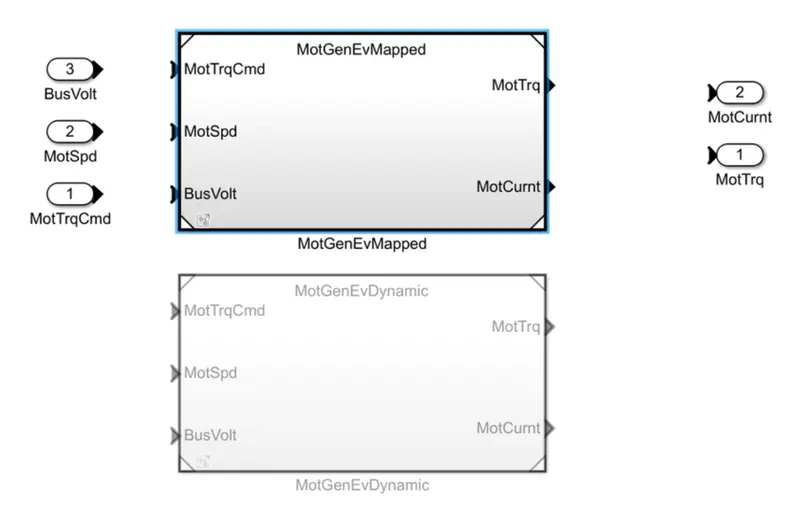
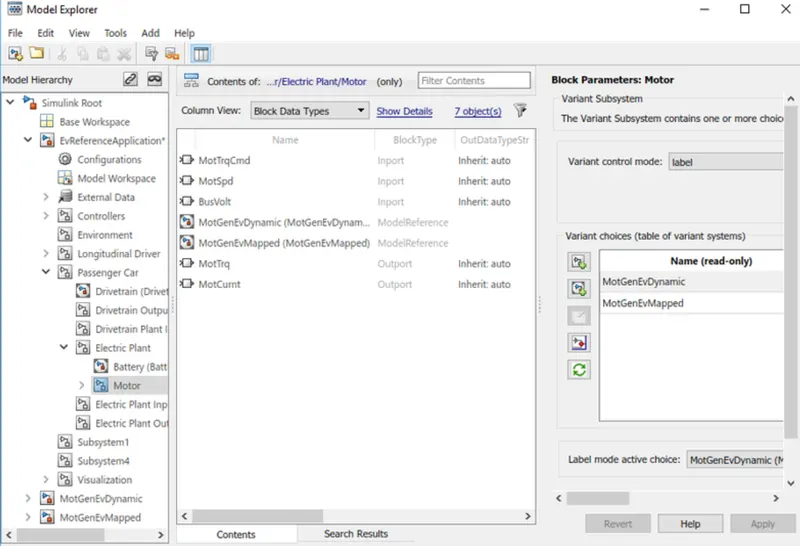
- Enter the modelling options and enter the model explorer
- Enter the passenger block ---> open Electric Plant ---> Open motor block
- We can now see the mapped model "MotGenEvMapped" option is selected by default.
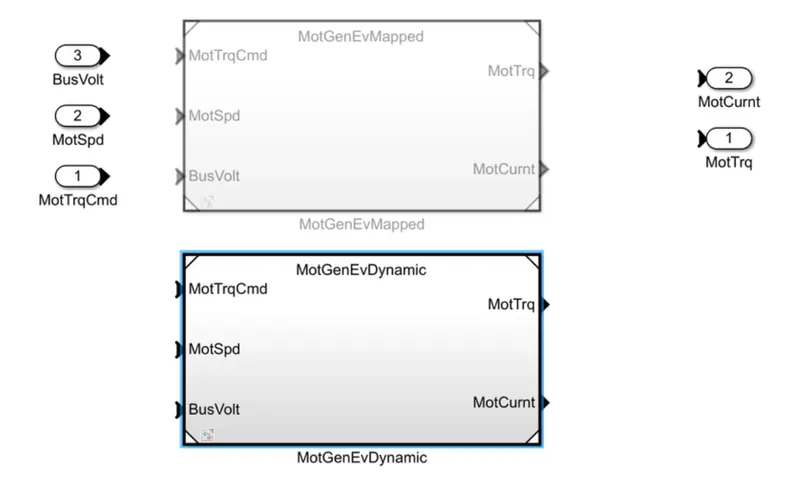
- To change the model type right click on our preferences ---> a popup will be shown "set as label mode active choice"
- Now the model type will be changed as "MotGenEvDynamic"
Task 2:
How does the model calculate miles per gallon? Which factors are considered to model fuel flow?
MPG or miles per gallon is a measure of fuel efficiency of a vehicle. It is the distance a vehicle can travel using a gallon of fuel.
In a Simulink model, the MPG is measured in a visualization block
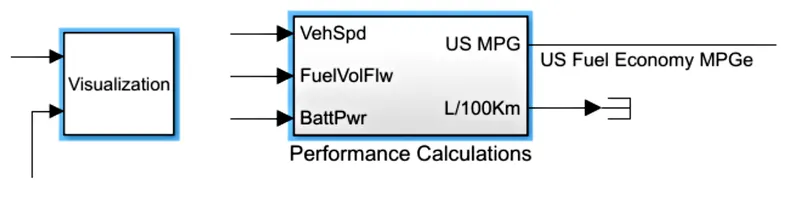
Simulink model:
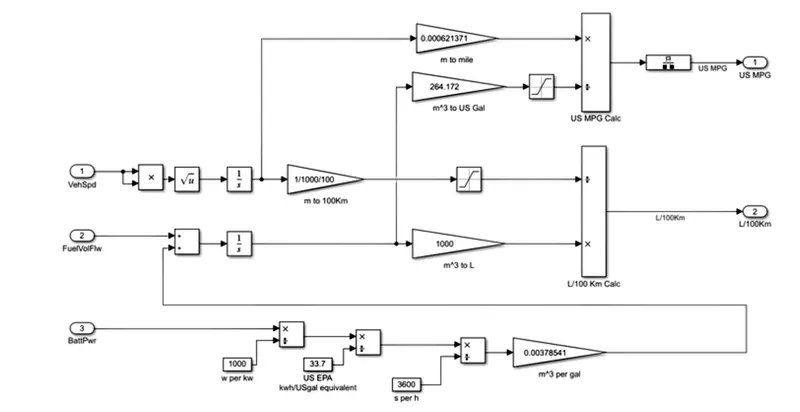
- In an HEV, the energy is used both from battery and fuel. So we need to add both battery and fuel energies after converting both the values into m3/gallon
- Battery power in W is converted to kW and then to kW/h
- By dividing it by a standard value33.7 we get US gallons per second.
- So now Wh is converted to Ws by dividing it by 3600
- The output is multiplied by a gain block by a factor of 0.00378541
- Now we have the same units for battery and fuel energy
- Now both values are added using add block
- Now this value is integrated to get the value of power at a particular second of time
- The square root of vehicle speed is found using the math function block
- The vehicle speed at a particular second is also found using the integrator block
- The speed value is multiplied by 0.00021371 to convert m to miles
- To convert m3 to gallons the fuel output is multiplied by 264.172
- Now the total miles travelled is divided by gallons of fuel used.
- This gives the MPG of the vehicle.