Week-4 Challenge WOT Condition Part-2
ANSWER-1
Mapped Engine: Mapped Engine is the default settings in powertrain blockset. It is used to measure to measure performance parameters of the vehicle by using standard lookup tables which are prefed to the system. This type of modelling is less accurate. The lookup tables value are based on the values of brake torque, commanded torque and engine speed. If any other parameter like Input engine temperature is selected then lookup table values are also a function of the temperature parameter. The data extracted from lookup tables are: air mass flow, fuel flow, emission data, exhaust temperature and efficiency. This data is used to find out other parameters which are needed by the end user.
Dynamic Engine: This type of model uses real time data fed by the user at run time for modelling. This model is more accurate than mapped engine model. This type of model is used when the data of subsystems of a vehicle is required. We can calculate : Brake torque, fuel flow, port gas mass flow, exhaust temperature, exhaust mass flow rate and exhaust emissions.
Mapped Motor: The mapped motor works in torque control mode. This type of motor is used when the user requires a faster simulation and doesn't have the knowledge of motor parameters. The output torque and reference torque is compared and changes are made. Input torque or speed can be specified, electrical losses and maximum motor power and torque can be defined.
Dynamic Motor. In the dynamic motor a three phase interior permanent magnet synchronous motor (PMSM) is used. The block uses three phase input voltages to regulate the individual phase currents, allowing control of the motor torque or speed. This block is used when the user knows what parameters are to be used in that particular simulation. This motor is more accurate.
Mapped Generator. The mapped generator block is also similar like other blocks. Most of the data required is taken from the lookup tables corresponding to the given input parameters. Its simulation time is less.
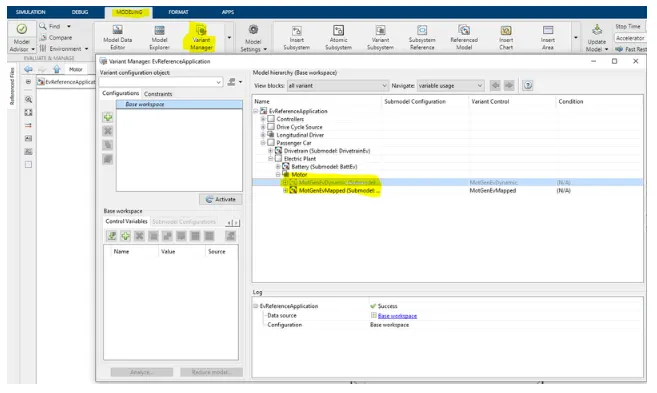
Dynamic Generator. The dynamic generator involves user entering the parameters manually during the run time for their particular applications. The results take time and are more accurate. To change the model from mapped to dynamic: Go to Modelling then Variant Manager.
change model type
CHANGING the model type in EV powertrain blocks: we can use the variant manager in the modeling tab to find the variant systems we have. right-click on the model you want and use set as Label mode active choice.
_________________________________________________________________________________________________________________________________________________________________________________________________________________________________
Ans2:
Miles per gallon (mpg) & miles per gallon equivalent (mpge): for a conventional gasoline vehicle,the fuel efficiency is calculated via miles per gallon (mpg).however fuel efficiency for hybrid electric vehicles is calculated via miles per gallon equivalent(pge).mpg is the number of miles your car can drive per gallon of gas.figuring out an mpge rating is a Mile more complicated.since engines that can use an alternative source of fuel cant be measured by liquid gallons of fuel,the mpge rating is calculated by figuring out the number of milles a vehicle can go using the same energy content as gallon of gas.the epa calculated that 33.7 kilowatt hours of electriccity is equivalent to one gallon of gas. We should go inside ev reference block that is performance calculations:
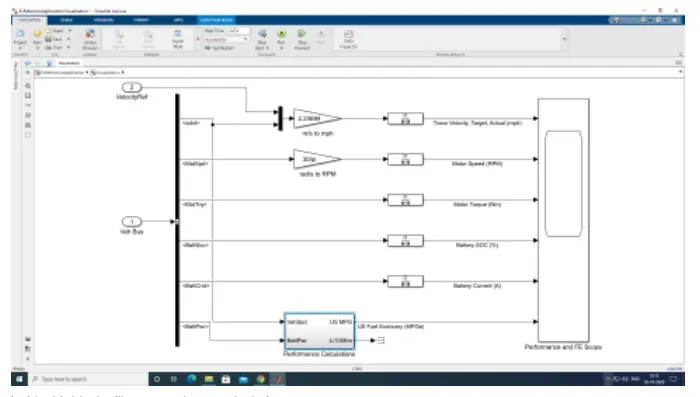
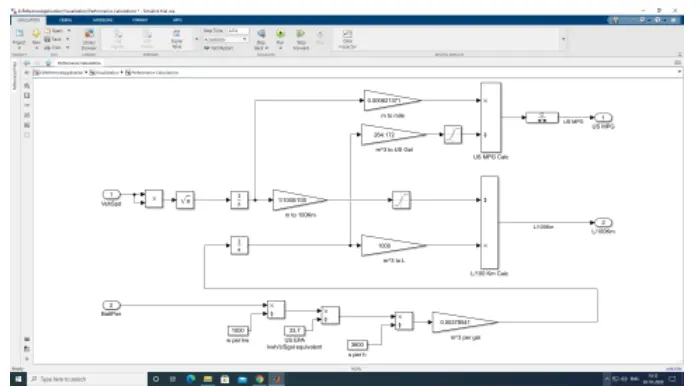
Here,three different inputs are taken into considerations:
1.vehicle speed.
2fuel flow.
3.battery power.
The vehicle speed inputs is in m/s which is converted into miles by multiplying with 0.000621371. similarly the kilogram of fuel is converted into cubic meter by multiplying by l/(1000'0.739) this cubic meter value is then converted into gallons by multiplying it with 264.172.the mile value and gallon value is used to find mpg of the vehicle. now the battery value is initially converted from watts to kwh by dividing with 1000 and then to gallon equivalent by again dividing it with 33.7(sincw 33.7 kwh=1 gallon) then divide the value by 3600 to get in per seconds and multiply by 0.00378541 into get the value in cubic meter per gallons.
__________________________________________________________________________________________________________________________________________________________________________________________________________________________________
ANSWER_3
Use the command 'autoblkHevStart in the command window to open the liEV reference application. Then double click Drive cycle source block and then change the drive cycle to 'WOT as shown in the below image. Also configure the parameters like time duration, WOT start time, initial speed, final speed, max speed and time to start deceleration.
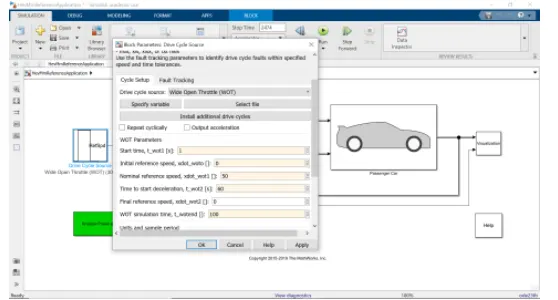
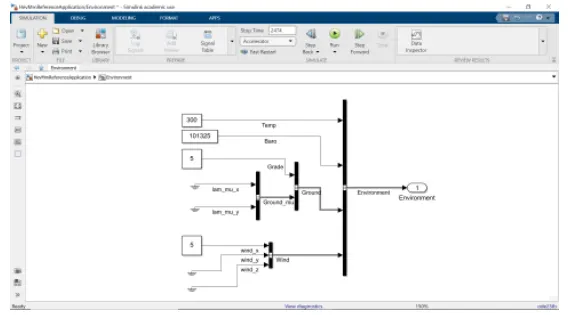
Now change the wing speed and grade from environment block
GRAPH: WOT analysis
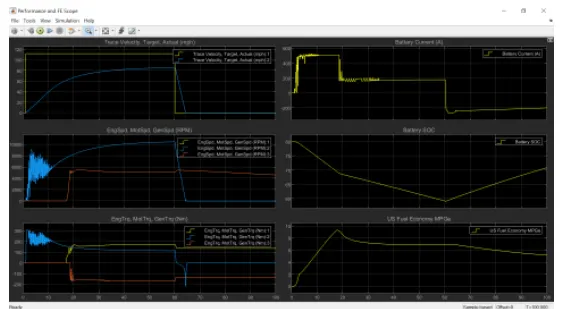
RESULTS:
with the increase in grade and wind velocity,
• peak velocity achieved is reduced as gradient force and aerodynamic force becomes dominant.
• fuel economy is also reduced because the distance traveled is reduced due to external forces.
• deceleration time is reduced so batter recharging capacity is also reduced.
• Battery SOC at the end of WOT acceleration is similar but during deceleration battery is charged more is the grade and wind velocity is less.
__________________________________________________________________________________________________________________________________________________________________________________________________________________________________
ANSWER-4
Now simulating the EV with WOT drivecylce, wind velocity as 5m/s, grade as 5 degree and keeping the rest of the parameters same as above HEV case.
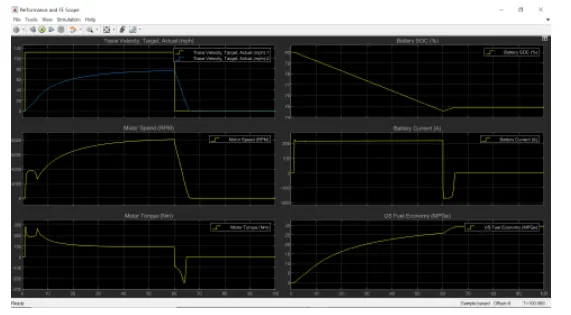
After comparing the graphs of both EV and HEV following conclusions can be drawn:
1. The first graph (target and actual velocity graph) performance is almost same. the reason could be that in that region only motor was operating so the performance in both EV and HEV is similar.
2. The battery current drawn by HEV initially is upto 500 A and later decreases to 200 A. This can be attributed to the fact that initially only motor takes all the load and later engine kicks in so motor load drops thus current drawn by motor reduces. And during the deceleration it is seen that negative current (regenerative braking) flows for a longer time in HEV as compared to EV. So we can say that regenerative braking is more aggressive in HEV.
3. SOC improvement of almost 15% is seen in HEV during deceleration and only 2% improvement can be seen in EV during deceleration. This can be understood by the same reason explained in point 2.
4. Motor torque and motor speed are stable in EV and they keep fluctuating a lot in HEV during the starting. Also the peak RPM of the motor in EV is less than HEV. These differences can attributed to the fact that battery power of EV is more than HEV.
5. fuel economy of EV is significantly greater than HEV. This is because electric motor is more efficient than engine.