Week-4 Challenge WOT Condition Part-2
1.MAPPED AND DYNAMIC MODEL OF ENGINE ,MOTOR AND GENERATOR:
mapped model:
Powertrain Blockset provides two types of combustion engine models mapped and dynamic.
Mapped engines represent macro engine behavior as a set of lookup tables (brake torque, fuel flow, air mass flow, exhaust temperature, efficiency, and emissions) as functions of commanded load and measured engine speed.
It is very speed and takes less time for the simulation. It aso the example for the strady state vehicle models. It is based on the level of details present in it.
dynamic models:
Dynamic engines decompose engine behavior into individual component(various subsystems) models that account for engine dynamics.
It will take too mant time for the simulation and the result cameout is very accurate and realistic in nature.
It is an example of quansi and dynamic state vehicle models. Dynamic engine models are suitable for designing control, estimator, and diagnostic algorithms that depend on dynamic subsystem states.
hardware-in-loop(hil) testing:
Hardware-in-the-loop (HIL) simulation is a technique for validating your control algorithm, running on an intended target controller, by creating a virtual real-time environment that represents your physical system to control. HIL helps to test the behavior of your control algorithms without physical prototypes.
CHANGING THE MODEL TYPE:
Changing the model type is done by using the VARIANT SUBSYSTEM command.
From this command box the variant subsystem is changed and the inputs are changed according to the active subsystem present there.
2.HOW A MODEL CALCULATE MPGe:
Miles per gallon gasoline equivalent (MPGe) is a measure of the average distance traveled per unit of energy consumed. MPGe is used by the United States Environment Protection Agency (EPA) to compare energy consumption of alternative fuel vehicles, plug in electric vehicles and other advanced technology vehicles with the energy consumption of conventional internal combustion vehicles rated in miles per US gallon.
The above image shows the output tab where the MPGe is shown.
CALCULATION OF MPGe:
MPGe is determined by converting the vehicle consumption per unit distance, as determined through computer modeling or completion of an actual driving cycle, from its native units into a gasoline energy equivalent.

Figuring out an MPGe rating is a little more complicated. Since engines that use an alternative source of fuel can't be measured by liquid gallons of fuel, the MPGe is calculated by figuring out the number of miles a vehicle can go using the same energy content as a gallon of gas.
FACTORS IN MODELLING A FUEL FLOW:
There are two major factors considered for the modelling of fuel flow, they are as follows;
Fuel economy.
Fuel consumption.
FUEL ECONOMY:
Fuel economy is a measure of how far a vehicle will travel with a gallon of fuel. It is expressed in Miles Per Gallon(MPG). As a metric, fuel economy actually measures distance traveled per unit of fuel.
FUEL CONSUMPTION:
Fuel consumption is the inverse of fuel economy. It is the amount of fuel consumed in driving a given distance. Fuel consumption is a fundamental engineering measure that is directly related to fuel consumed per 100 miles and is useful because it can be employed as a direct measure of volumetric fuel savings.
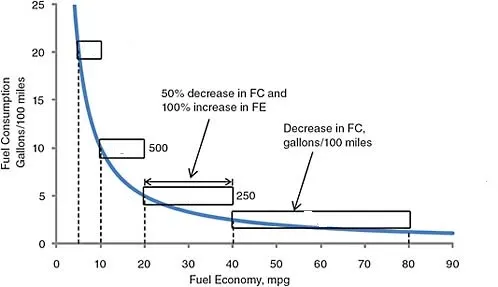
There are other factors also involved in the flow of fuel in the models, they are
Mass of the vehicle,
The aerodynamic drag coefficient,
The vehicle frontal area,
The vehicle acceleration and speed,
The road gradient.
3.HEV REFERENCE APPLICATION WITH WOT DRIVE CYCLE:
To run a simulation based on a Wide Open Throttle(WOT) condition and to change the wind velocity and gradability of a HEV model.
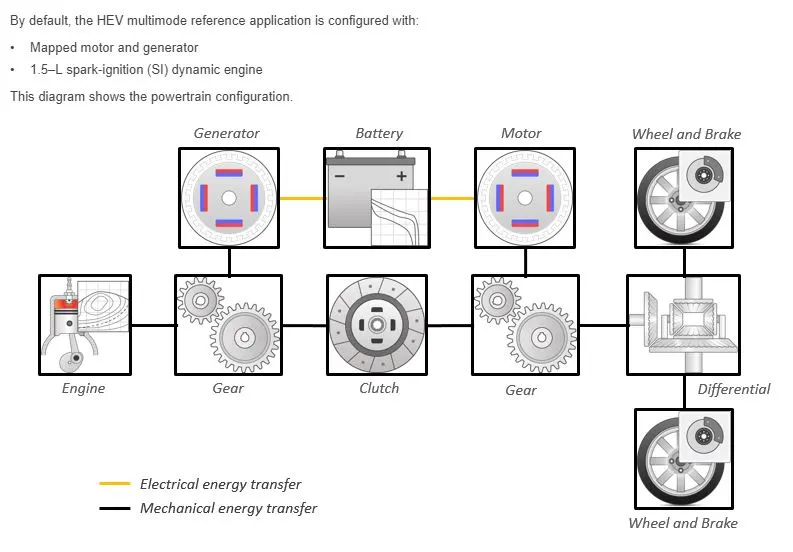
CONDITIONS TAKEN:
To run a simulations we have to take two conditions.
The wind velocity and grade conditions are not changed.
The wind velocity and grade conditions are changed.
HEV MODEL:
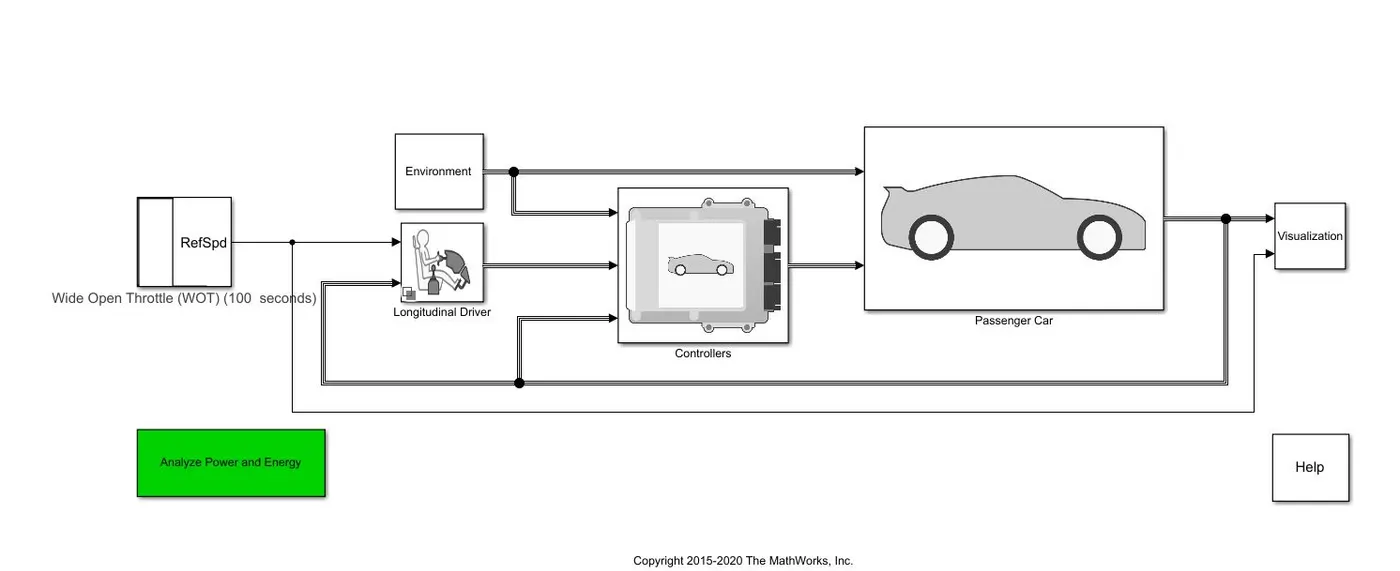
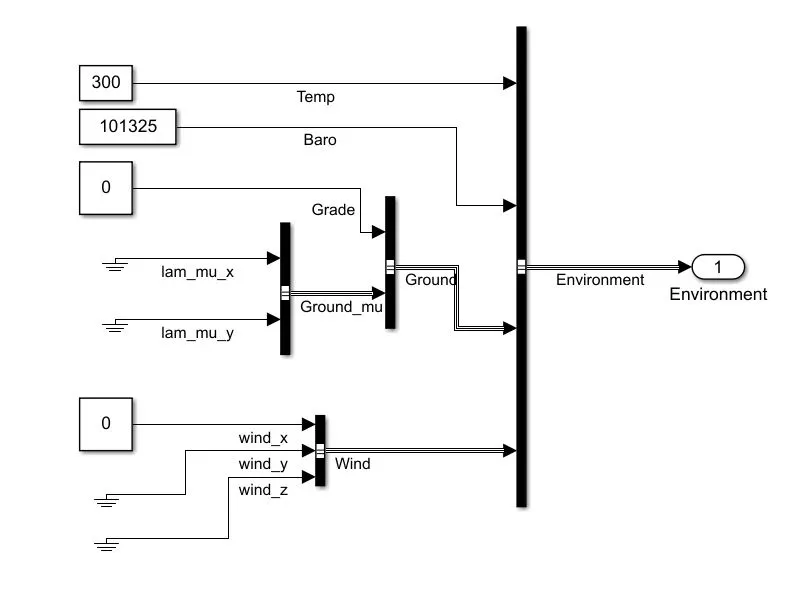
DRIVE CYCLE INPUT:
In this simulation we choose WOT condition. The input parametres are as follows.
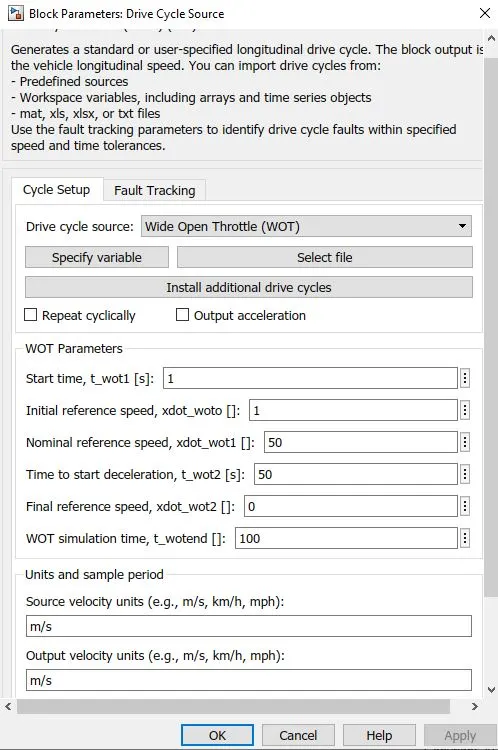
CONDITION 1:
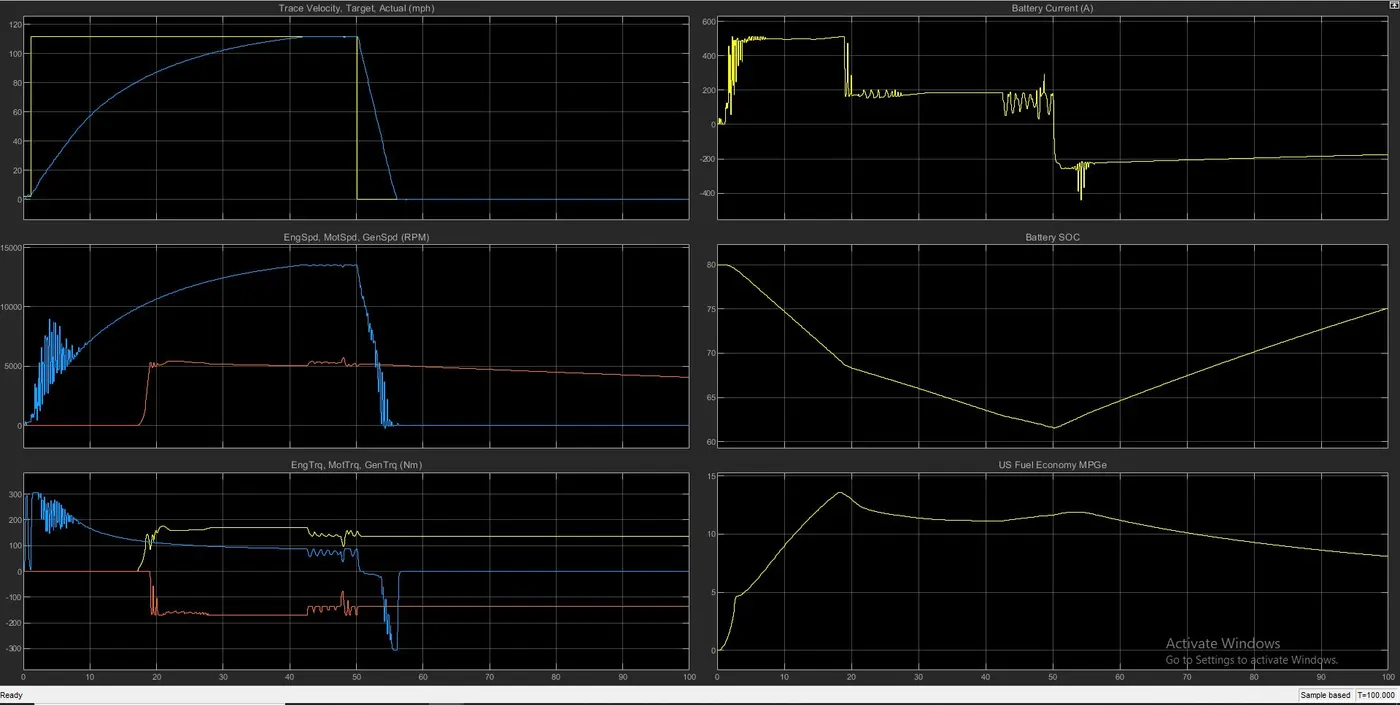
The wind velocity and grade conditions are not changed with the WOT conditions.
RESULT FOR CONDITION 1:
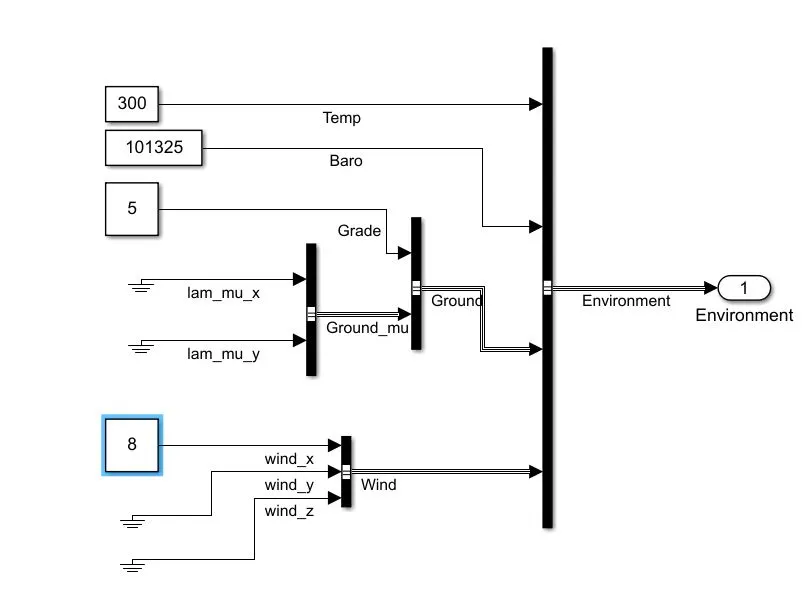
CONDITION 2:
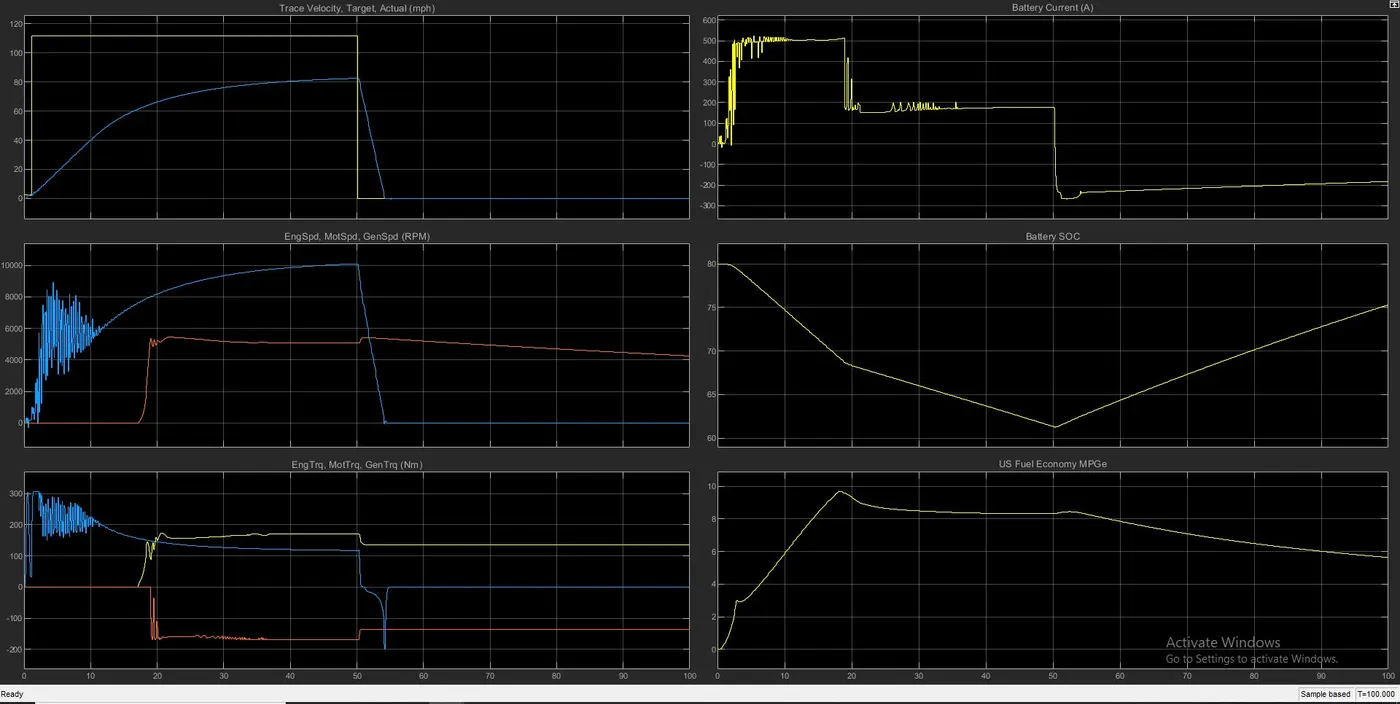
The wind velocity and grade conditions are changed with same WOT conditions.
RESULT FOR CONDITION 2:
4)COMPARISON BETWEEN HYBRID ELECTRIC VEHICLE(HEV) AND BATTERY ELECTRIC VEHICLE(BEV):
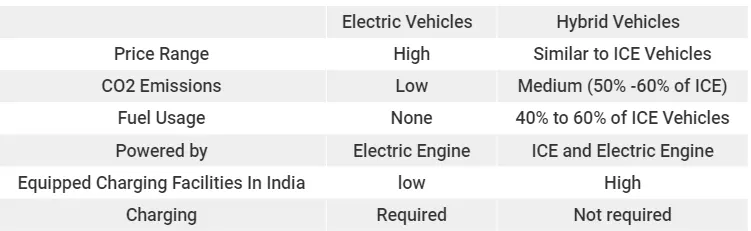
With climate change electric mobility has become against climate change and air pollution. When it comes to e-mobility, it is not just about electric vehicles. Hybrid vehicles are being seen as a temporary way to reduce the pollution. And for a country like India where EV charging infrastructure is still not created, hybrid vehicles can make a difference in the short to medium term.
There are three main types of electric vehicles (EV) depending on the source of their power(charging).
Battery electric vehicles (BEV) are what we popularly call pure electric vehicles that come with rechargeable batteries. These batteries can be charged using external sources and EV chargers are classified according to the speed of charging.
Level 1:
The Level 1 charging systems use a standard household outlet with an output of 120 Volts. With this type of charger, an EV can be charged in over eight hours to run for 75-80 miles. The chargers have the capability to charge most EVs available on the market.
Level 2:
The Level 2 charging are special systems with an output of 240 Volts. These types of charging systems are found at workplaces and public charging stations. The charging systems can charge an EV in about 4 hours to run for 75-80 miles.
Level 3:
The Level 3 also known as the direct current (DC) fast charging systems are the fastest charging solution in the EV market at the moment. The chargers can charge vehicles to run for 90 miles within 30 minutes.
Hybrid Electric Vehicles (HEV)
Hybrid Electric Vehicles (HEVs) are equipped with both batteries and ICE that runs on fuel. The batteries in some way support the ICE by giving it the capacity of a conventional vehicle in terms of speed and run rate. These vehicles cannot be plugged into an external source for charging, hence, they completely rely on regenerative braking through fuels.
Full hybrids are installed with much larger batteries and electric motors that can power the engine solely for a short distance and low speed.
HEVs vs BEVs
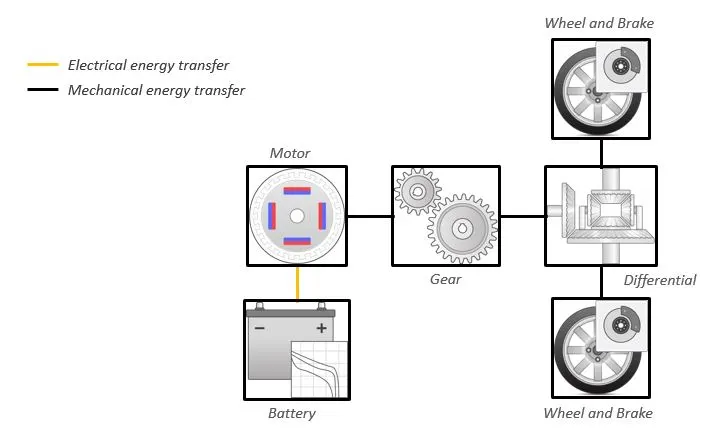
To run a simulation based on a Wide Open Throttle(WOT) condition and to change the wind velocity and gradability of a BEV model.
CONDITIONS TAKEN:
To run a simulations we have to take two conditions.
The wind velocity and grade conditions are not changed.
The wind velocity and grade conditions are changed.
HEV MODEL:
DRIVE CYCLE INPUT:
In this simulation we choose WOT condition. The input parametres are as follows.
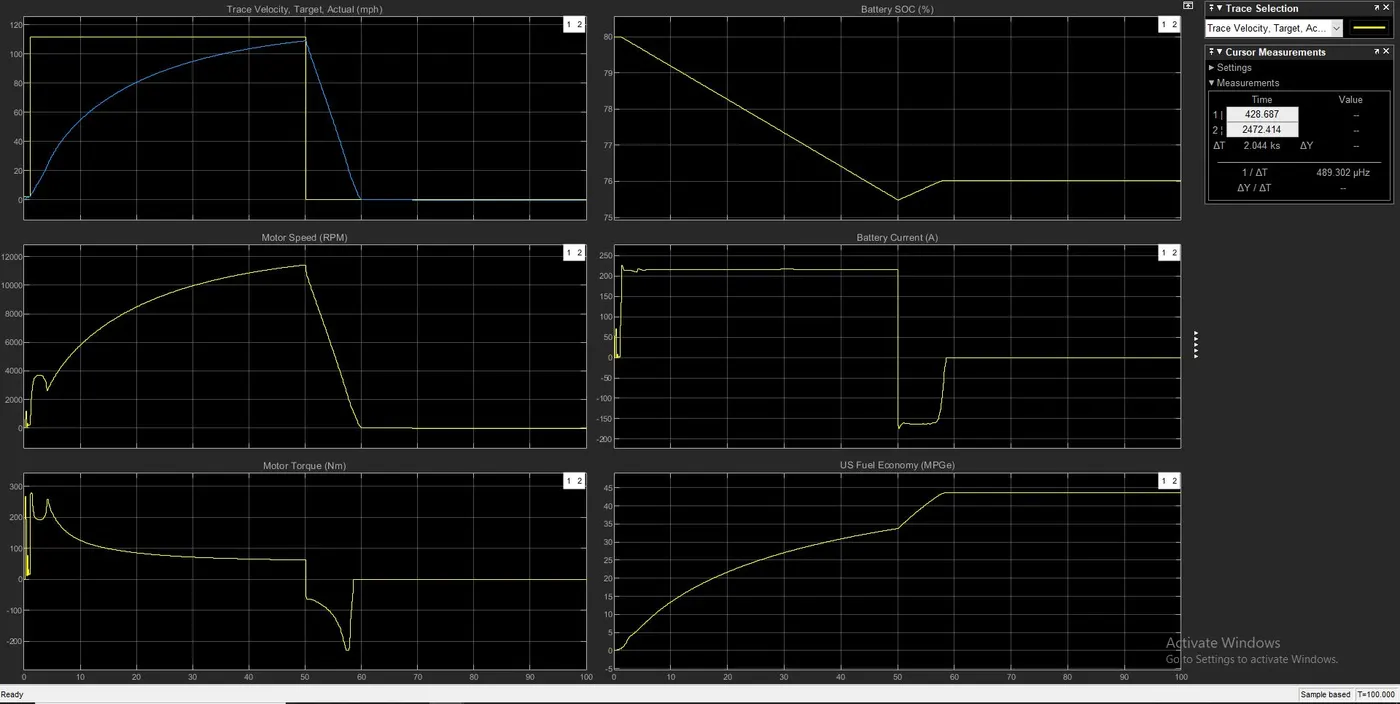
CONDITION 1:
The wind velocity and grade conditions are not changed with the WOT conditions.
RESULT FOR CONDITION 1:
CONDITION 2:
The wind velocity and grade conditions are changed with same WOT conditions.
RESULT FOR CONDITION 2:
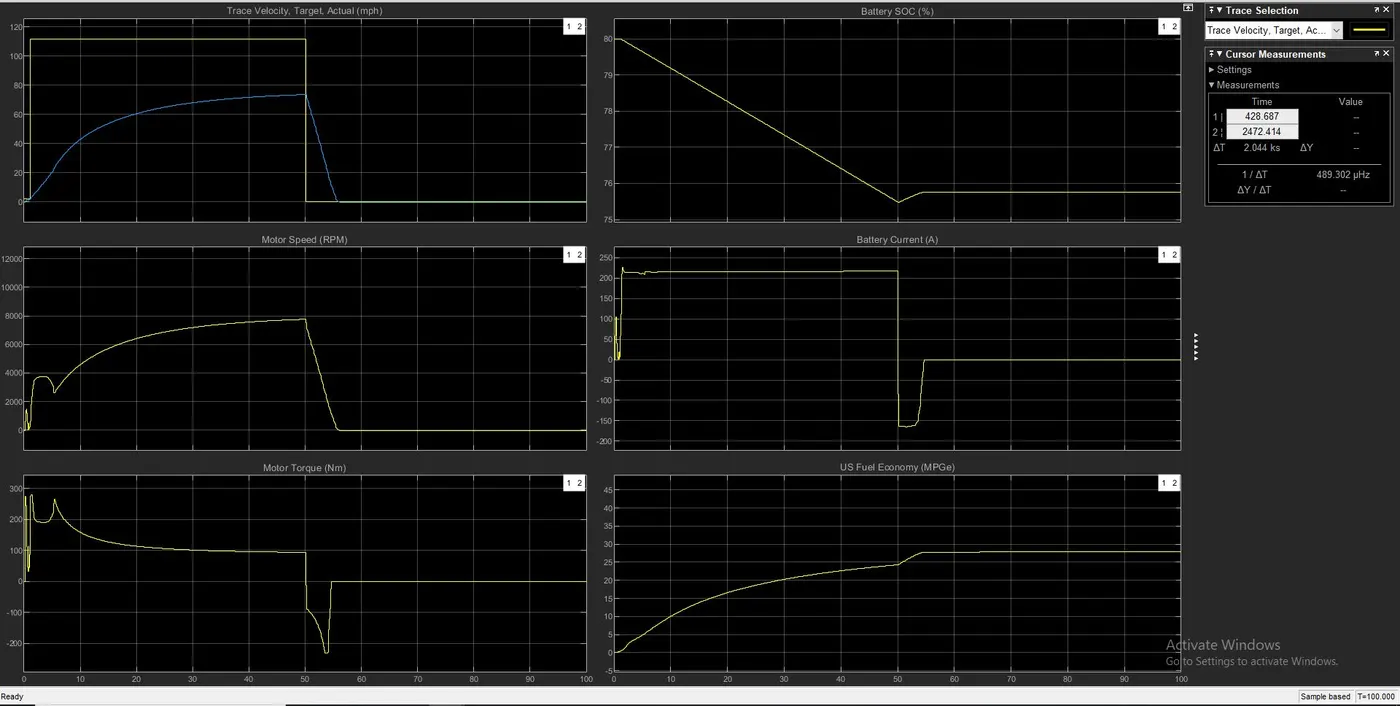
COMPARISON FROM THE SCOPE:
The BEV's uses litium-ion battery whereas the HEV's not uses the same batteries. The discharge rate is high in BEV's so the power is created instantly in this vehicle rather than in HEV's.
The SOC is higher in BEV's than in HEV's. So the motor creates more torque and pickup is more faster than in the HEV's.
The BEV's produces no pollution and zero emission whereas HEV's produces some emissions. The effficiency is greater in BEV's than HEV's.