Week-4 Challenge WOT Condition Part-2
1)
Mapped Model:
- Mapped model gets data from lookup tables
- time taken for simulation is comparativey less as data is readily available without complications.
- As these lookup tables are pre eastabished values accuracy of this model is comparatively low.
Dynamic model:
- It is a real time model executes model based on parameters given in real time.
- time taken for simulation is high as data it is a real time operation.
- More accurate than mapped model.
Changing model type:
- First select vehicle whether it is fully electric or hybrid then Simulink model appears with blocks of model.
- In passenger block electric click on ev motor/generator block.
- By right clicking go to varience mode choose either mapped or dynamic.
2)
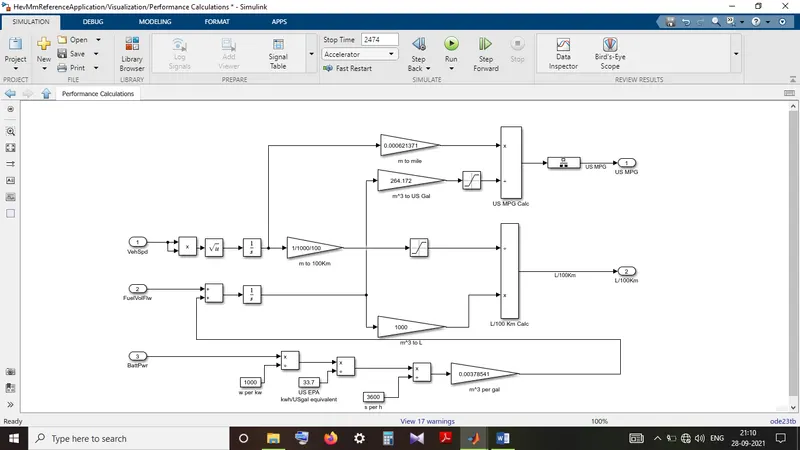
in order to calculate miles per gallon hybrid electric vehicle reference model is taken.
a)In this after opening performance calculations we can find how exactly miles per gallon calculated.
b)First from speed input is integrated over time which gives distance travelled.
c)This is converted into miles by using a gain block.
d)Battery active power consmed is first converted into active KW this then converted into gallons equivalent of fuel by dividing with a constant value of KWH/gallon of gas provided by US EPA.
e)Sinsce it needed to be converted to energy(KWH) it is divided by 1hr = 3600sec.
f)The gallon is turned to litres and and summation of both the powers consumed is integrated.
g)The distance travelled is now divided with fuel consumed with certain ltr to gallon conversions we get miles per gallon average.
3)
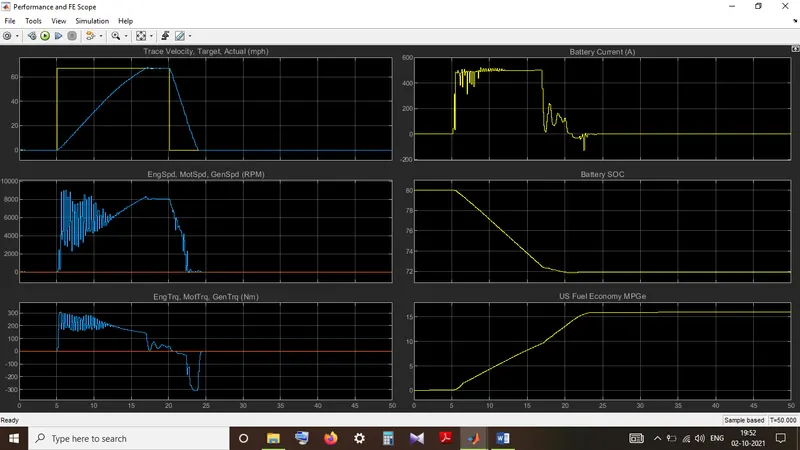
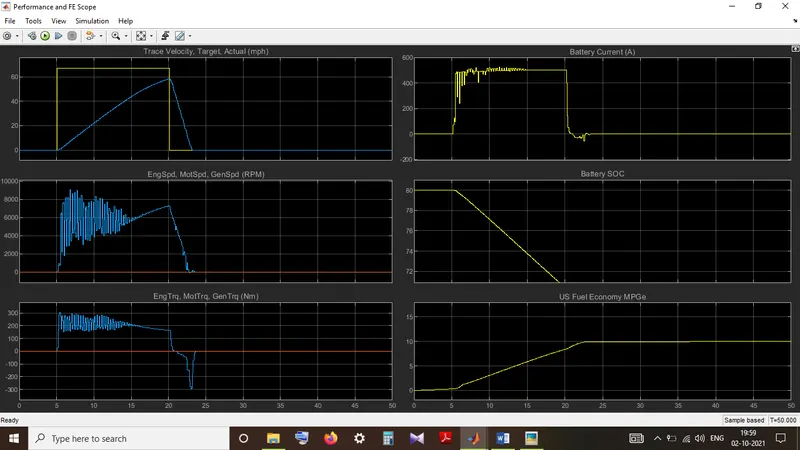
Comparison of outputs done of HEV with drive cycle as wide open throttle drive cycle with and without gradient and wind velocity. Results comparison is as follows.
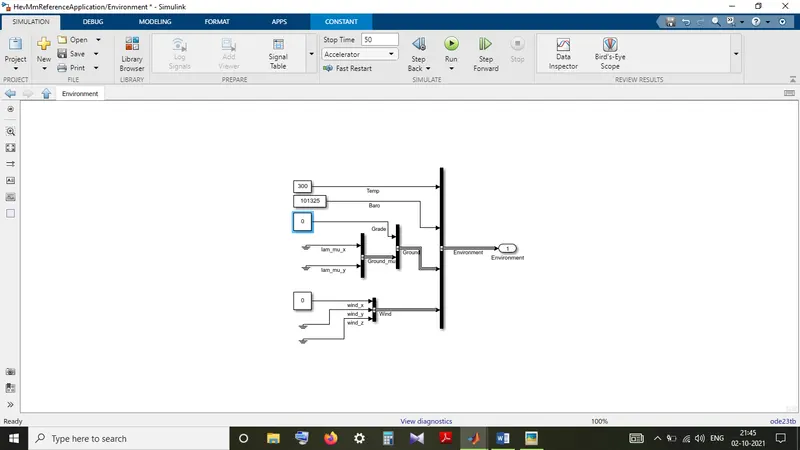
Wind velocity = 20mph, gradient = 5% given
|
Parameter |
Without wind velocity and gradient modification |
With wind velocity and gradient modification |
|
Velocity |
Vehicle has reached target velocity of 70mph within the give time of 30s |
Vehicle was unablereached target velocity of 70mph w within the give time of 30s |
|
Battery current |
In both cases it is almost same once vehicle reached target speed current drawn decreased |
In both cases it is almost same speed. current drawn continuously as target speed not reached |
|
RPM |
Motror reached 8000 rpm at the initial stage itself with oscillations and when reached final speed it stayed constant |
Motor oscillated over 8000 rpm for a bit late but most of the time it stayed under 8000 |
|
SOC |
Battery AH discharged less upto 72% |
Battery drained more comparatively |
|
Torque |
Motor torque generated is almost same in both cases but when motor reached ma speed, torque almost became zero. During deceleration regenerative torque is also high |
Motor torque generated is almost same in both cases. regenerative torque is also comparatively low. |
|
Fuel economy |
MPG is comparatively low 10 |
MPG is comparatively high almost 1.5 times i.e, 15 |
without wind velocity and gradient
with wind velocity and gradient
4)
Pure EV and HEV models are run for FTP 75 drive cycle and their results are compared.
a.In HEV when desired speed is more than a threshold then only engine turned ON whereas in EV there is no such option entire speed has to be achieved by motor itself.
b.Whenever engine started generator coupled engine started and charged the battery whereas in pure EV regenerative action during deceleration is the only time where battery is charged.
c.This can be observed in in both battery current and SOC graphs.
d.Battery current is –ve whenever battery charged and in SOC it can also observed charging percentage increased.
e.For the same drive cycle MPGe is more for pure EV when compared to Hybrid EV.
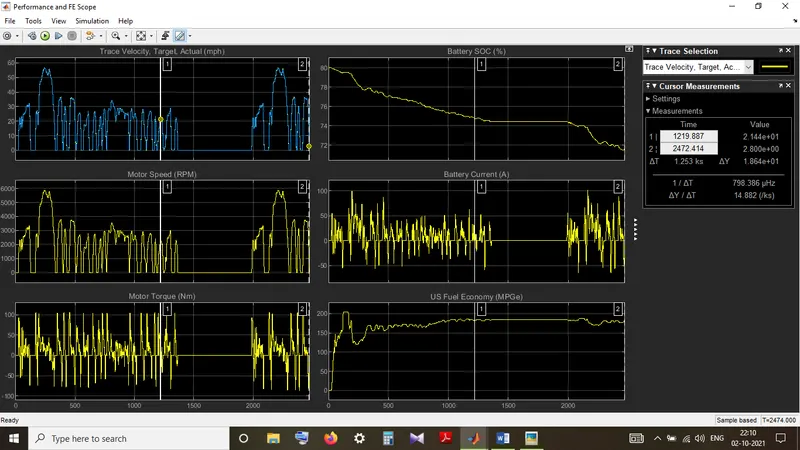
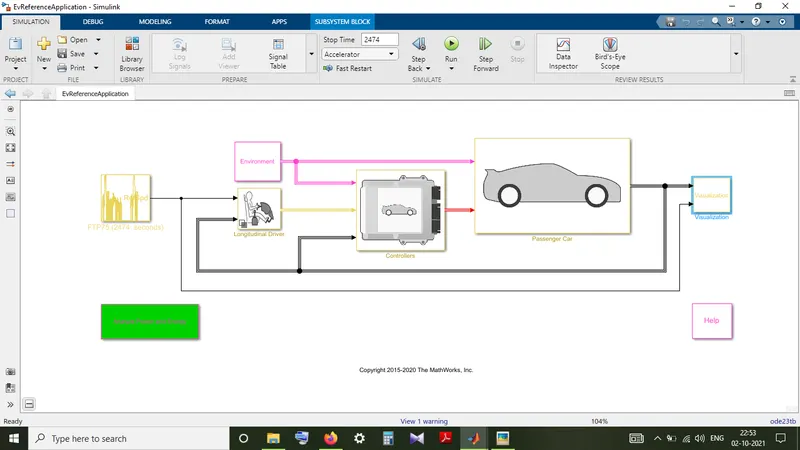
Pure EV
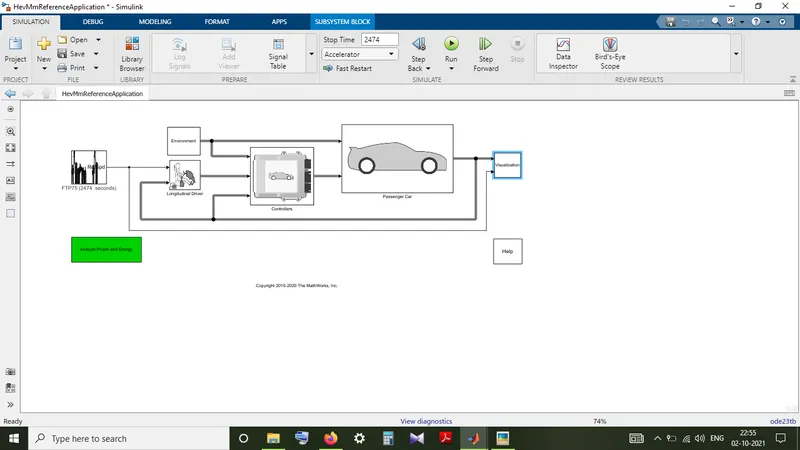
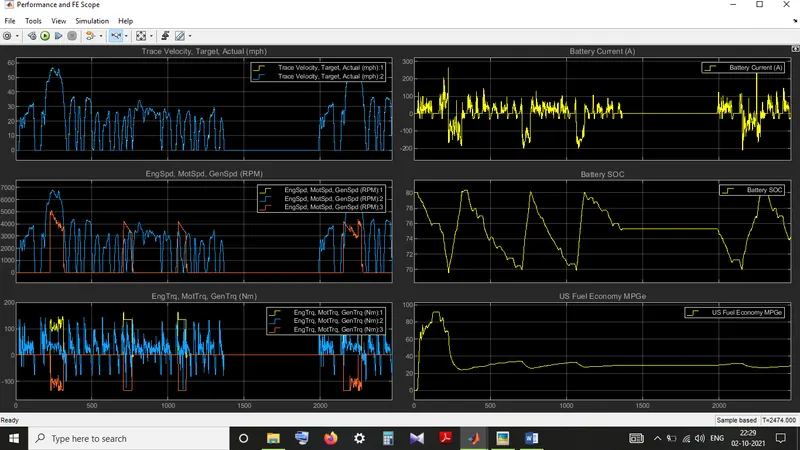
Hybrid electric vehicle