Week - 4
AIM
- Implement control logic of a “washing machine” using Stateflow as per given sequence:
- If the power supply is available, the system gets activated
- If the Water supply is not available, stop the process & indicate through LED
- Soaking time should be 200s followed by Washing time of 100s.
- Then rinsing happens for the next 20s & dryer runs for 50s
After all the processes have completed turn on the finished LED
- Make a Simulink chart for the “Gear shift” logic as per the below conditions:
Speed Range(km/ph) Gear
0 to 15 1
16 to 25 2
26 to 40 3
41 to 60 4
Above 61 5
Give speed input while the simulation is running & display the gear number.
SECTION A
PROCEDURE :
WORKING PRINCIPLE OF A WASHING MACHINE:-
The working principle of a washing machine is centrifugation. Centrifugation is a separation process that uses the action of centrifugal force to promote the accelerated settling of particles in a solid-liquid mixture. The washing machine consists of a centrifuge for this purpose. A centrifuge is a piece of equipment that puts an object in rotation around a fixed axis, applying a force perpendicular to the axis of spin that can be very strong.
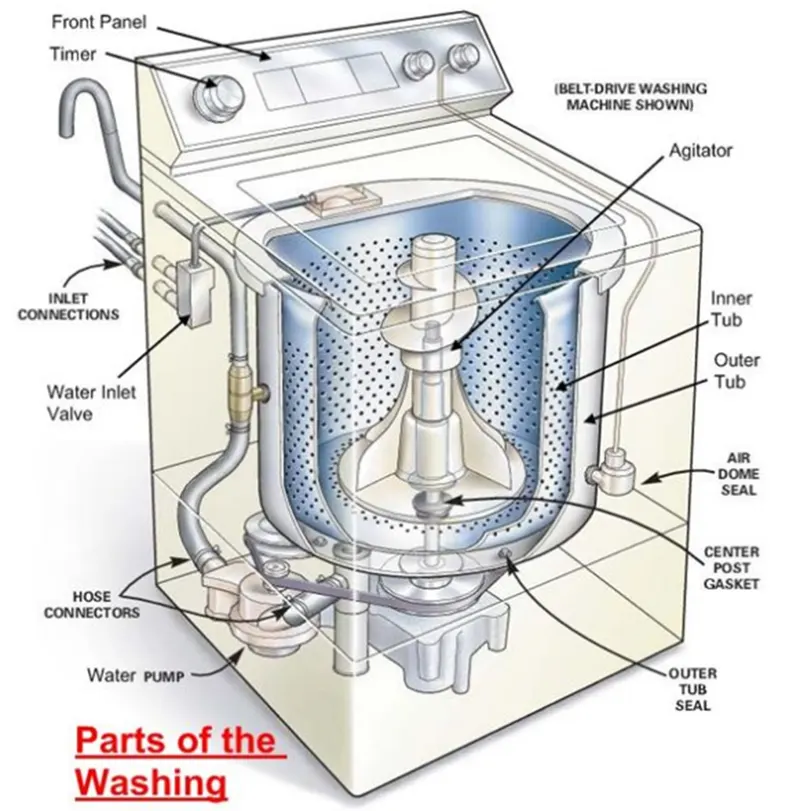
WASHING:-
Many front-stacking machines have interior electrical warming components to warm the wash water, to approach bubbling whenever wanted. The pace of the synthetic cleaning activity of the cleanser and other clothing synthetics increments incredibly with temperature, as per the Arrhenius condition. Clothes washers with inner warmers can utilize exceptional cleansers formed to deliver distinctive synthetic fixings at various temperatures, permitting diverse kind of messes and soils to be cleaned from the garments as the wash water is warmed up by the electrical radiator. Be that as it may, higher-temperature washing utilizes more energy, and numerous textures and elastics are harmed at higher temperatures. Temperatures surpassing 40 °C (104 °F) have the unfortunate impact of inactivating the compounds when utilizing organic detergent. Numerous machines are cold-fill, associated with cold water just, which they warmth to working temperature. Where water can be warmed all the more inexpensively or with less carbon dioxide discharge than by power, the cool fill activity is wasteful. Front-loaders need to utilize low-sudsing cleansers in light of the fact that the tumbling activity of the drum folds air into the garments load that can cause over-sudsing and floods. Nonetheless, because of the productive utilization of water and cleanser, the sudsing issue with front-loaders can be constrained by essentially utilizing less cleanser, without reducing cleaning activity.
RINSING:-
Clothes washers play out a few flushes after the fundamental wash to eliminate the greater part of the cleanser. Current clothes washers utilize less water because of ecological concerns; notwithstanding, this has prompted the issue of helpless flushing on many clothes washers on the market, which can be an issue for individuals who are touchy to cleansers. The Allergy UK site recommends re-running the flush cycle or rerunning the whole wash cycle without a cleanser. In light of grievances, many clothes washers permit the client to choose extra flush cycles, to the detriment of higher water utilization and longer process duration. Bosch for instance, in its hypersensitivity wash program, consolidates an extra 3-minute flush cycle with water of in any event 60 degree Celsius to flush off cleanser deposits and any allergen.
SPINNING:-
Higher twist speeds, alongside bigger tub widths, eliminate more water, prompting quicker drying. Then again, try not to press can be gotten by not utilizing a twisted cycle in the clothes washer. In the event that a warmed garments dryer is utilized after the wash and twist, energy use is decreased if more water has been taken off from garments. Be that as it may, quicker turning can wrinkle garments more. Additionally, mechanical wear on direction increments quickly with rotational speed, diminishing life. Early machines would turn at 300 rpm and, due to the absence of any mechanical suspension, would frequently shake and vibrate.
SOAKING:-
The washer did not immediately wash when added the detergent, but the washer will be intermittent rotation, because there has a soak time, and the washing machine automatically starts washing when the soak time has elapsed.
DRYER:-
A washer-dryer is a washing machine with an inbuilt tumble dryer, so if you need to dry clothes quickly, it’s a good option as it both washes and dries your clothes in the same cycle – so all you need to do is remove the clothes from the machine and they’re ready to wear.
INPUT:-
Stage 1:
Implement control logic of a “washing machine” using Stateflow as per given sequence:
- If the power supply is available, the system gets activated
- If the Water supply is not available, stop the process & indicate through LED
- Soaking time should be 200s followed by Washing time of 100s.
- Then rinsing happens for the next 20s & dryer runs for 50s.
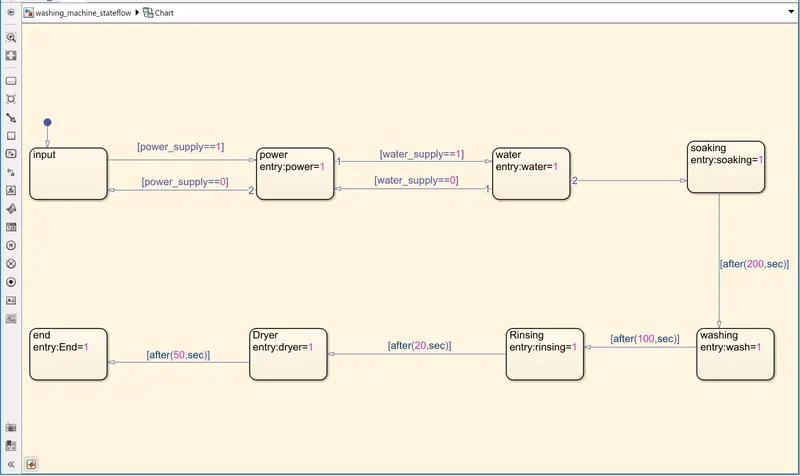
After all the processes have completed turn on the finished LED
Stage 2: Next starting the input forms in the chart, Go to Symbole Pane and select the assigned variable. (Example: input data. Output data,etc)
Stage 3: Give the input conditions for turning on or off for the Power Supply and Water Supply.
Condition:
if condition 1; Power and Water Supply will turn On.
if condition 0; Power and Water Supply will turn off.
Stage 4: Use 'display block and 'Lamp' indicator to represent the effects
OUTPUT:-
Situation 1
If the Power_Supply =0, the Power supply is not available and the system will not activate.
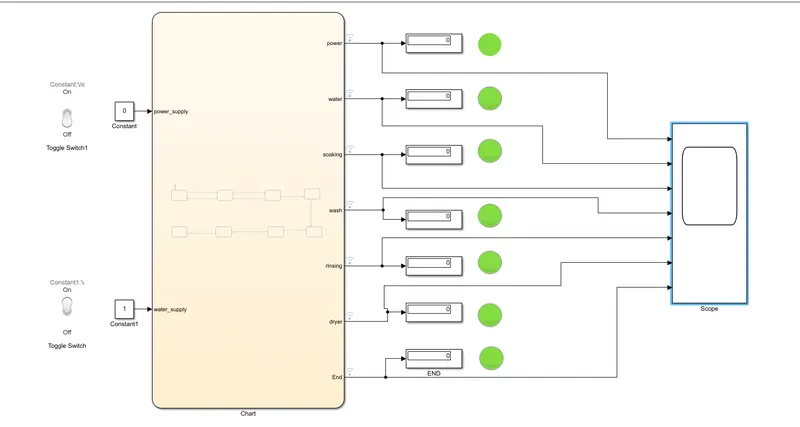
Situation 2
If the Power_Supply=1, and Water_Supply=0 then the power supply will turn on and the water supply will not be available and so the system will not be activated.
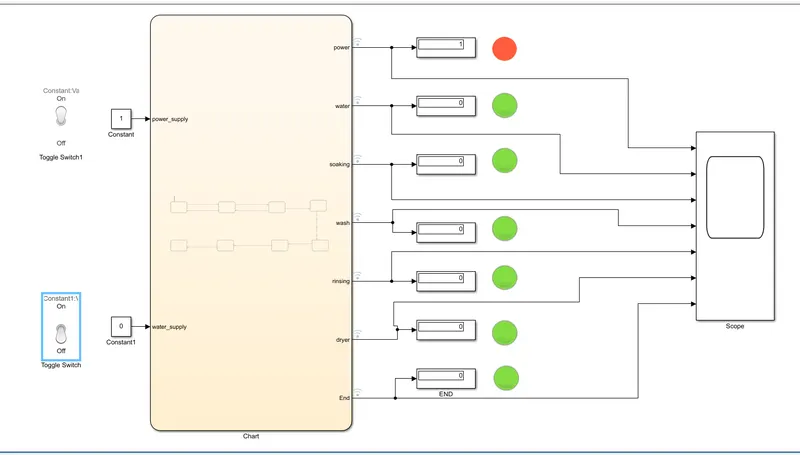
the power supply indication is shown by RED lamp rest of process not fullfilled the design condition shown by green lamp.
Situation 3
If the Power_Supply=1, and Water_Supply=1 then the power supply will turn on and the water supply will be available and so the system will be activated.
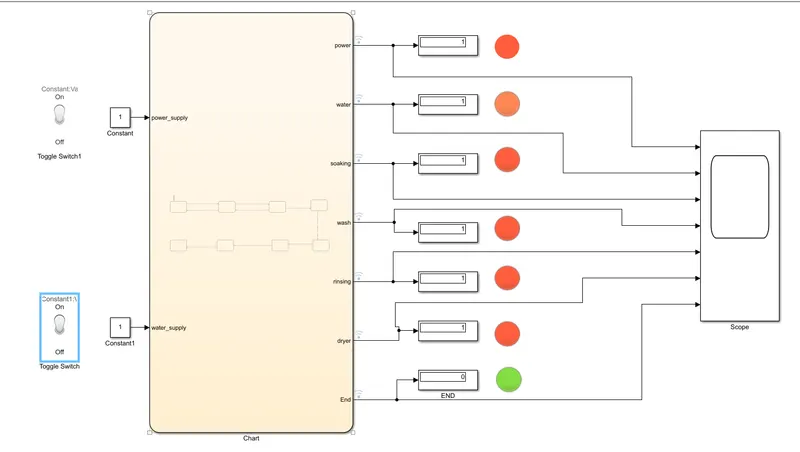
after completion of all the process in the washing machine the END signal is notified with the green signal.
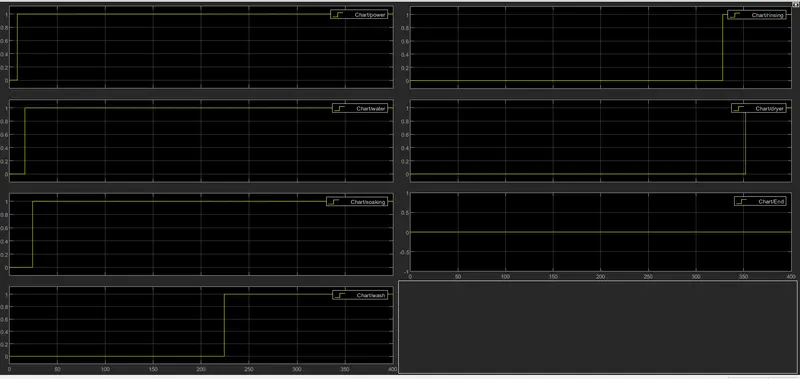
fig. different process with different time sequence
SECTION B
PROCEDURE :
WORKING PRINCIPLE OF A GEAR SHIFTING MECHANISM:-
In a manual transmission for a back tire drive vehicle, the stuff train is built upon three shafts. The information shaft stretches out from the front of the transmission.An outer parallel-splined area draws in with inner splines on the grip driven plate. A primary drive gear is a vital piece of the shaft. It networks continually with a mating gear on a counter-shaft which has various cog wheels shaped on it. These pinion wheels network with mating gears on the principle shaft, or yield. These primary shaft gears are upheld on orientation on the shaft. They can pivot without turning the yield. Every fundamental shaft gear has an outer toothed segment on one side. The teeth face an inside toothed commitment sleeve situated on a focal centre point, which is itself splined to the primary shaft. The commitment sleeve can slide one or the other way to draw in the outside teeth on the suitable stuff.
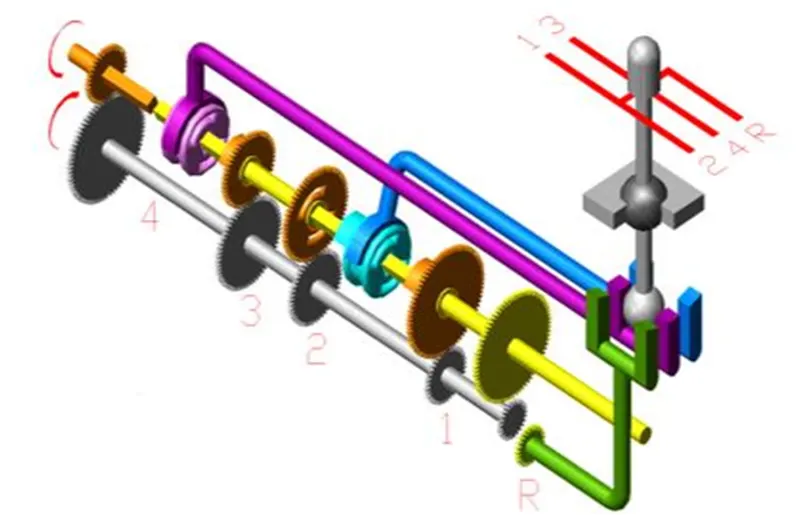
This bolts the stuff through the sleeve and centre, to the principle shaft. The commitment sleeve can slide one or the other way to connect with the outer teeth on the proper stuff. This bolts the stuff through the sleeve and centre, to the principle shaft. Before the commitment of the segments happens, a synchromesh gadget between the sleeve and stuff synchronizes them. The cogwheels continually in the network, have their teeth cut on a helix, at a point to the stuff place line. This decreases gear clamour and circulates load all the more uniformly, as a few teeth are in touch at any one time. Teeth on the opposite idler are regularly straight cut or prod gears, slice corresponding to the stuff place line. At the point when the opposite is chosen, this interfaces the converse idler with mating gears on the countershaft and principle shaft.
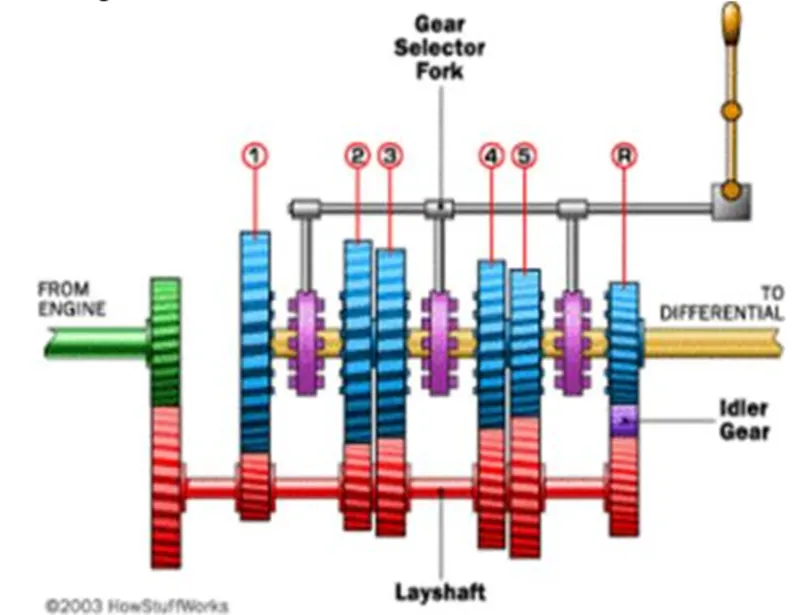
The opposite idler turns on a plain shaft fixed in the packaging. It moves the drive from one shaft to the next and switches the bearing of the turn of the primary shaft. To effect a gear change, selecting first gear, for example, the driver depresses the clutch, disengaging the input shaft. Using the shift lever, the driver selects the first gear, and the linkage moves the shift junction to connect the 1st-2nd locking collar with the 1st gear, locking it to the output shaft.
Explanation of gear shifting mechanism using Simulink :
INPUT:-
Stage 1: Creating chart by using the given gear arrangement
Speed Range(kmph) Gear
0 to 15 1
16 to 25 2
26 to 40 3
41 to 60 4
Above 61 5
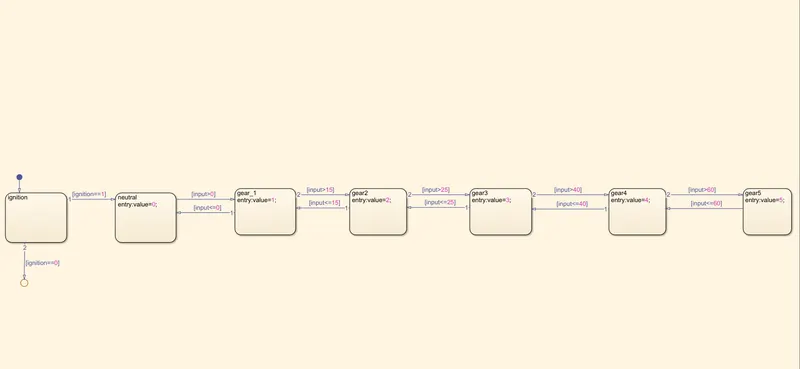
Stage 2: After entering the information conditions in the graph. Go to Symbols sheet and allot the given variable (Example input information. Yield information)
Stage 3 Connect the "Slider Gain" to fluctuate the speed while the system is running.
Stage 4: Create Constant and giving worth 1 and 0 as a input to toggle switch.
Stage 5: connect the toggle switch to constant block.
Stage 6 Use a presentation Block to show the Gear position.
OUTPUT:-
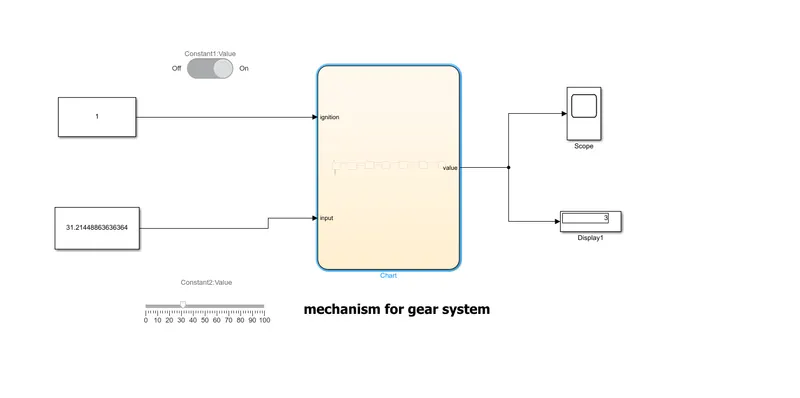
Situation1 :- WHEN TOGGLE SWITCH IS ON
when the switch is ON constant block shows the value 1 means the ignition (engine ) started.
the INPUT given to the chart is variable speed which can be vary by slider the output show on the display
is 3 on the current form as speed vary gear vary. speed is proportional to gear.(refer above figure)
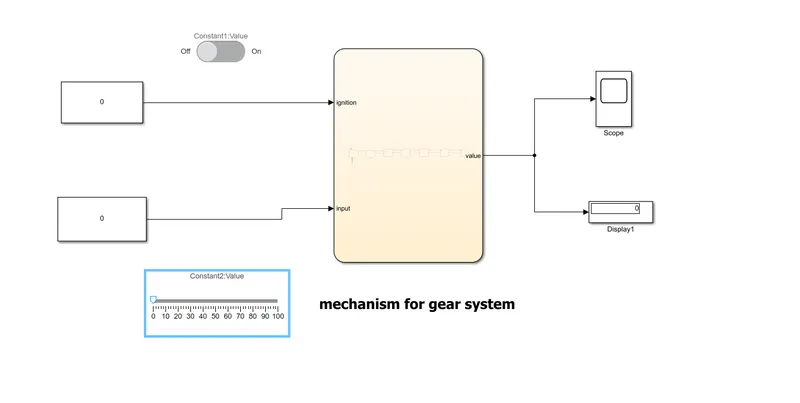
Situation 2 :- when the toggle switch is off
when the switch is OFF the ignition constant block shows the 0 value hence the speed is 0
and display block show 0 output gear (refer above figure).