Effect of pre-heating on combustion efficiency
Aim:
- To study the effect of preheated air on combustion efficiency using python and cantera.
In a typical furnace, less than 50% of the heat generated is converted to useful heat. The rest of the heat is lost in many forms in which flue gas loss being the major loss and accounts for about 30% of the total heat input. This high temperature flue gas has the potential to be reused in the furnace. To recover the waste heat from flue gases, a recuperator/heat exchanger is used. In a recuperator, heat exchange takes place between flue gases and inlet combustion air through ceramic or metallic walls. As energy moves from a hot body to a cold one, the inlet air is heated to a higher temperature using the waste gas. This pre-heated air is feeded to the burner directly or as air-fuel mixture. Doing so has resulted in increased flame temperature, fuel saving and overall improvement in furnace efficiency.
Objectives:
- To preheat air (298K to 600K) and to study it's effect on adiabatic flame temperature.
- To plot the effect of pre-heating on combustion efficiency.
Case-1: To find the effect of preheating of air on adiabatic flame temperature.
The fuel used for combustion was methane at 298.15 K and one atmospheric pressure. The air was set at one atmospheric pressure and air temperature was varied from 298 K to 600K to account for the preheating and adiabatic flame temperature was to be calculated for different preheated air temperatures. Zero heat loss was assumed for this case.
import matplotlib.pyplot as plt
import cantera as ct
import numpy as np
'''
Air is initially set at 298K standard temperature and it is preheated up to 600K.
Plotted effect of preheating of air on adiabatic flame temperature.
'''

gas = ct.Solution('gri30.cti')
AFT= []
phi= 1 #equivalence ratio
pre_ht = np.zeros(20)

for i in range(0,len(pre_ht)):
	pre_ht[i] = 298+(i*(600-298)/19) #Preheated air temperatures from 298 K to 600 K

	air = ct.Quantity(gas) #creating air object from gas quantity


	air.TPX = pre_ht[i],ct.one_atm, {'O2':0.21, 'N2':0.79}
	air.moles = (2/phi)*4.76


	fuel = ct.Quantity(gas) #creating fuel object from gas quantity
	fuel.TPX = 298.15,ct.one_atm,'CH4:1'
	fuel.moles = 1


	mix = air + fuel #air-fuel mixture
	mix.equilibrate('HP', 'auto')
	AFT.append(mix.T)

print('Air temperatures= '+str(pre_ht))
print('Adiabatic flame temperature = ' +str(AFT))

plt.plot(pre_ht,AFT,'r-*')
plt.title('Air temperature Vs Adiabatic flame temperature', fontweight = 'bold')
plt.xlabel('Air temperature (K)')
plt.ylabel('Adiabatic flame temperature (K)')
plt.grid(True)
plt.show()
Results & observations:
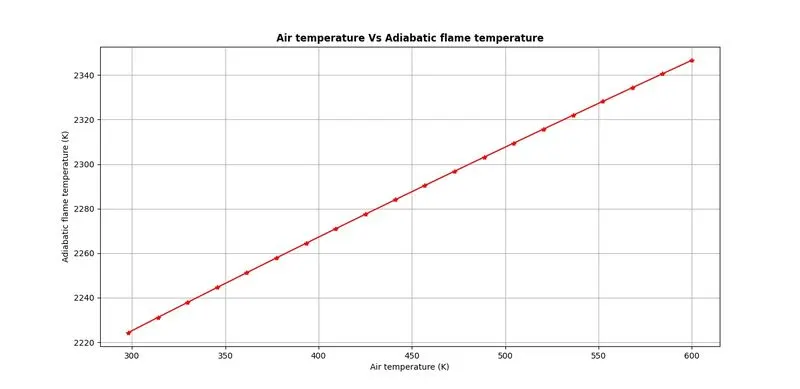
Fig.1
Initially air was set at 298K standard temperature. For this input, an AFT of 2224K was obtained. When the air was pre-heated gradually, a proportional rise in AFT was also recorded. The AFT rose by roughly 6K for 15 to 16K increase in air preheated temperature. The resulting plot gave a straight line graph as shown above. With a pre-heated air temperature of 600K, an adiabatic flame temperature of 2346.6 K was obtained.
| Air temperature (K) | Adiabatic flame temperature (K) |
| 298 | 2224.3 |
| 313 | 2231.1 |
| 329 | 2237.9 |
| 345 | 2244.6 |
| 361 | 2251.2 |
| 377 | 2257.9 |
| 393 | 2264.4 |
| 409 | 2271 |
| 425 | 2277.5 |
| 441 | 2283.9 |
| 456 | 2290.4 |
| 472 | 2296.7 |
| 488 | 2303 |
| 504 | 2309.4 |
| 520 | 2315.7 |
| 536 | 2321.9 |
| 552 | 2328.1 |
| 568 | 2334.3 |
| 584 | 2340.4 |
| 600 | 2346.6 |
Table.1
Case-2: To find the effect of pre-heating on combustion efficiency and fuel consumption.
The combustion efficiency(`eta`) is a measure of the effectiveness of the furnace to convert the heat content of the fuel to usable heat energy. It can also denote how well the fuel being burned is being utilized in the combustion process. By calculating the combustion efficiency, the efficiency gains that may result by preheating can be realized.
Combustion efficieny, `eta =` Heat released by combustion / heat value of fuel
`eta = (Q_(out)/Q_(fuel))`
here, `Q_(out)` is the heat released by combustion. It is the sum of useful heat and heat losses that occur in the process. If the combustion were to happen inside a adiabatic chamber, the heat loss would become zero. `Q_(fuel)` is the heat value or the calorific value of the fuel. It has to be multiplied by the mass flow of fuel input since the furnace is control volume.
`eta = Q_(out)/(mf_(fuel)* LHV of fuel)`
`Q_(out)` can be found from equating the input and output enthalpies as shown below;
`Q_(out) = (mf_(air)*h_(air))+(mf_(fuel)*h_(fuel)) -(mf_(p)*h_(p))`
Where,
`mf_(air)` = mass of air input
`mf_(fuel)` = mass of fuel input
`h_(air)` = Enthalpy of air
`h_(fuel)` = Enthalpy of fuel
`h_(p)` = Enthalpy of exhaust gases
`mf_(p)` = mass of exhaust gases = `mf_(air) + mf_(fuel)`
The exhaust gas temperature was set at 1700K and the combustion was assumed to be adiabatic.
import matplotlib.pyplot as plt
import cantera as ct
import numpy as np

gas = ct.Solution('gri30.xml')
phi= 1 #equivalence ratio
LHV = 50e+6 #J/KG
pre_ht = np.linspace(298,600,20) #Preheated air temperatures (K)
AFT= []
eta =[]

for i in range(0,len(pre_ht)):

	air = ct.Quantity(gas)
	air.TPX = pre_ht[i] ,ct.one_atm, {'O2':0.21, 'N2':0.79}
	air.moles = (2/phi)*4.76
	mass_air = air.mass
	h_air = air.h


	fuel = ct.Quantity(gas)
	fuel.TPX = 298.15,ct.one_atm,'CH4:1'
	fuel.moles = 1
	mass_fuel = fuel.mass
	h_fuel = fuel.h


	products = ct.Quantity(gas)
	products.TPX = 1700, 1013251,{'CO2':0.095,'H2O':0.1901,'N2':0.7148}
	products.moles =10.52
	mass_products = products.mass
	h_products = products.h


	Q_out = (mass_air*h_air) + (mass_fuel*h_fuel) - (mass_products*h_products)
	Q_fuel = (mass_fuel*LHV)

	#efficiency gains = (Q_out/Q_fuel)*100
	eta.append((Q_out/Q_fuel)*100)


plt.plot(pre_ht,eta,'-4')
plt.title('Efficiency gains due to pre-heating', fontweight='bold')
plt.xlabel('Air temperature (K)')
plt.ylabel('Combustion efficiency(%)')
plt.grid(True)
plt.show()
Results & observations:
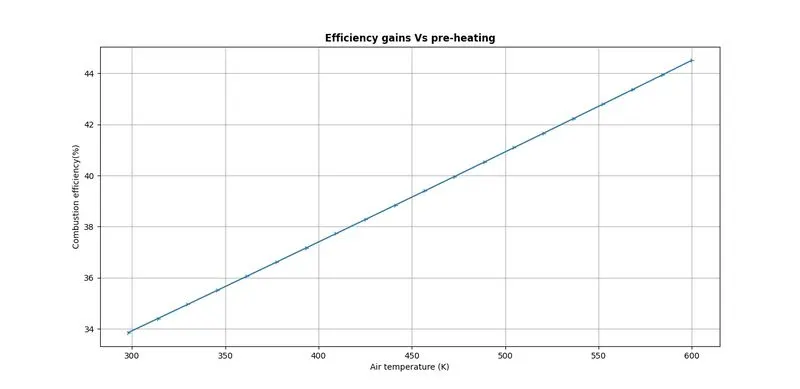
Fig.2
Evidently, from the above plot, combustion efficiency is directly proportional to the air temperature. With higher pre-heating, greater efficiency gains were achieved. For 15K rise in air temperature by preheating, roughly 0.6% efficiency gains were recorded. With pre-heated air temperature of 600K, combustion efficiency was recorded to be 44.5%, which was over 10% greater in efficiency than that of non-preheated air system. Since a higher pre-heated air gave greater amount of useful heat energy and higher adiabatic flame temperature, it can be confirmed that with higher pre-heating of air, lesser amount of fuel is required to achieve the required temperature in the furnace.
| Air Temperature (K) | Combustion efficiency (%) |
| 298 | 33.8 |
| 313.8 | 34.4 |
| 329.7 | 34.9 |
| 345.6 | 35.5 |
| 361.5 | 36.0 |
| 377.4 | 36.6 |
| 393.3 | 37.1 |
| 409.2 | 37.7 |
| 425.1 | 38.2 |
| 441.0 | 38.8 |
| 456.9 | 39.4 |
| 472.8 | 39.9 |
| 488.7 | 40.5 |
| 504.6 | 41.0 |
| 520.5 | 41.6 |
| 536.4 | 42.2 |
| 552.3 | 42.7 |
| 568.2 | 43.3 |
| 584.1 | 43.9 |
| 600 | 44.5 |
While running this case, the furnace exhaust temperature was assumed to be constant(1700 K). If the exit temperature had not been set to a constant, the furnace temperature would keep on increasing since the air is pre-heated according to the exit temperature. Maintaining the furnace exhaust temperature to a limit is necessary so that temperature of pre-heated air remains unchanged and does not cross its intended safety limits.
Conclusions:
- Furnace flame temperature is directly proportional to pre-heated air temperature. Found efficiency gains to be increasing with pre-heating of air.
- Pre-heating of air can help reduce fuel consumption, exhaust gas pollution and overall efficiency of the system.