Week 4.2 - Combustion Efficiency Calculation after Preheating
Preheating Combustion Efficiency
Aim: Study and Evaluation of Combustion efficiency after preheating in recuperator.
Objective: -
- To evaluate the combustion efficiency in recuperator.
- To calculate the AFT for different range of inlet temperatures.
- To determine the effect of pre-heating on the combustion efficiency.
Introduction: -
For the combustion phenomenon it is important to have incoming air at a certain degree of temperature for effective combustion and less fumes gases which is product of combustion. Preheating of gases are done in internal combustion engine by using EGR system which is most similar to recuperator. The recuperator is a special purpose counter flow energy recovery heat exchanger which is placed in between supply and exhaust air gases. It is mostly used in the exhaust gases treatment of industrial sector. The main function of recuperator is to remove the heat from the exhaust gases and used to heat the incoming air which is entering in the combustion chamber for releasing heat.
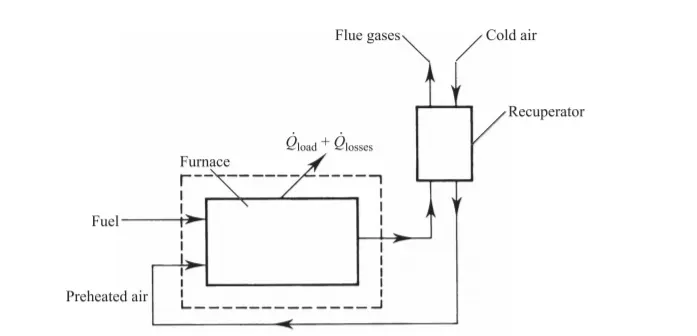
In above schematic figure it can be seen that, furnace have both fuel and air inlet for the combustion process. The exhaust from the furnace is travelled through the recuperator and another inlet of cold air is passed through the recuperator. This flues gases attending higher temperature due to combustion exchange heat with cold air and same air is used preheated air for the combustion. If the same cold air is directly fed to the combustion the mixture become more rich as the cold air humid and dense in nature will take longer time for combustion.
The combustion efficiency of the recuperator can be derived by assuming both the heat transferred to the load and heat losses are the same, with and without preheating conditions. Considering the steady state flow for the whole mechanism, the heat transfers out of control volume is given as:
`-Q ̇= Q ̇_((load) )- Q ̇_((loss) )= m ̇(h_((Prodt) )-h_((react) ) )`
`=(m ̇_A+ m ̇_F ) h_((Prodt) )- m ̇_F h_F- m ̇_A h_A`
From above equation the heat transfer can be written as considering equivalence ratio.
`Q ̇= -([(A/F)+1] h_((Prodt))- (A/F) h_A-h_F )`
The fuel utilization efficiency for the recuperator is given as:
`η=((Q ̇)/(m ̇_F LHV))`
Considering equivalence ratio as 1 we can calculate fuel savings as:
`SavIng =1- (η_298/η_600 )`
Coding Approach: -
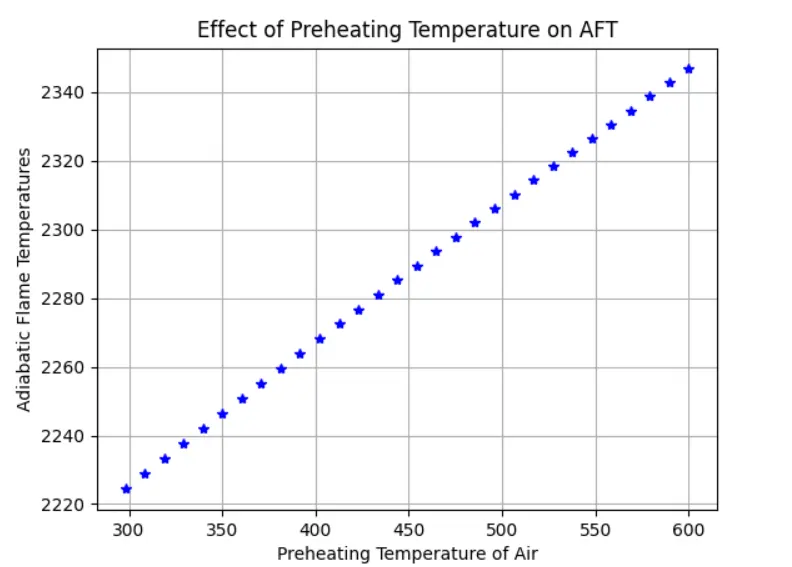
The defined objective of problem is separated between two different codes. The first code will calculate the Adiabatic Flame Temperature with respect to different preheating temperatures ranging from 298 to 600 kelvin. In this code methane plus air combustion reaction is used for calculation of AFT. The reaction is given as:
`CH4+2(O2+3.76N2)=CO2+2H2O+7.52N2`
From the cantera we call the ‘gas’ object from which gri30.cti natural gas combustion mechanism is used to calculate the AFT. Then to calculate the AFT at different preheating temperature ‘linspace’ command is used to make instances in the temperature ranging from 298 to 600. The fuel is considered at one atmospheric pressure and 298K temperature and number of moles considered for fuel is 1. Similarly, the air properties are taken from the class called ‘Quantity’ from the cantera. The equilibrate function is used to calculate the AFT for the chemical reaction using auto solver.
For the second code setup the exit temperature of furnace which is product temperature in the code is consider as 1700K. In the second code the efficiency of the recuperator is calculated. The given parameter in the code are LHV which is 50Mj/KG. The air fuel mixture is also considering for this code as 17.1 which is further used to calculate the efficiency. The enthalpy of fuel and products are calculated in the code and respectively used for AFT in given preheating temperature values.
Code 1
"""
Calculation of Adiabatic Flame Temperature for Different preheating temperature in Recuperator
Chemical Reaction used for Calculating AFT
CH4 + 2(O2+3.76N2) ==> CO2 + 2H20 + 7.52N2
Code written by: Shubham K. Chaudhari
"""

import cantera as ct
import matplotlib.pyplot as plt
import numpy as np

# Taking the Object gas from Cantera

gas = ct.Solution('gri30.cti')

# Defining fuel for the chemical reaction

fuel = ct.Quantity(gas)
fuel.TPX = 298.15, ct.one_atm, 'CH4:1'
fuel.moles = 1

# Defining air for chemical reaction at different inlet temperature

air = ct.Quantity(gas)
T = np.linspace(298, 600, num=30)   # creation of Linspace command to take value in between 298 to 600

# Creating loop to calculate the AFT at different preheating temperature

for T_p in T:
    air.TPX = T_p, ct.one_atm, {'O2': 0.21, 'N2': 0.79}
    air.moles = (2*3.76)/0.79

    M = fuel + air
    M.equilibrate('HP', 'auto')

    print(M.T)
    plt.plot(T_p, M.T, '*', color='blue')

# Plotting of Results
plt.grid()
plt.xlabel('Preheating Temperature of Air')
plt.ylabel('Adiabatic Flame Temperatures')
plt.title('Effect of Preheating Temperature on AFT')
plt.show()
Results Code 1: -
Conclusion: -
- From the graph it can be seen that increase in preheating temperature cause the adiabatic temperature to rise linearly.
- The larger preheating temperature cause the increase of AFT shows effective burning of fuel inside burner.
- The consumption of fuel is considerably less as preheating temperature of air is more cause less fuel to burn.
Code 2: -
"""
Code 2: - Calculation of Combustion efficiency for the different preheating temperature of air
Code written by: - Shubham K. Chaudhari
Heat loss equation used in code:
Q = (ma + mf)*h_prodt - mf*h_fuel - ma*h_air
Q = -(((A_f + 1) * h_prodt) - (A_f * h_react) - h_fuel)
A_f = mass of air / mass of fuel
A/f = 17.1
equivalence ratio = 1
"""

import cantera as ct
import matplotlib.pyplot as plt
import numpy as np

gas = ct.Solution('gri30.cti')
LVH_fuel = 50e6
A_f = 17.1

# Creation of Inlet temperature from 298 to 600K
T = np.linspace(298,600,num=100)
# Enthalpy of Fuel
fuel = ct.Quantity(gas)
fuel.TPX = 298.15, ct.one_atm,{'CH4':1}
h_fuel = fuel.enthalpy_mass
fuel.moles = 1
# Enthalpy of Products from Reactions
prodt = ct.Quantity(gas)
prodt.TPX = 1700,ct.one_atm,{'CO2': 0.094, 'H2O': 0.189, 'N2': 0.715}
h_prodt = prodt.enthalpy_mass
prodt.moles = 1

# Creating array of enthalpy
h_react = []

for T_p in T:
    react = ct.Quantity(gas)
    react.TPX = T_p, ct.one_atm, {'O2':0.21, 'N2':0.79}
    react.moles = 2
    h_react.append(react.enthalpy_mass)

Q = []
eta = []

for g in range (len(T)):
    Q = -(((A_f + 1)*h_prodt) - (A_f*h_react[g])-h_fuel)
    eta.append(Q/LVH_fuel)

# Finding the Fuel saving in Percentage
fuel_sv = 1-(eta[0]/eta[99])
Fs = fuel_sv*100
print('Total saving of Fuel in % = ',Fs)
plt.plot(T,eta,'*',color = 'red')
plt.grid()
plt.xlabel('Preheating Temperature of Inlet Air')
plt.ylabel('Combustion efficiency')
plt.title('Effect of Preheating Temperature on Combustion efficiency')
plt.show()
Result Code 2: -
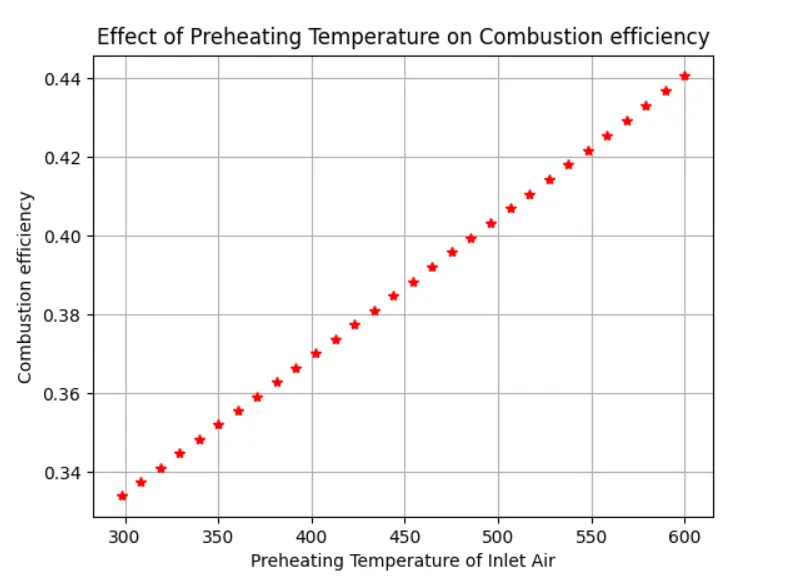
1) Combustion efficiency
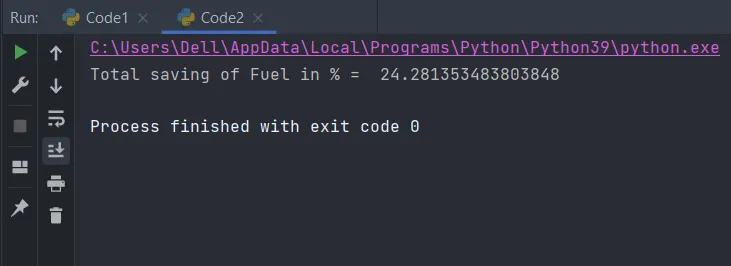
2) Fuel saving in %
Conclusion: -
- From the plot of combustion efficiency it can be seen that increase in preheating temperature increase in combustion efficiency linearly.
- The percentage of fuel saving for the product temperature at 1700K is around 24.28%.