Week 4.2 - Combustion Efficiency Calculation after Preheating
Combustion Efficiency Calculation after Preheating
- Aim :
- the effects of preheating on the adiabatic flame temperature.
- To find out if preheating helps with fuel saving.
- To find out how combustion efficiency goes up as a function of pre-heating temperature.
- To plot the effects of pre-heating on combustion efficiency.
- Theory :
Furnace - Furnace, structure in which useful heat is produced by combustion or other means. Historically, the furnace grew out of the fireplace and stove, following the availability of coal for heating. Chemical energy is transformed into heat by burning fuels such as coal, wood, oil, and hydrocarbon gases. Furnaces may apply their heat to other devices, as boilers, ovens, and kilns, or they may apply it directly to material in the course of being processed, as in steel production.
Recuperator - A recuperator is a special purpose counter-flow energy recovery heat exchanger positioned within the supply and exhaust air streams of an air handling system, or in the exhaust gases of an industrial process, in order to recover the waste heat. Generally, they are used to extract heat from the exhaust and use it to preheat air entering the combustion system. In this way they use waste energy to heat the air, offsetting some of the fuel, and thereby improves the energy efficiency of the system as a whole.
In many types of processes, combustion is used to generate heat, and the recuperator serves to recuperate, or reclaim this heat, in order to reuse or recycle it. The term recuperator refers as well to liquid-liquid counterflow heat exchangers used for heat recovery in the chemical and refinery industries and in closed processes such as ammonia-water or LiBr-water absorption refrigeration cycle.
Recuperators are often used in association with the burner portion of a heat engine, to increase the overall efficiency. For example, in a gas turbine engine, air is compressed, mixed with fuel, which is then burned and used to drive a turbine. The recuperator transfers some of the waste heat in the exhaust to the compressed air, thus preheating it before entering the fuel burner stage. Since the gases have been pre-heated, less fuel is needed to heat the gases up to the turbine inlet temperature. By recovering some of the energy usually lost as waste heat, the recuperator can make a heat engine or gas turbine significantly more efficient.
Combustion Efficiency - Combustion efficiency is a measure of how effectively the heat content of a fuel is transferred into usable heat. The stack temperature and flue gas oxygen (or carbon dioxide) concentrations are primary indicators of combustion efficiency.
The combustion efficiency ηc [-] is defined as the ratio between the energy released by the burnt fuel and the theoretical energy content of the fuel mass during one complete engine cycle.
`η_c=(H_R – H_P)/(m_f⋅Q_(HV))`
where, HR [J] – enthalpy (internal energy) of the reactant
HP [J] – enthalpy (internal energy) of the product
mf [kg] – mass of fuel inducted per cycle
QHV [J/kg] – lower heating value of the fuel
Heating Value - The heating value (also knows as energy value or calorific value) of a fixed quantity of fuel, is the amount of heat released during its combustion. The heating value of a fuel is the magnitude of the heat of reaction measured at constant pressure/volume and standard temperature (26 °C) for the complete combustion of a unit of mass of fuel.
Fuel saved - Fuel saved by change in combustion efficiency is given by,
Fuel saved = 1 - `eta_0/eta`
where `eta_0` is efficiency at T = 298K or stp
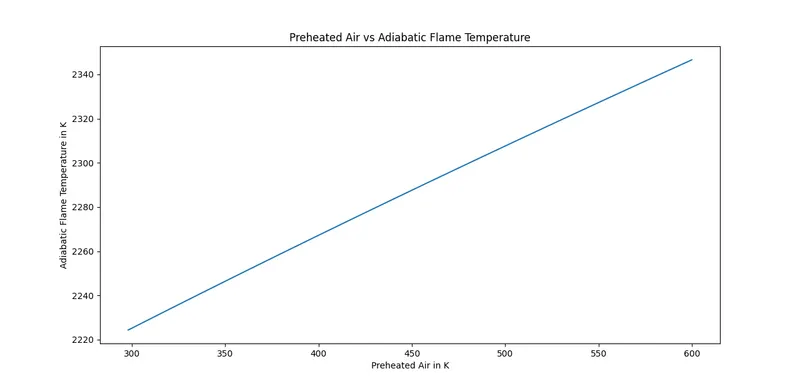
- Case I : Effect of air preheating on Adiabatic flame temperature.
Firstly we have to solve this using cantera so we import cantera and matplotlib for making plots.
Using notations 'A' and 'B' for air and fuel respectively.
Define quantity function of A and B in solution class.
Using '.TPX' command to define temperature , pressure and mole fraction for A and B.
Varying preheated temperature within range of 298 K to 600 K.
Appending preheated temperature in array as T_preheat.
Mix A and B to form fuel mixture as M.
Using constant enthalpy and pressure solver to calculate AFT. Appending the AFT values.
Printing and plotting AFT vs Preheated temperature.
"""
CH4 + 2(O2 + 3.76N2) => CO2 + H2O + 7.52N2
"""

import cantera as ct
import matplotlib.pyplot as plt


gas = ct.Solution('gri30.cti')

T_min = 298.15
T_max = 600


B = ct.Quantity(gas)
B.TPX = 298.15,ct.one_atm,'CH4:1546'
B.moles = 1

T_preheat = []
AFT = []

for T_pre in range(298,601):


	A = ct.Quantity(gas)
	A.TPX = T_pre,ct.one_atm,{'O2':0.21, 'N2':0.79}
	A.moles = 9.52
	T_preheat.append(T_pre)


	# Mixture of air and fuel is given as
	M = A + B
	M.equilibrate('HP','auto')
	AFT.append(M.T)
	print(AFT)

print(T_preheat)
plt.plot(T_preheat, AFT)
plt.title("Preheated Air vs Adiabatic Flame Temperature")
plt.xlabel("Preheated Air in K")
plt.ylabel("Adiabatic Flame Temperature in K")
plt.show()
Plots :
Results -
- The value of Adiabatic flame temperature increases linearly as pre heated temperature rises.
- Max value of AFT is at 600 K or upper limit of the preheated air temperature.
- Suitable value of AFT can be obtained by varying value of pre heated temperature.
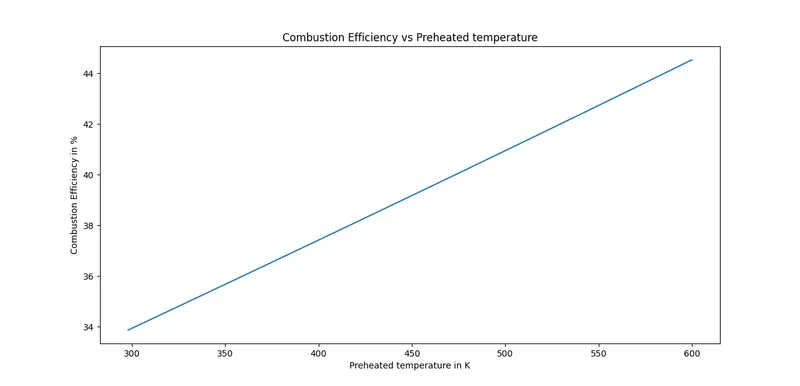
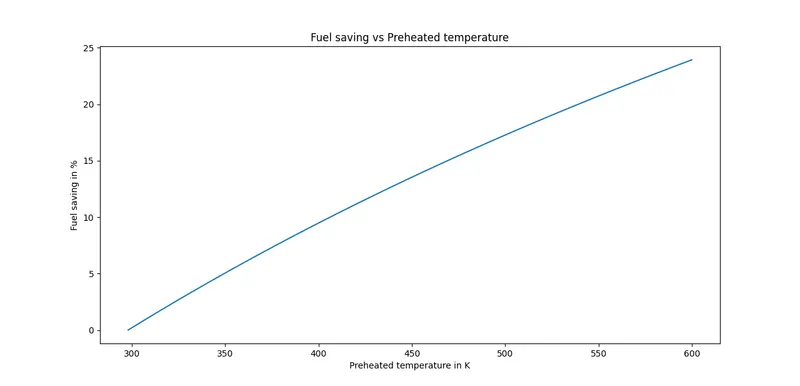
- Case II : Effect of preheating on combustion efficiency and fuel saving
The initial steps are similar to code we have written for Case I.
Defining 'C' as products from the reaction with exhuast temperature of 1700 K.
Using commands '.mass' and '.enthalpy_mass' to find out mass and enthalpy of different reactants and products.
Lower heating value for this case is given as 50 MJ/kg which is equal to 50*10^6 J/kg.
Calculating heat realeased (Q) to find out the effciency (`eta`) using formula mentioned above.
Calculating the percentage of fuel saved using formula mentioned above.
Appending the values in array.
Printing and plotting the values of efficiency and fuel saved vs preheated temperature.
"""
CH4 + 2(O2 + 3.76N2) => CO2 + H2O + 7.52N2
"""

import cantera as ct
import matplotlib.pyplot as plt

gas = ct.Solution('gri30.cti')

B = ct.Quantity(gas)
B.TPX = 298.15, ct.one_atm, {'CH4':1}
B.moles = 1
B_M = B.mass
B_H = B.enthalpy_mass


# Defining C for products from reaction
C = ct.Quantity(gas)
C.TPX = 1700, ct.one_atm, {'CO2':1/10.52, 'H2O':2/10.52, 'N2':7.52/10.52}
C.moles = 10.52
C_H = C.enthalpy_mass

LHV = 50e6     #Lower heating value J/Kg

Efficiency = []
Fuel_saving = []
T = []


for T_pre in range(298,601):


	A = ct.Quantity(gas)
	A.TPX = T_pre, ct.one_atm, {'O2':0.21, 'N2':0.79}
	A.moles = 9.52
	A_M = A.mass
	A_H = A.enthalpy_mass


	Q = B_H + ((A_M/B_M)*A_H) - ((1 + (A_M/B_M))*C_H)
	eff = (Q/LHV)*100


	if (T_pre == 298):

		eff_0 = eff

	fuel_saved = abs((1 - (eff_0/eff))*100)

	Fuel_saving.append(fuel_saved)
	Efficiency.append(eff)
	T.append(T_pre)


print(Efficiency)
print(Fuel_saving)


plot_1 = plt.figure(1)
plt.plot(T,Efficiency)
plt.xlabel('Preheated temperature in K')
plt.ylabel('Combustion Efficiency in %')
plt.title('Combustion Efficiency vs Preheated temperature')

plot_2 = plt.figure(2)
plt.plot(T,Fuel_saving)
plt.xlabel('Preheated temperature in K')
plt.ylabel('Fuel saving in %')
plt.title('Fuel saving vs Preheated temperature')
plt.show()
Plots -
Results -
- Combustion efficiency increases linearly as preheated temperature is raised.
- The percentage of fuel saving increases fairly in linear nature.
- Air preheating is beneficial as both combustion efficiency and fuel saving improves.
- To find out the optimal temperature where maximum fuel savings can be obtained, we need to run the calculations for wider range of preheated temperature.
Q. Is it right or wrong to assume a fixed furnace exit temperature?
Ans : It is right to assume to a fixed furnace exit temperature. Different furnaces have different range of operating temperatures. To save furnace from damages and improve its running efficiency we should assume a fixed furnace exit temperature and control the combustion with respect to it. Also assuming furnace exit temperature helps us in finding out the optimal temperature at which combustion efficiency and fuel savings can be maximized.