Week 4.1 - Genetic Algorithm
GENETIC ALGORITHM
AIM :
- To optimise the stalagmite function and find the global maxima of function.
OBJECTIVES :
- Expalin the concept of genetic algorithm in your own words and also explain the syntax for ga in MATLAB.
- Plot graphs for all 3 studies and for F maximum vs no. of iterations .
INTRODUCTION (GA) :
- A genetic algorithm is a search heuristic that is inspired by Charles Darwin’s theory of natural evolution. This algorithm reflects the process of natural selection where the fittest individuals are selected for reproduction in order to produce offspring of the next generation.
Notion of Natural Selection :
- The process of natural selection starts with the selection of fittest individuals from a population. They produce offspring which inherit the characteristics of the parents and will be added to the next generation. If parents have better fitness, their offspring will be better than parents and have a better chance at surviving. This process keeps on iterating and at the end, a generation with the fittest individuals will be found.
Five phases are considered in a genetic algorithm.
- Initial population
- Fitness function
- Selection
- Crossover
- Mutation
Initial Population :
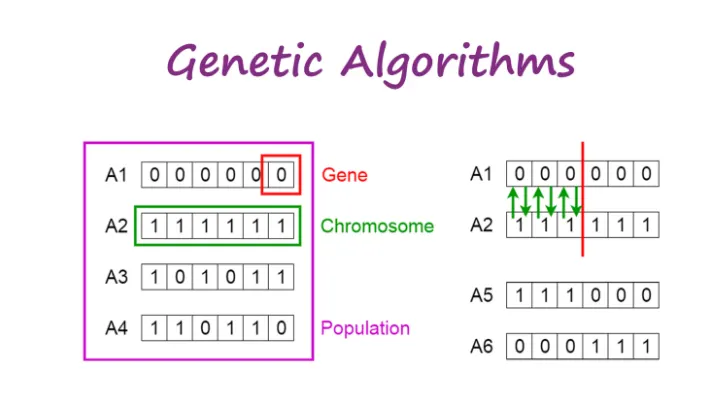
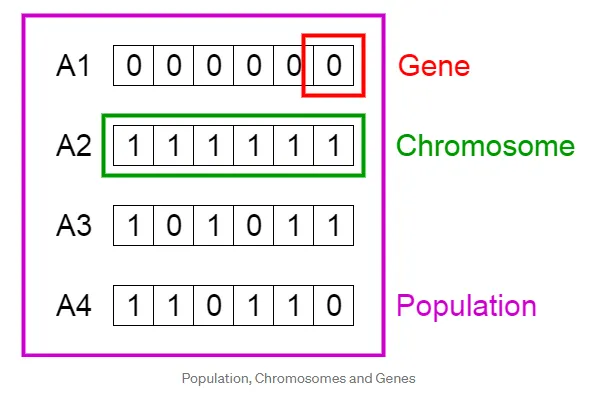
- The process begins with a set of individuals which is called a Population.
- Each individual is a solution to the problem you want to solve.
- An individual is characterized by a set of parameters (variables) known as Genes.
- Genes are joined into a string to form a Chromosome (solution).
- In a genetic algorithm, the set of genes of an individual is represented using a string, in terms of an alphabet. Usually, binary values are used string of 1s and 0s .
- We say that we encode the genes in a chromosome.
Fitness Function
- The fitness function determines how fit an individual is (the ability of an individual to compete with other individuals).
- It gives a fitness score to each individual. The probability that an individual will be selected for reproduction is based on its fitness score.
Selection
- The idea of selection phase is to select the fittest individuals and let them pass their genes to the next generation.
- Two pairs of individuals (parents) are selected based on their fitness scores. Individuals with high fitness have more chance to be selected for reproduction.
Crossover
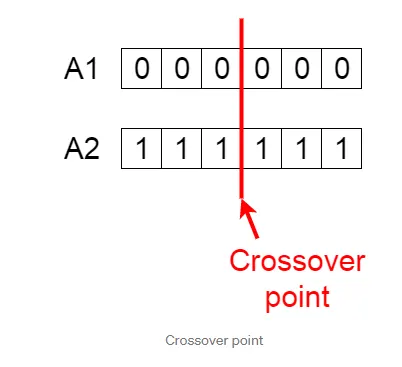
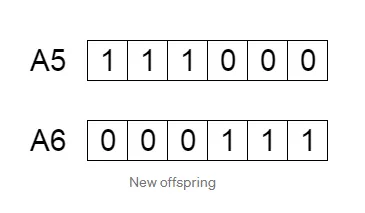
- Crossover is the most significant phase in a genetic algorithm. For each pair of parents to be mated, a crossover point is chosen at random from within the genes.
- For example, consider the crossover point to be 3 as shown below.
- Offspring are created by exchanging the genes of parents among themselves until the crossover point is reached.
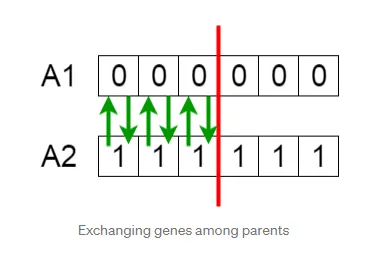
- The new offspring are added to the population.
Mutation
- In certain new offspring formed, some of their genes can be subjected to a mutation with a low random probability. This implies that some of the bits in the bit string can be flipped.
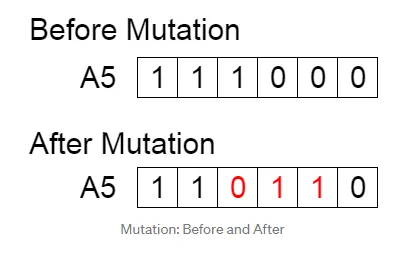
- Mutation occurs to maintain diversity within the population and prevent premature convergence.
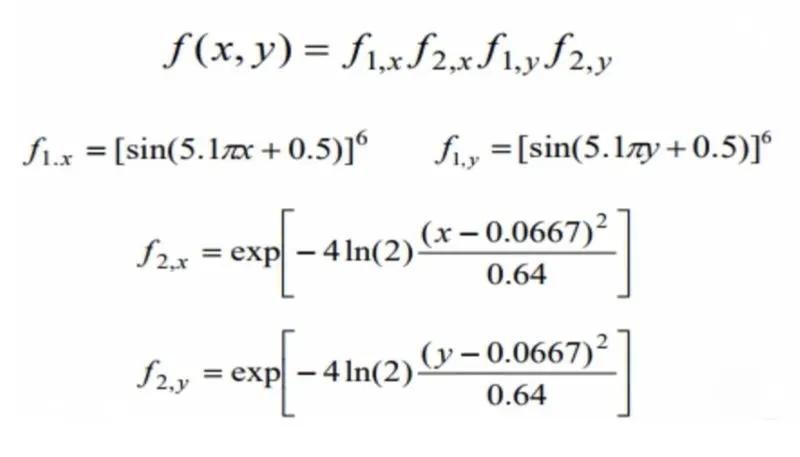
FUNCTION EQUATION :
SYNTAX FOR GA :
x-ga(func,nvars,A,B,Aeq,Beq, LB.UB,nonlcon,intcon.options)
func = objective function.
nvars= number of variables.
A & B = subject to inequalities of the form A'x<-B.
Aeq & Beq = subject to linear equalities of the form A*x-B.
LB-lower bond.
UB - upper bond.
nonicon - non linear inequalities
intcon- integrated constraints.
options - helps to add constraints tolerance by increasing population size.
PROGRAM CODE :
FUNCTION CODE :
function [f]=stalagmite(input_vector)
x=input_vector(1);
y=input_vector (2);
f1=(sin(5.1*pi*x+0.5))^6;f2=(sin(5.1*pi*y+0.5))^6;
f3=exp(-4*log(2)*(x-0.0667)^2/0.64);
f4=exp(-4*log(2)*(y-0.0667)^2/0.64);
f=-(f1*f2*f3*f4);end
MAIN PROGRAM CODE :
% PROGRAM FOR GENETIC ALGORITHM
clear allclose allclc% defining our search space
x=linspace(0,0.6,150);y=linspace(0,0.6,150);
% creating 2d diamesional mesh
[xx,yy] = meshgrid(x,y);
% evaluting stalagmite function.
for i=1:length(xx) for j=1:length(yy) input_vector(1)=xx(i,j);
input_vector(2)=yy(i,j);
f(i,j)=stalagmite(input_vector);
end
end
num_cases=50;
tic
% study 1- stastical behaviour
for i=1:num_cases
[inputs, fopt1(i)] = ga(@stalagmite, 2);xopt1(i) = inputs(1);
yopt1 (i) = inputs(2);
end
study1_time = toc
figure(1)
subplot(2,1,1)
hold on
surfc(x, y, -f)
shading interp
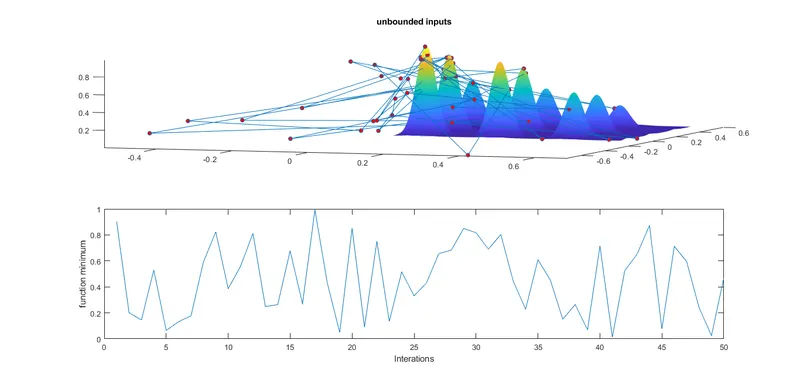
plot3(xopt1,yopt1,-fopt1,'marker','o','markersize',5,'markerfacecolor','r')title('unbounded inputs')
subplot(2,1,2)
plot(-fopt1)
xlabel('Interations')
ylabel('function minimum')
tic
%study 2-stastical behaviour - with upper and lower bonds
for i=1:num_cases
[inputs2, fopt2(i)] = ga(@stalagmite,2,[],[],[],[],[0.5:0.5],[1:1]);xopt2(i) = inputs2(1);
yopt2(i) = inputs2(2);
end
study2_time = toc
figure(2)
subplot(2,1,1)
hold on
surfc(x, y, -f)
shading interp
plot3(xopt2, yopt2, -fopt2,'marker','o','markersize',5,'markerfacecolor','r')
title('unbounded inputs')
subplot(2,1,2)
plot(-fopt2)
xlabel('Interations') ylabel('function minimum')
% study 3 increasing GA iterations
options = optimoptions('ga');
options = optimoptions(options, 'populationsize', 170)
tic
for i = 1 :num_cases
[inputs3,fopt3(i)] = ga(@stalagmite, 2,[],[],[],[],[0:0],[1:1],[],[],options); xopt3(i) = inputs3(1);
yopt3(i) = inputs3(2);
end
study3_time = toc
figure(3)
subplot(2,1,1)
hold on
surfc(x, y, -f)
shading interp
plot3(xopt3,yopt3,-fopt3,'marker','o','markersize',5,'markerfacecolor','r')
title('unbounded inputs') subplot(2,1,2)
plot(-fopt3)
xlabel('Interations')
ylabel('function minimum')
OUTPUTS :
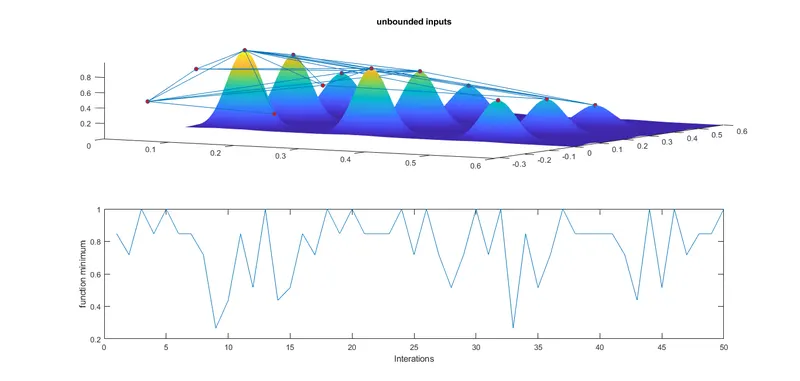
study 1- stastical behaviour
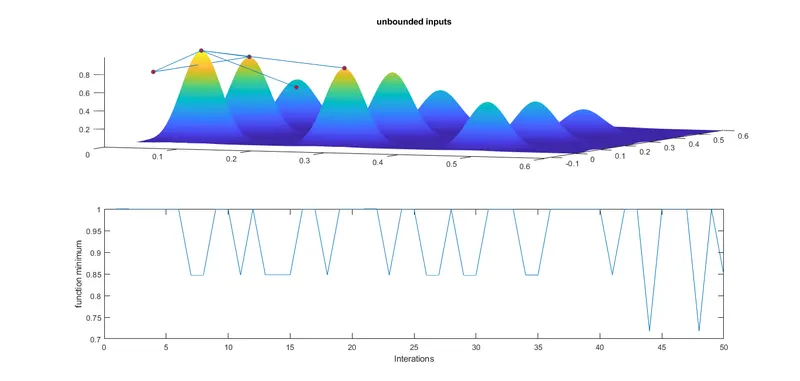
Study 2- stastical behaviour - with upper and lower bonds
study 3- increasing GA iterations
MAIN CODE EXPLAINATION :
- First, Linspace command is used to define x and y with 150 elements between zero and 0.6 including the bounds
- Then num_cases is set which will be used as counter for iterations to 50
- Then a 2D grid is made using meshgrid command is created from x and y input to be outputted to xx and yy
- Then for loop is used to solve the genetic algorithm for every element in the 2D mesh grid
- The length of rows and columns (which have equal length) are used as counters
- Then the input vector is declared as ga requires input vector which is each value in the 2D mesh grid
- Then output of stalagmite function is stored in matrix
- Then tic command is used to start a timer
- Then for loop bounded by the number of iterations is formed
- Then ga code is entered for unbounded statistical study which have the following format:[inputs,fopt] = ga(fun,nvars)
- Inputs represent the values of parameters x and y for which the function has the least value (fopt) fun - The function to be optimized, in this case Stalagmite
- nvars - the number of design variables, in this case only x and y are the variables to be plotted
- Then smallest (minimum) value of the function for each iteration is outputted and its x and y coordinates Which are stored in separate variable
- Then toc command is used to stop the timer and the output is stored in study_time 1
- Then figure 1 is plotted by the following steps:
- First subplot command is used to partition the plot window in order to draw more than one plot in the same windows,two rows and one column are specifiedand then the position of each plot is selected
- Then Hold on command is used to prevent plot from being removed
- The surfc command is used to plot contour with xx value and yy value from the mesh grid as input and negative optimum value is used because we need to maximize the function
- Then x, y,and z axis are labeled
- Then shading interp is used to smoothen the function plot and to remove the grid lines
- Then plot 3 command is used to plot a point in 3 dimensions,here it will plot -fopt because we need the maximum value of the function not the minimum
- Then the graph title is selected
- Then -fopt value of the function is plotted on the second plot in the second row
- Then its x and y axis are labeled
- Then the same study is made but this time it is bounded (has lower and upper limit) which requires the same commands and steps except the ga command which have the following format:[inputs,fopt] = ga(fun,nvars,A,b,Aeq,beq,lb,ub) Inputs, fopt,fun and nvars are the same as Study 1
- A - Linear inequality constraints: real matrix, if there are none, then[]
- b- Linear inequality constraints: real vector, if there are none, then Aeq - Linear equality constraints: real matrix, if there are none, then[]
- beq - Linear equality constraints: real vector, if there are none, then[]
- lb - Lower bounds, specified as a real vector array ub - Upper bounds, specified as a real vector or array
- The range of the genetic algorithm is Bounded by introducing values for lower and upper bounds and hence the values of global maxima and the values of x and y will be within the defined search space in inputs.
- Then increasing population size study was done which is the same as before but it had different ga code of:[inputs,fopt]-ga(fun,nvars,A,b,Aeq,beq,lb,ub,nonlcon,IntCon,optio inputs, fopt,fun and nvars,A,b,Aeq,beq,lb,ub are the same as Study 1 and Study 2 respectively) nonlcon - Nonlinear constraints, specified as a function handle or function name. If there are IntCon - Integer variables, specified as a vector of positive none,then [] integers, if there are none, then Options - Optimization options, specified as the output of optimoptions or a structure.
- The range of the genetic algorithm is Bounded as in Study 2 but to improve the accuracy, the commands optimoptions is introduced to increase the Population Size.
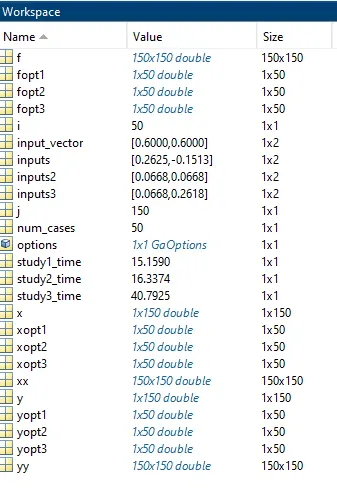
- Then total time is computed
- Then using fprintf command the results are printed in the command windows
- Then the study time is printed
- Then x,y coordinates of the maximum optimum valueare printed
- Then the optimum value of the function (maximum value) is printed which is calculated from the (negative mean) of the all iterations of the output value and the negative sign is used to get the maximum value.
- Then the study time of the whole 3 studies combined is printed.
Stalagmite function code Explaination :
- First the function is declared and its input vector is specified.
- Then equations are written with inputs from mesh grid .
- Then in the last step negative sign is used because we want to maximize the function.
ERRORS :
- No Errors
RESULT :
- To optimise the stalagmite function and find the global maxima of function has been successfully complete.