Week 3 - Taylor table method and Matlab code
x=pi/3;
dx=linspace(pi/20,pi/400,20);
exact_derivative= -2*exp(x)*sin(x);
Input of X is taken as pi/3 and value of dx is taken in range of 20 intervals from pi/20 to pi/400.
exact derivative of given expression is calculated.
for i=1:length(dx)
skewed_right_diffrencing=(3.75*exp(x)*cos(x)-12.833333333333333*exp(x+dx(i))*cos(x+dx(i))+17.8333333333333*exp(x+2*dx(i))*cos(x+2*dx(i))-13*exp(x+3*dx(i))*cos(x+3*dx(i))+5.08333333333333*exp(x+4*dx(i))*cos(x+4*dx(i))-0.83333333333*exp(x+5*dx(i))*cos(x+5*dx(i)))/dx(i)^2;
central_differencing=(-0.08333333333333333333*exp(x-2*dx(i))*cos(x-2*dx(i))+1.333333333333333333333*exp(x-dx(i))*cos(x-dx(i))-2.5*exp(x)*cos(x)+1.33333333333333333*exp(x+dx(i))*cos(x+dx(i))-0.083333333333333333333*exp(x+2*dx(i))*cos(x+2*dx(i)))/dx(i)^2;
skewed_left_diffrencing=(3.75*exp(x)*cos(x)-12.833333333333333*exp(x-dx(i))*cos(x-dx(i))+17.8333333333333*exp(x-2*dx(i))*cos(x-2*dx(i))-13*exp(x-3*dx(i))*cos(x-3*dx(i))+5.08333333333333*exp(x-4*dx(i))*cos(x-4*dx(i))-0.83333333333*exp(x-5*dx(i))*cos(x-5*dx(i)))/dx(i)^2;
skewed_right_error(i)=abs(exact_derivative-skewed_right_diffrencing);
central_error(i)=abs(exact_derivative-central_differencing);
skewed_left_error(i)=abs(exact_derivative-skewed_left_diffrencing);
end
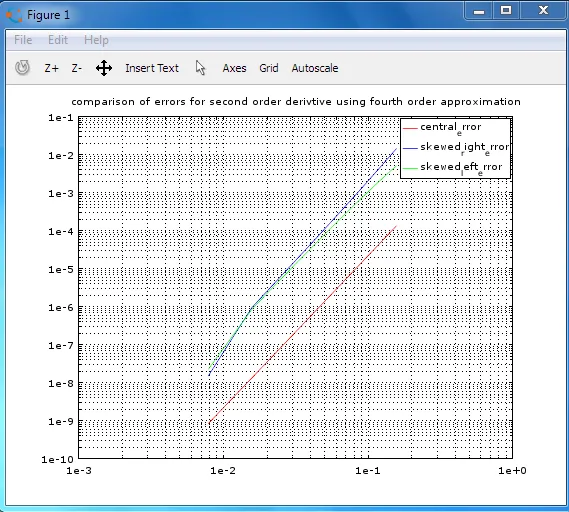
for all values of 'dx' central _differencing, skewed_right_ddifferencing, skewed_left_differencing is calcullated whose equation for given expression is derived using Taylor's table. central_error is calculated by differencing exact and central_differencing. similarly skewed_left_derivative and skewed_right_derivative is calculated.
figure(1)
loglog(dx, central_error, 'r');
hold on
loglog(dx,skewed_right_error,'b');
loglog(dx,skewed_left_error,'g');
legend('central_error','skewed_right_error','skewed_left_error')
grid on;
title('comparison of errors for second order derivtive using fourth order approximation' )
central_error, skewed_left_differencing, Skewed_right_differencing is plotted.legend of error is calculated, 'comparison of errors for second order derivative using fourth order approximation' is title of graph.