Week 3 - Solving second order ODEs
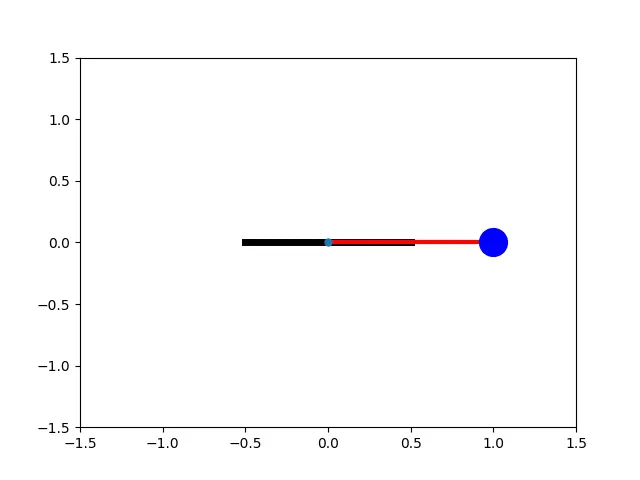
Aim : To solve an ode using python that represents the equation of motion of a simple pendulum with damping and create an animation to show the movement of the pendulum acoording to the funtion given.
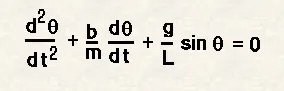
Theory : The given Ode is a second order differential equation, that represents the motion of a simple pendulum.
where
b = damping coefficient
m = mass of the bob
g = acceleration due to gravity
L = length of string
Solution :
Firstly, we converted the 2nd order differential equation to a lower order differential equation using some assumptions in the 2nd order ode. 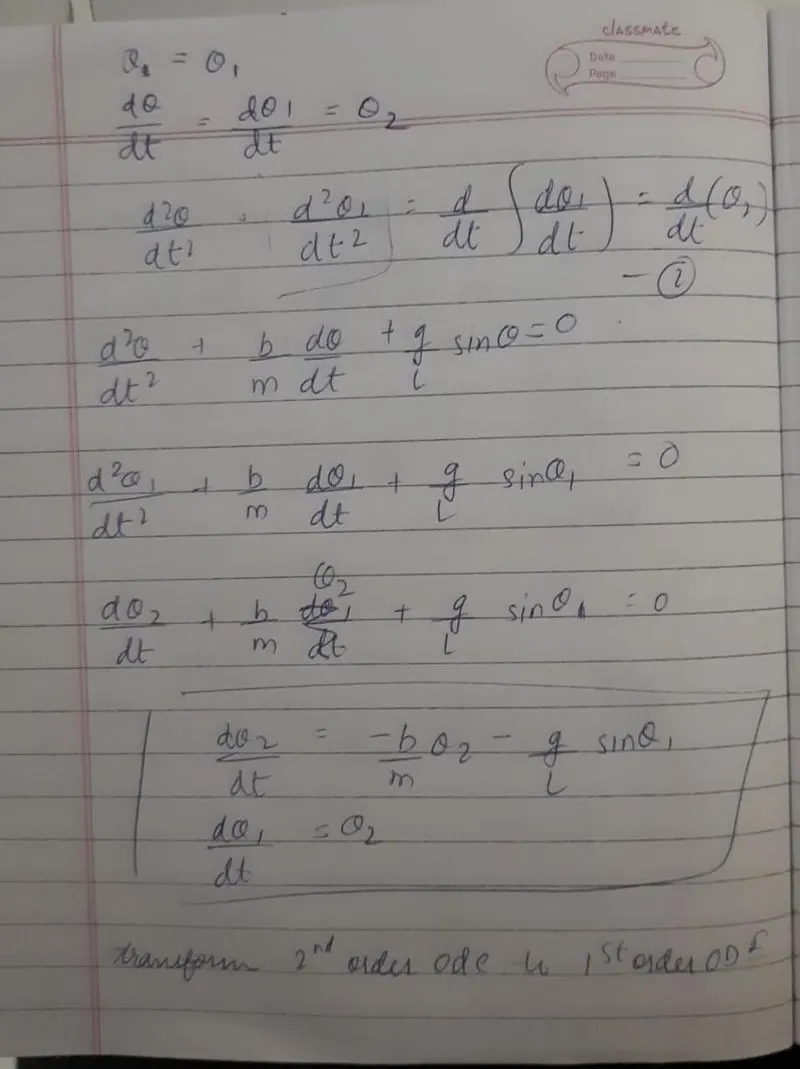
Code :
import numpy as np
from scipy.integrate import odeint
import matplotlib.pyplot as plt
import math

def ode_func(theta,t,b,g,l,m):
	theta1 = theta[0]
	theta2 = theta[1]
	dtheta1_dt = theta2
	dtheta2_dt = -(b/m)*theta2 - (g/l)*math.sin(theta1)
	dtheta_dt = [dtheta1_dt,dtheta2_dt]
	return dtheta_dt

b=0.05     #damping coefficient
g=9.81     #acceleration due to gravity
l=1        #length of string
m=1	       #mass of the sphere

#initial conditions
theta_0 = [math.pi/2,0]

#time points
t=np.linspace(0,20,150)   #the simulation is taken under the time interval of 0-20

#solve ode
theta = odeint(ode_func,theta_0,t,args = (b,g,l,m))    #odeint is used to solve the ode

#plot results
plt.plot(t,theta[:,0],'b-',label=r'$\frac{d\theta_1}{dt}=\theta2$')
plt.plot(t,theta[:,1],'r--',label=r'$\frac{d\theta2}{dt}=-\frac{b}{m}\theta_2-\frac{g}{L}sin\theta_1$')
plt.ylabel('Plot')
plt.xlabel('Time')
plt.legend(loc='best')
plt.show()

ct=1

#for animation
for t in theta[:,0]:
	x0=0
	y0=0
	x1=(1*math.sin(t))
	y1=-(1*math.cos(t))
	filename = str(ct)+'.png'
	ct = ct+1

	#plotting as done for forward kinematics
	plt.figure()
	plt.plot([-0.5,0.5],[0,0],'black',linewidth = 5)  #baseline
	plt.plot([x0,x1],[y0,y1],linewidth = 3, color = 'r')
	plt.plot(x0,y0,'o',markersize=5)
	plt.plot(x1,y1,'o',markersize = 20, color = 'blue')
	plt.xlim([-1.5,1.5])
	plt.ylim([-1.5,1.5])
	plt.savefig(filename)
Result :
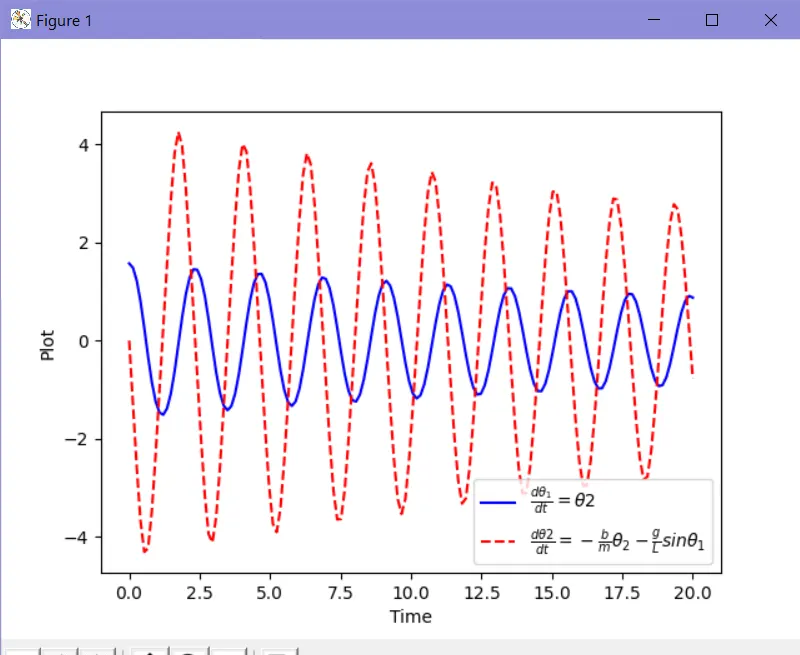
Graph that shows damping in the pendulum
Animation:
In the given animation we can see the depletion of the amplitude of the pendulum, this shows the damping effect on the pendulum.