Week 3 Sheet metal Bending challenge
OBJECTIVE
Set up the sheet metal bending simulation with a die, sheet metal plate and a punch in ANSYS for all the below three cases and compare ther esults for all the three cases.
Case 1:Use the matriasl Aluminium Alloy 1199,Copper Alloy NL and Magnesium Alloy NL to sheet metal plate. Find out the Equivalent stress, Equivalent elastic strain and Total Deformation in Y direction and compare the results for the three materials.
Case 2:With the material as Aluminium Alloy, change the friction coefficient to 0.19 and run the analysis as mentioned in Case 1. Compare the results with that in case 1.
Case 3: Refine the mesh on the plate such that it doesn't cross the academic limit. With Aluminium alloy as material, run the analysis as in Case 1 and compare the results
CASE SETUP
In the ansys workbench , from the engineering sources add the aluminium alloy , copper alloy and magnesium alloy material into the library.
Then we can insert the CAD model of the sheet metal bending and then we can assign structural steel on the punch and die. And as a case 1 we can assign aluminium to the sheet metal part.In case 2 we can change this material to copper alloy and in case 3 we can assign magnesium alloy to sheet metal part.
Next in the mechanical modeller , delete the existing contacts and create a manual contact region with formulation as augmented langrange which is less sensitive to the stiffness of the conatct and have better convergance.In the normal stiffness we can set a value of 0.1 since this is a bending problem. And we set the contacts as frictional and add the friction coefficient value of 0.1
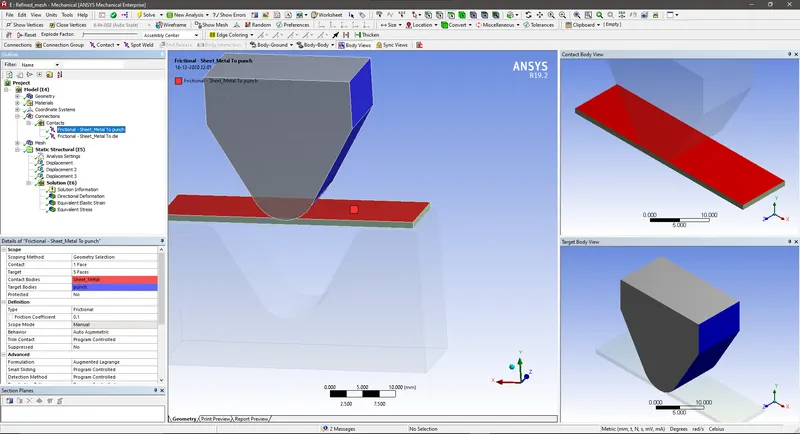
Fig 1 Contact between plate and the punch
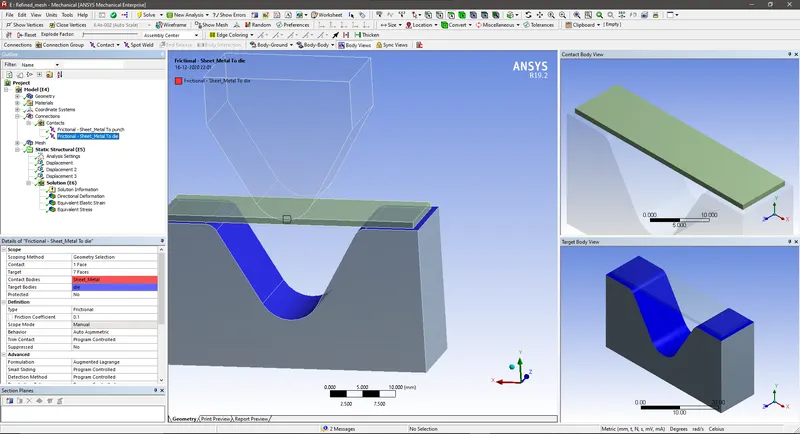
Fig 2 Contact between plate and the die
Next is the setting up of the analysis settings .In that set steps as 10 and select all those steps and switch ON auto timestepping, Then define by time and set the intial time step,minimum time step and maximum timestep.Intial time step is made low so that the solver will run through first set of iteration without any errors as the possibility of the contacts happening in the model will be less.Set solver type as Direct and set the method of stablization as Energy and set the Energy dissipation Factor as 0.1.
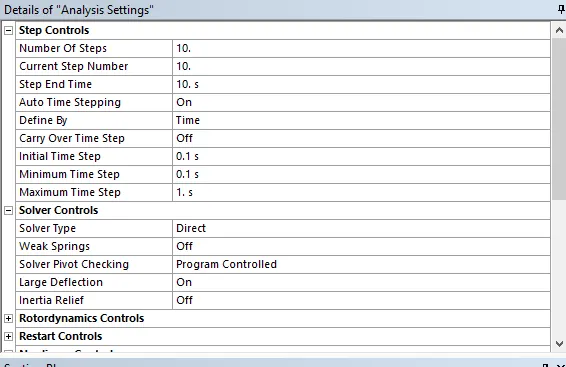
Fig 3 Analysis Settings
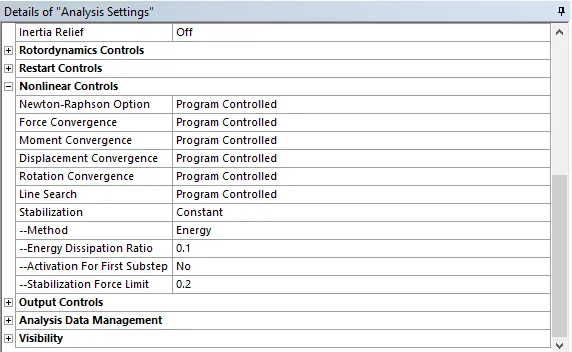
Fig 4 Energy Dissipation ratio set in Analysis Settings
Then we can set the boundary conditions.First we need to set the displacement for the die which needs to be move downwards and stamp the sheet metal.this displacement needs to be such that the till a particular time step, the die must be moved downwards and after the die reaches the punch, this die needs to be moved upwards. This needs to be defined in a single axis and set it in a tabular form setting the values in that axis and set zero for evry time step in all other axis.
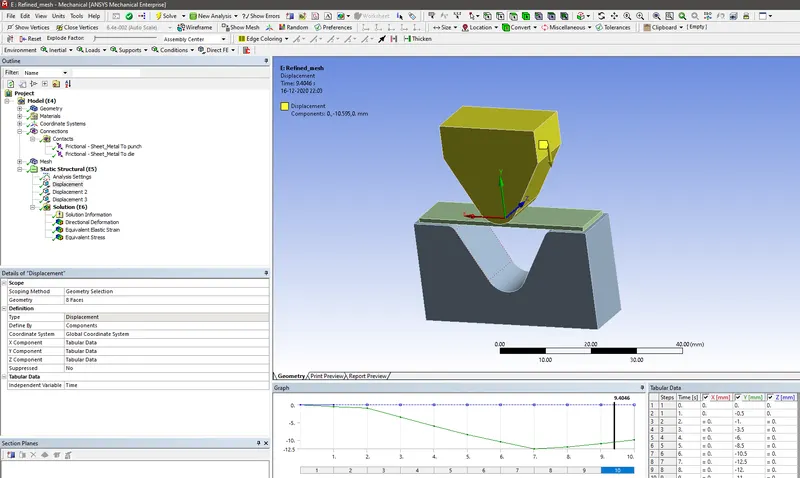
Fig 5 Displacement Applied to die
Then we need to restrict the sheet metal in the sideways direction , for that set up another displacemnt along z axis in tabular form with all the values as zero.
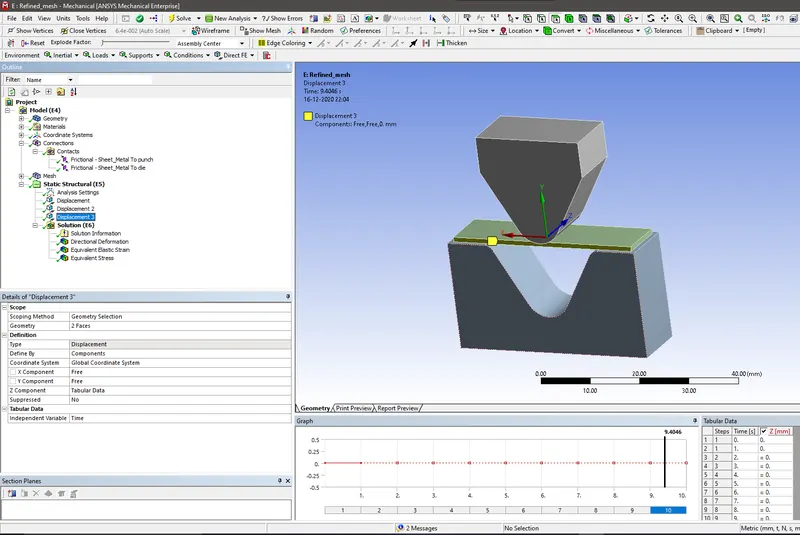
Fig 6 Z axis of Sheet metal plate constrained
Similarly the punch also needs to be retracted from the sheet metal so add another displacement in tabular form along y axis .but her the retraction movement needs to be happen only at the last two steps as the punch needs to be retractd only after the stamping process ends.
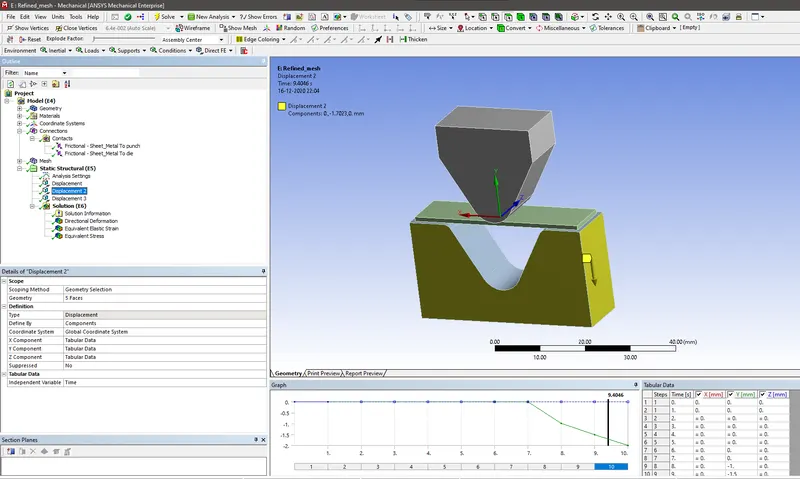
Fig 7 Displacement Applied to Die
Then rest is we need to request for the solutions such as the Directional stress in Y axis, Von mises stress and Von mises strain.
RESULTS
Case 1
| Equivalent Elastic Stress | Equivalent Elastic Strain | Y directional deformation | |
| Aluminium Alloy 1199 |
20650 |
0.1033 | 3.3665 |
| Copper Alloy NL | 23234 | 0.11634 | 3.7171 |
| Magnesium Alloy NL | 17690 | 0.088692 | 2.9542 |
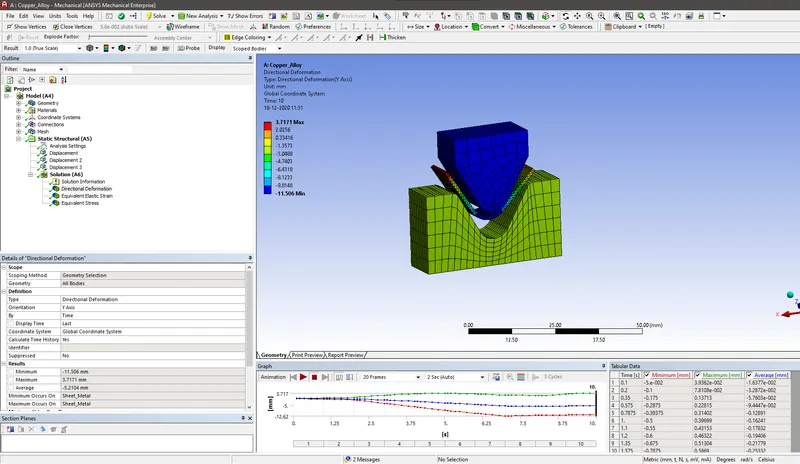
Y Directional deformation of sheet metal plate with Copper Alloy
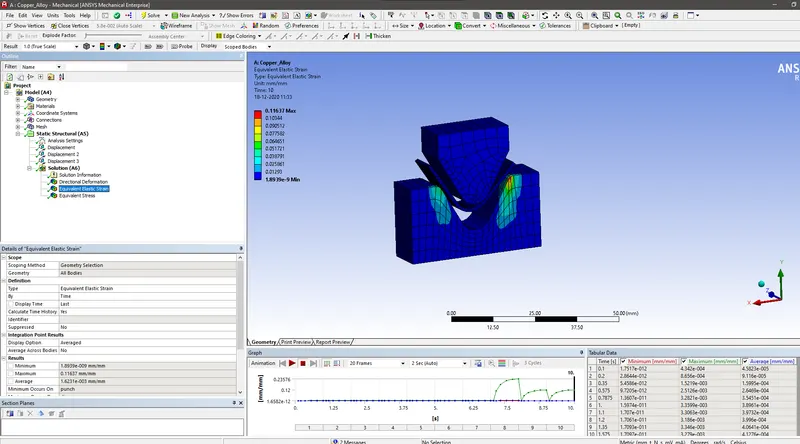
Equvalent Elastic Strain of sheet metal with Copper Alloy
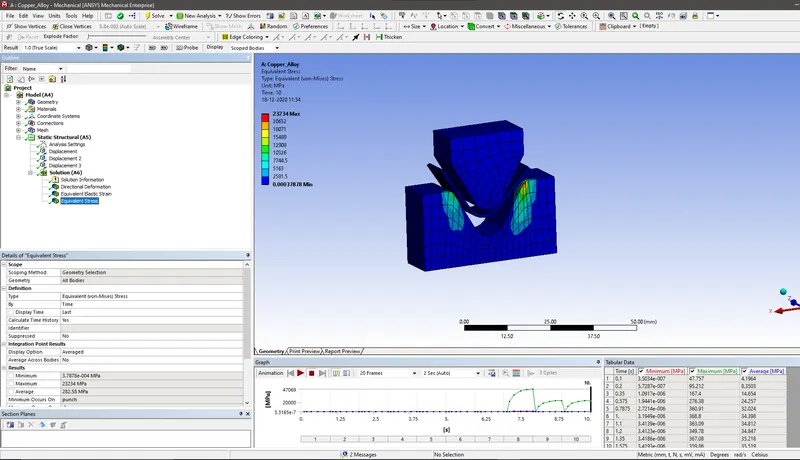
Equivalent Stress of sheet metal plate with Copper alloy
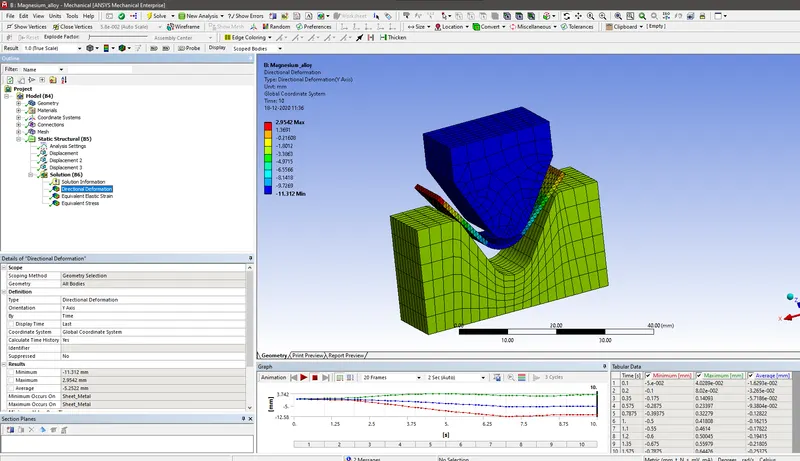
Y Directional deformation of sheet metal plate with Magnesium Alloy
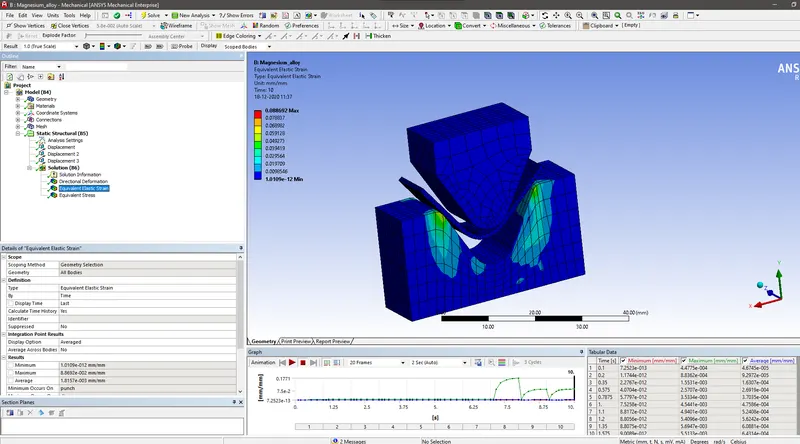
Equvalent Elastic Strain of sheet metal with Magnesium Alloy
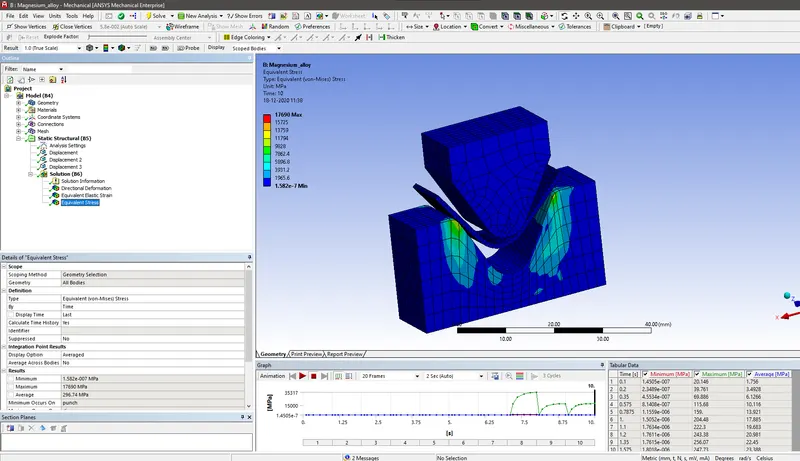
Equivalent Stress of sheet metal plate with Magnesium alloy
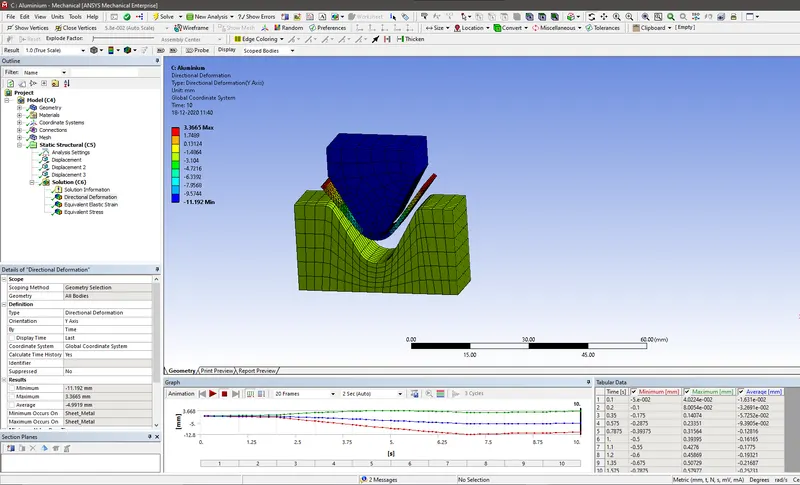
Directional deformation of Sheet metal plate with Aluminium Alloy
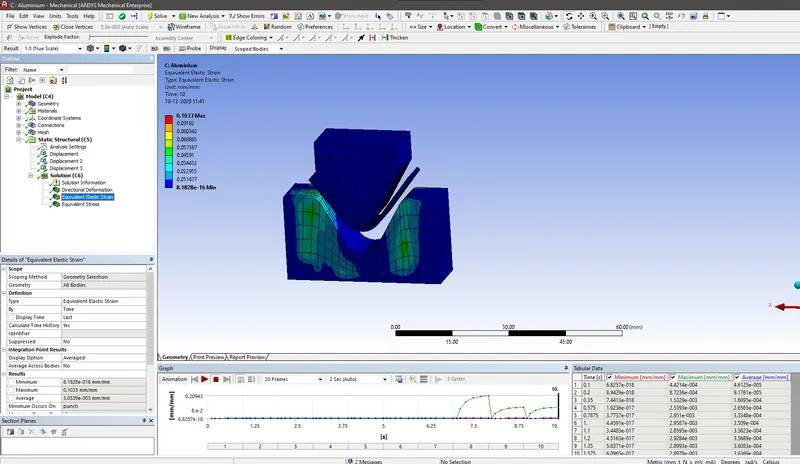
Equivalent Elastic Strain of Sheet metal plate with Aluminium Alloy
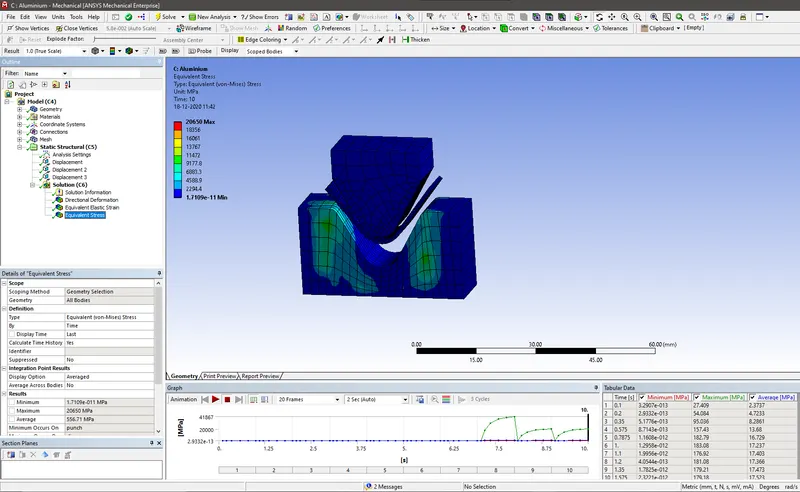
Equivalent Stress of Sheet metal plate with Aluminium Alloy
What we can see is that the for aluminium alloy and copper comparitavely more stress is generated than the magnesium alloy, This means the aluminium and copper is having low strength than the magnesium alloy, that is why the deformation happened to the magnesium alloy is less tha the other two.So that will signify that the youg's modulus of magnesium alloy is more than the other two.Magnesium alloy is stronger than other two , so the deformation happens to it is less , so the stress also genrated is less.
This is the same reason why the elastic strain which is the vonmises strain is also less for the magnesium alloy.And also the directional defpormation happens to the magnesium alloy is less than the other two materials.
Case 2
| Equivalent Elastic Stress | Equivalent Elastic Strain | Y directional deformation | |
| Aluminium Alloy with Frictiional Coefficient of 0.1 | 20650 | 0.1033 | 3.3665 |
| Aluminium Alloy with Frictiional Coefficient of 0.19 | 38534 | 0.19295 | 3.1286 |
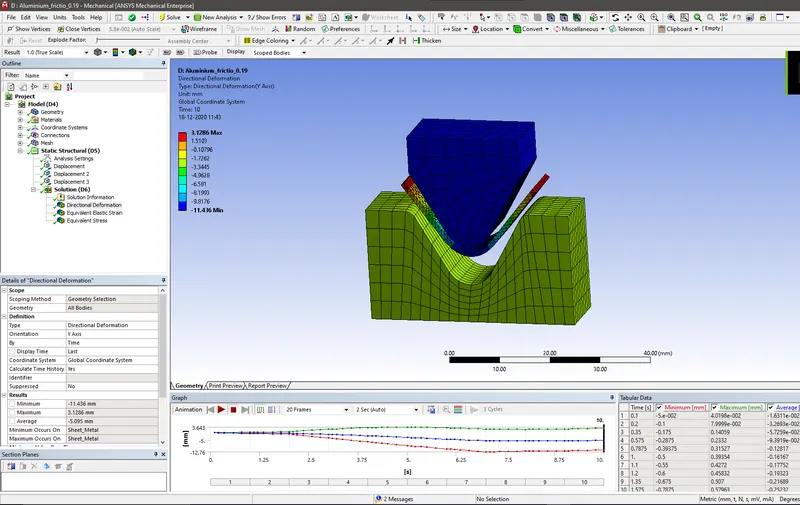
Directional deformation of Sheet metal plate with Aluminium Alloy with friction 0.19
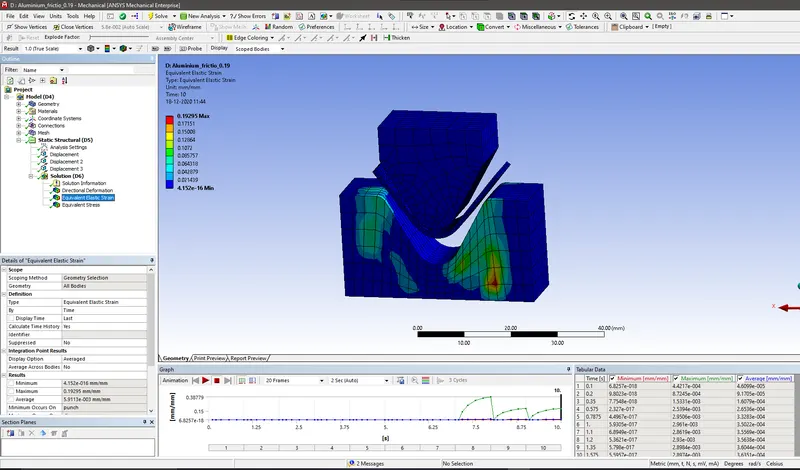
Equivalent Elastic Strain of Sheet metal plate with Aluminium Alloy with friction 0.19
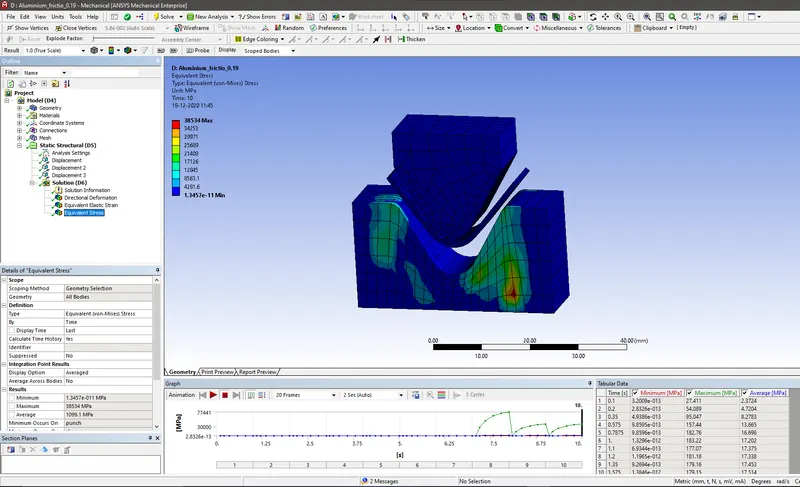
Equivalent Stress of Sheet metal plate with Aluminium Alloy with friction 0.19
Here we can see that the friction is an importamnt parameter which is deciding the stress and strain happens to the sheet.As with the friction of 0.19 the value of stress and the strain is less greater than the case with friction value of 0.19.So as the friction increases the stress and the strain also increses.This is beacuse the sheet metal is slided over the die as the sheet metal bends that results in some frictional shear force generated and this makes the principal force greater than the actual value. This cause the increases in von mises stress and the strain values.
Case 3
| Equivalent Elastic Stress | Equivalent Elastic Strain | Y directional deformation | |
| Aluminium Alloy with case 1 mesh | 20650 | 0.1033 | 3.3665 |
| Aluminium Alloy with refined mesh | 35250 | 0.17635 | 2.7045 |
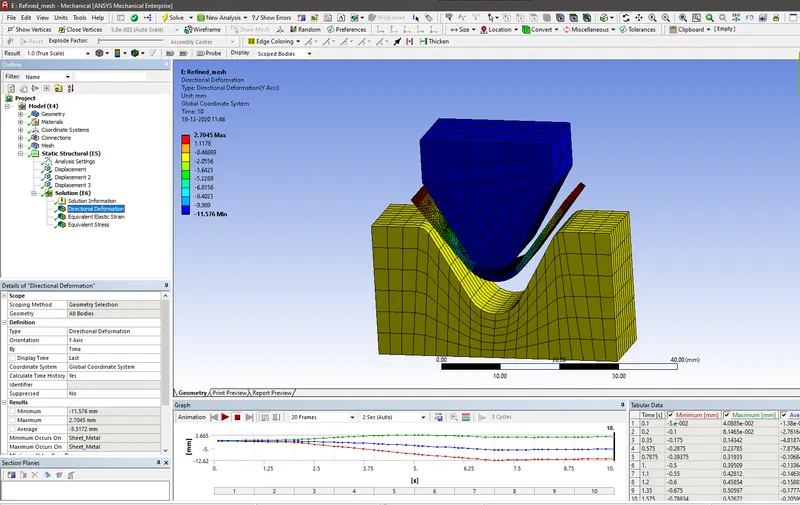
Y Directional Deformation of sheet metal with Alumium alloy material having Refined Mesh
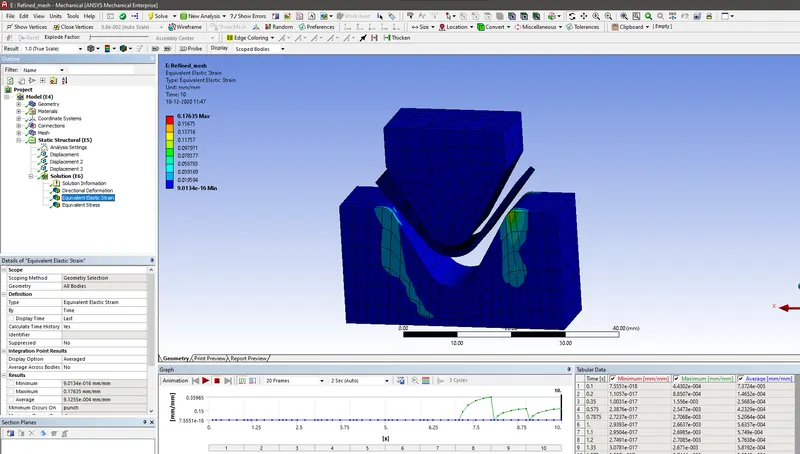
Elastic Equivalent Strain of sheet metal with Alumium alloy material having Refined Mesh
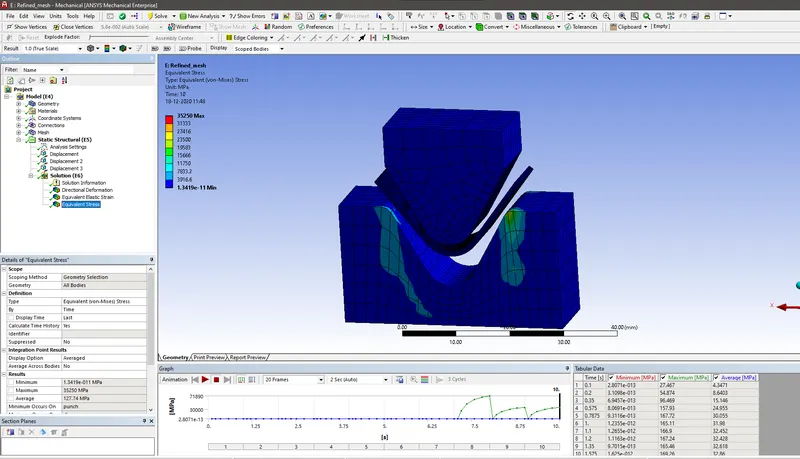
Equivalent Stress of sheet metal with Alumium alloy material having Refined Mesh
As the mesh gets refined the accuracy of the resyult will be increased. This means the solution we obtained with the refind mesh will be more close to the actual result.As we know that the numerical methods are an approximate result obtaining technique the solution will also be approximate but the result obtained with the refined mesh will be more accurate.So her the Actual stress , strain and deformation happend to the sheet metal with aluminummaterial is that with the refined mesh.
CONCLUSION
Magnesium alloy is having low deformation as compared to copper alloy and alumium alloy, So that means the life of the product made with this material will be more than others and also the magnesium is a light weight material . So it can be used in applications where we need to have low weight but need high strength.Also we came to know that the refined mesh will be providing more accurate results than the other one with more coarse mesh, at the cosst of some computational time