Week 3 Session 7
AIM: Compare the different motors used in EV and list down the advantages and disadvantages of each.
Procedure:
Electric vehicles are not something new to this world, but with the technological advancement and increased concern on controlling pollution has given it a tag of future mobility. The core element of the EV, apart from Electric Vehicle Batteries, which replaces the Internal Combustion engines is an Electric motor. The rapid development in the field of Power electronics and control techniques has created a space for various types of electric motors to be used in Electric Vehicles.
EVs use traction motors that are capable of delivering torque to the wheels. Electric motors can be roughly divided into two types: DC and AC motors. Both types can be used in EV applications.
Features in an EV Motors:
- An EV’s motor and electronics efficiency directly influences the battery weight, because the lost power needs to be compensated. Every 1% lower efficiency requires 1% more power from the battery (meaning more batteries).
- The EV’s performance directly depends on the electrical motor specifications. The performance of the motor is determined by the torque-speed and power-speed characteristic of the traction motor.
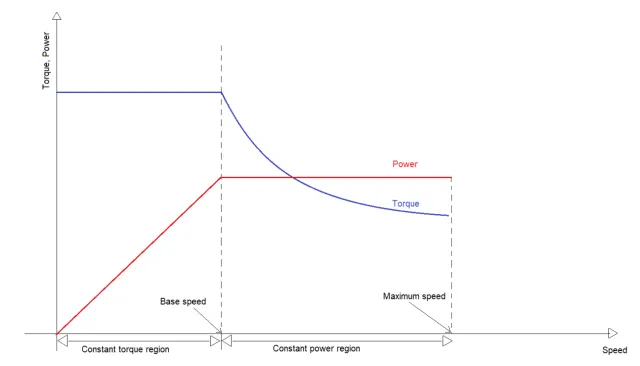
Fig. Torque/power – speed traction motor characteristics.
- The grade ability and maximum speed are important parameters in these curves. The desired motor grade ability requires high torque at low speed, enabling proper starting and acceleration. The EV motor needs to have high power at high speed and a wide speed range in the constant power region as shown in Fig. The constant torque operating region is important at low speed to provide a good start and up-hill drive. The constant power region determines the maximum EV speed on flat surfaces.
- When the base speed is achieved, the motor reaches its rated power limit and the motor torque decreases proportionally to the square of speed. The constant power region starts beyond base speed in the range from base speed up to maximum motor speed. This range is different in different motor types and it is an important parameter when selecting the proper EV motor type. Also, the motor operation range can be adjusted by using the corresponding control drives.
- Selecting the proper output characteristic of an EV motor is a challenge because it is necessary to find the balance between acceleration performance and wide speed range in the constant power region. When increasing the constant power region, the power requirement for acceleration performance is decreased. The torque requirement is increased which influences the motor size and its final price.
These are the features we desire in an EV motor:
-
High efficiency
-
High instant power
-
Fast torque response
-
High power density
-
Low cost
-
High acceleration
-
Robustness
Various types of Electric Motors used in Electric Vehicles:
- DC Series Motor
- Brushless DC Motor
- Permanent Magnet Synchronous Motor (PMSM)
- Three Phase AC Induction Motors
- Permanent Magnet Synchronous Motor (PMSM)
- Switched Reluctance Motors (SRM)
DC Series Motor
- High starting torque capability of the DC Series motor makes it a suitable option for traction application. It was the most widely used motor for traction application in the early 1900s.
- The advantages of this motor are easy speed control and it can also withstand a sudden increase in load. All these characteristics make it an ideal traction motor. The biggest advantages of DC motors in EVs are robust construction and simple control.
- DC motors have appropriate torque-speed characteristics providing high torque at low speed.
- The main disadvantages are size, low efficiency, low reliability and high maintenance, and limited speed because of the friction between brushes and collectors. The DC series motor is high maintenance due to brushes and commutators.
- The latter are increasingly suppressed because of the advances in power electronics.
- These motors are used in Indian railways. This motor comes under the category of DC brushed motors.
Permanent Magnet Brushless DC Motors (PM BLDC)
- PM BLDC motors use permanent magnets instead of the rotor windings. Since they do not include rotor losses their efficiency is higher than inductive motors.
- PM BLDC motors have a short constant power operation region because of their permanent magnet field weakened by a stator field. Since EVs require a wider constant power region, this can be extended by using conduction angle control where the speed range may reach three to four times the base speed.
- The permanent magnets also limit the motor torque to be high. The magnets are significantly influenced by the high temperature which reduces the remnant flux density and thus the motor torque capacity.
- The mechanical forces and magnet prices are the biggest disadvantages of this type of motor. The increased centrifugal forces caused by higher motor rotation speed can cause safety issues due to the possible breaking of the magnets.
- It is called brushless because it does not have the commutator and brush arrangement. The commutation is done electronically in this motor because of this BLDC motors are maintenance free. BLDC motors have traction characteristics like high starting torque, high efficiency around 95-98%, etc. BLDC motors are suitable for high power density design approach.
- The BLDC motors are the most preferred motors for the electric vehicle application due to its traction characteristics. You can learn more about BLDC motors by comparing it with normal brushed motor.
BLDC motors further have two types:
i. Out-runner type BLDC Motor:
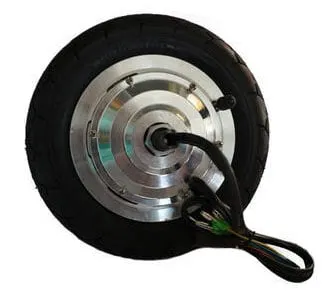
- In this type, the rotor of the motor is present outside and the stator is present inside. It is also called as Hub motors because the wheel is directly connected to the exterior rotor. This type of motors does not require external gear system. In a few cases, the motor itself has inbuilt planetary gears.
- This motor makes the overall vehicle less bulky as it does not require any gear system. It also eliminates the space required for mounting the motor. There is a restriction on the motor dimensions which limits the power output in the in-runner configuration.
- This motor is widely preferred by electric cycle manufacturers like Hullikal, Tronx, Spero, light speed bicycles, etc. It is also used by two-wheeler manufacturers like 22 Motors, NDS Eco Motors, etc.
ii. In-runner type BLDC Motor:
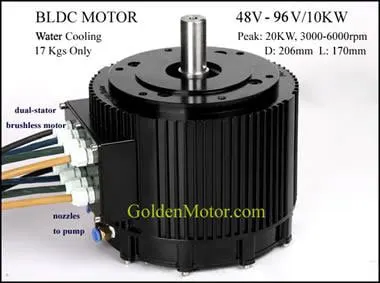
- In this type, the rotor of the motor is present inside and the stator is outside like conventional motors. These motor require an external transmission system to transfer the power to the wheels, because of this the out-runner configuration is little bulky when compared to the in-runner configuration.
- Many three- wheeler manufacturers like Goenka Electric Motors, Speego Vehicles, Kinetic Green, Volta Automotive use BLDC motors. Low and medium performance scooter manufacturers also use BLDC motors for propulsion.
- It is due to these reasons it is widely preferred motor for electric vehicle application.
- The main drawback is the high cost due to permanent magnets. Overloading the motor beyond a certain limit reduces the life of permanent magnets due to thermal conditions.
Permanent Magnet Synchronous Motor (PMSM)
- This motor is also similar to BLDC motor which has permanent magnets on the rotor. Similar to BLDC motors these motors also have traction characteristics like high power density and high efficiency.
- The difference is that PMSM has sinusoidal back EMF whereas BLDC has trapezoidal back EMF. Permanent Magnet Synchronous motors are available for higher power ratings.
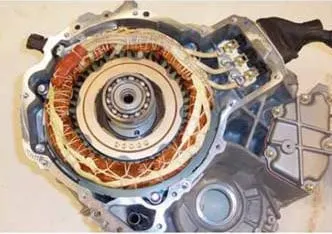
- PMSM is the best choice for high performance applications like cars, buses. Despite the high cost, PMSM is providing stiff competition to induction motors due to increased efficiency than the latter. PMSM is also costlier than BLDC motors.
- Most of the automotive manufacturers use PMSM motors for their hybrid and electric vehicles. For example, Toyota Prius, Chevrolet Bolt EV, Ford Focus Electric, zero motorcycles S/SR, Nissan Leaf, Hinda Accord, BMW i3, etc use PMSM motor for propulsion.
Three Phase AC Induction Motors
- This motor type is very common in EVs because of its simple construction, high reliability, robustness, simple maintenance, and low cost and operation at different environmental conditions.
- IMs can be naturally de-excited if the inverter faults, an important safety advantage for EVs. The field-oriented vector control of IMs is industrially standardized.
- The induction motors do not have a high starting toque like DC series motors under fixed voltage and fixed frequency operation. But this characteristic can be altered by using various control techniques like FOC or v/f methods. By using these control methods, the maximum torque is made available at the starting of the motor which is suitable for traction application.
- Squirrel cage induction motors have a long life due to less maintenance. Induction motors can be designed up to an efficiency of 92-95%.
- The drawback of an induction motor is that it requires complex inverter circuit and control of the motor is difficult.
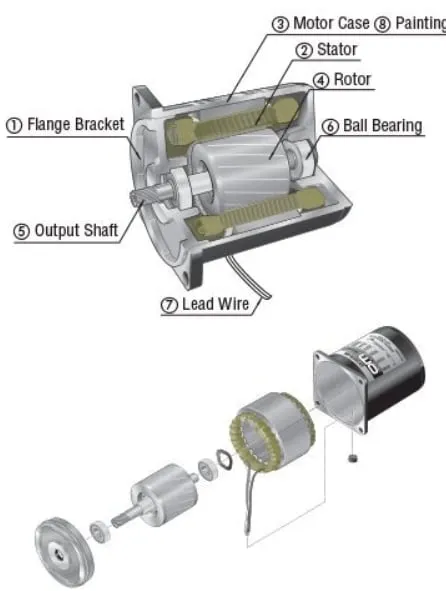
- In permanent magnet motors, the magnets contribute to the flux density B. Therefore, adjusting the value of B in induction motors is easy when compared to permanent magnet motors. It is because in Induction motors the value of B can be adjusted by varying the voltage and frequency (V/f) based on torque requirements. This helps in reducing the losses which in turn improves the efficiency.
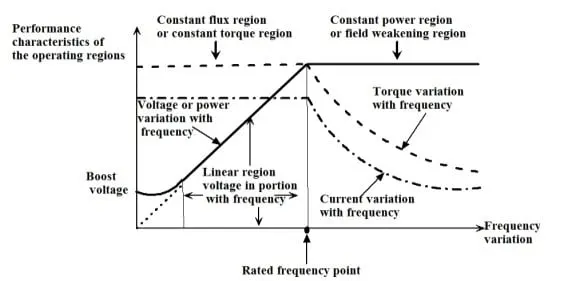
- The disadvantages of IMs are slightly lower efficiency (compared to PM motors), higher power losses (increased because of the cage losses), and a relatively low power factor. The weakening of the flux can be used to extend the speed range in the constant power operation region. This region can be extended by using dual inverters as well. Rotor losses can be also reduced by careful motor design.
- Tesla Model S is the best example to prove the high performance capability of induction motors compared to its counterparts. By opting for induction motors, Tesla might have wanted to eliminate the dependency on permanent magnets. Even Mahindra Reva e2o uses a three phase induction motor for its propulsion. Major automotive manufacturers like TATA motors have planned to use Induction motors in their cars and buses.
- The two-wheeler manufacturer TVS motors will be launching an electric scooter which uses induction motor for its propulsion. Induction motors are the preferred choice for performance oriented electric vehicles due to its cheap cost.
- The other advantage is that it can withstand rugged environmental conditions. Due to these advantages, the Indian railways has started replacing its DC motors with AC induction motors.
Permanent Magnet Synchronous Motor (PMSM)
- PMSMs, similar to BLDCs, have permanent magnets in the rotor. Unlike BLDC motors that have a trapezoidal back electromotive force (EMF) waveform, PMSMs have a sinusoidal back EMF.
- They have a simple construction, high efficiency, and high power density, thus they are suitable to be used as traction motors (common in hybrid vehicles, EVs, and buses). PMSM motors have a higher efficiency compared to IMs.
- The drawbacks of this type are high costs, eddy current loss in PMs at high speed, and a reliability risk because of the possible breaking of the magnets.
- There are two varieties of PMSM motors: surface-mounted permanent magnet (SPM) and interior permanent magnet (IPM) synchronous motor drives. IPM motors have better performance than SPMs, but the downside is their complex design.
Switched Reluctance Motors (SRM)
- Switched Reluctance Motors is a category of variable reluctance motor with double saliency. Switched Reluctance motors are simple in construction and robust. The rotor of the SRM is a piece of laminated steel with no windings or permanent magnets on it. This makes the inertia of the rotor less which helps in high acceleration. The robust nature of SRM makes it suitable for the high speed application.
- The absence of magnets eliminates the problem with mechanical forces, enabling the motor to operate at a high speed. Since the motor's windings are not used, there are no copper losses in the rotor ensuring the rotor temperature is lower than other motor types. Since the phases are not connected, SRM motors can continue their operation even when one of the phases disconnects.
- SRM rotors have a lower inertia than other motor types. The drawbacks of this motor type are increased vibration and acoustic noise. In addition, the salient-pole rotor and stator construction cause high torque ripple. The high rotor inductance ratio allows sensor-less control to perform.
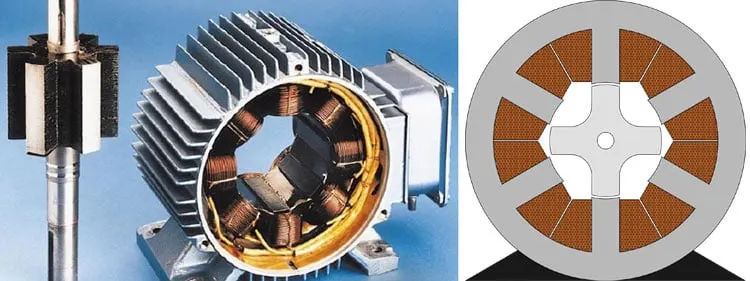
- The benefit of SRMs is their high torque component, enabling their use in many applications such as wind energy, generator starter systems in gas turbine engines, and high-performance aerospace applications. Moreover, their advantages in EVs include their robustness, simple control, high efficiency, wide constant power operation region, fault tolerance, and effective torque-speed characteristics. Since they do not contain brushes, collectors, or magnets, the maintenance of SRMs is very simple and effective and their price is very competitive.
- SRM also offers high power density which are some required characteristics of Electric Vehicles. Since the heat generated is mostly confined to the stator, it is easier to cool the motor.
- Proper motor design enables the wide constant power operation region, which in turn allows operation at high speeds. SRMs have a suitable torque/power speed characteristic for EV applications.
Comparison of various motors used in EV's:
| Characteristics | Motor type | |||
|---|---|---|---|---|
| DC Motor | IM | PM | SRM | |
| Power density | Low | Medium | Very high | Medium |
| Efficiency | Low | Medium | Very high | Medium |
| Controllability | Very high | Very high | High | Medium |
| Reliability | Medium | Very high | High | Very high |
| Technological maturity | Very high | Very high | High | High |
| Cost | Low | Very low | High | Low |