Week 3 - External flow simulation over an Ahmed body.
External flow over an Ahmed body
Aim:
Simulating external flow over an Ahmed body to calculate lift and drag forces.
Problem Statement:
Run the simulation for the velocity of 25 m/sec with the default air properties in fluent.
- Describe Ahmed's body and its importance.
- Explain the reason for the negative pressure in the wake region.
- Explain the significance of the point of separation.
Ahmed Body
The Ahmed body is a geometric representation of a car with a rectangular cross-section and a slanted rear end. It was introduced by Ahmed et al. in 1984 as a simplified model to study the aerodynamic behavior of road vehicles. The body shape captures the essential features that affect the flow patterns around a car, such as the separation and wake regions.
By simulating the flow around the Ahmed body, researchers can gain insights into the aerodynamic characteristics of road vehicles, such as drag and lift forces, pressure distribution, and flow separation patterns. This information is crucial for optimizing the design of cars to improve their performance, fuel efficiency, and stability.
The Ahmed body is of significant importance in the field of automotive aerodynamics for several reasons:
- Flow Separation and Wake Analysis: The Ahmed body exhibits flow separation, which is the detachment of the airflow from the car's surface. This separation leads to the formation of a wake region behind the vehicle. By studying the flow separation and wake patterns around the Ahmed body, researchers can gain insights into the effects of car design on drag, lift, and flow stability. This information helps in reducing aerodynamic drag and improving vehicle handling.
- Drag Reduction and Fuel Efficiency: One of the primary objectives of automotive aerodynamics is to reduce drag. Drag forces act in opposition to the vehicle's motion and consume energy, reducing fuel efficiency. By analyzing the flow patterns around the Ahmed body, researchers can investigate various design modifications and assess their impact on drag reduction. This knowledge aids in the development of streamlined vehicles that offer improved fuel efficiency and reduced emissions.
- Wind Tunnel Testing and Validation: The Ahmed body serves as a benchmark case for wind tunnel testing and numerical simulations. Its well-defined geometry and standardized experimental setups enable researchers to compare their results and validate their simulation methodologies. This validation is crucial for ensuring the accuracy and reliability of aerodynamic simulations and improving the overall understanding of external flow behavior.
Ahmed Body- Geometry creation
Top View
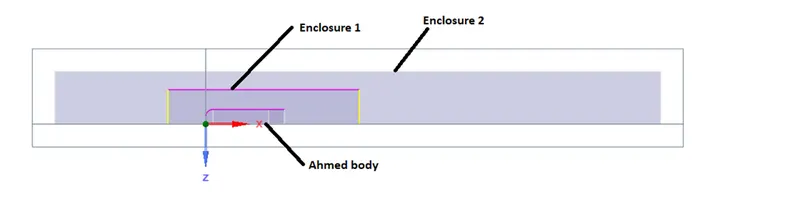
Enclosure 2
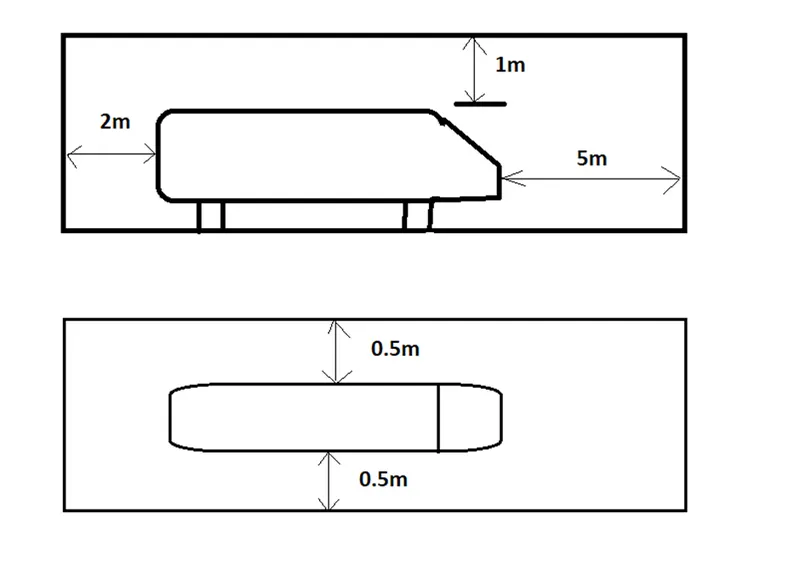
Enclosure 1
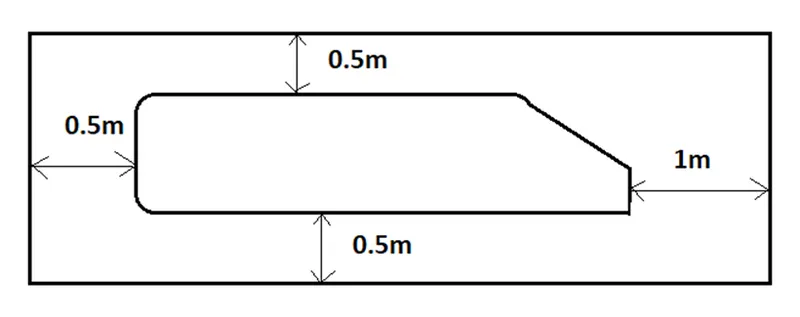
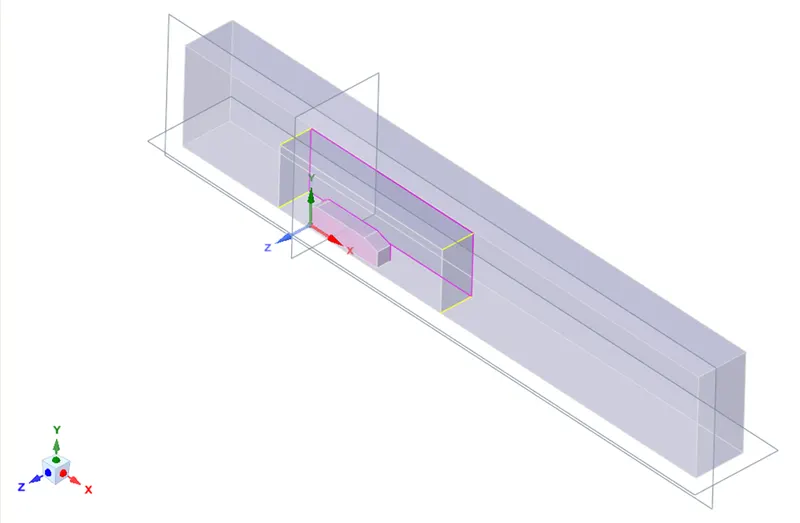
As the body is perfectly symmetric, we can run the simulation by considering the only half body. This is the best practice where we can save on the number of cells and get the results faster as well.
We need to use the 'split body' command in SpaceClaim to perform the operation and then we can use the symmetry boundary condition in fluent to perform the simulation.
Meshing
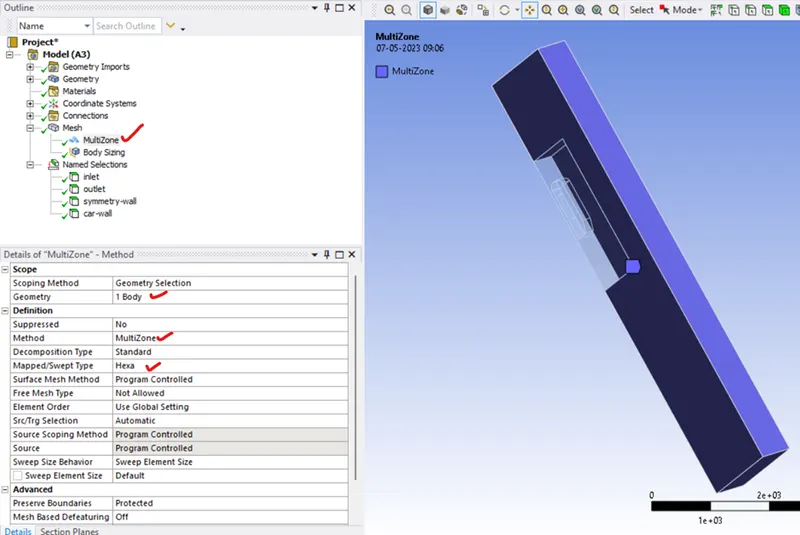
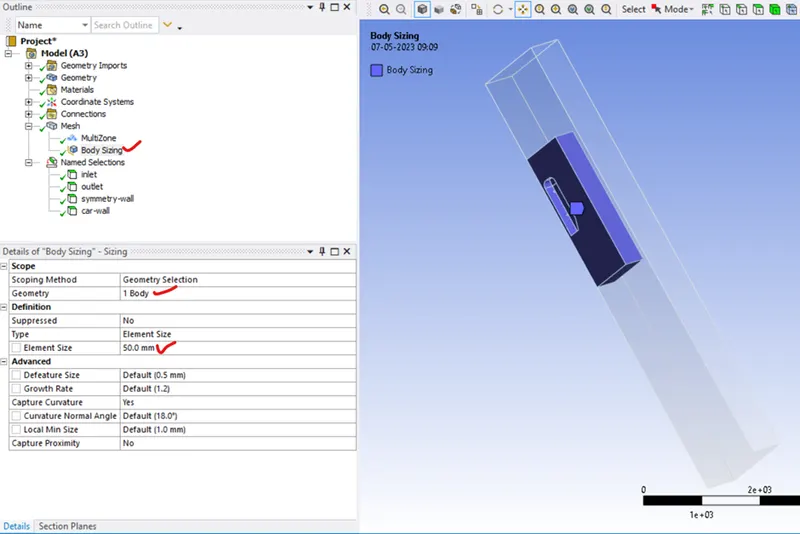
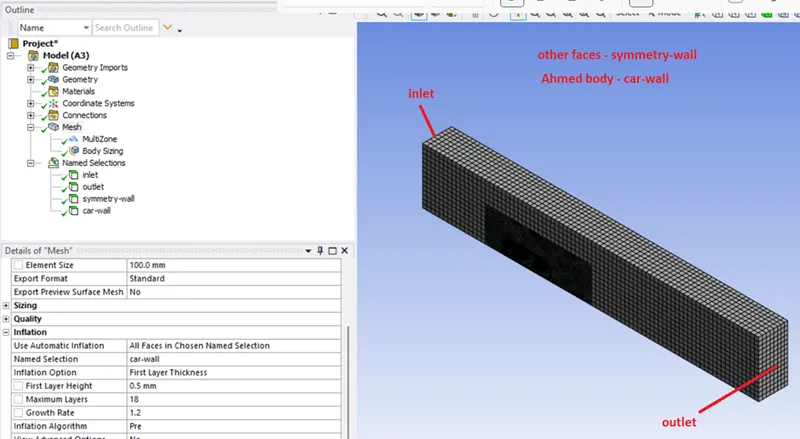
Hexahedral Mesh created for Enclosure 2 as follows
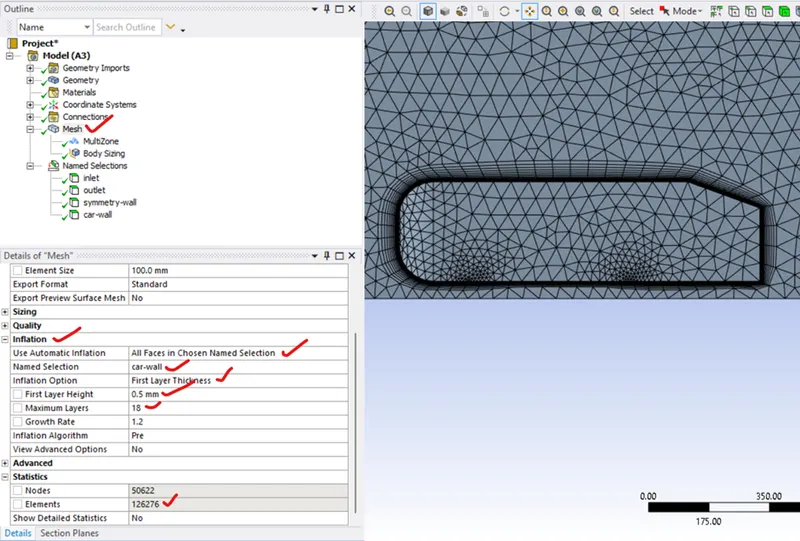
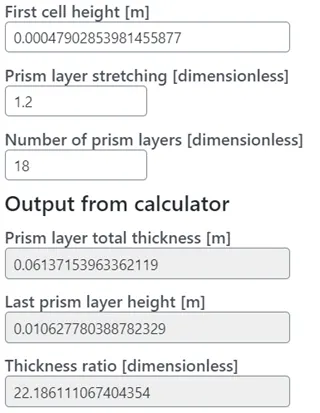
Inflation layer
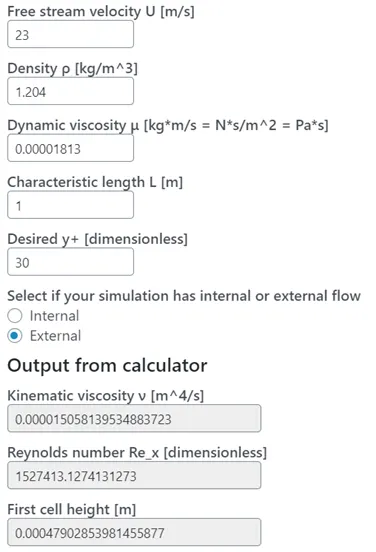
Calculation of Y+ Value
Named Selections
Setup
Inlet Velocity= 25m/s
Material = air
Pressure based, Absolute, Steady state, Energy Equation enabled
K-epsilon model used
Hybrid initialization is done to solve for potential flow variables to get an estimate of the initial velocity and pressure. This provides good starting point for our simulation
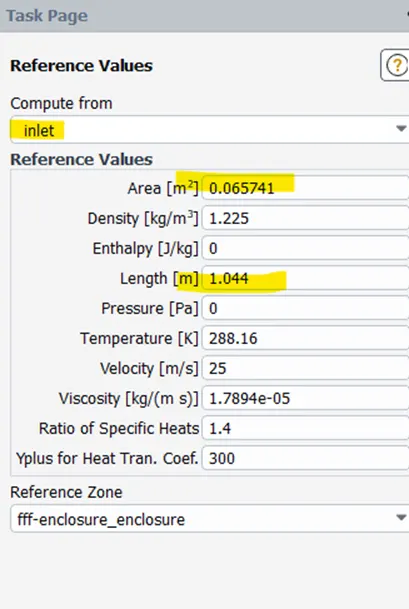
Reference values
Results
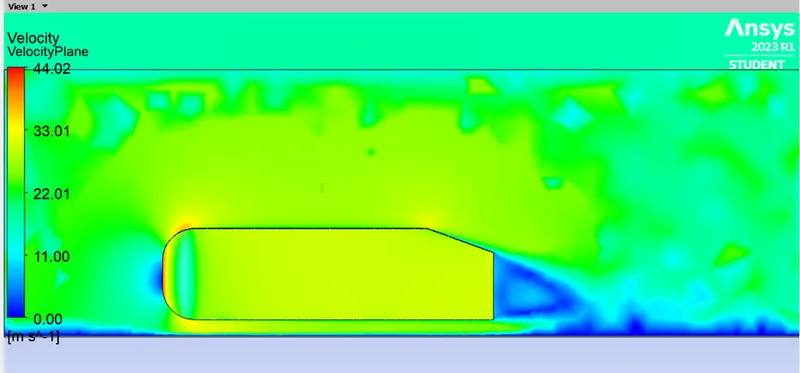
Velocity contour
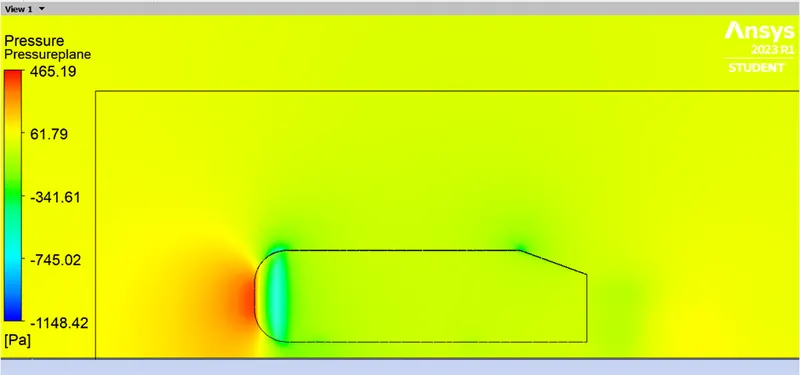
Pressure contour
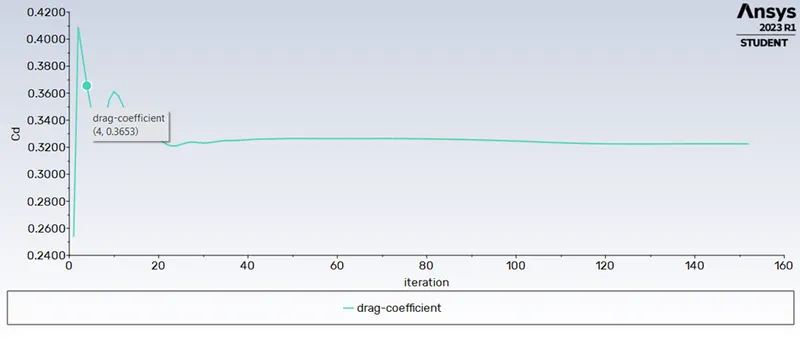
Drag Coefficient plot
CD = 0.32248343
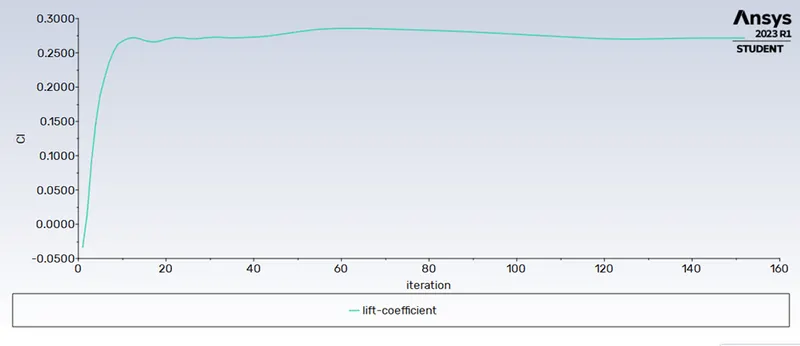
Lift Coefficient Plot
CL = 0.27147026
Vector Plot
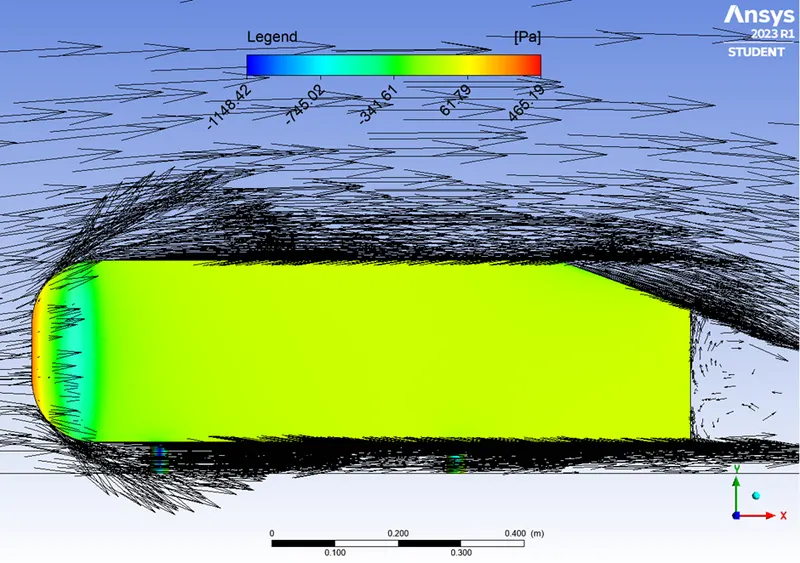
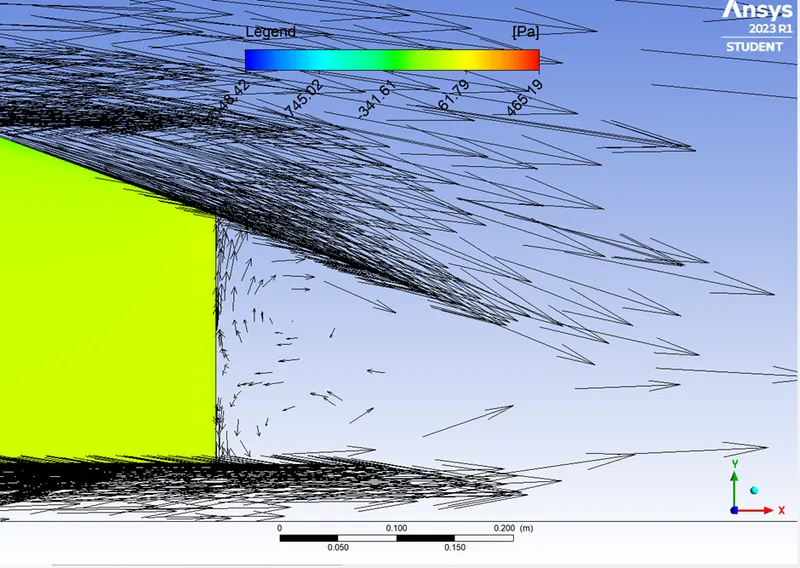
Reason for Negative Pressure in the wake region
In the external flow simulation of the Ahmed body, the negative pressure in the wake region can be attributed to the complex flow phenomena that occur around the body. Here are some reasons for the presence of negative pressure in the wake region:
- Flow Separation: As the flow encounters the rear end of the Ahmed body, it tends to separate or detach from the surface. This separation is influenced by factors such as the body's shape, angle, and the flow velocity. When the flow separates, it creates a region of low-pressure air behind the body, contributing to the negative pressure in the wake.
- Vortex Shedding: The separation of flow from the Ahmed body's surface leads to the formation of vortices in the wake region. These vortices are regions of swirling motion in the flow and are associated with areas of low pressure. The shedding of vortices creates alternating regions of low pressure (suction) and high pressure in the wake, with the suction peaks corresponding to the negative pressure.
- Acceleration of Airflow: As the Ahmed body moves through the flow, the airflow in the wake region tends to accelerate due to the pressure difference between the high-pressure front region and the low-pressure wake region. This acceleration further lowers the pressure in the wake, contributing to the negative pressure.
The negative pressure in the wake region of the Ahmed body has implications for the aerodynamic characteristics of the body, such as drag and lift. The generation of negative pressure can contribute to the generation of downforce, which enhances the stability and traction of the vehicle. However, it also contributes to increased drag, which negatively affects the overall efficiency of the vehicle.
Significance of Point of Separation
The point of separation is a critical aspect in fluid dynamics, particularly in the study of boundary layers and aerodynamics. It refers to the location on a solid surface where the flow of a fluid transitions from attached (flowing smoothly along the surface) to separated (detaching or separating from the surface). The significance of the point of separation lies in its influence on the overall flow behavior and the aerodynamic characteristics of an object. Here are some key points regarding its significance:
- Flow Characteristics: The point of separation marks the boundary between attached flow and separated flow. Understanding the location and behavior of this point helps determine the flow patterns around an object, including the formation of a boundary layer, wake region, and vortices. It provides insight into the flow separation process, including the formation of shear layers and recirculation zones.
- 2. Drag and Lift Forces: The point of separation plays a crucial role in determining the drag and lift forces acting on an object. Flow separation typically leads to an increase in drag as the detached flow creates a low-pressure region behind the object, causing pressure drag. By controlling or manipulating the point of separation, engineers can influence the drag and lift characteristics of objects, optimizing their design for improved performance and efficiency.
- Boundary Layer Analysis: The point of separation is closely related to the behavior of the boundary layer, which is the thin layer of fluid in immediate contact with the solid surface. Understanding the location of separation assists in studying the development of boundary layers, their thickness, and the transition from laminar to turbulent flow. This knowledge is critical for accurate aerodynamic modeling and designing efficient flow control techniques.
In summary, the significance of the point of separation lies in its influence on flow behavior, drag and lift forces, control and stability of objects, boundary layer analysis, and design optimization. Understanding and manipulating this point allows engineers to develop efficient and high-performance systems across a range of applications in aerospace, automotive, marine, and other industries.
Grid independence Test
|
CD |
CL |
No.of.Elements |
|
0.3170709 |
0.28696476 |
374753 |
|
0.32248343 |
0.27147026 |
410151 |
|
0.31938254 |
0.27946341 |
449351 |
Conclusion
External Flow simulation of Ahmed body is performed for inlet velocity 25m/s. The Drag coefficient 0.32248343 obtained with pressure based steady state simulation. Ahmed body, its significance and the reason for negative pressure in the wake region is explained.