Week-3 Challenge: ADVISOR Tool
AIM:
Use ADVISOR tool and simulate the following objectives.
Objective:
- For EV_defaults_in file, if cargo mass is 500 kg with all other default conditions, can the vehicle travel for 45 km with FTP drive cycle? Conclude your observations.
- In the above case, try changing the battery capacity and repeat the simulation.
- Perform gradeability test with PRIUS_Jpn_defaults_in file
Compare your results in table and conclude.
ADVISOR:
ADVISOR was developed as an analysis tool, and not originally intended as a detailed design tool. Its component models are quasi-static, and cannot be used to predict phenomena with a time scale of less than a tenth of a second or so. Physical vibrations, electric field oscillations and other dynamics cannot be captured using ADVISOR, however recent linkages with other tools such as Saber, Simplorer, and Sinda/Fluint allow a detailed study of these transients in those tools with the vehicle level impacts linked back into ADVISOR.
As an analysis tool, ADVISOR takes the required/desired speed as an input, and determines what drivetrain torques, speeds, and powers would be required to meet that vehicle speed. Because of this flow of information back through the drivetrain, from tire to axle to gearbox and so on, ADVISOR is what is called a backward-facing vehicle simulation.
Forward-facing vehicle simulations include a model of a driver, who senses the required speed and responds with an accelerator or brake position, to which the drivetrain responds with a torque. This type of simulation is well suited to the design of control systems, for example, down to the integrated circuit and PC card level—the implementation level.
ADVISOR is well suited to evaluate and, by iterative evaluation, design control logic and energy management strategies. By this, we mean something like “When the engine torque output is low and the battery state of charge is high, turn off the engine.” The control logic, with which ADVISOR can work, is about what you want the vehicle to do. The detailed control system, getting into details of how you would implement this control logic in hardware, is about how to make the vehicle do what you want and is not the original intention of ADVISOR’s application.
- For EV_defaults_in file, if cargo mass is 500 kg with all other default conditions, can the vehicle travel for 45 km with FTP drive cycle? Conclude your observations.
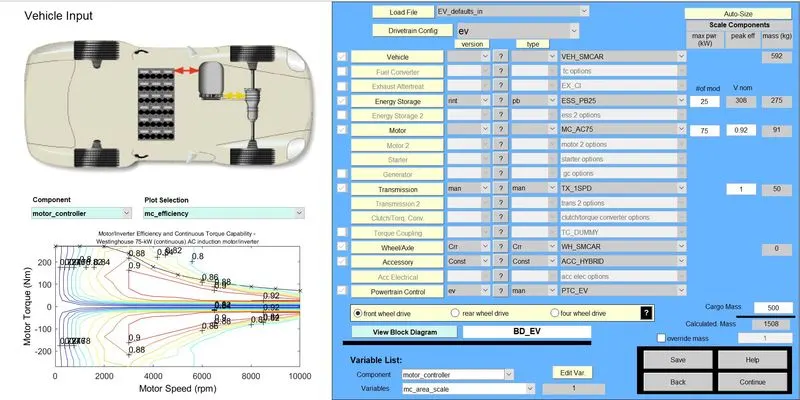
choose EV_defaults_in in Load file and change the cargo mass to 500kg.
In second GUI select the given drive cycle cyc_FTP
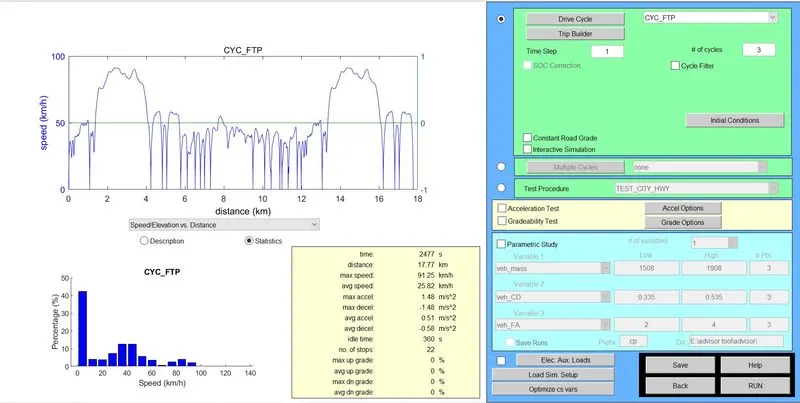
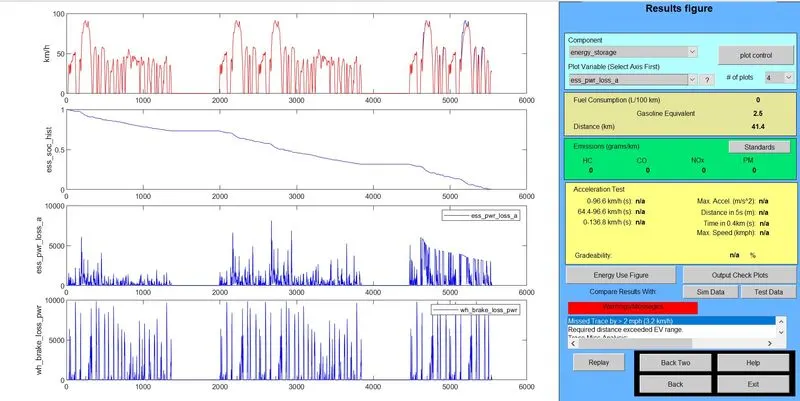
In this case we can cover only 41.4kms from 3 no. of cycles with cargo mass of 500kg.
2. In the above case, try changing the battery capacity and repeat the simulation.
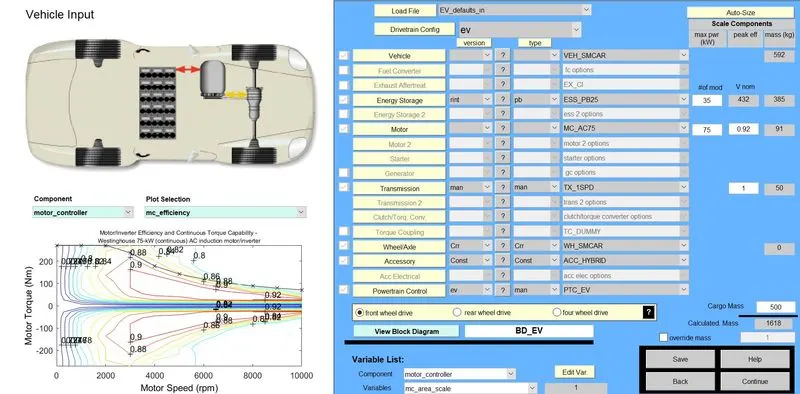
For the same case we increase the battery specification from 25kw to 35kw
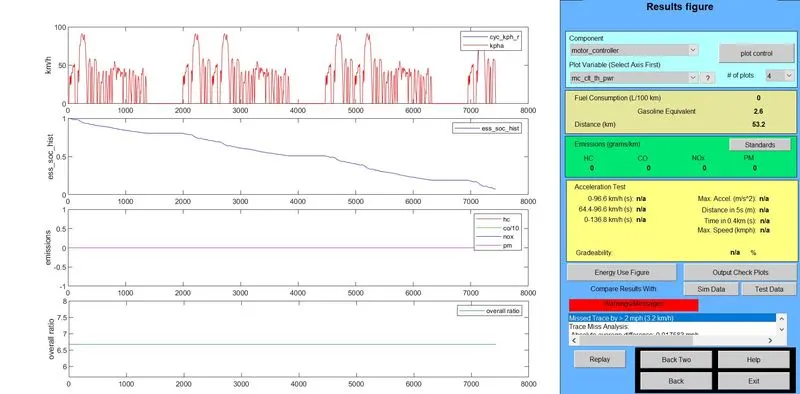
By altering the battery capacity we can achieve 53.2kms for same no. of 3 cycles.
- Perform gradeability test with PRIUS_Jpn_defaults_in file
Compare your results in table and conclude.
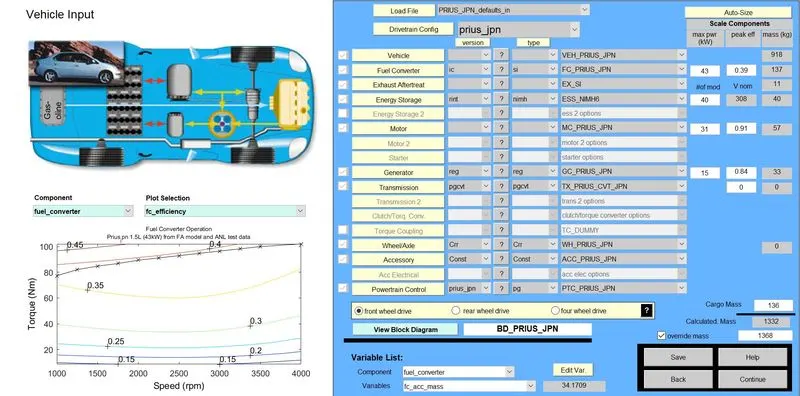
Model name : prius_jpn_defaults_in
case 1: Run a cycle at 20mph for 60sec
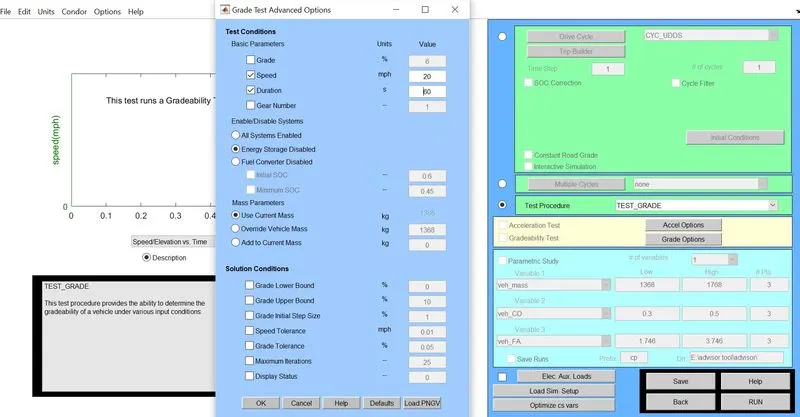
Result
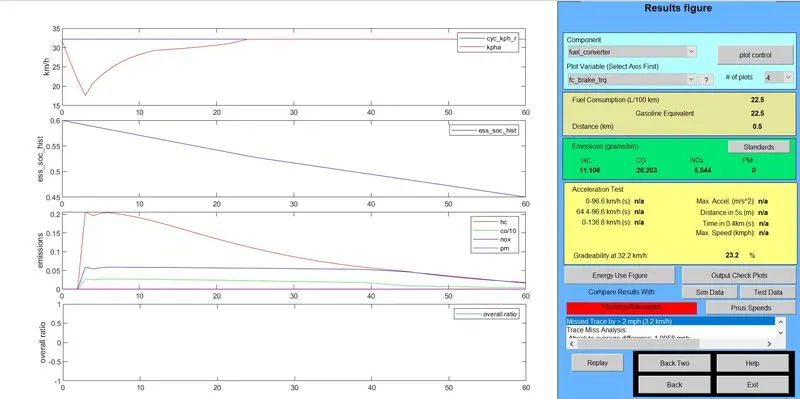
Gradeability is 23% at 32.2kmph
case 2: Run acycle at 50mph for 60sec
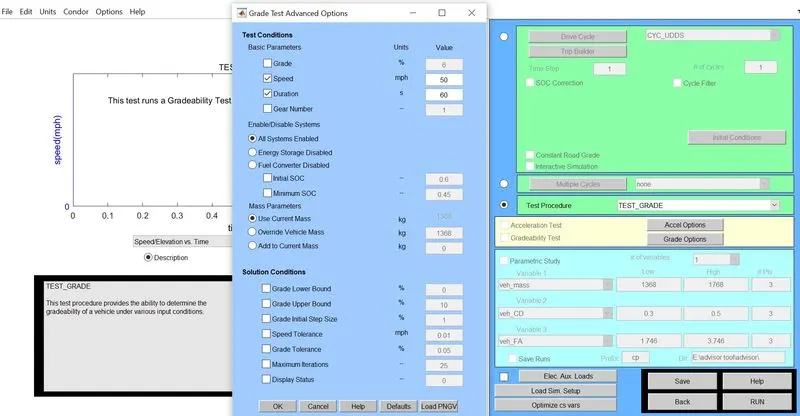
Result
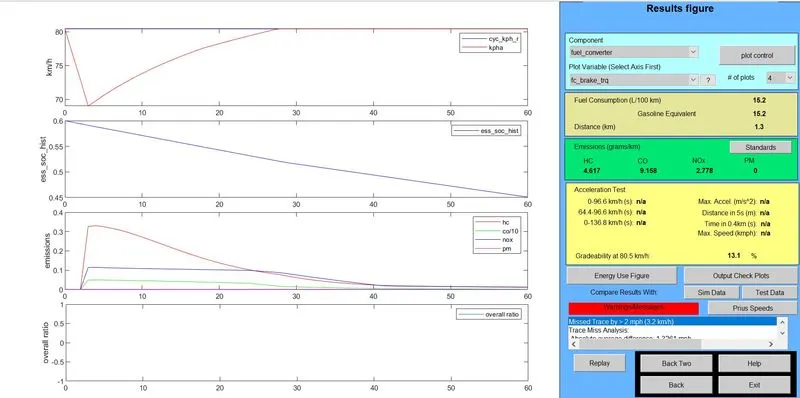
Gradeability at 80.5kmph is 13%
case 3: Run a cycle at 60mph for 60sec
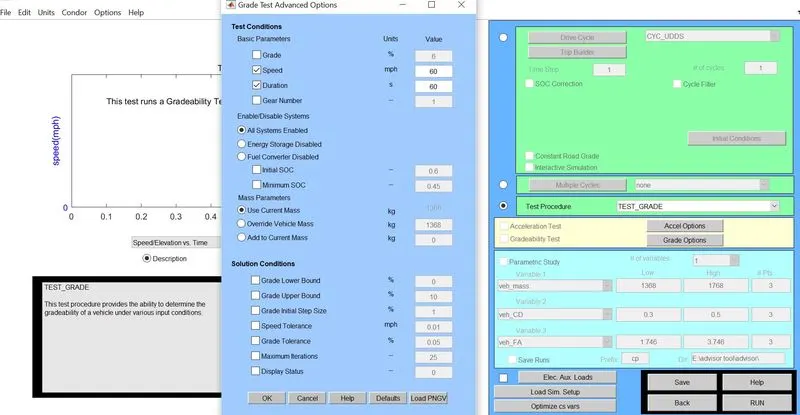
Result
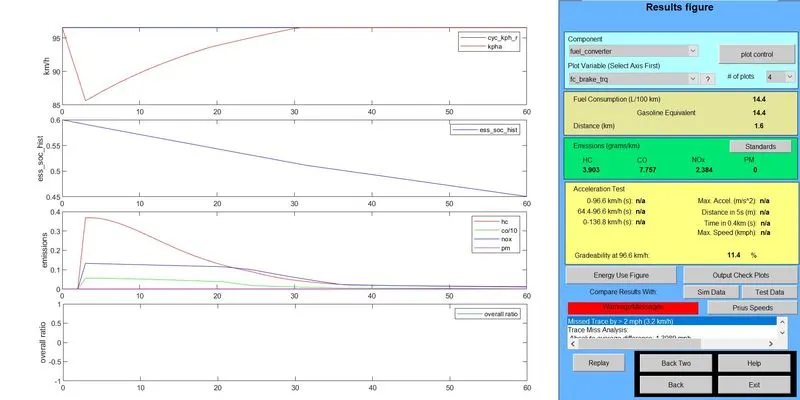
For this case Gradeability is 11% at 96.6kmph
If we compare these three cases Gradeability decreases with increase in speed.