Week-3 Challenge: ADVISOR Tool
1. For EV_defaults_in file, if cargo mass is 500 kg with all other default conditions, can the vehicle travel for 45 km with FTP drive cycle? Conclude your observations.
Ans:
Summary:
The Advanced Vehicle Simulator (ADVISOR)—the US Department of Energy’s (DOE’s) ADVISOR written in the MATLAB/Simulink environment and developed by the National Renewable Energy Laboratory. ADVISOR provides the vehicle engineering community with an easy-to-use, flexible, yet robust and supported analysis package for advanced vehicle modeling. It is primarily used to quantify the fuel economy, the performance, and the emissions of vehicles that use alternative technologies including fuel cells, batteries, electric motors, and IC engines in hybrid (i.e. multiple power sources) configurations. This tool helps engineers, in quantifying the relative change that can be expected due to the implementation of technology compared to a baseline scenario.
ADVISOR model definition employs linked library architecture, where the actual vehicle model is composed of a collection of component models.
ADVISOR employs a unique combination of backwardand forward-facing simulation attributes.
1)Generic backward-facing approach:
This approach answer the question ‘‘assuming the vehicle met the required trace, how must each component perform?’’ No model of driver behavior is required in such models. Its convenient because automotive drivetrain components tend to be tested in a laboratory environment such that a table of efficiency or loss versus output torque and speed (or power) is developed. Quick to execute but due assumption that the trace is met and from the use of steady-state testing, efficiency or loss maps this approach is not well suited to compute dynamic best-effort performance.
2)Forward-facing approach:
Vehicle simulators that use a forward-facing approach include a driver model, which considers the required speed and the present speed to develop appropriate throttle and brake commands (often through a PI controller). Easy to understand as study flows in the direction of the physical power flow in the vehicle. This approach is particularly desirable for hardware development and detailed control simulation, as well as well-suited to the calculation of maximum effort accelerations, as they are essentially wide-open throttle events. Since, drivetrain power calculations rely on the
vehicle states, including drivetrain component speeds that are computed by integration, simmulation need more time.
3)Combined backward/forward-facing approach:
A hybrid backward/forward approach that is closely related to the strictly backward-facing approach. Here two overriding assumptions are possible; 1.No drivetrain component will require more torque or power from its upstream neighbor than it can use; 2.A component is as efficient in the forward-facing calculations as it was computed to be in the backwardfacing calculations.
Capabilities and limitations:
ADVISOR was originally developed as a simple analysis tool that could be used to quickly quantify the relative impacts of advanced technologies in a vehicle. It quickly evolved into a tool with a wide range of capabilities. Key attributes are,
- Intuitive, easy-to-use graphical interface;
- Fast solutions;
- Distributed as open source code;
- Customizable;
- Scalable component models;
- Good customer support, software maintenance, and documentation;
- Free and publicly available;
- Highly parameterized models;
- Provides robust solutions;
- Modular architecture;
- can simulate impact of auxiliary sub systems
The two most common simulations performed for a vehicle in ADVISOR include drive cycle analysis and performance tests. A drive cycle constitutes a series ofvehicle speeds as a function of time. There are more than40 different drive cycles to choose from in the ADVISOR database.
Including the following:
- Grade Test Procedure;
- Acceleration Test Procedure;
- FTP Test Procedure;
- FTP Test Procedure for hybrids;
- City/Highway Test Procedure;
- City/Highway Test Procedure for hybrids;
- SAE J1711 Test Procedure;
- ‘‘Real World’’ Test Procedure
Limitations:
ADVISOR was developed as an analysis tool, and not a design tool. Its component models are quasi-static, and should not be used alone to predict phenomena with very small time scales. For example, ADVISOR should not be used to quantify physical vibrations, electric field oscillations and other fast dynamics. However, has been successfully linked with other tools that do perform dynamicanalysis capability. Tools like Saber for electrical systemsmodeling and ADAMS/Car for vehicle dynamics have been linked with ADVISOR.
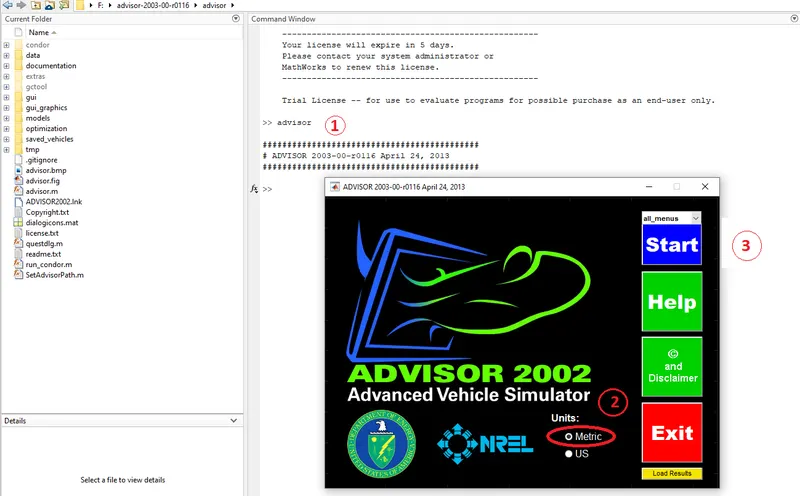
Step-01: Open Matlab environment and enter command =>advisor to initiate Advisor GUI=>Choose unit system=>Start.
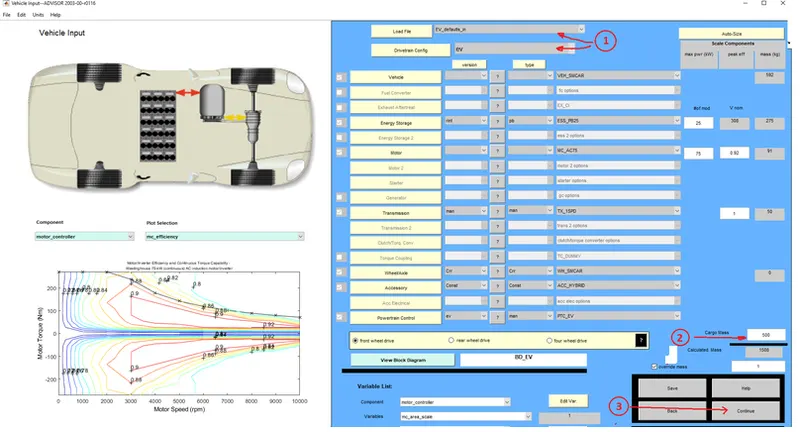
Step-02: Choose EV_defaults_in in drop down menu=>add 500kg cargo mass
Step-03: Choose FTP drive cycle data from drop down menu=>Check total one cycle distace 17.77Km;not 45Km=>Number of cycles need to be increased;
By trial and error method; we can estimate cycles required:
| Lead acid battery ESS_(Hawker Genesis 12V26Ah10EP VRLA battery) | ||||||
| Parameter | FTP cycles | Distance | SOC | Modules | Total Voltage(12V/M) | Mass(11kg/M) |
| Unit | (Km) | % | No. | V | Kg | |
| Senario-1 | 1 | 17.77 | 43 | 25 | ||
| Senario-2 | 2.33 | 41.4 | 100 | 25 | 300 | 275 |
| Required range Senario-3 |
2.53 | 45 | 109 | 27.2 | 326 | 299 |
| Senario-4 Requried range+20% range |
3.04 | 54 | 130 | 32.6 | 391 | 359 |
Simulation out put for scenario-1 with 1 FTP cycle-25 modlues 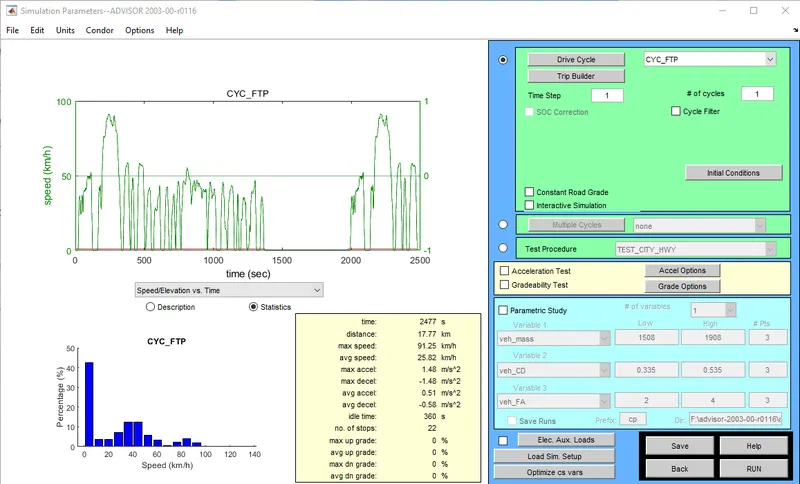
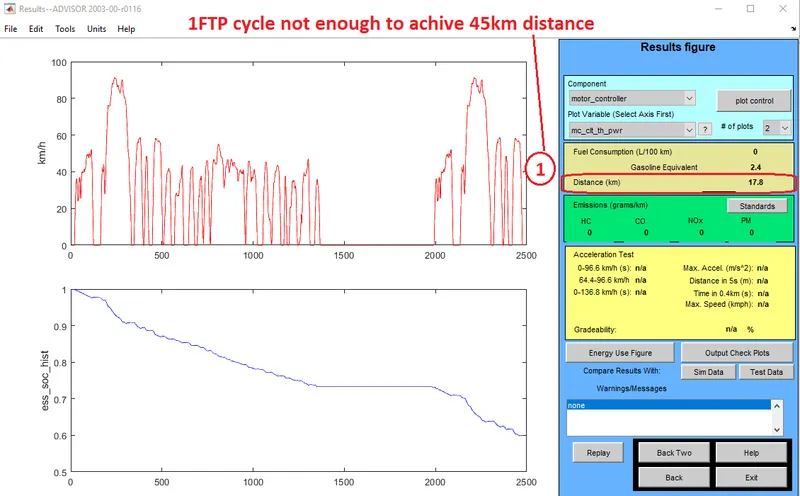
Step-04: Simulation out put for scenario-2 with 2 FTP cycles-25 modlues 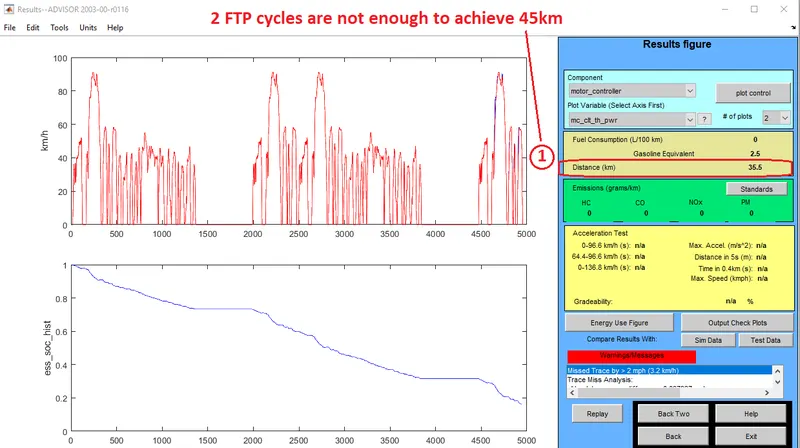
Step-5: Simulation out put for scenario-3 with 3 FTP cycles with 25modules.
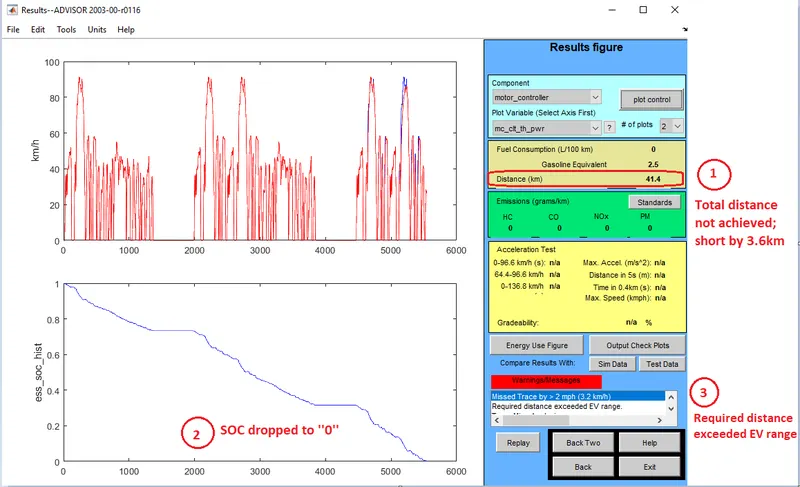
Observations:
1)Warning message: Required distance exceeded the EV range.
SOC drooped to zero before completing 45km drive cycle and distance tracelled is only 41.4km
2)Battery with 25modules; which can propell only 92% of the distance only.
3)Battery with 27.2=>28 modules; can propell complete the distance; with Battery mass of 299kg
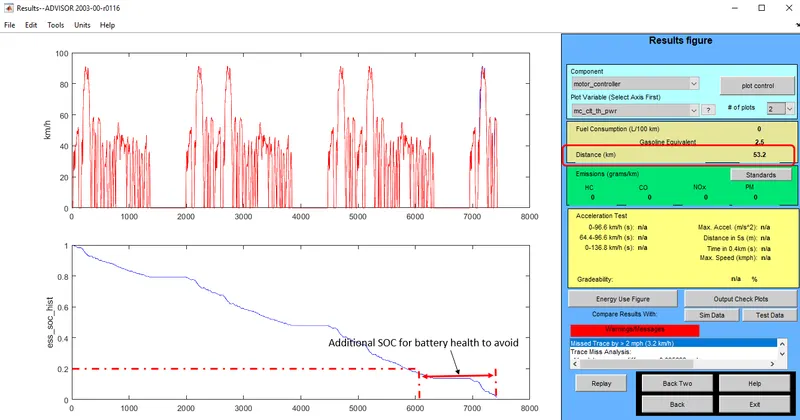
3)More over its advice to keep 20% SOC to maintain battery health; so SOC required = SOC for 45km+20% additional SOC
4)Approx. 32 modules of 12V required for SOC for 45km+20% additional SOC senario; With battery mass 359kg
Conclusion:
1)Battery mass increased, so need to relook at type of battery used considering vehilce packaging space,cost and mass.
2)An alternative battery type like Li based may be considered to reduce the battery mass with increseased energy efficiency.
----------------------------------------------------------------------------------------------------------------------------------------
2. In the above case, try changing the battery capacity and repeat the simulation.
Ans:
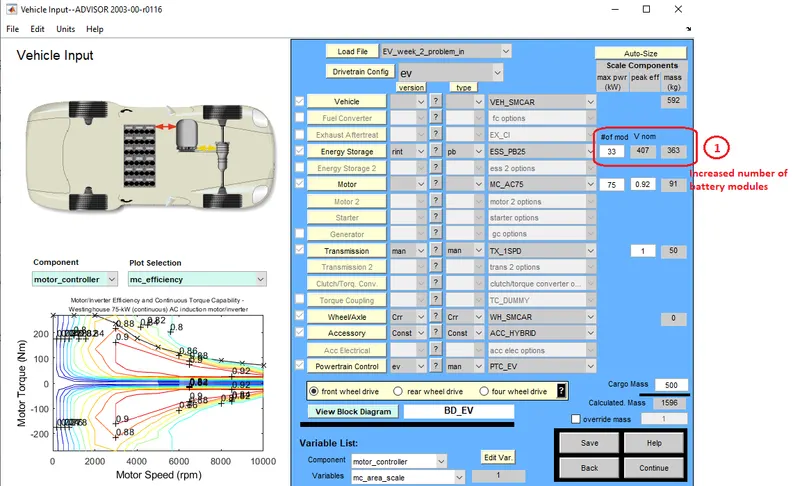
Step-01:Increased number of battery modules as in scenario 3; 25 to 27.2=>28 to achieve range 45km based on estimation in previous problem.
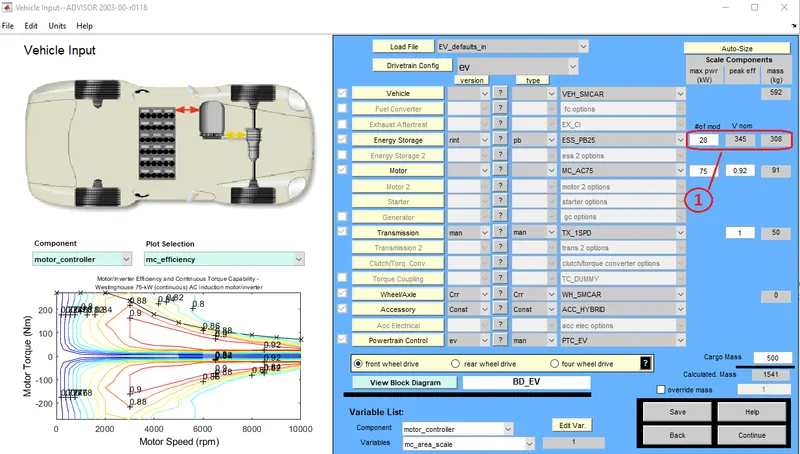
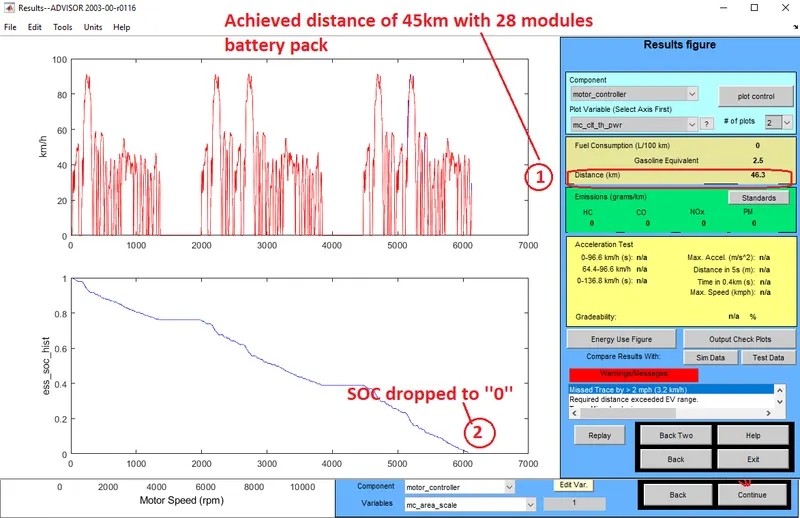
Step-02: 32 modules of 12V required for SOC for 45km+20% additional SOC senario; With battery mass 363kg
3. Perform gradeability test with PRIUS_Jpn_defaults_in file
Compare your results in table and conclude.
Ans:
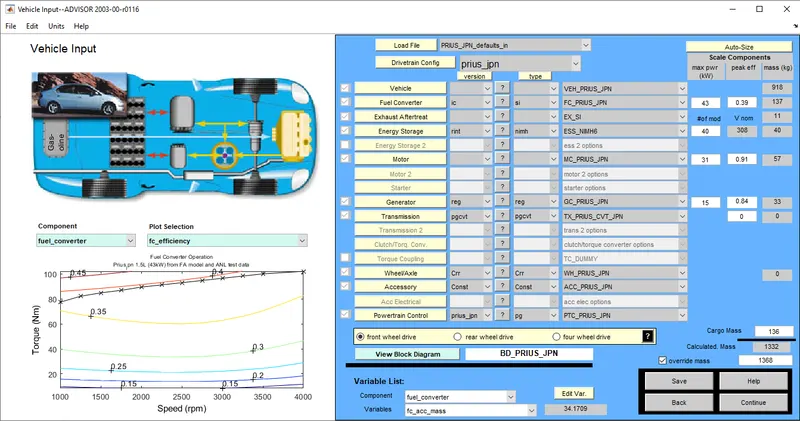
Step-01:Select PRIUS_Jpn_defaults_in from drop down manu
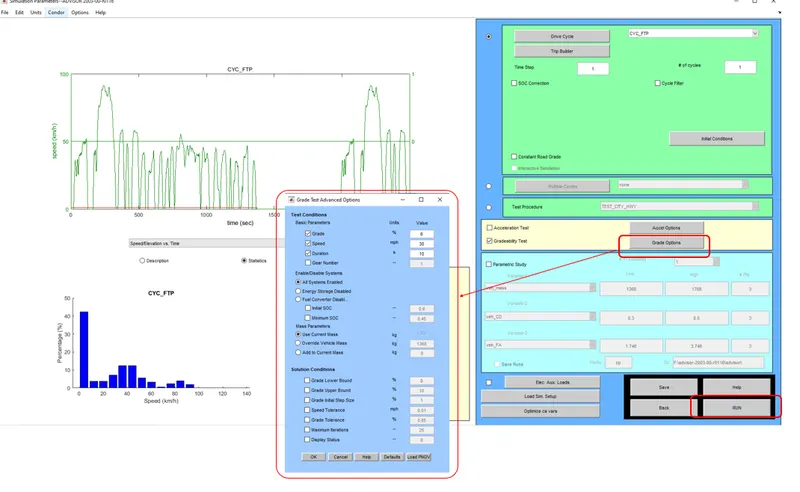
Step-02: Analysis of data from simmulation
| Grade(%) | Speed(kmh) | Duration(sec) | Distance kmh/10sec | Grade data result |
| 6 | 48.3 | 10 | 0.13 | 6 |
| 8 | 48.3 | 10 | 0.13 | 8 |
| 9 | 48.3 | 10 | 0.13 | 9 |
| 10 | 48.3 | 10 | 0.13 | 10 |
| 11 | 48.3 | 10 | 0.13 | 11 |
| 12 | 48.3 | 10 | 0.13 | 12 |
| 13 | 48.3 | 10 | 0.13 | 13 |
| 14 | 48.3 | 10 | 0.13 | 14 |
| 15 | 48.3 | 10 | 0.13 | NA |
| 16 | 48.3 | 10 | 0.13 | NA |
| 16 | 48.3 | 20 | 0.27 | 16 |
| 6 | 64.4 | 10 | 0.18 | 6 |
| 8 | 64.4 | 10 | 0.18 | 8 |
| 9 | 64.4 | 10 | 0.18 | 9 |
| 10 | 64.4 | 10 | 0.18 | 10 |
| 11 | 64.4 | 10 | 0.18 | 11 |
| 12 | 64.4 | 10 | 0.18 | NA |
| 12 | 64.4 | 20 | 0.36 | 12 |
Step-03: Conclusion
As vehicle speed increases, gradability limit of vehilce decreases; possible reasons are not enaugh tractive forece or slip of wheels or Front wheel drive only may not have enaugh grip.
Note:Data in excel file