Week 3:- BiW Fixture Design Methodologies Challenges
1. What is Design Methodology?
Design Methodology is a sequence of steps that we have to follow while doing design.
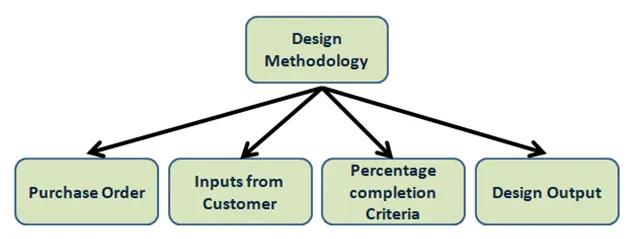
The above image is of the design methodology and steps involve in it.
- Purchase Order: We start designing after the customer gives us a purchase order. So, basically, it is an indication to start designing the particular fixture.
- Inputs from Customer: The customer gives us requirements or specifications of the fixture before starting actual design work. So, we have to design fixtures by considering all the points of customers.
- Percentage Completion Criteria: To complete the design in time we have to create a schedule or time plan called Percentage Completion Criteria. In this, we mention all activities related to design and the time required to complete that task like concept design, finally finished design, and 2D of all units in the fixture, etc.
- Design Output: Design Output consists of lots of data like 3D and 2D documents, VMC IGS files, STEP files, gas-cut or laser-cut files in dwg format and BOM, etc. We have to give these data to our customers as design output.
Answer 2-
Following are the inputs from customers to start design work:
- Function Requirement: Generally, function requirement means for what purpose we are going to design fixtures like welding, gluing, or riveting fixtures and inspection fixtures.
- Preferred Standard Components: While designing fixtures, we have to use standard components as much as possible to save time, money, and effort to design, and manufacturing that non-standard component.
- Car Product: It consists of 3D, read files, geometric tolerance, and PLP (principle locating points) of the fixture.
- Layout: Layout is nothing but management of space which helps to understand the process or flow of work of the entire assembly line.
- Ergo data: Every company has standard ergo data and they provide it to fixture designers to design fixtures considering that points Ex. height of fixture is decided according to to ease while working on the fixture. So, we have to design a fixture by considering safety, easy and foolproof design.
- Weld Study: In this input, the customer specifies which type of welding (spot or seam) is required to join components according to which we have to design fixture.
- Standard Detailing Templet: The customer gives us a standard detailing template, so we can use that to detail or dimension components according to that template.
Answer 3-
- Part List: It states the parts and assembly style. Part lists consist of unique part names of each and every part in the assembly and each part has its own part number which helps while assembly process to identify each and every part in the assembly.
- Cad Files of Car Part: 3D cad files of parts are necessary while designing fixtures.
- Clamp Plan: It is one of the important data while designing fixtures because the clamp plan mentions the location of clamps in which component is going to clamp.
- Product Assembly Process Sheet: In the product assembly process sheet, sequence or stages of assembly of components are given.
Answer 4-
Clamps are nothing but a mechanism or component used to hold or clamp jobs in fixtures securely. Clamps are manual type, hydraulic type, or pneumatic type depending on customer requirement. The clamp plan mentions or gives the location of clamps in which component is going to clamp. We can't change the clamp location without the customers' approval, first of all, we have to take permission from the customer's side to change the clamp location. The clamp plan also provides information regarding the location of pins, rest, clamps, and dumps.
Answer 5-
The layout is nothing but management of space which helps to understand the process or flow of work of the entire assembly line.
The layout is used to achieve more efficiency or coordination of the 4 M's (men, material, machines, and methods). Plant layout is simply a floor plan for arranging machinery and equipment present in the plant and these things are arranged according to their usage, easy for everyone to use particular equipment or machinery, and should not disturb the flow of material. Actually, the layout is very helpful to save time and money on plants.
Answer 6-
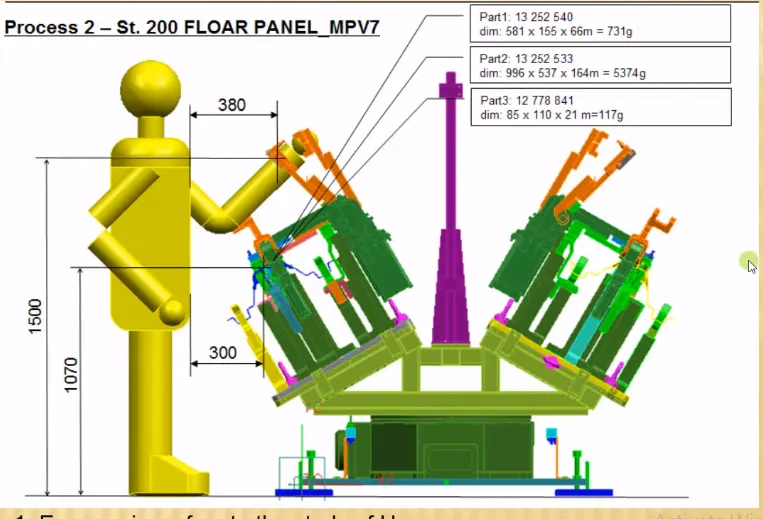
Every company have standard ergo data and they provide it to fixture designer to design fixture considering that points Ex. height of fixture is decided according to ease while working on the fixture. So, we have to design a fixture by considering safety, easy and foolproof design. Ergo Data is used to reduce human errors and increase productivity, human comfort, and safety.
Answer 7-
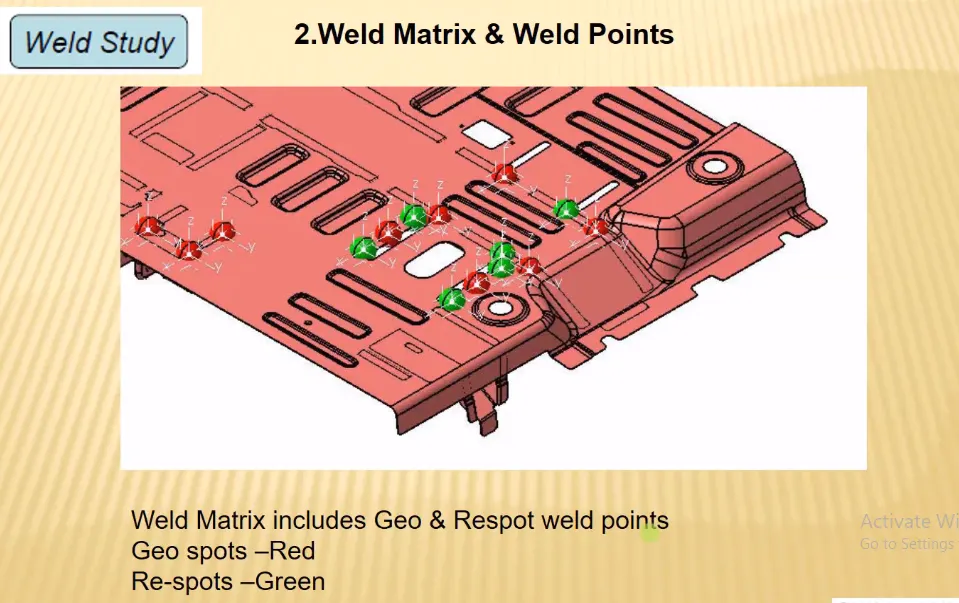
Weld Study is nothing but a study of welding guns that we are going to use in welding fixtures and where we are going to weld. It consists study of welding gun details, weld matrix, weld point, geo weld points, re-spot weld points, etc. Weld's study consists of study following points:
- Weld Gun Details: In this, we are going to study which type of gun is suitable for particular fixtures and selected gun to use and how to use it.
- Weld Matrix and Weld Points: Weld points are the points where welding is to be done.
- Geo Weld Points and Re-spot Weld Points: Weld Points are divided using color code, one of them is red color points and the remaining points have a green color. In these, red color points indicate geo weld points that are going to weld in the geo tool, and green color points indicate re-spot weld points which are going to weld in the re-spot tool.
Answer 8-
To complete the design in time we have to create a schedule or time plan called Percentage Completion Criteria. In this, we mention all activities related to design and the time required to complete that task like concept design, finally finished design, and 2D of all units in the fixture, etc. The percentage completion criteria are as below:
- 0-25% (Input & Concept Design): In this stage of percentage completion criteria, we have to build a concept design for fixtures in this stage.
- 25-40% (Concept Approval & Simulation): In this stage, the concept design is approved by the customer and gives some correction points if any. Later we have to give a working simulation of the fixture for a better understanding of how the fixture works.
- 40-85% (Design Freezing & Detailing): If all requirements and specifications of customers are satisfied then the design is frozen and detailing work starts.
- 85-100% (Check & Final Dispatch): In this stage, quality checking is done using CMM (coordinate measuring machine) and then dispatched to customers.
Answer 9-
Design Output consists of lots of data like 3D and 2D documents, VMC IGS files, STEP files, gas-cut or laser-cut files in dwg format and BOM, etc. We have to give these data to our customers as design output. The basic outputs are 3D models and 2D drawings of fixtures. Output is classified as below:
1. Unitised Tool: This tool consists of two types of sheets, which are as follows:
- Key Sheet: Key sheet mentions or shows the location of every unit in the fixture.
- Layout Sheet: A layout sheet is a detailed drawing of a particular unit in the fixture.
2. Non-unitised Tools: This type of tool doesn't require a key sheet. Ex. stands and tool changer. Tools that can stand alone and details in a layout sheet.
Answer 10-
Structuring a design tree is very necessary while designing a fixture because it helps to identify all manufactured parts in the whole fixture. Every customer company has there own standard. This will help us during design study, manufacturing, and inspection to avoid errors.
If we ignore structuring a design tree it will create confusion to understand design and many errors will appear in fixtures.
11. What are Units? Mention 5 types of units.
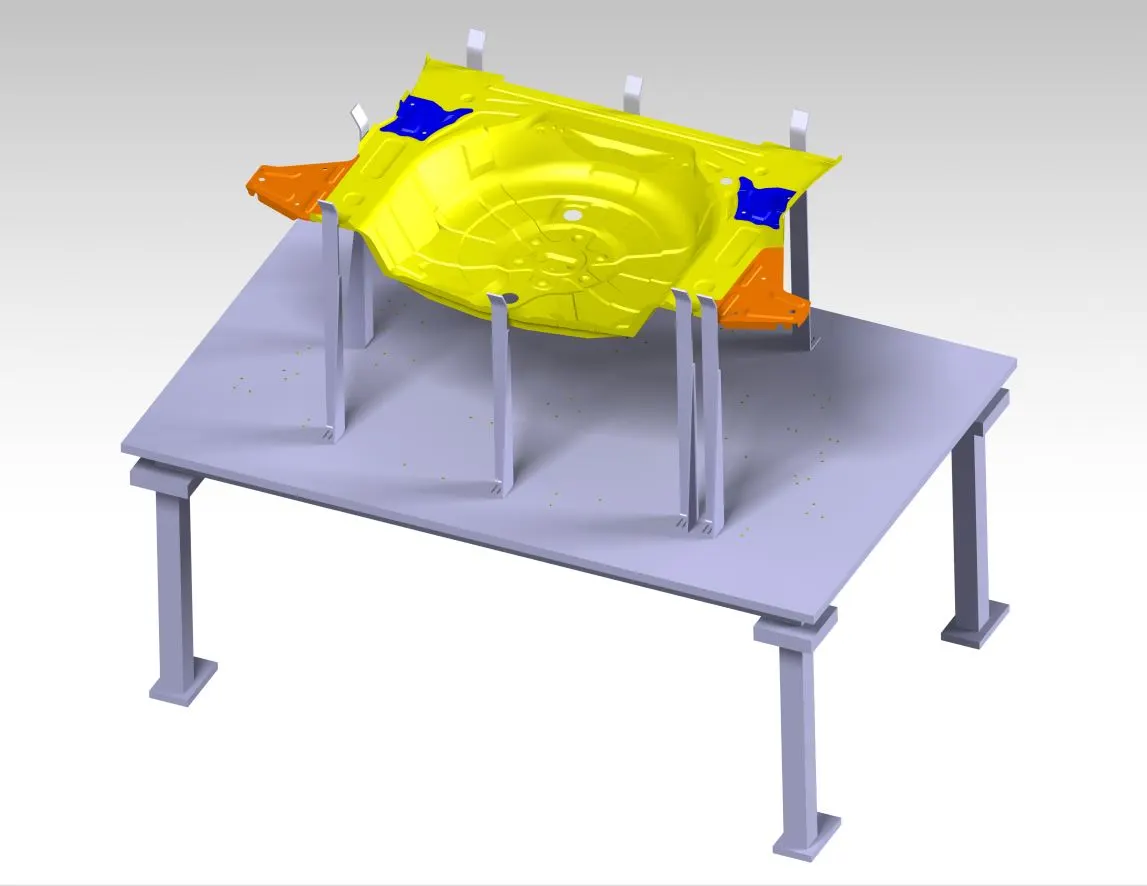
A unit is nothing but an assembly having a specific function like clamping, location, or resting. In fixtures, there is a number of units. According to the 3-2-1 principle of location, a fixture is designed having two major purposes the clamp and to locate the component for which the fixture is designed. Image shows fixture consist of different units:
The types of units are as below:
- Fixed Pin Unit: Fixed Pin Unit is a nonmovable locating unit that arrests the movement of components in fixtures.
- Retract Pin Unit: Retract Pin Unit has a retracting unit that is used to move pins to ensure proper loading and unloading of components.
- Rough Locator Unit: This unit helps the operator with the correct loading of the component.
- Rest Unit: As the name suggests, the rest unit is used to rest the component.
- Base Unit: All the units in the fixture are placed on this base unit.
Answer 12-
A fixed Pin Unit is a nonmovable locating unit that arrests the movement of the component in the fixture. It consists of a pin, pin retainer, blade, two-way shims or spacer which control X, Y direction adjustment, block, and riser.
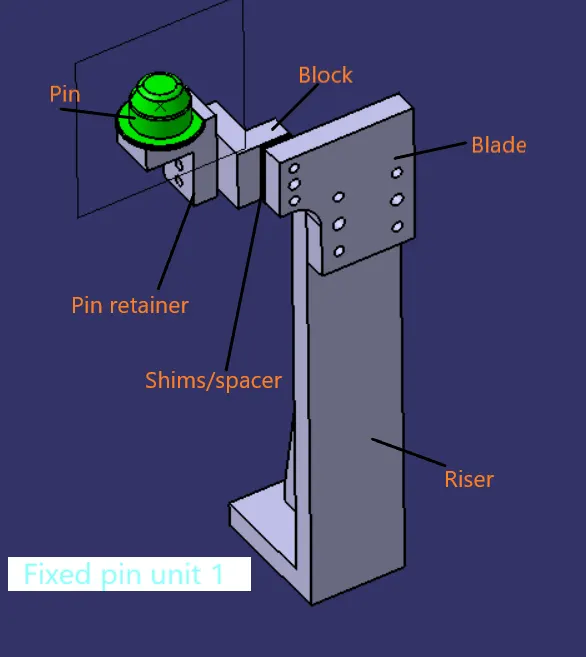
The purpose of the Fixed Pin Unit is as below:
- The main purpose of a fixed pin unit is to locate component
- This unit is used to arrest 6 degrees of freedom of component
- Two pins are used to locate components. The first pin restricts 4 translational motions and the other one restricts 2 rotational motions.
Answer 13-
Different parts of the fixed pin unit are as below:
A fixed Pin Unit is a non-movable locating unit that arrests the movement of the component in the fixture. Fig. shows an example of a fixed pin unit. It consists of a pin, pin retainer, blade, two-way shims, or spacer which controls X, Y direction adjustment, block, and riser.
- PIN: The pin is the main part of this type of unit because it is used to locate components.
- 2 pins are used to restrict 8 degrees of freedom. In this type of fixed pin unit, pins are fixed or nonmovable.
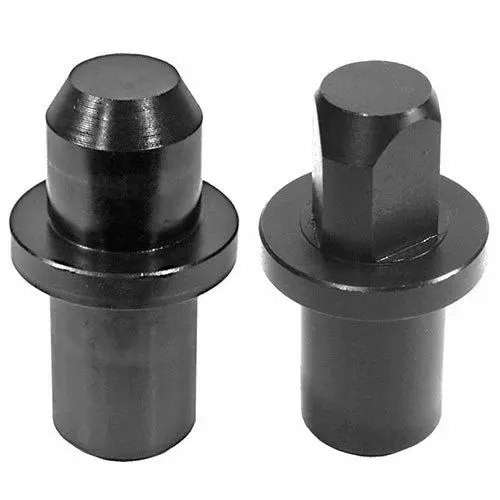
- PIN RETAINER: Pin Retainers are used to support or carry pins in it as shown in the figure.
- BLOCK: Block can be machined in any desired shape according to the fixture. It may be a simple square or rectangular block or it may be L shaped block as shown in the figure.
- SHIMS OR SPACER: Shims or spacers are used to compensate for tolerance stack up. In the pin unit, we need to control two directions that is X and Y using shims or space. Shims are generally thin-sized plates used in a group called Shimpack and spacers are used as single plates and can be machined accordingly.
- BLADE: As shown in the figure blades are bolted on the riser.
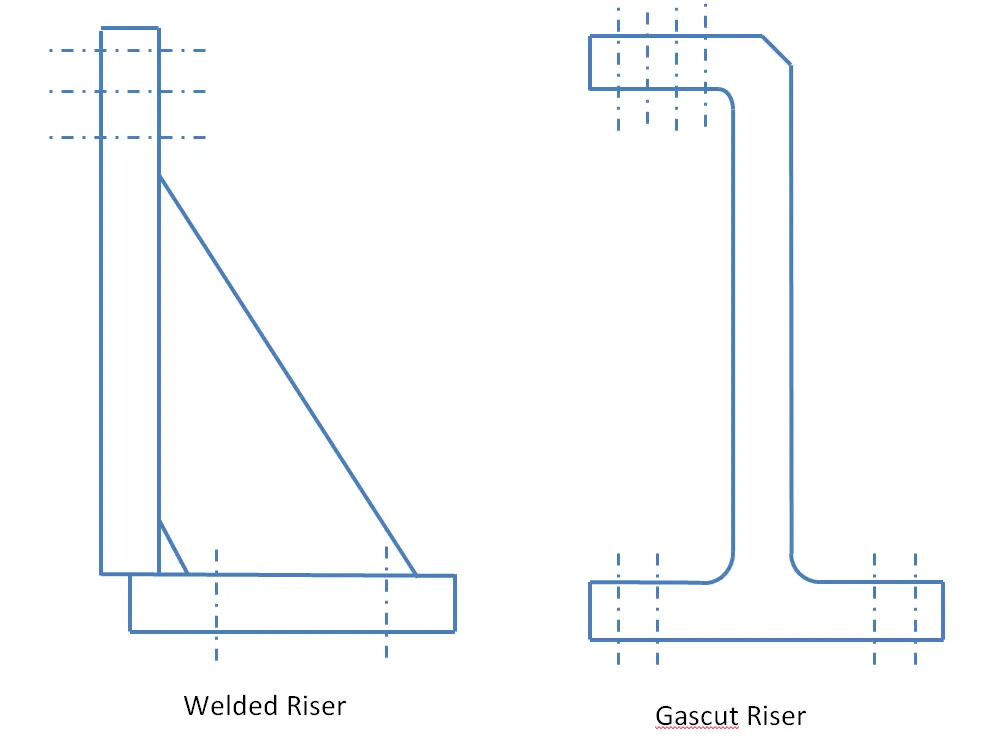
- RISER: A riser is used to increase the height of the unit and these are standard parts so need no detail or design it.
Answer 14-
Rest Unit is one of the simplest units in fixture used with myler. As the rest unit is simple to manufacture and require low cost, hence rest unit is combined with the clamp unit and location unit. The Rest unit consists of the following parts:
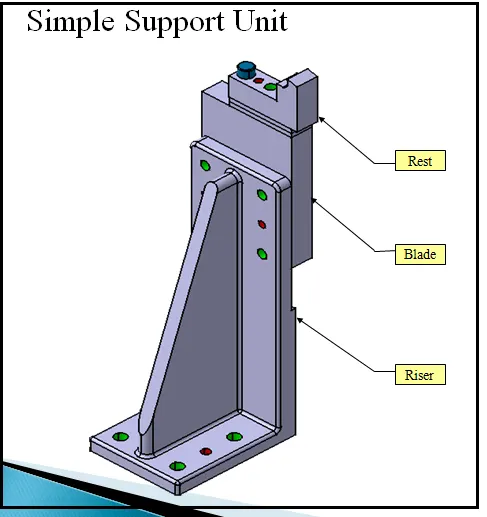
- RISER: Riser are used to increase height of unit and these are standard parts so need not detailed it or designed it.
- BLADE: As shown in the figure blades are bolted on the riser.
- SHIMS OR SPACER: Shims or spacers are used to compensate for tolerance stack up. In the pin unit, we need to control two direction that are X and Y using shims or space. Shims are generally thin-sized plates used in a group called Shimpack and spacer are used as single plate and can be machined accordingly.
- MYLARS: Mylars are the parts in the rest unit which are in contact with the car panel or component used to give support or rest to the component.
Answer 15-
A sensor is a device that detects or measures a physical property. The unit which is built to sense the component or car panel using electrical sensors called Unit sensors. The output signal of the sensor is then sent to PLC (Programmable Logic Control) for further process. There of different types of sensors such as proximity sensors, and laser sensors.
Each components which are welded in fixture should be sensed. So, we manufactured or assemble components free from errors. Consider an example of car panel having multiple components to assemble using welding. These multiple components are going to be sensed by the sensor to assure the correct component is placed at the correct position.
Answer 16-
Rough Locators are the parts used to locate components correctly in fixtures, basically, they guide the operator while loading components in fixtures. The figure shows an example of a Rough locator and different locators we can use. It may be a standard part or we can design it according to our component.
FUNDAMENTALS:
- They are used to guide the component to load correctly in fixtures and placed at the edges of components.
- The angle in locator should be according to component.
- Rough Locator helps components to be placed in pins used in fixtures to locate components.
- The entry angle should be 30 to 45 degrees and the rough locator should start guiding the component before 10 to 15mm to start the pin engagement.
- For easy adjustment rough locator mounted on base with two slots in it.
- The direction of slots are in the direction of the car panel or component.
Answer 17-
ANS. As the name suggests, a Base unit is used to provide a base for other units such as location unit, rest unit, or sliding unit in the fixture. These all units are mounted on this base unit.
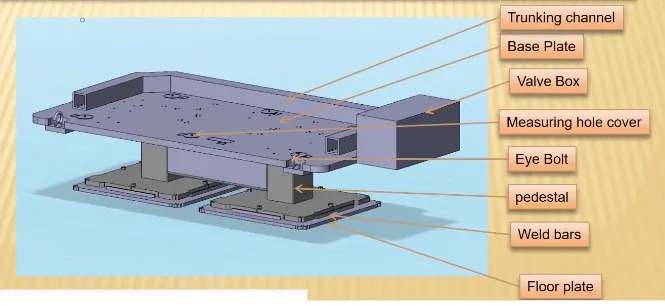
Parts involved in the base unit are as below:
- Floor Plate: A plate that is used to join fixtures and floor is called Floor Plate.
- Weld bars and Pedestal: Pedestal is support or base on which fixture is mounted.
- Eyebolt: Eyebolt is used to move a fixture or place a fixture in its place using cables or ropes. This threaded eyebolt is sustained by 45 degrees of angular forces.
- Measuring Hole Cover: Measuring Holes are also known as Tooling holes from which other holes on the base are drilled. So, measuring holes are basically reference holes. These measuring holes are covered using a measuring hole cover.
- Base Plate: The plate on which all units are mounted called base plate. The base plate is machined on both to achieve parallelism. The thickness of the base plate is too high to sustain the load of all units.
- Valve Box & trunking Channel: Pneumatic Fixture consist of solenoid valve and these valves are placed inside valve box. Trunking Channel protects all pressure inlet tubes that is attached to pneumatic devices such as cylinders and clamps.
Answer 18-
Dump unit is used due to a lack of space on fixtures to build a unit. So, this is a complex unit consist of a dump cylinder used for clamping or unclamping of car panels or component.
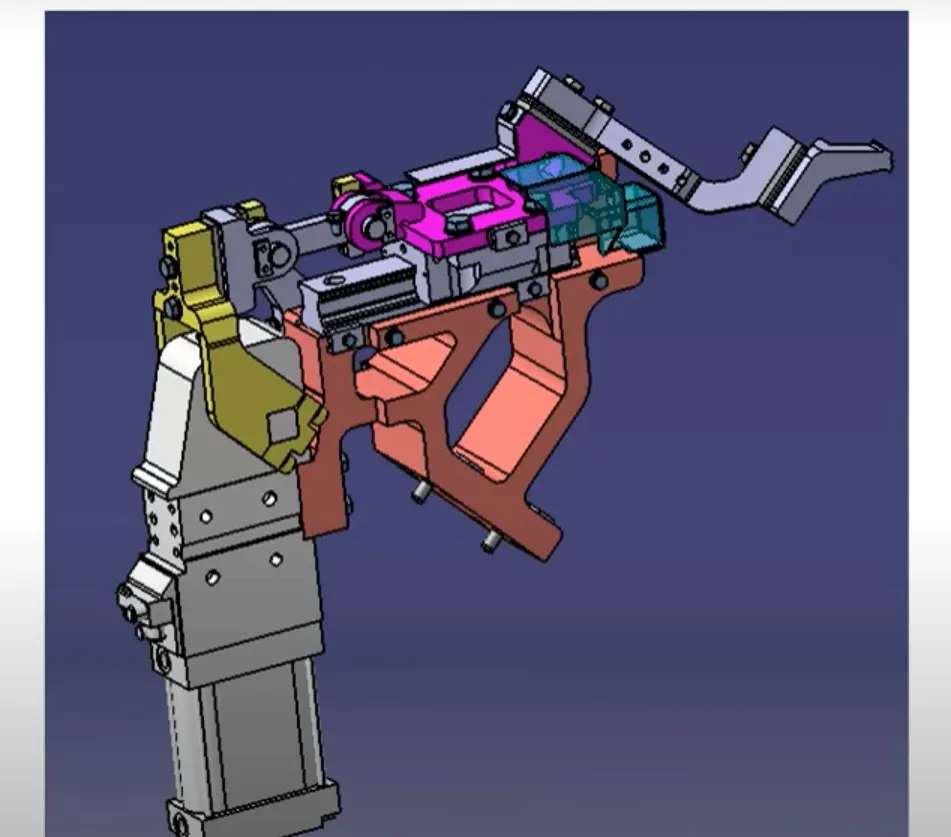
FUNCTION:
Due to space constrain dump unit used in the fixture. It has a dump cylinder having an open and closed position for a better understanding of the design. It also has a clamp cylinder used for clamping purposes.
hence this is a too complex unit to build.
Answer-19-
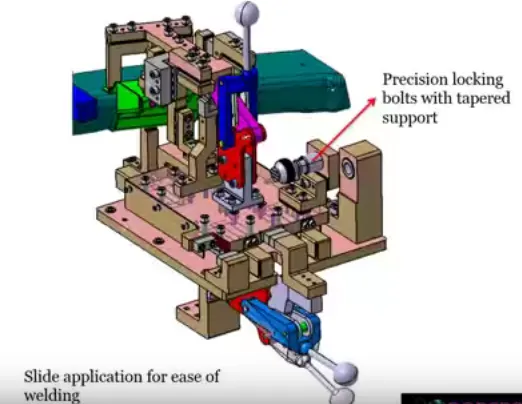
Slide Units are positioning units used to position fixtures, units, weld guns, and robots. This unit consists of a sliding rail on which the entire unit is slid in direction of rails for further operation. The sliding unit consists of the open and closed positions. This sliding unit is commonly used in the automotive industry for different similar components. Following is an example of a slide unit provided for welding purposes.