from the above question fourth order approimation in second order differenence
i find out the central difference by using the taylors equation
our numerical stencil will be
f(i-2),f(i-1),f(i),f(i+1),f(i+2) are the points from the center for the f(i)
and the distance between the two points of the equation is (deltax)
based on the above analysis equation we write is
diff(f,x,2)=a*f(i-2)+b*f(i-1)+c*f(i)+d*f(i+1)+e*f(i+2)
inorder to find the value of coefficents of a,b,c,d,e we right as the follows the from the taylors equation table
| |
f(i) |
dxf(i) |
dx^2f"(i) |
dx^3f'"f(i) |
dx^4f''"f(i) |
dx^5f'""f(i) |
dx^6f'""'f(i) |
| f(i-2) |
a |
-2a |
4a/2 |
-8a/6 |
16a/24 |
-32a/120 |
64a/240
|
| f(i-1) |
b |
-b |
b/2 |
-b/6 |
b/24 |
-b/120 |
b/240
|
| f(i) |
c |
0 |
0 |
0 |
0 |
0 |
0
|
| f(i+1) |
d |
d |
d/2 |
d/6 |
d/24 |
d/120 |
d/240 |
| f(i+2) |
e |
2e |
4e/2 |
8e/6 |
16e/24 |
-32e/120 |
64e/240 |
| sum(f(i-2):f(i+2) |
0 |
0 |
1 |
0 |
0 |
|
|
there fore from the above equation we find the
a+b+c+d+e=0
-2a-b+0+d+2e=0
4a/2+b/2+0+d/2+4e/2=1
-8a/6-b/6+0+d/6+8e/=0
16a/24+b/24+0+d/24+16e/24=0
we right this equation in matrix from as show below
a=[1 1 1 1 1;-2 -1 0 1 2;2 1/2 0 1/2 2;-8/6 -1/6 0 1/6 8/6;16/24 1/24 0 1/24 16/24]
b=[0 ;0 ;1; 0;0]
x=[a; b; c ;d ;e]
inverse (A)
a=-0.0833
b=1.33
c=-2.5000
d=1.333
e=0.0833
we subsitite this in the above equation as shown
similaary for the skewed right hand difference
defined for the five pont from the right hand side as showm
f(i),f(i+1),f(i+2),f(i+3),f(i+4),f(i+5)
we right as the
diff(f,x,2)=a*f(i)+b*f(i+1)+c*f(i+2)+d*f(i+3)+e*f(i+4)+g*f(i+5)
in the above equation a,b,c,d,e,g are the coefficient of the above equation
in the similary way, we find the
a=3.75
b=-12.88
c=17.888
d=-13.00
e=5.088
g=-0.833
using the skewed left hand difference
defined for the five pont from the right hand side as showm
f(i-5),f(i-4),f(i-3),f(i-2),f(i-1),f(i)
e right as the
diff(f,x,2)=a*f(i-5)+b*f(i-4)+c*f(i-3)+d*f(i-2)+e*f(i-1)+g*f(i)
in the above equation a,b,c,d,e,g are the coefficient of the above equation
in the similary way, we find the
a=-0.8333
b=5.0833
c=13.000
d=-17.833
e=-12.8333
g=3.75
program i divided the program in four parts as the
central difference
skewed right side difference
skewed left side difference
function [error_1]= numerical_function(x,dx)
%second order differenece
anatical_difference= -2*exp(x)*sin(x)
%fourth order central difference approixmation
%f"(x)=((a*f(i-2)+b*f(i-1)+c*f(i)+d*f(i+1)+e*f(i+2))/(dx)^2
%a,b,c,d,e are coefficient of the equation
a= -0.0833
b= 1.333
c= -2.5000
d= 1.3333
e= -0.08333
error_1= ((a*exp(x-2*dx)*cos(x-2*dx)+b*exp(x-dx)*cos(x-dx)+c*exp(x)*cos(x)+d*exp(x+dx)*cos(x+dx)+e*exp(x+2*dx)*cos(x+2*dx)))/(dx)^2;
%errors in fourth order central diference approixmation
error_fcda =abs(error_1-anatical_difference)
end
function [error_2]=numerical_function1(x,dx)
%second order differenece
anatical_difference= -2*exp(x)*sin(x)
%fourth order skewed right side approixmation
%f"(x)=(g*f(i))+(h*f(i+1)+l*f(i+2)+j*f(i+3)+k*f(i+4)+m*f(i+5))/(dx)^2
%g,h,k,l,m are coefficent of approximation in taylors equation
g=3.75
h=-12.3
j=17.83
k=-13.00
l=5.08
m=-0.800
error_2 =(g*(exp(x)*cos(x)))+(h*(exp(x+dx)*cos(x+dx)))+(j*(exp(x+2*dx)*cos(x+2*dx)))+(k*(exp(x+3*dx)*cos(x+3*dx)))+(l*(exp(x+4*dx)*cos(x+4*dx))+(m*(exp(x+5*dx)*cos(x+5*dx)))/(dx)^2);
%error in skewed_right_side_approixmation
error_fsra=abs(error_2-anatical_difference)
end
function [error_3]=numerical_function3(x,dx)
%second order differenece
anatical_difference =-2*exp(x)*sin(x)
%fourth order skewed right side approixmation
%f(x)=p*f(i-5)+q*f(i-4)+r*f(i-3)+s*f(i-2)+t*f(i-1)+u*f(i)/(dx)^2
%n,p,q,r,s,t are coefficent of approximation in taylors equation
n=-0.8333
p=5.088
q=-13.000
r=17.800
s=-12.800
t=3.7500
%by using talyors equation
error_3=((n*exp(x-5*dx)*cos(x-5*dx))+(p*exp(x-4*dx)*cos(x-4*dx))+(q*(exp(x-3*dx)*cos(x-3*dx)))+(r*(exp(x-2*dx)*cos(x-2*dx)))+(s*(exp(x-dx)*cos(x-dx)))+(t*(exp(x)*cos(x))))/(dx)^2
%error finding the equation
error_fsla = abs(error_3-anatical_difference)
end
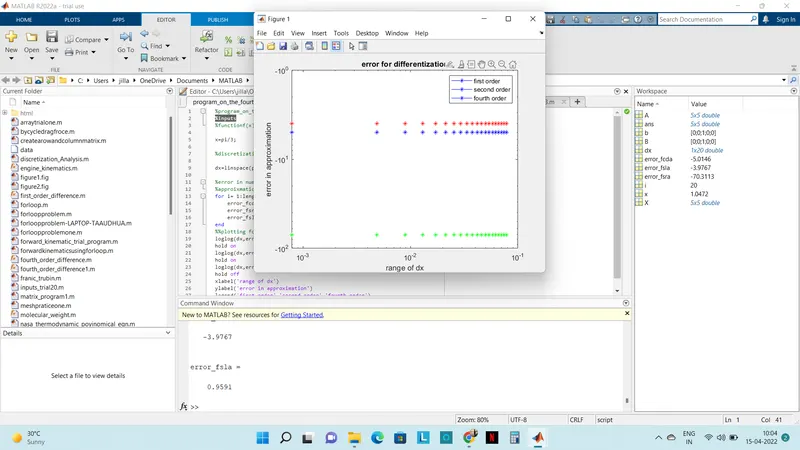
%program_on_the_fourth_order_derivation
%inputs
%functionf(x)=exp(x)*cos(x)
x=pi/3;
%discretization of size x
dx=linspace(pi/4000,pi/40,20);
%error in numerical discretizatio for the first,second and fourth order
%approixmation
for i= 1:length(dx)
error_fcda=numerical_function(x,dx(i));
error_fsra=numerical_function1(x,dx(i));
error_fsla=numerical_function3(x,dx(i));
end
%%plotting for the graph dx vs errors
loglog(dx,error_fcda,'b-*')
hold on
loglog(dx,error_fsra,'g-*')
hold on
loglog(dx,error_fsla,'r-*')
hold off
xlabel('range of dx')
ylabel('error in approximation')
legend('first order','second order','fourth order')
title('error for differentization')