Week 2 Session 7
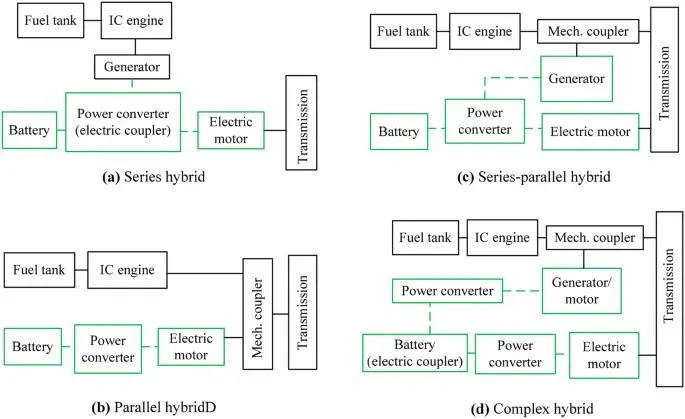
Diffrent HEV architecture as shown
The HEV’s architecture has been classified into four different categories, which are series hybrid,series parallel hybrid, Parallel hybrid, Complex hybrid.
In series HEV, the power sources provide electrical energy at DC bus, which is then converted to traction power . In parallel HEVs, traction power can be supplied by ICE or EM alone, or together by both the sources. The EM is used to charge the Battery by means of regenerative braking .The parallel mild HEV is an ideal option as they provide better relation between the cost of vehicle and its performance.Complex HEVs incorporate features of both parallel as well as series architecture. They are almost like the series–parallel hybrid except for the variance in power flow of the motor, which is bidirectional in complex hybrid and unidirectional in series–parallel HEVs. The disadvantage of complex hybrid is its complexity in design.
Advantage of using a parallel over a series hybrid is electric motor can be used at low power over short distances ( increases fuel economy)
Whereas ICE can be used over long distances
Disadvantage of parallel hybrid electric vehicle
1) Complex design
2) ICE is not decoupled with the wheels; so it can't be charged at standstill
3) It doesn't operate in a narrow range of RPM & so the efficiency is low at low speed rotation