Week 2 Session 7
AIM:
Compare the different architectures of HEV. Discuss the pro's and con's
Solution:
Architechture of Hybrid Electric Vehicles:
1] Series HEV Architecture:
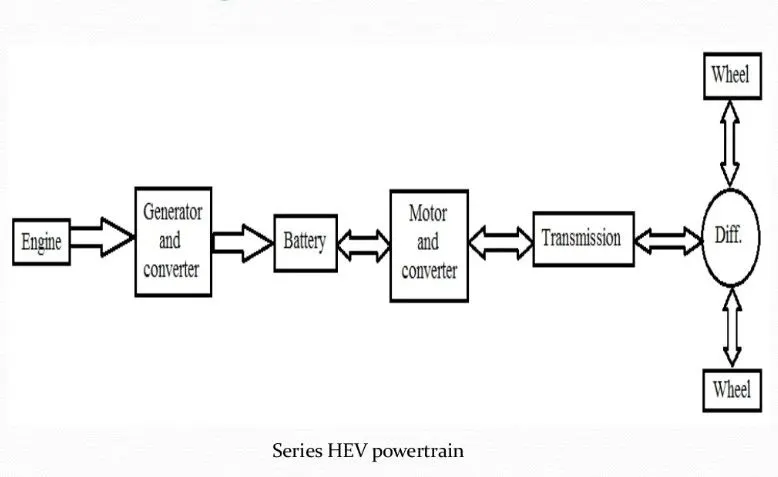
- In Series HEV, consist of motor and ICE engine for the power conversion in which only one energy converter can provide propulsion power.
- Only electric motor all propulsion power to the wheels via transmission system. So, there is no direct connection between the ICE engine and the wheels.
- A downsized IC engine drives a generator, which supplies power to the battery and can charge them when its capacity fall below certain charge level.
- The generator output is given the to power converter or controller and from this controller to the battery. So the battery remains in the charged condition and which supplies the electrical power to the motor and the vehicle runs continously.
- The drawback of this configuration is size of traction motor, which as to be rated for maximum power requirement of the vehicle.
Advantages:
- Simplicity of Drive train.
- Suitable for short trips with stop and go traffic.
Disadvantages:
- It needs IC engine, generator and motor.
- Motor must be designed for max. sustained power that vehicle require such as climbing a high gradient
- All drivetrain components need to be sized for maximum power for long distance, high speed driving.
2] Parallel HEV Architecture:
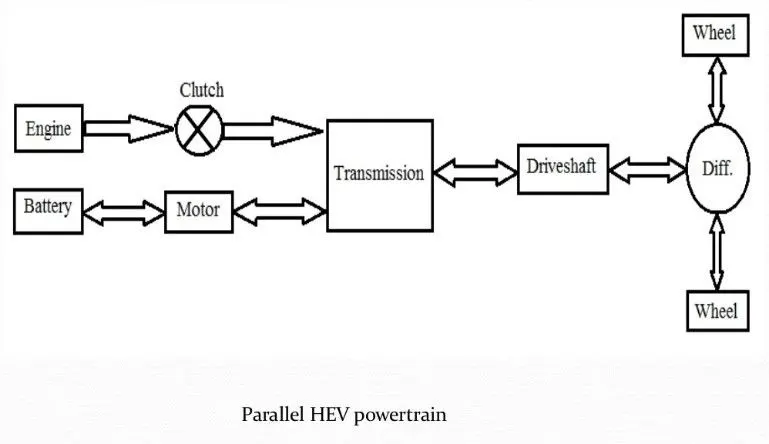
- A Parallel Hybrid is one in which more than one energy conversion device can deliver propulsion power to the wheels.
- The IC engine and Electric motor are configured in parallel with a mechanical coupling.
- The power requirements of electric motor is lower than that of series HEV.
Advantages:
- It needs only IC engine and motor/ generator.
- A smaller engine and motor can be used to get same performance, until batteries are depleted.
Disadvantages:
- The control complexity increases, since power flow has to be regulated and blended from two parallel sources.
- The power blending from IC engine and motor needs a complex mechanical device.
3] Series-Parallel HEV Architecture:
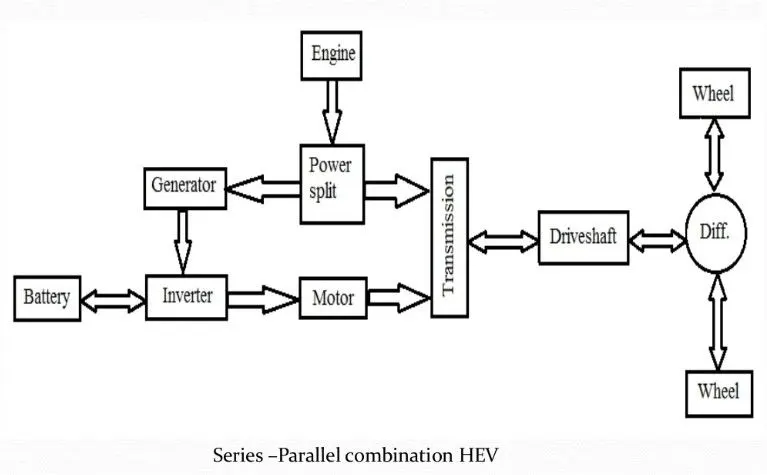
- It combines the benefits of series and parallel HEV architecture with charge sustaining cabability.
- The power-split device divides the output from the engine into mechanical and electrical transmission paths.
- Even IC engine is also used to charge the battery.
- They are capable of providing continuous high output power compared to series or parallel powertrain.
Comparison of different Architectures of HEV:
| Parameters | Parallel HEV with two clutches |
Parallel HEV with DCT |
Axle-split HEV | Series HEV | Series-parallel HEV | Power-split HEV | |
| Engine Stop & Start | Yes | Yes | Yes | Yes | Yes | Yes | |
| Energy recuperation | Yes | Yes | Yes | Yes | Yes | Yes | |
| Torque assist/boost | Yes | Yes | Yes | No | Yes | Yes | |
| Electric driving | Yes | Yes | Yes | Yes | Yes | ||
| Coasting | Yes | Yes | No | No | No | Yes | |
| Charge at standstill | Yes | Yes | Yes | Yes | Yes | Yes | |
| Power ratings | – engine power much higher than electric machine power | – engine power much higher than electric machine power | – engine power higher than electric machine power | – similar power rating between engine and electric machines | – similar power rating between engine and one electric machine – lower power rating of second electric machine |
– similar power rating between engine and one electric machine – lower power rating of second electric machine |
|
| Advantages | – flexible powertrain configuration – can be easily integrated with an existing conventional powertrain – only one electric machine required for full hybrid performance |
– requires minim additional installation space for the electric machine – only one electric machine required for full hybrid performance |
– continuous all-wheel drive capability | – flexibility in installation due to non existing mechanical link between electric machines – engine can operate in most efficient area regardless of the vehicle speed – does not require multi-step transmissions |
– engine can transmit torque directly to the drive wheels – does not require multi-step transmissions – can switch between series and parallel hybrid |
– compact installation due to usage of planetary gear set – energy efficient at low-medium vehicle speed |
|
| Disadvantages | – requires a fully automatic transmission to be also integrated | – the electric machine torque is only multiplied by half (odd or even) of the gear ratios | – Coasting not possible due to permanent connection or electric machine – requires additional installation space on the rear axle |
– requires two electric machines of similar power rating – the vehicle dynamic performance depends entirely on the electric machine torque and power – energy inefficient due to double conversion of engine power (mechanical-electrical-mechanical) |
– requires two electric machines – engine and electric machines are mechanically linked which requires additional installation space |
– requires two electric machines – no fuel efficiency benefit at high engine speed |