Week 2 Railwheel and Track
STATIC STRUCTURAL ANALYSIS ON THE RAILWHEEL AND TRACK
Objective: -
The objective of the project is to perform a static structural analysis on railwheel and track and compare total Deformation, Equivalent Stress, and life under different loading condition. Also, implement the user-defined result and compare the total deformation.
- Multiply the bearing load by 5 times and compare the results with the load of 100000 N .Compare the Total Deformation, Equivalent stress and the life under both the loads
- Implement a User defined result and calculate the Total Deformation from this result and check if it is the same as that obtained by the inbuilt result by ANSYS for a load of 100000 N.
Procedure: -
- Open the Ansys workbench and drag and drop the static structural analysis system in the project schematic.Rename the project as "Railwheel and Track".
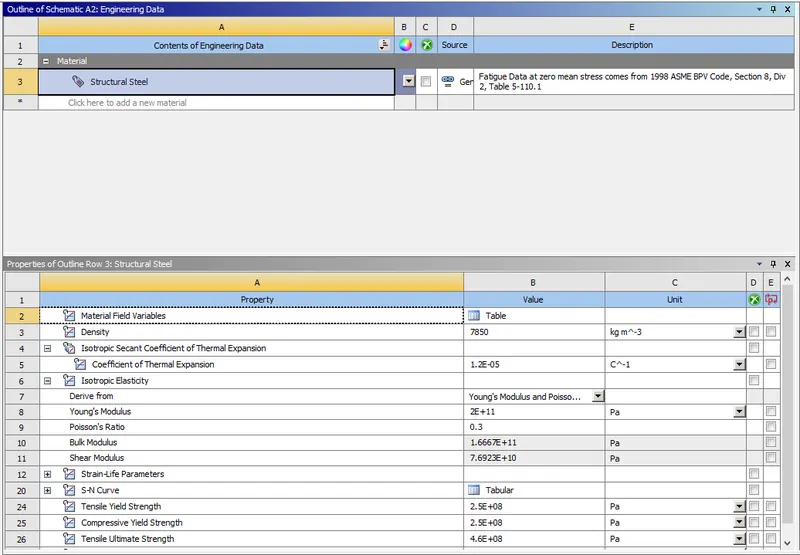
- Double click on engineering data to add the material or we can cllck right mouse botton and choose edit option from the drop down menu. We will use structural steel as working material for this analysis.
Geometry: -
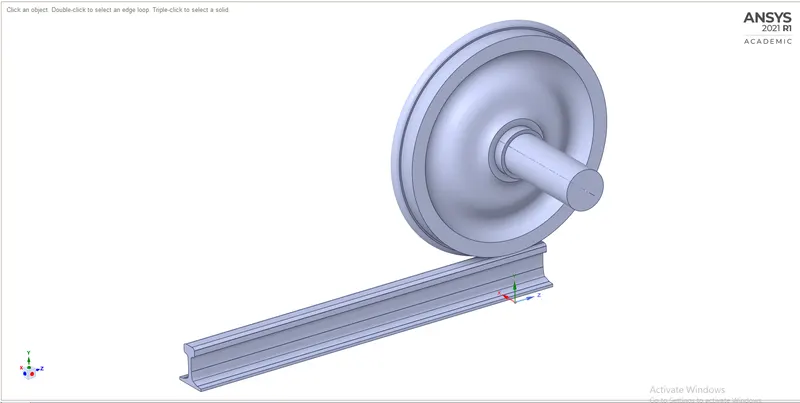
The geometry contains a shaft, a railwheel and a Railtrack.
Contacts: -
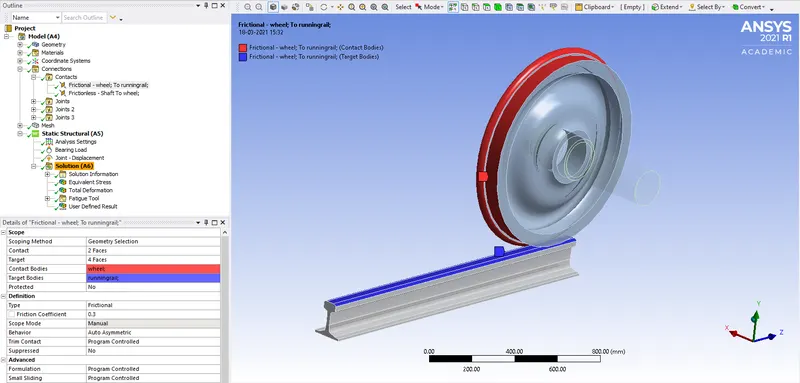
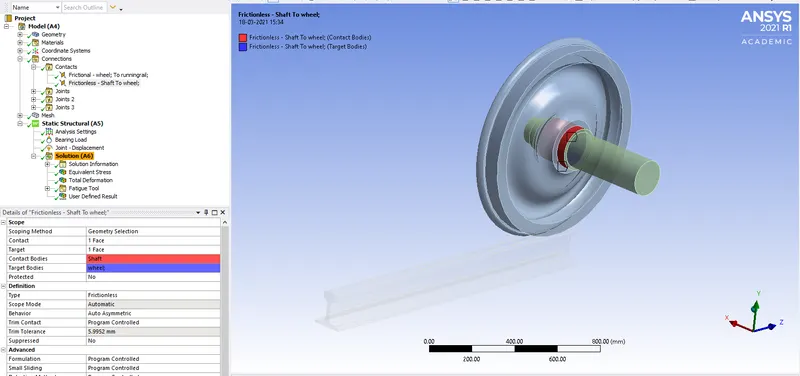
Contacts at the interface were set up between the wheel and track with contact type frictional and friction coefficient of 0.3 and between the wheel and the shaft with contact type as frictionless.
ANSYS considers the contact body as the one which is not allowed to penetrate into the target body. But the target is allowed to penetrate into the contact body. Behaviour is set to auto asymmetric to achieve the convergence.
Joints: -
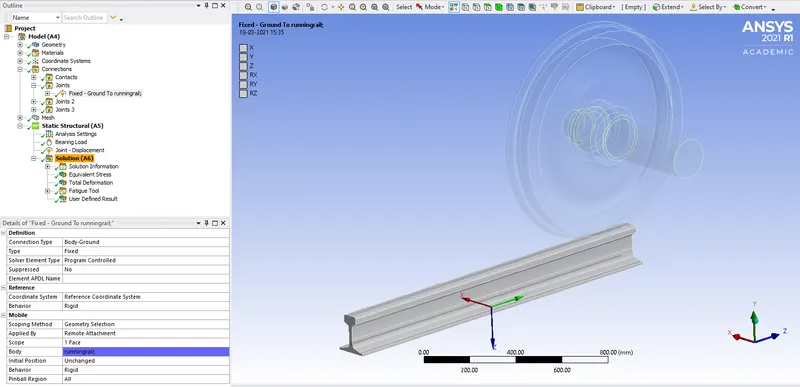
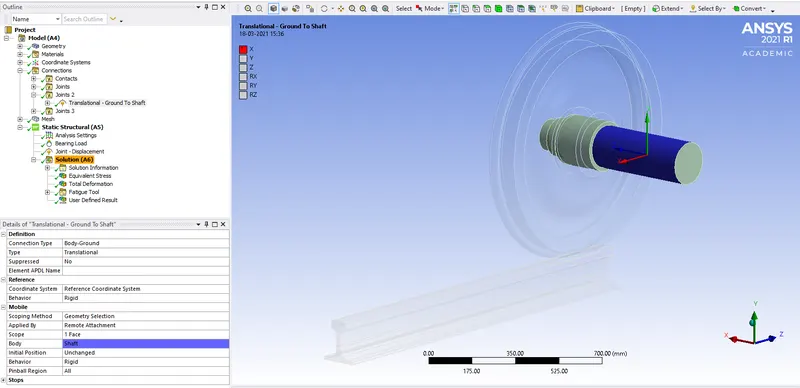
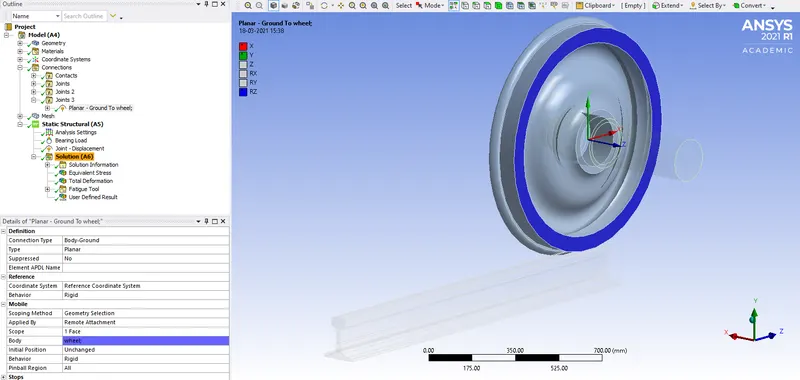
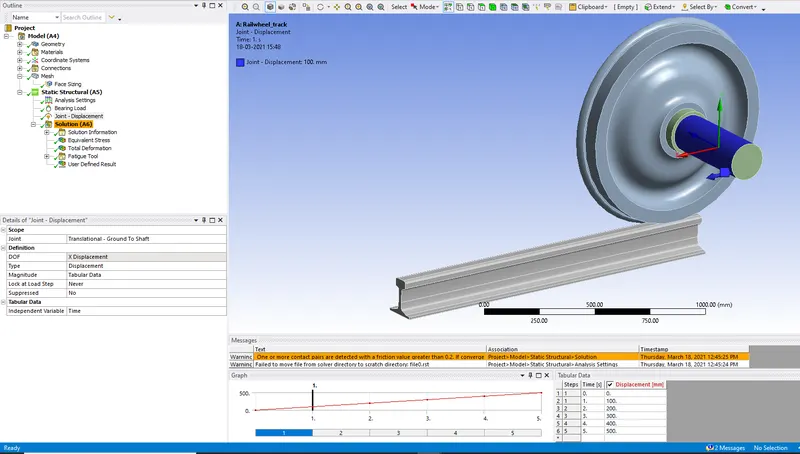
Fixed joint is given to the track and translational joint is given to the shaft that indeed turns the wheel to a displacement of 500mm.Planer joint is given on the side face of the wheel to maintain contact with the plane and free to rotate and translate in the plane.
Meshing: -
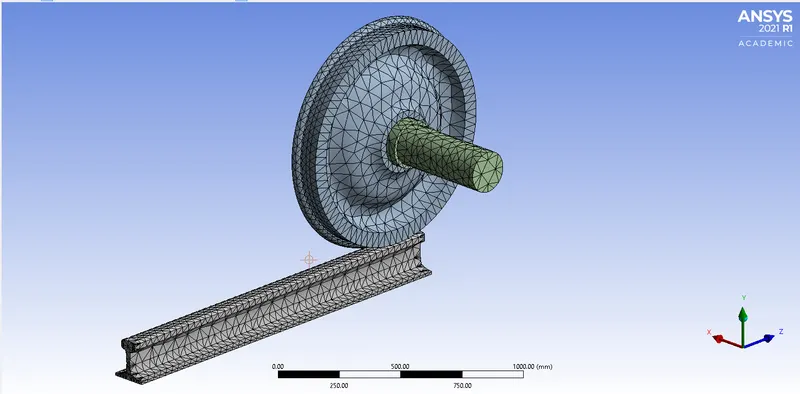
A global mesh size of 35mm is applied to the wheel, the track and the shaft.
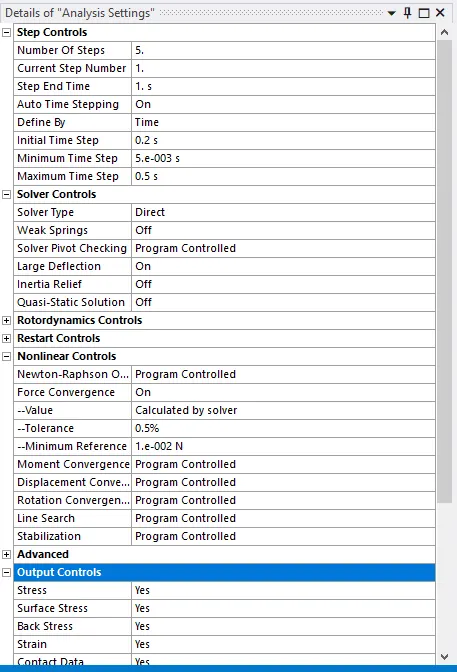
Analysis settings: -
Boundary conditions: -
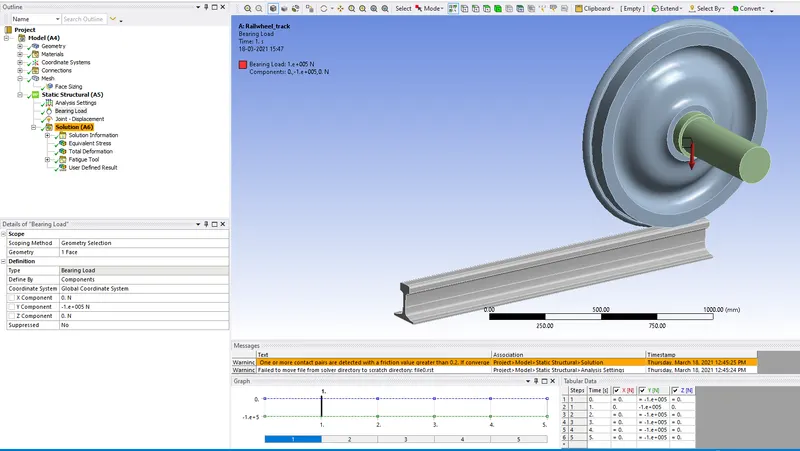
Bearing load
Bearing load is varied for the two cases
Case I. A bearing load of 1e+5N is applied constantly to the wheel.
Case II. Abearing load of 5e+5N is applied constantly.
Displacement
A displacement of 100mm is given for each step.And a total of 500mm displacement is covered by the wheel.
RESULTS: -
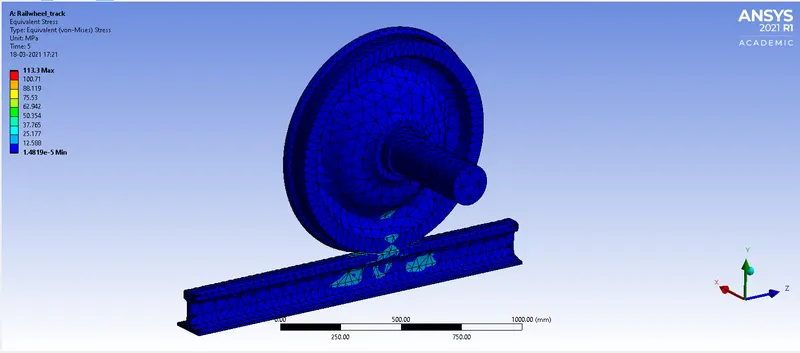
Equivalent stress for a bearing load of 1e+5N on the wheel.
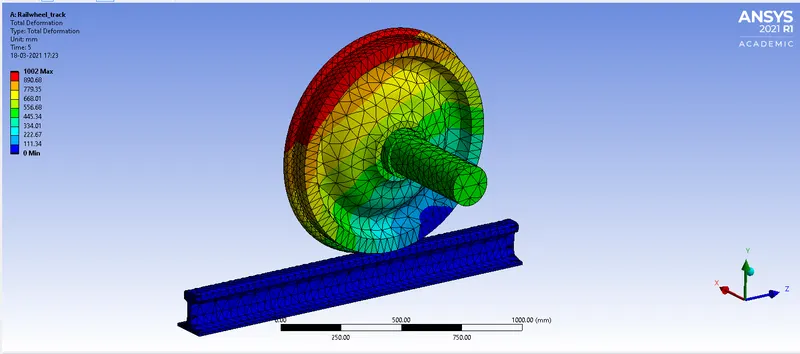
Total deformation for a bearing load of 1e+5N on the wheel.
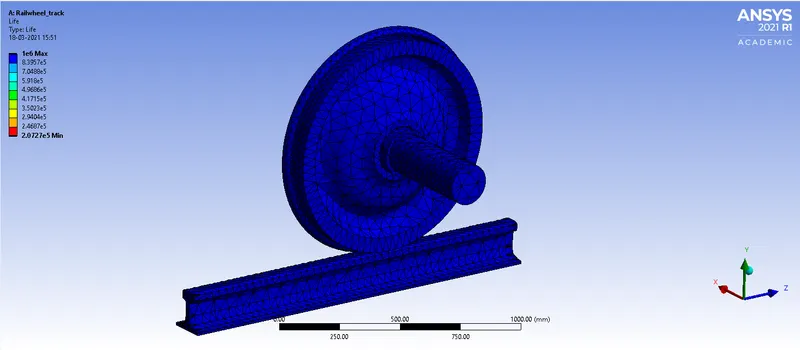
Life(cycles) for a bearing load of 1e+5N on the wheel.
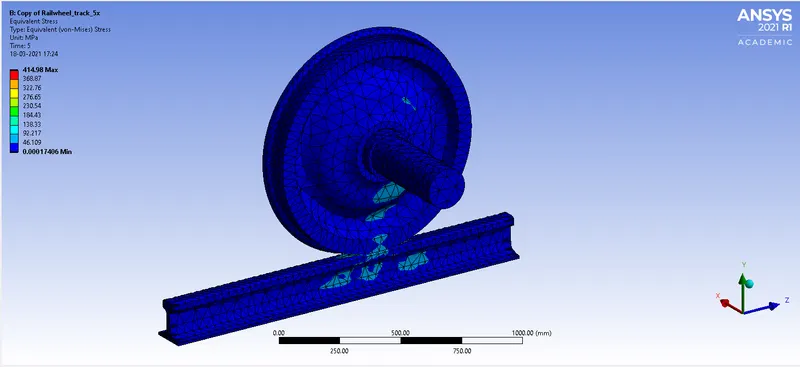
Equivalent stress for a bearing load of 5e+5N on the wheel.
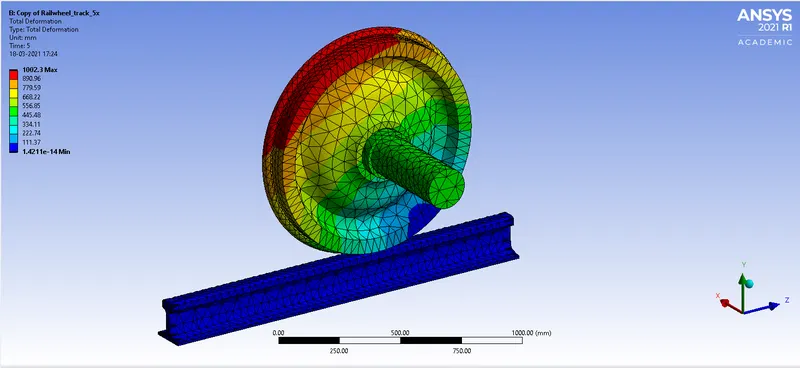
Total deformation for a bearing load of 5e+5N on the wheel.
Life(cycles) for a bearing load of 5e+5N on the wheel.
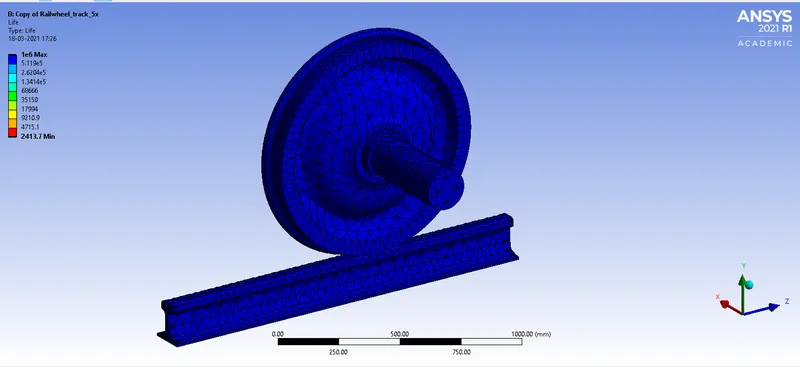
We can sum up the entire observation for different bearing loads in the following tabular manner-
| Sr.No. | Bearing load(N) | Maximum Equivalent stress(MPa) | Maximum Total Deformation(mm) | Minimum Life(Cycles) |
| 1. | 100000 | 113.3 | 1002 | 2.07e+5 |
| 2. | 500000 | 414.98 | 1002.3 | 2413.7 |
CONCLUSION: -
We can see that for a load of 500000 N we get equivalent stress of 414.98 MPa which much larger compared to the load of 100000 N which is only 113.3 MPa. Also the Minimum fatigue life reduced in case of an increased load in comparison to 100000 N load.
We get the same total deformation with user-defined result and the expression used for the user-defined result is (sqrt(Ux^2 + Uy^2 + Yz^2)).