Week 2 Railwheel and Track
Objective:
To perform static structural analysis on Railwheel and track for the below two cases:
Case 1: Multiply the bearing load by 5 times and compare the results with the load of 100000 N (As done in week 2 video). Compare the Total Deformation, Equivalent stress and the life under both the loads
Case 2: Implement a User defined result and calculate the Total Deformation from this result and check if it is the same as that obtained by the inbuilt result by ANSYS for a load of 100000 N.
Solution:
Geometry:
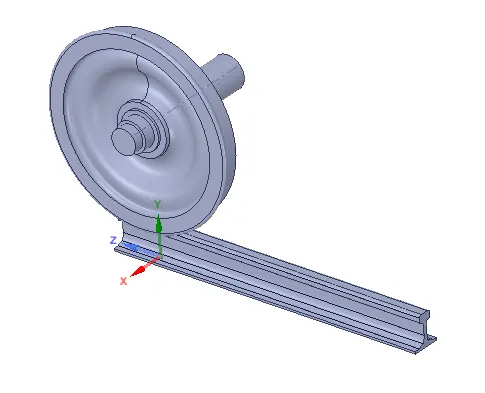
The geometry file (shown below) has been imported into the workbench for running the simulation.
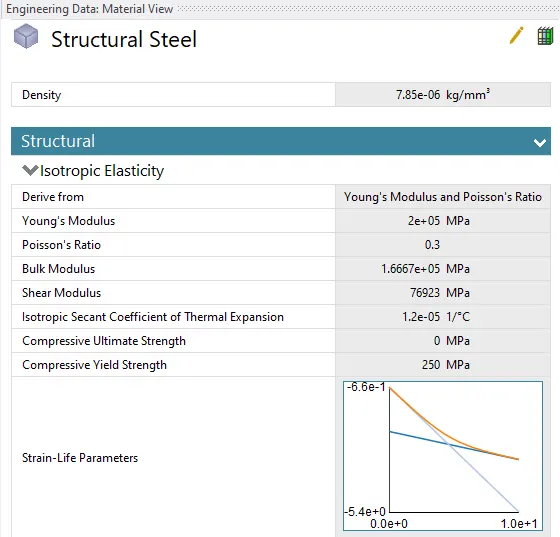
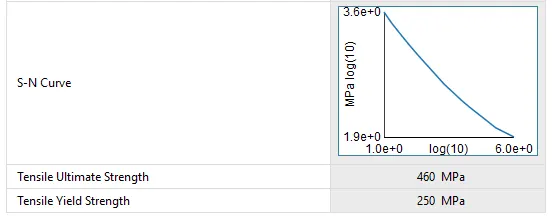
Material Used: Structural Steel
Analysis Set Up Details:
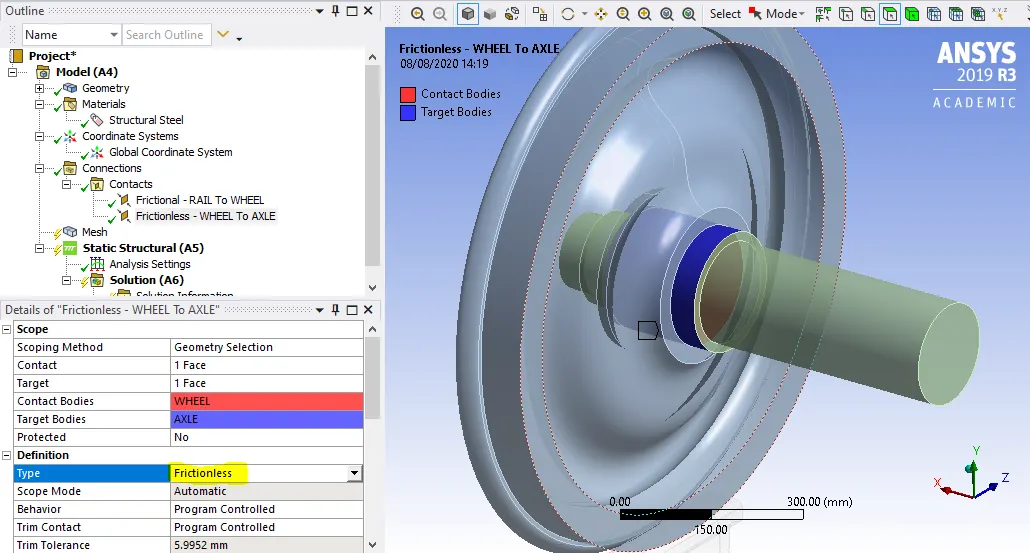
Contact:
There are two contacts set up which are defined as below:
1. Frictional Contact (Frictional Coefficient 0.3) between the wheel and the Track.
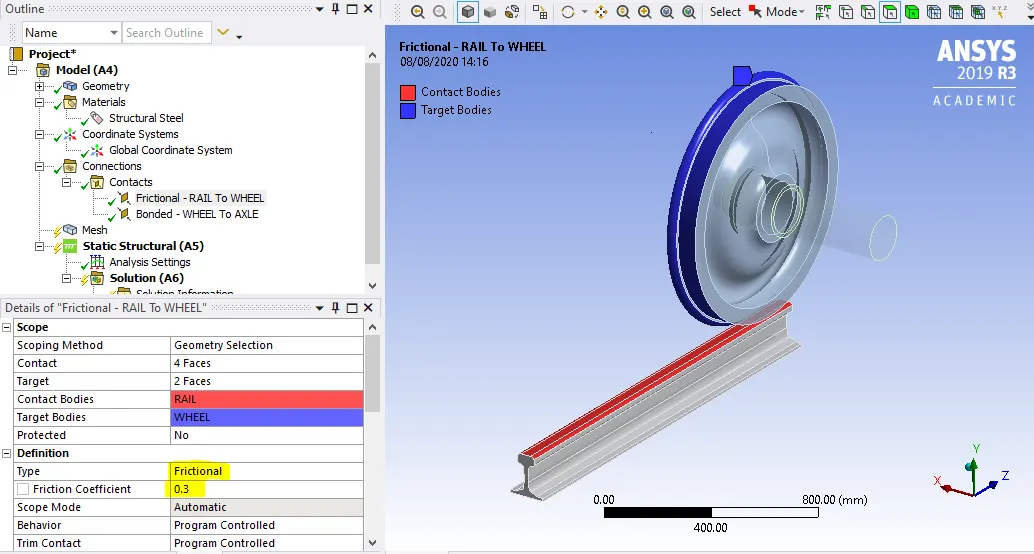
2. Frictionless contact between the axle and the wheel.
Joints:
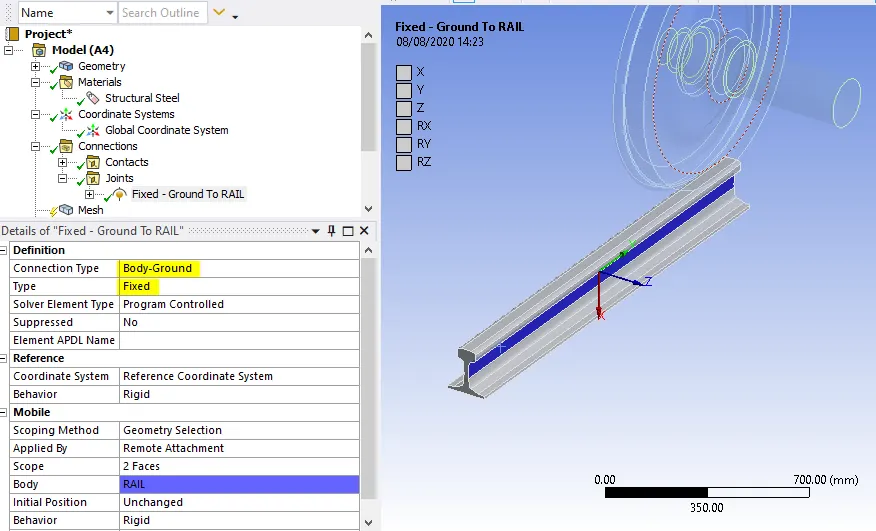
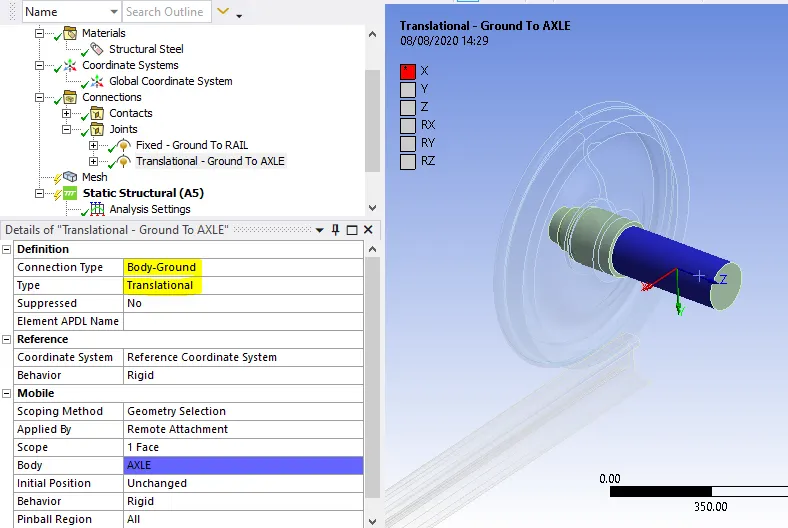
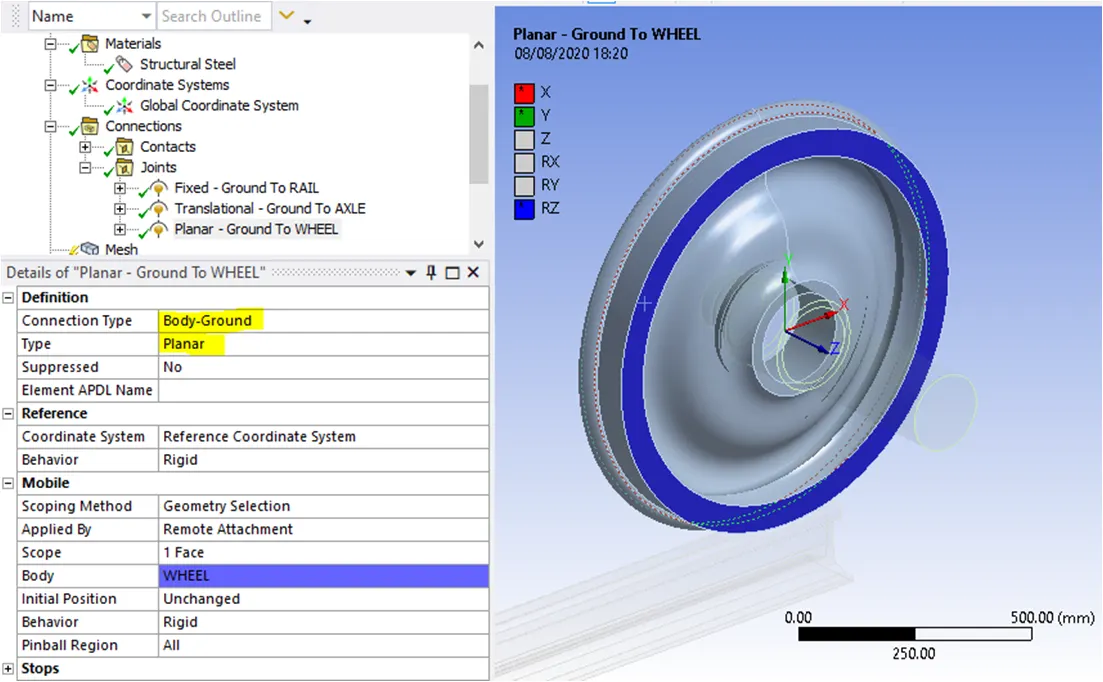
There are three joints which are set up as below:
1. The fixed joint between the rail and the ground.
2. Translational joint between the axle and the ground.
3. Planar joint between the wheel and the ground.
Meshing Details:
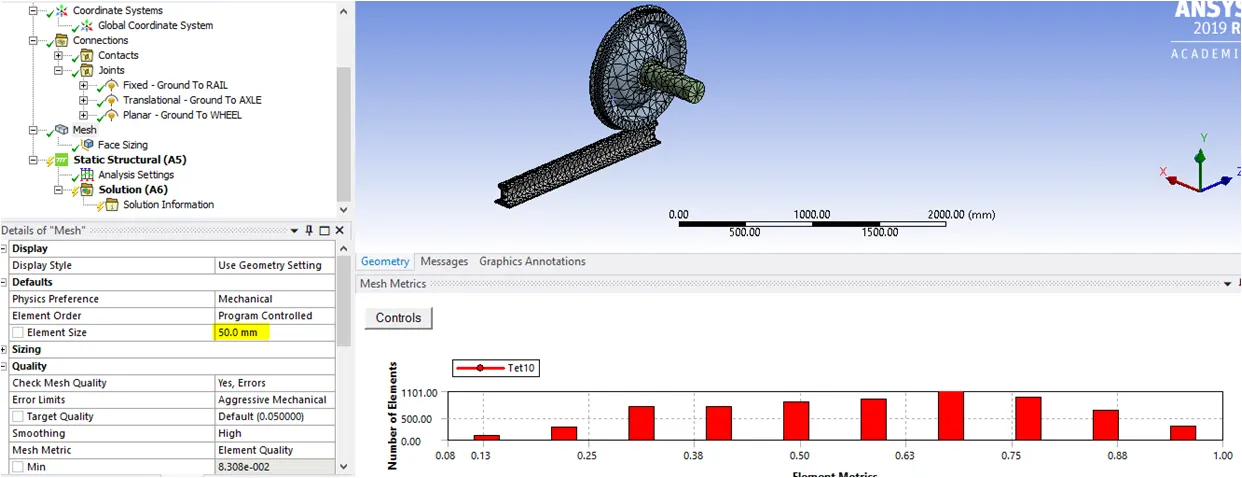
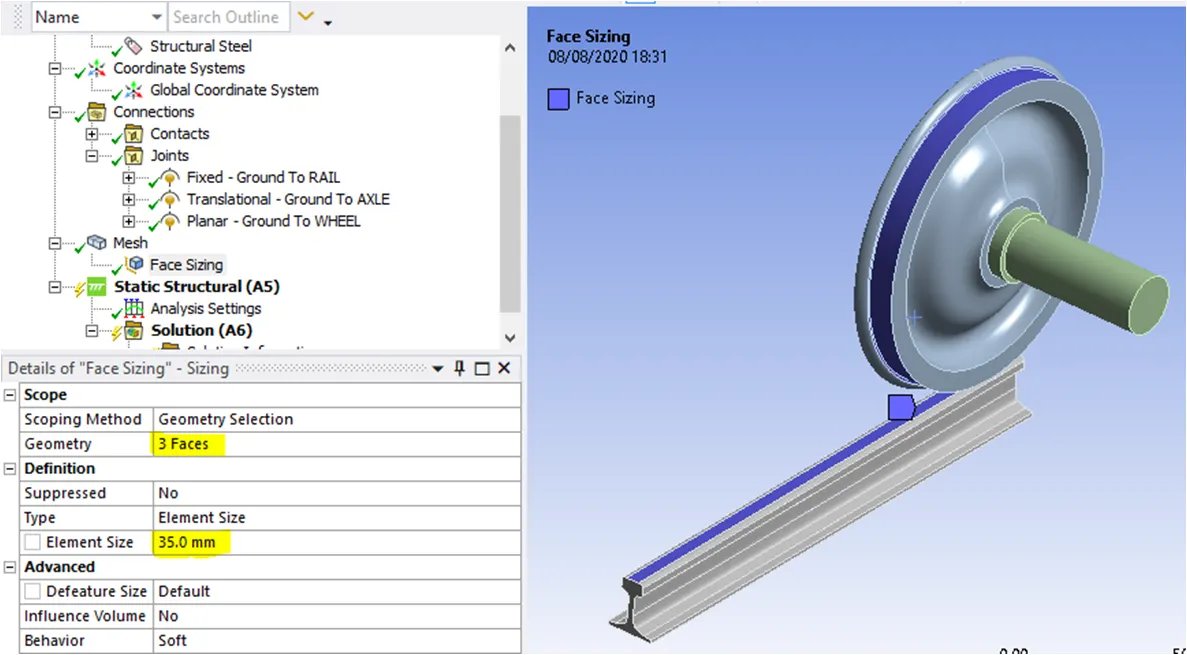
The overall geometry has been given a mesh size of 50 mm whereas the contact region faces has been given a mesh size of 35 mm as shown below:
Analysis Settings:
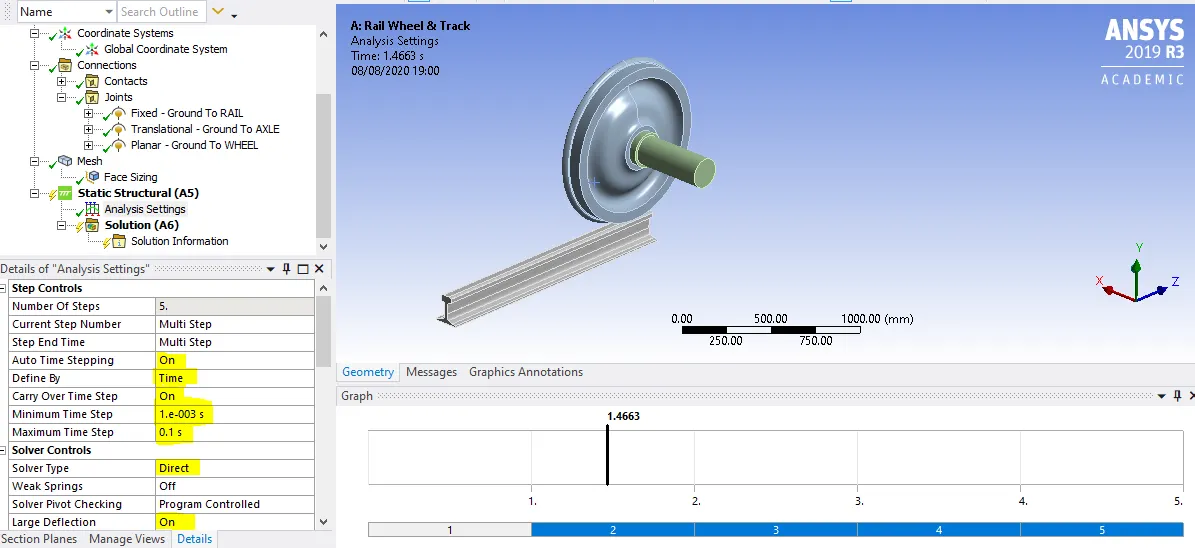
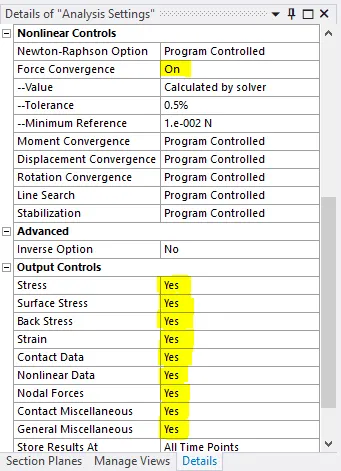
The analysis has been set up in 5 steps with specifying the initial, minimum and maximum time step and the time stepping is automatically controlled. Also, the large deflection is kept on.
Boundary Conditions:
The boundary condition has been applied as the displacement joint load and the bearing load as shown below:
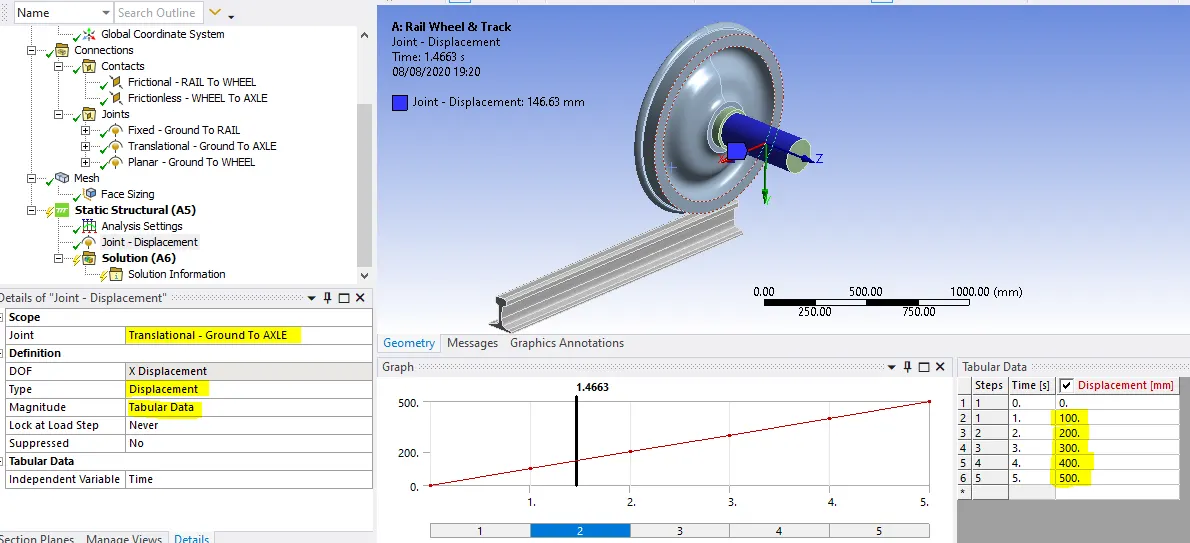
1. Joint Load
The displacement load has been given to the axle with an increment of 100 mm at every step.
Total Displacement: 500 mm
2. Bearing Load
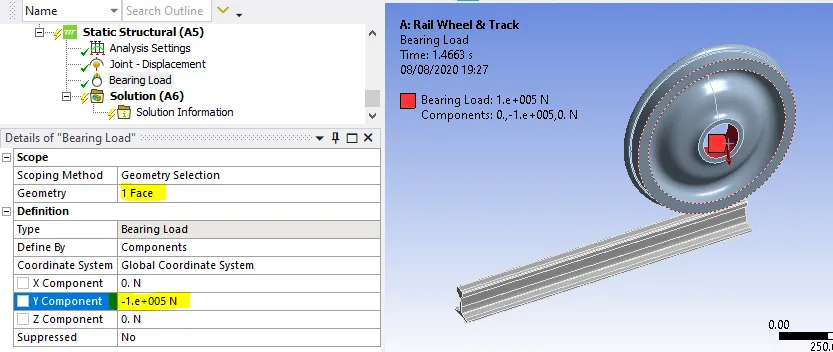
The bearing load transferred by the carriage has been provided to the wheel in the downward direction at the shown location below.
Case 1:
A. Bearing Load Magnitude: 100000 N
Results:
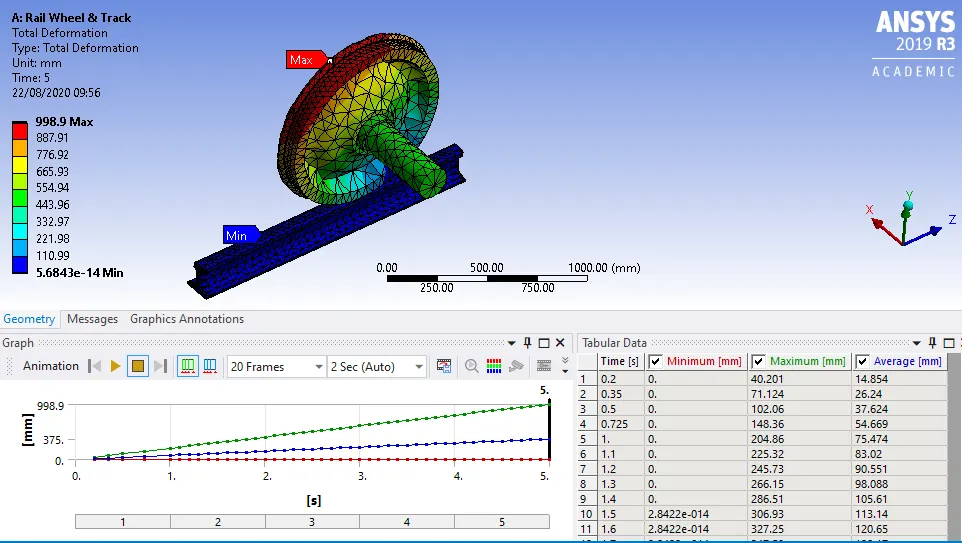
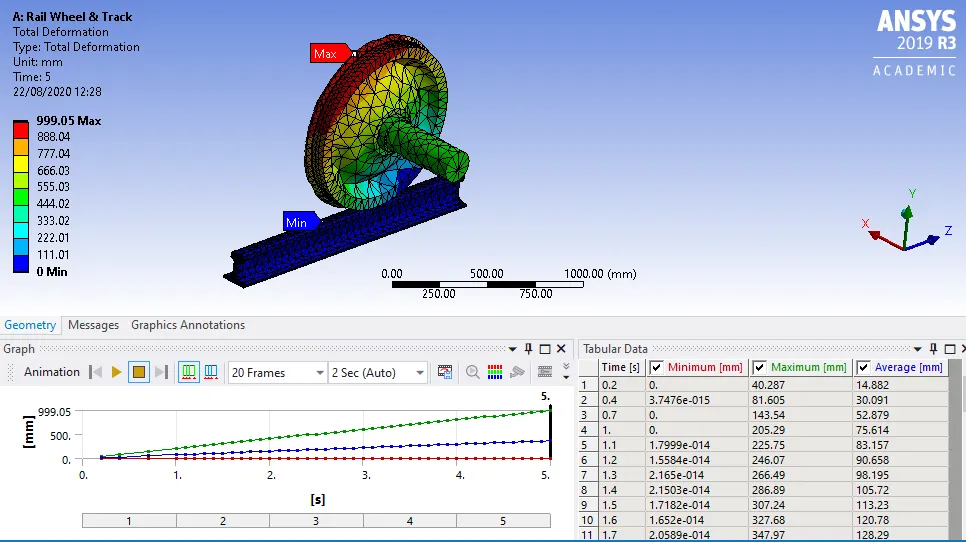
Total Deformation (For 100000 N)
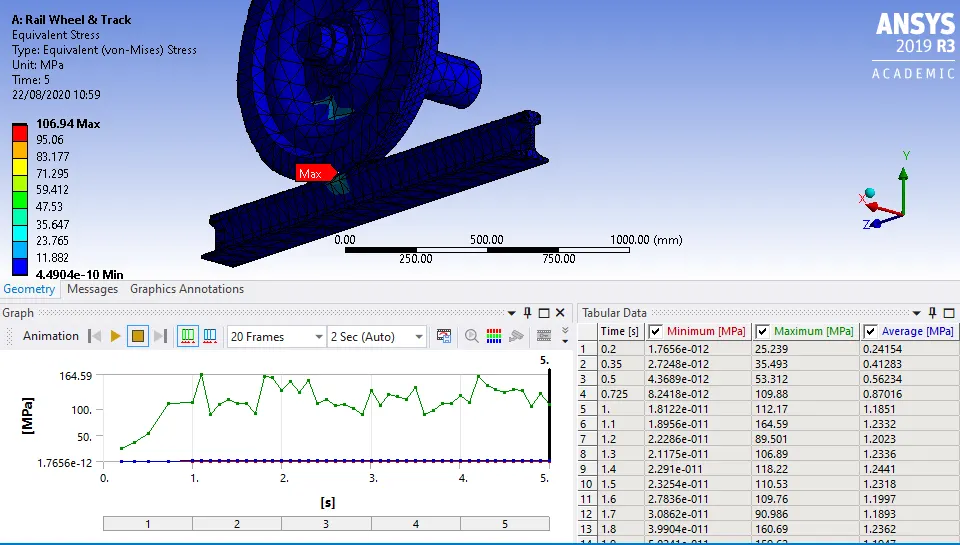
Equivalent Stress (von mises) (For 100000 N)
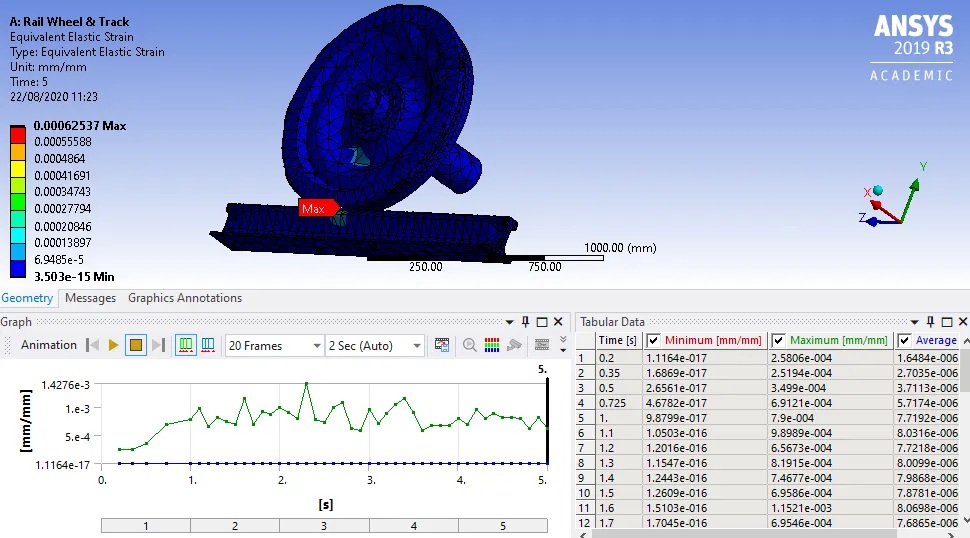
Equivalent Elastic Strain (For 100000 N)
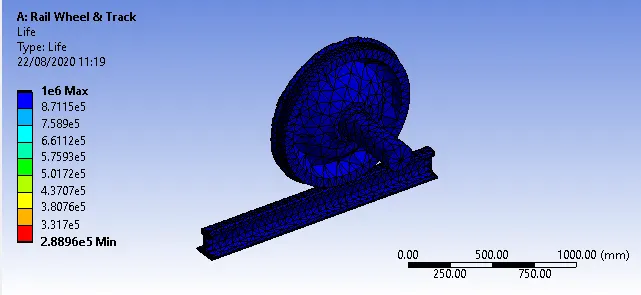
Life (For 100000 N)
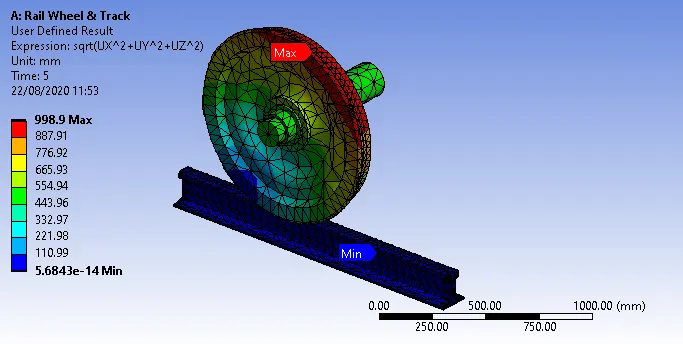
User Defined Result (For 100000 N)
B. Bearing Load Magnitude: 500000 N
Total Deformation (For 500000 N)
Equivalent Stress (von mises) (For 500000 N)
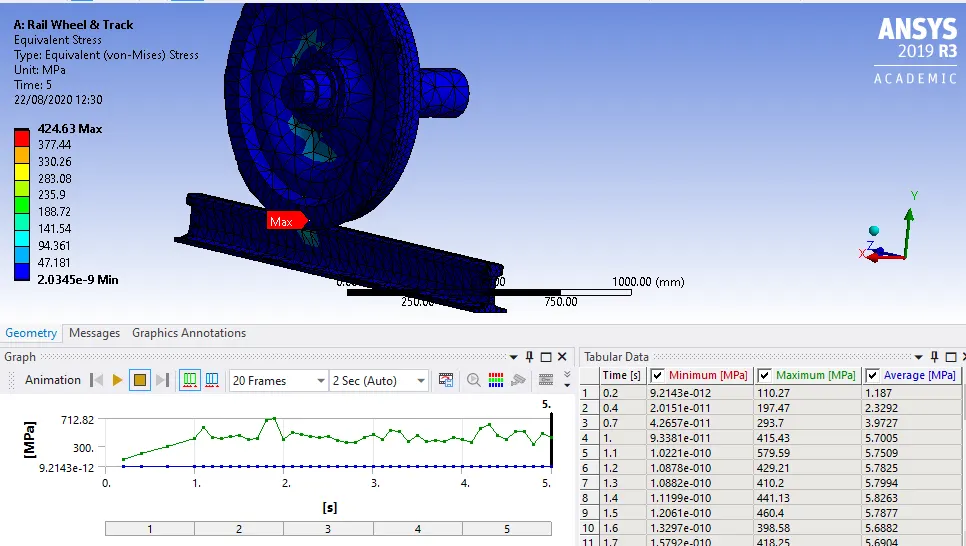
Equivalent Elastic Strain (For 500000 N)
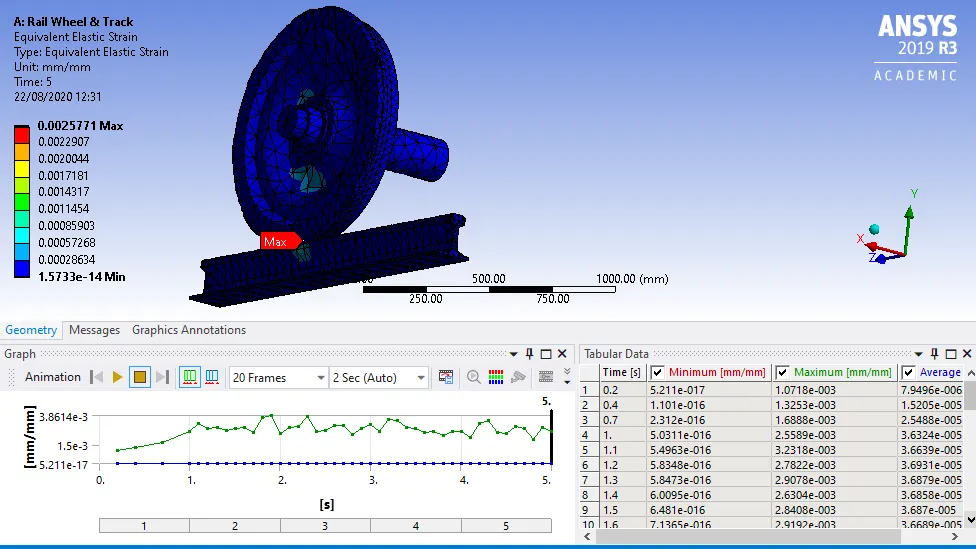
Life (For 500000 N)
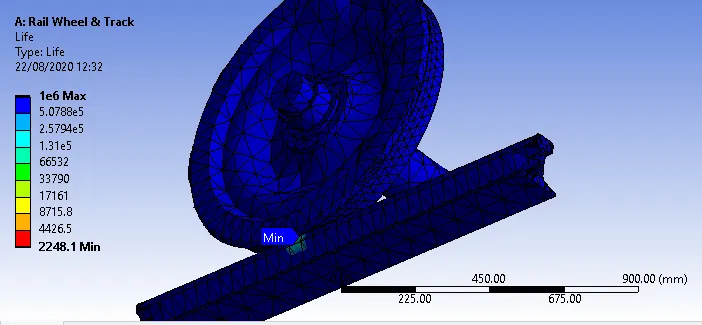
User Defined Result (For 500000 N)
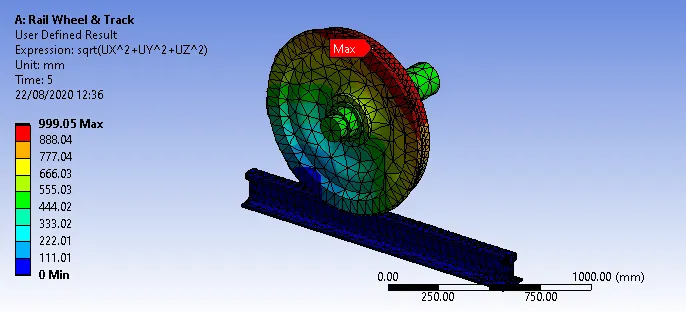
Results Comparison:
Cases Total Deformation(mm) Equivalent Stress (MPa) Equivalent Strain (mm/mm)
Min Max Min Max Min Max
Case 1.A : 0 mm 998.9 4.4904e-10 106.94 3.503e-15 6.2537e-004
Case 1.B : 0 mm 999.05 2.0345e-009 424.63 1.5733e-014 2.5771e-003
Also,
Minimum Life: (For 100000 N) : 2.8896e^5 cycles
Minimum Life: (For 500000 N) : 2248.1 cycles
Conclusion:
1. Total Deformation Value is almost the same even after incresing the bearing load by 5 times.
2. The equivalent stress and strain values have increased with increase in the bearing load.
3. The minimum Life has decreased after increaing the bearing load by 5 times. However, the maximum life remained constant.
Case 2:
The User defined results images has been shown above for both the cases and the total deformation results obtained by using the equation is found to be approximately the same value as that obtained by the inbuilt result by ANSYS for a load of 100000 N.
Expression Used:
