Week 2 - Flow over a Cylinder.
Project Report - Flow over a Cylinder
Introduction
Flow past object, has been a topic of interest since long time. The phenomenon is very common in engineering designs. The complex nature of physics and behaviour of transport phenomenon around the object is still being actively studied. The nature of flow changes at critical Renolds No. around the object, that gives rise to varying velocity and pressure field. The phenomenon is most commonly known as Kármán vortex street.
Objective
The present study is focused on studying the effect of Renolds no. on Drag and Lift coefficient on the object. Also, we will discuss about differences in steady state and transient simulation from computational aspect.
For achieving the objective, the study has been divided into two parts as follows: -
Part 1: -
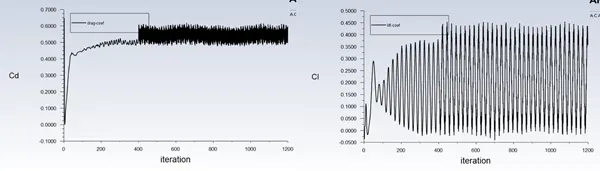
To simulate the flow with the steady and unsteady case and calculate the Strouhal Number for Re= 100.
Part 2: -
To calculate the coefficient of drag and lift over a cylinder by setting the Reynolds number to 10,100,1000,10000 & 100000 using steady state solver.
To discuss the effect of Reynolds number on the coefficient of drag.
Solving & Modelling approach
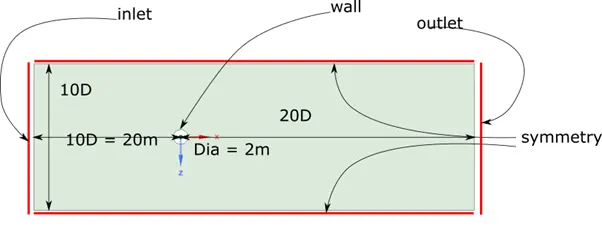
Geometry
Meshing
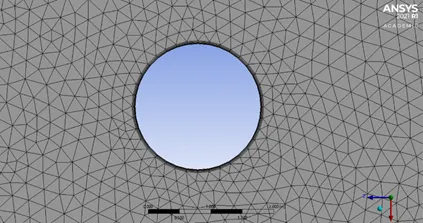
Meshing has been done with triangular cells, with the element size of 0.25m. Circular edge representing the object has been divided into 36 parts. A total of 6 inflation layers has been added around the circular edge with the first layer of height 5e-3 m.
Solving Approach
For lower Renolds no., laminar viscous model has been used to solve the computational domain. And for increased Renolds no. The K-Omega SST turbulence model has been applied. User defined material, similar to air with constant density of 1 kg/m3 and viscosity of 0.02 kg/ (m s) has been used as the flow material for internal mesh. The value of velocity has been changed for simulating change in Renolds no.
Boundary Conditions
The defined geometry has inlet boundary of velocity type. The magnitude of velocity has been varied to simulate the variation in Renolds no. The outlet geometry is of type pressure, with constant gauge pressure of 0. The wall has no-slip boundary, where as the top and bottom sides has symmetry boundary conditions.
Semi-Implicit Method for Pressure Linked Equations has been used for pressure-velocity coupling. In spatial Discretization, least square cell-based gradient has been used for gradient. Second Order for pressure and Second Order Upwind scheme for Momentum has been used.
Hybrid Method for initialization has been used.
Processing Details
Monitor Point Velocity
A monitor point 10m away from the circle center has been used to monitor the velocity. This may help us in calculating the frequency of the vortex shedding.
Coefficient of Drag and Lift Calculation
Ansys module has been used to calculate the coefficient of drag and lift. Though it can be calculated by manual calculation if we know the force of drag and lift and using the equations: -
Coefficient of Drag
`C_d = {2*F_D}/{rho*V^2*A}`
Coefficient of Lift
`C_L = {2*F_L}/{rho*V^2*A}`
Where,
`F_D` is the Force of Drag
`F_L` is the Force of Lift
V is the Velocity of flow
A is the Cross-Section Area
Strouhal Number
Strouhal Number `(S_t)` as defined by `{f*l}/{V}` , requires the frequency parameter `f`. The frequency has been calculated based on coefficient of Lift peaks. Later the characteristics length has been used as 2 m and velocity as 1 m/s.
Results and Discussions
Part I
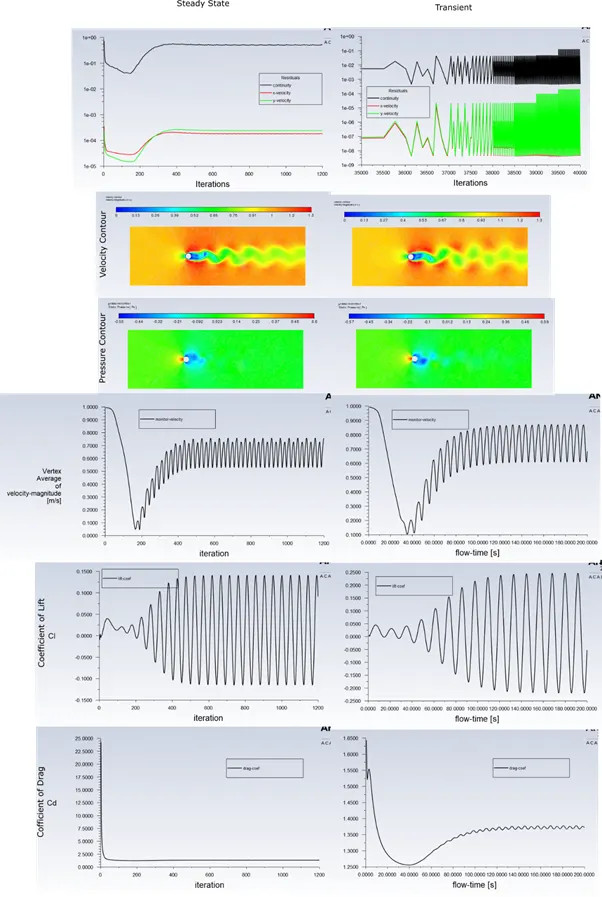
Steady State Simulation has been clearly able to detect the phenomenon, since the problem is highly nonlinear, there is no clarity about the time duration in the steady state results. While transient solution has been able to capture the phenomenon with relatively better idea of time duration. Transient simulation can be employed to get the time dependent property of the phenomenon called Strouhal Number.
For Steady State Simulations, observing the residuals or any control variables can get idea about the convergence. Here, the residuals stagnated at a value also, the control point variable (velocity) at monitor point has a repeating pattern. This behavior indicates the convergence for steady state analysis.
For transient simulations, each time step undergoes convergence criteria check of certain limit for residuals, or no. of iterations. Transient simulation is better at grasping time dependent phenomenon relative to steady state simulations.
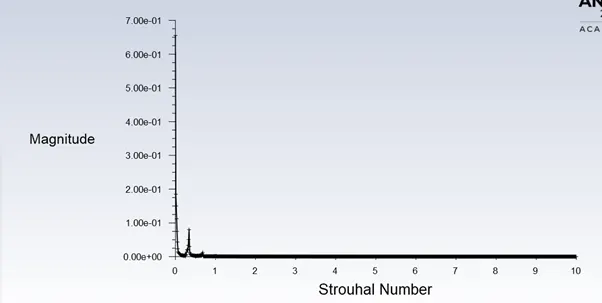
From the above method the frequency calculated is 0.0855.
the strouhal no. thus calculated to be 0.1709
Part II
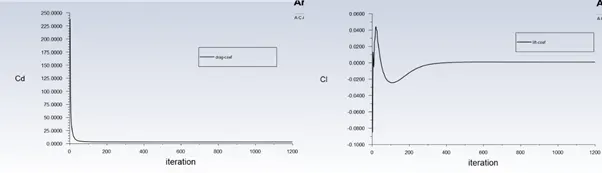
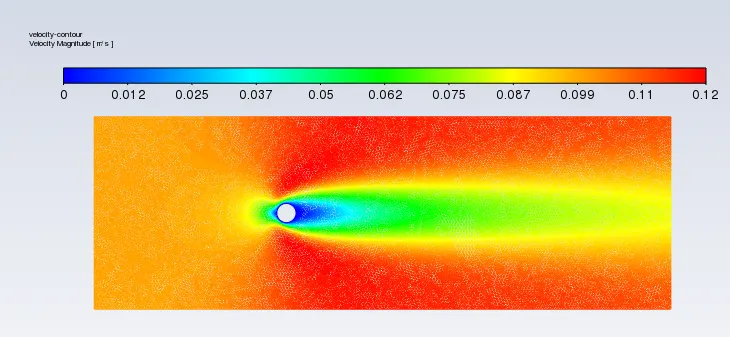
Re 10
Velocity = 0.1 m/s
Velocity Contour Animation
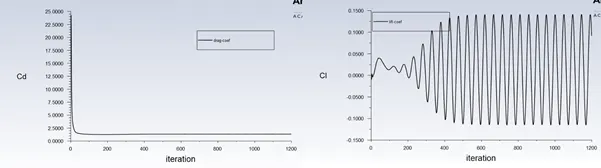
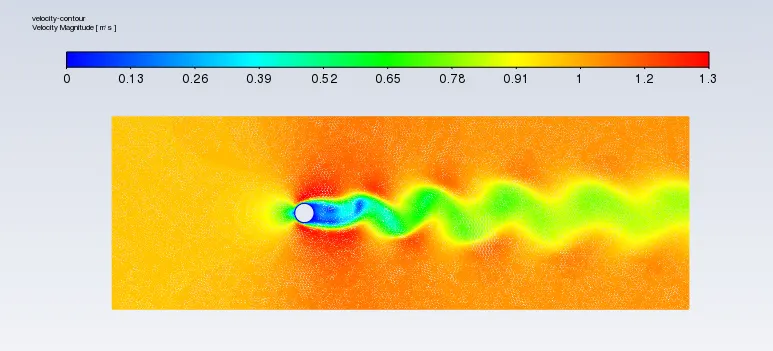
Re 100
Velocity = 1 m/s
Velocity Contour Animation
Re 1000
Velocity = 10 m/s
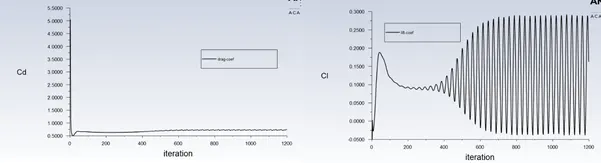
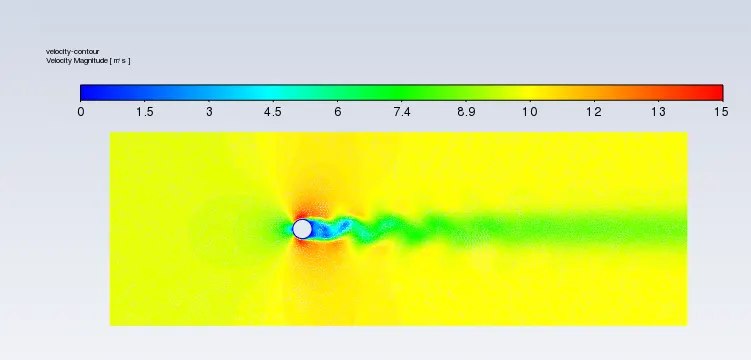
Velocity Contour Animation
Re 10000
Velocity = 100 m/s
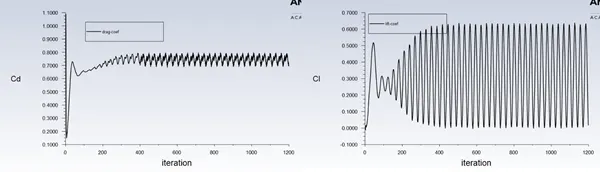
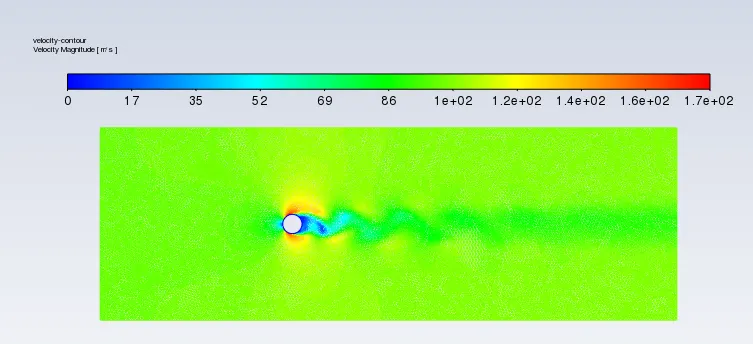
Velocity Contour Animation
Re 100000
Velocity = 1000 m/s
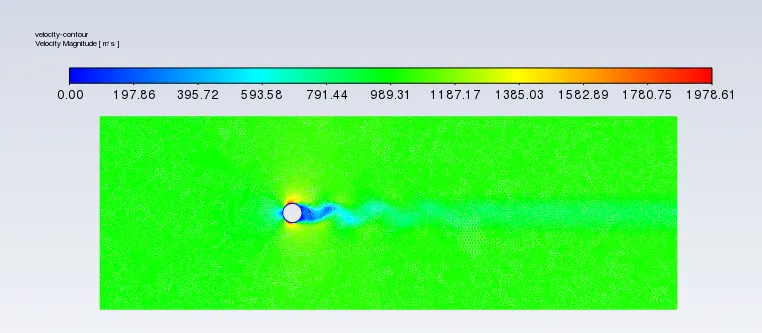
Velocity Contour Animation
With increase in Renolds number, vortex shedding is more prominent for the extreme end surfaces of cylinder. The increase in inertial against the viscous force, results in decrease in coefficient of drag (Cd). The rate of decrease in Cd for Renolds number 10 to 100 is way more drastic than after it. The similar behavior has been observed by Yuce et. al[1] and Rajani et. al[2].
Variation of Coefficient of Drag with Renolds No.
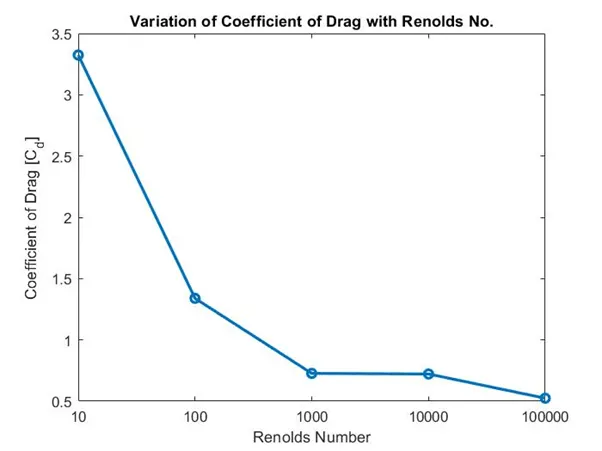
At low Re, the coefficient of drag decreases linearly with increasing Renolds number. Similar behavior has also been studied by Yuce et al[1].
References:
1. Yuce, Mehmet Ishak, and Dalshad Ahmed Kareem. "A numerical analysis of fluid flow around circular and square cylinders." Journal‐American Water Works Association 108.10 (2016): E546-E554.
2. B.N. Rajani, A. Kandasamy, Sekhar Majumdar, Numerical simulation of laminar flow past a circular cylinder, Applied Mathematical Modelling, Volume 33, Issue 3, 2009, Pages 1228-1247, ISSN 0307-904X, https://doi.org/10.1016/j.apm.2008.01.017.